<?xml version="1.0" encoding="utf-8"?>
<feed xmlns="http://www.w3.org/2005/Atom">
    <id>https://www.geoffreychallen.com</id>
    <title>Geoffrey Challen, Teaching Faculty</title>
    <updated>2026-11-05T20:44:47.883Z</updated>
    <generator>https://github.com/jpmonette/feed</generator>
    <author>
        <name>Geoffrey Challen</name>
        <email>geoffrey.challen@gmail.com</email>
        <uri>https://www.geoffreychallen.com/</uri>
    </author>
    <link rel="alternate" href="https://www.geoffreychallen.com/"/>
    <link rel="self" href="https://www.geoffreychallen.com/atom.xml"/>
    <subtitle>Hi, I'm Geoff Challen. I love to teach, and I love to code. I teach students to code. And I write code that helps them learn.</subtitle>
    <logo>https://www.geoffreychallen.com/cartoon-light.png</logo>
    <icon>https://www.geoffreychallen.com/favicon.ico</icon>
    <rights>All rights reserved 2026, Geoffrey Challen</rights>
    <entry>
        <title type="html"><![CDATA[Recipe Programming]]></title>
        <id>https://www.geoffreychallen.com/essays/2021-06-03-recipe-programming</id>
        <link href="https://www.geoffreychallen.com/essays/2021-06-03-recipe-programming"/>
        <updated>2021-06-03T00:00:00.000Z</updated>
        <summary type="html"><![CDATA[Recipe programming comprises working of a set of instructions to produce a program that achieves some desired outcome. While recipe programming is powerful and useful, it should not be confused with teaching the basics of programming, particularly when teaching introductory computer science courses.
]]></summary>
        <content type="html"><![CDATA[<p>After years of practice, I have become a decent home cook.
I can prepare a variety of tasty and nutritious meals suitable for both weeknights and more special occasions.
However, like many home cooks, I have a simple strategy: I follow recipes.</p>
<p>Learning to cook at home is usually synonymous with learning to follow recipes.
There is nothing wrong with this.
Nor is following recipes as straightforward as it sounds.
“Cook for three to five minutes or until lightly browned.”
Five minutes have passed and no signs of color.
Should I continue?
Even the best recipes frequently improve through repetition, as you perform small experiments with timing, quantity, and other minor deviations from the instructions.
I have gotten better at these things over time, through practice.
And, sometimes, serendipity.
My wife improved one recipe simply by misreading teaspoons as tablespoons.</p>
<p>Still, nobody would or should hire me to run a restaurant kitchen.
Without a recipe, I am not confident that I can produce something delicious, even if it will probably be safely overcooked.
I definitely cannot develop my own recipes, since I have only the scantest of observational understanding of how time and heat transform ingredients into a meal.
I am a home cook. I am not a chef.</p>
<p>Like recipe cooking, recipe programming comprises working off a set of instructions to produce a working program.
Like recipe cooking, recipe programming is a tremendously valuable skill—even more so than recipe cooking, as I will explain.</p>
<p>But just as recipe cooks are not chefs, recipe programming does not necessarily require or develop basic programming abilities.
And there is a problematic tendency to conflate these two different skills.
Nobody who attended a weekend home cooking workshop would declare “I am a chef!”
But often students that complete a recipe programming course will declare “I know how to program!”</p>
<p>This misunderstanding is frequently supported by teachers and administrators who don’t understand programming themselves, and are impatient with the slow process of building up competency at something that is, in fact, hard.
Somebody who attends a weekend cooking workshop will probably walk away able to cook a few simple meals.
Somebody who attends culinary school may spend an entire year mastering a basic understanding of ingredients, preparation techniques, and food science.
The first is a fast path to shallow but useful knowledge.
The second is the necessarily slower route towards deep understanding.
Both have value, but need to be differentiated.</p>
<p>Confusion here is also exacerbated by missing vocabulary. We cannot differentiate what we cannot distinguish.
When discussing food we have good options to indicate somebody’s goals and depth of knowledge: home cook versus cook versus chef.
The term <em>recipe programming</em> is my attempt to help.
But I am unsure of the right way to refer to programming abilities grounded in the basics, rather than recipe-following.
The term <em>real programming</em> seems to establish too much of a negative connotation.
Recipe programming is in fact incredibly useful, and should be taught everywhere.</p>
<p>For the sake of clarity I will use the term <em>scratch programming</em> in contrast to recipe programming, to reflect the goal of being able to teach students to write and understand entire programs from scratch without requiring a recipe or template.
I am not entirely happy with this term, but it will do for now.</p>
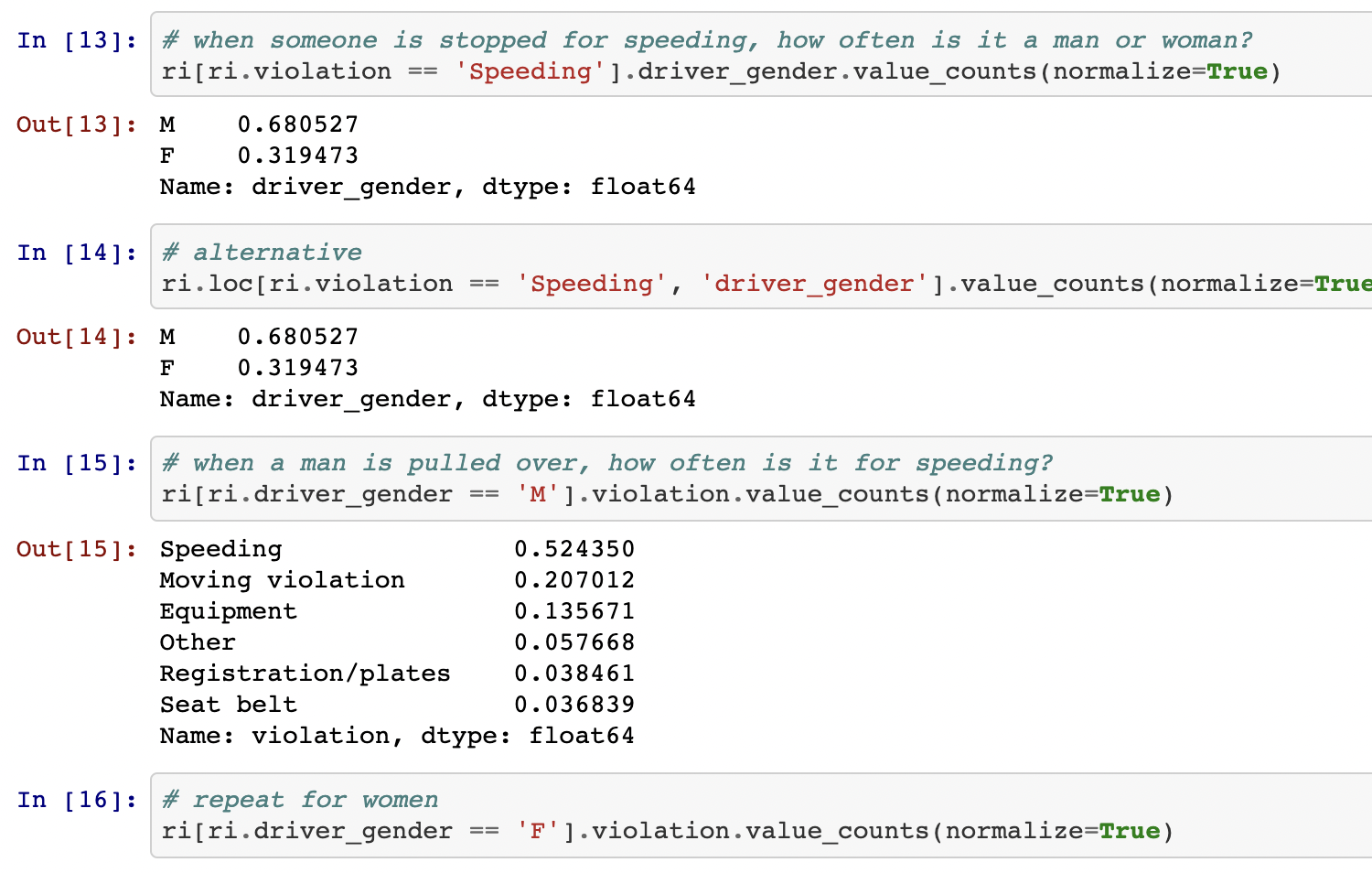
<p>The language, environment, and task most strongly associated with recipe programming is Python in a Jupyter Notebook to perform data analysis and visualization.</p>
<p><img src="https://www.geoffreychallen.com/mdx/essays/2021-06-03-recipe-programming/01.png" alt="Example recipe programming"></p>
<p><em>
I grabbed this screenshot from <a href="https://github.com/justmarkham/pycon-2018-tutorial/blob/master/tutorial.ipynb">this tutorial notebook</a>.
It goes on and on, and the rest is just like this.
I dare you to find a loop, or a class, or even a method definition.</em></p>
<p>If you examine code written to perform these tasks, like what is shown above, you will quickly note the characteristics of recipe programs.
Recipe programs are very flat, often having no control structures, subroutines, or loops.
They usually define no custom data types.
Most if not all of the code consists of calls to library methods used to import, manipulate, and display data, as well as output results at intermediate stages.</p>
<p>Because data processing recipes can be reused on different data sets, recipe programming is extremely powerful, even more so than recipe cooking.<sup><a href="#user-content-fn-1" id="user-content-fnref-1" data-footnote-ref aria-describedby="footnote-label">1</a></sup>
A recipe programmer can reproduce almost the exact set of steps as the recipe
But, by processing different data, can reach a completely new set of conclusions.
The promotional materials for <a href="https://www.fast.ai/">fastai</a>—a good example of an excellent recipe programming course—are full of examples of this happening.</p>
<p>The power of recipe programming is a great sign of how far computer science has come as a field and how much impact we are having.
It is absolutely worth teaching.</p>
<p>But note again that recipe programs incorporate almost none of the basic programming constructs and computational thinking that we labor to explain to aspiring scratch programmers.
Naturally, recipe programmers tend not to learn these things in courses on recipe programming.
This itself is not a problem.
It only becomes one once we think that they have.</p>
<p>Consider a typical first course that teaches the basics of scratch programming: variables, types, conditional and looping constructs, implementing methods, declaring custom data types, basic structures for linear and relational data, as well as computational thinking and problem solving.
The specifics may and do vary, but the goal is to begin the process of producing students that can create entire programs from scratch.</p>
<p>What can an average student in a course like this do at the end of the semester?<sup><a href="#user-content-fn-2" id="user-content-fnref-2" data-footnote-ref aria-describedby="footnote-label">2</a></sup>
In my course they can build a simple Android App, but usually that itself requires a fair amount of recipe-like tutorial following as well as basic Java or Kotlin abilities.
In other courses the artifacts may be more or less impressive.
By jettisoning a lot of the basics in favor of introducing the entire web stack, CS50 students seem to be able to produce simple web applications.</p>
<p>But usually we’d expect the average student that completes CS1 to be able to complete a small and fairly unimpressive program.
You can make this seem more impressive in a variety of ways—including having students work on Android.
And most CS1 courses, including mine, tend to promote the more impressive student projects, which are probably more the result of prior experience rather than understanding gleaned during the semester.</p>
<p>Now consider a recipe programming course where students focus not on understanding the basics but just on figuring out which set of library methods they need to call in what order to create a particular graph or compute a particular statistic.
I think it’s fair to assume that, at the end of the semester, work produced by the students in the recipe programming course will be <em>far</em> more impressive than work by students in the scratch programming course.
The scratch programming course is the necessarily slower route towards true understanding, while the recipe programming course is a fast path to shallow but useful knowledge.</p>
<p>But now consider what happens when instructors or administrators that don’t understand the distinction assess the results.
Wow!
Teaching data science in Python must be the magic strategy that accelerates the process of learning how to program!
We should teach everything in Python.
And let’s figure out how to fast-track the students from the recipe programming course into the rest of the computer science curriculum. They can probably also skip several more of the scratch programming courses as well.</p>
<p>Needless to say, students that have learned recipe programming are just about as prepared to continue with advanced scratch programming and computer science coursework as I am to start the second year of culinary school.
Sometimes you can perpetuate this misunderstanding further by creating an additional set of parallel courses for the recipe programmers—recipe data structures!
But the wheels are bound to come off at some point.</p>
<p>It’s worth pointing out a few other things that worsen this misunderstanding.
First, data processing in Python is a sweet spot for recipe programming.
I do no scratch programming in Python, but do break it out when I need to process me some data, and follow recipes just like everyone else.
It works well, and this is a real and obvious strength of the Python ecosystem.</p>
<p>Second, there are a lot of recipe programmers in academia, and so this specific use case is even more impressive and important to them.
Even a fairly sophisticated custom Android app will usually fail to interest them.
But produce a stacked bar graph using MatplotLib and Pandas and their eyes light up.
Familiarity breeds appreciation.
This also makes them even more likely to just not really care whether students are learning the fundamentals of programming and computer science or not.
The more we frontload the recipe programming skills that are useful to them, the more likely that a student will produce a graph that they can use in a publication.
And that’s what matters.</p>
<p>The solution here is not complicated.
Recipe programming and scratch programming are both extremely useful skills.
As long as we are clear about what we are teaching and what students are learning, we can and should offer separate courses that teach both skills, as well as courses that blend instruction in both.</p>
<p>Scratch programming on its own can be quite frustrating, and it can be helpful to incorporate some recipe programming into these courses to help students have fun and build cool stuff while they are learning the basics.
Learning how to follow recipes is also extremely important for scratch programmers as they perform tasks like installing software, setting up development environments, or getting started on assignments, which frequently involve needing to carefully follow a set of instructions—a recipe.</p>
<p>But let’s also dispense with some of the fictions supported by the confusion between recipe and scratch programming.
Python is not a magically-effective language for teaching CS1.
It can be used to teach scratch programming, although it’s neither the best or worst choice for that task.
But a lot of its reputation probably rests on its use in recipe programming classes and misunderstandings about what students are actually learning in these courses.</p>
<p>Data science is also not the magically-effective topic for teaching CS1.
It just happens to be a domain where recipe programming is particularly powerful and impressive.
And while it <em>is</em> a tremendously useful skill, it’s just one of many different ways in which students can have impact through coding.</p>
<p>We also need to acknowledge that data science tends to be overemphasized within the academy, and make sure that our introductory courses don’t mirror that skew.
We should be teaching students to build beautiful user-facing applications, the dark arts of architecting backend systems, how to program robots and embedded devices, and everything in between.
Not just how to generate scatterplots.</p>
<section data-footnotes class="footnotes"><h2 class="sr-only" id="footnote-label">Footnotes</h2>
<ol>
<li id="user-content-fn-1">
<p>At this point our analogy breaks down. <a href="#user-content-fnref-1" data-footnote-backref="" aria-label="Back to reference 1" class="data-footnote-backref">↩</a></p>
</li>
<li id="user-content-fn-2">
<p>It’s important to focus here on the average student, since outliers who take CS1 with prior experience can produce significant deviations. <a href="#user-content-fnref-2" data-footnote-backref="" aria-label="Back to reference 2" class="data-footnote-backref">↩</a></p>
</li>
</ol>
</section>]]></content>
    </entry>
    <entry>
        <title type="html"><![CDATA[Chalkface Nostalgia]]></title>
        <id>https://www.geoffreychallen.com/essays/2021-06-10-chalkface-nostalgia</id>
        <link href="https://www.geoffreychallen.com/essays/2021-06-10-chalkface-nostalgia"/>
        <updated>2021-06-10T00:00:00.000Z</updated>
        <summary type="html"><![CDATA[With the pandemic seemingly drawing to a close, at least in the United States, it's disappointing to see university students, administrators, and even instructors longing to return to outmoded and ineffective instructional methods. It's not just a return to classrooms. It's a return to lecturing, which we know doesn't work.
]]></summary>
        <content type="html"><![CDATA[<p>With the pandemic seemingly drawing to a close, at least in the United States, it’s disappointing to see university students, administrators, and even instructors longing to return to outmoded and ineffective instructional methods.
It’s not just a return to campus.
It’s a return to <em>classrooms</em>, and to droning at the chalkface.
It seems like the pandemic made lecturing cool again, in ways that could set back university education moving forward.</p>
<p>Prior to the pandemic there was widespread agreement that lecturing was not an effective way of disseminating information or a good use of instructional time.</p>
<p>It’s true that many instructors continued to lecture, particularly in large courses.
The reasons for this are various.
As an instructor who was still lecturing, I’m familiar with a few of them.</p>
<p>First and foremost, transitioning a course away from the lecture model takes time and energy.
I had started laying some of the groundwork, but hadn’t yet completed the transition.</p>
<p>Second, the university’s physical plant is set up to support lecturing and not other forms of instruction, particularly for large courses.
I can request and receive a 1200-seat auditorium to lecture in for three hours per week.
This is normal and not a problem.
I <em>cannot</em> request and receive 40-seat classrooms to run small group activities for the equivalent 90 classroom-hours per week.
This is abnormal and a huge problem.
Large courses are expected to lecture.<sup><a href="#user-content-fn-1" id="user-content-fnref-1" data-footnote-ref aria-describedby="footnote-label">1</a></sup></p>
<p>Students seemed equally aware of the ineffectiveness of lecturing.
In classes that posted recordings, attendance had already plummeted, with students choosing the pedagogically-superior online videos over the live classroom experience.
I have not seen any studies of actual attendance in college classes, particularly those with videotaped lectures.
But my own anecdotal experience is that it hovered between low and nonexistent.
Even the ones that were physically there were not mentally present.
Attend a few large college courses and sit in the back sometime.
It’s eye-opening.</p>
<p>Note that there are ways to make lecturing work, particularly in contexts like law or business school where classes are smaller and include a great deal of student participation.
But in most undergraduate courses we just weren’t really trying.
For example, instructors that truly believed in the lecture model or had found ways to make it work could have required attendance.
Some did.
Most didn’t, a tacit admission of defeat.
Most just showed up, gave their PowerPoint to the handful of students in the front of the room, and then returned to their office.
Learning!</p>
<p>So pre-pandemic most instructors had conceded that lecturing didn’t work.
Students agreed.
And things were changing.
Slowly.</p>
<p>But once the pandemic started, universities fired up the chalkface revisionism.
Attending in-person classes suddenly became <em>the</em> hallmark of the college experience.
Millions of dollars and millions of person-hours were devoted to trying to preserve this suddenly super-valuable college experience at institutions across the country during an unprecedented global health crisis.</p>
<p>Not all of this effort was devoted to filling lecture halls.
Bringing students back to campus so that they could interact with each other and participate in other aspects of college life was highly-valuable and completely worth it.
Some institutions got this right.
Harvard brought as many students back to campus as possible but ran all courses online, which struck me as exactly the right decision.
But at a lot of universities the raison d’être seemed to be getting students back into classrooms.</p>
<p>Needless to say, this whole push felt bizarre if you remembered the very recent history of lecturing at college.
There was a strange collective reluctance to discuss the reality that neither students nor faculty really believed in the lecture model.
Nowhere in any of the many articles I read about college pandemic planning did I encounter the simple question: Was anyone even attending class before the pandemic?
Could this really have been such a valuable part of college if so many students weren’t even participating in it?</p>
<p>Making matters worse is something that is still true, even in the waning days of the pandemic: The in-person instructional activities that are high-value are also higher-risk, and vice versa.
With adequate space, students can safely fill a classroom and daydream while the professor drones.
But group activities or other high-value small-group interactions that bring students in close proximity to each other violate social distancing guidelines.
Interaction is valuable, but tends to require proximity.
Watching is not that valuable, and while it can be done at a distance, that distance might as well be all the way to YouTube.</p>
<p>As a result, the things that we <em>could</em> do in our classrooms during the pandemic tended to be the things least worth doing.
But we did them anyway.
And through both our words and our deeds, we also proclaimed them to be the important and valuable parts of the college educational experience.</p>
<p>Now with Fall 2021 on the horizon, and the pandemic ebbing, there really is a big push to get students back into classrooms, again accompanied by a big and very reactionary focus on finding space to support the lecture model.</p>
<p>My university has been very clear with guidance about how to return to lecture halls, which will be operating at 50% capacity or 200 seats, whichever is smaller.
We’ve been given advice about how to modify our courses so that we can resume lecturing even given reduced classroom capacity.
Maybe teach 50% of your students on Tuesday and the other 50% on Thursday?
This kind of guidance can be giggle-provoking.
Imagine 50% of your students coming to class!</p>
<p>At the same time, we’ve been given essentially no advice about how to safely conduct higher-value interactive in-person activities like tutoring sessions, small group work, or drop-in office hours.</p>
<p>It’s at least possible that this is because conditions are still in flux to the point that it’s difficult to understand what kind of safety measures we’ll need to employ next fall.
But, at the same time, we’re still actively planning for lecture-style activities, even under fairly conservative assumptions like 50% room capacities.
This seems like a classic case of recency bias.
In May 2020 we were pretending campus would be open in the fall when it was clear it would probably be largely closed.
In May 2021 we’re pretending that campus will be largely closed in the fall when it’s at least likely that it may be largely open.
Particularly now that we’re requiring students to be vaccinated.</p>
<p>So, again, there seems to be a huge amount of effort going toward determining how to resume the <em>least valuable</em> educational activities.
The obvious problem with this approach is that it doesn’t produce the best outcome. But there’s another more pernicious problem: It elevates and promotes the lecture model that we should be trying to move away from.</p>
<p>A forward-thinking university would have recognized the pandemic as an opportunity to accelerate the transition towards more active learning and engagement and away from droning at the chalkface.
Instead, we’re pushing chalkface nostalgia, and encouraging students to get misty-eyed as they remember back to drowsing or Instagramming through their in-person lectures.
Those were the days!</p>
<p>What’s even more disappointing about this backwards thinking is that the pandemic actually did provide a lot of classes the opportunity to experiment with alternative teaching models.
Until Fall 2020 I had never been given the option to teach my course asynchronously online before.
Had I tried to do something like this before the pandemic I suspect I would have gotten a lot of pushback.
But how will students meet each other if they aren’t all coughing together through the same huge lecture?</p>
<p>Not every large class chose to seize this opportunity.
Some just hung out on Zoom and waited for things to get back to normal.
There wasn’t really a lot of institutional encouragement for trying these new formats, even if they were available.</p>
<p>But I did seize this opportunity, and the asynchronous online course that I designed is the best version of my course that I’ve ever taught.
For me, there is no back to normal.
We moved forward, and it’s better.
We will resume high-value in-person activities like peer tutoring sessions and in-person help hours once it’s safe.</p>
<p>But I will never return to droning at the chalkface.
Because lecturing doesn’t work.
We knew that once.
I hope that we remember it again.</p>
<section data-footnotes class="footnotes"><h2 class="sr-only" id="footnote-label">Footnotes</h2>
<ol>
<li id="user-content-fn-1">
<p>Some large rooms can be used to run interactive activities. But most lecture halls are designed for an audience, and include features like dense and banked seating which make running group activities awkward at best. <a href="#user-content-fnref-1" data-footnote-backref="" aria-label="Back to reference 1" class="data-footnote-backref">↩</a></p>
</li>
</ol>
</section>]]></content>
    </entry>
    <entry>
        <title type="html"><![CDATA[Why I Don't Use Piazza]]></title>
        <id>https://www.geoffreychallen.com/essays/2021-06-17-why-i-don't-use-piazza</id>
        <link href="https://www.geoffreychallen.com/essays/2021-06-17-why-i-don't-use-piazza"/>
        <updated>2021-06-17T00:00:00.000Z</updated>
        <summary type="html"><![CDATA[Piazza is not a forum. It doesn't build community, and it's design goals are oriented around enabling students to extract answers from course staff without engaging in the dialogue that builds understanding. If you are still using Piazza, please consider other much better alternatives.
]]></summary>
        <content type="html"><![CDATA[<p>If you’ve attended university in the past decade, you’ve probably used Piazza.
It’s become ubiquitous, at least at US universities.
I haven’t used Piazza for my courses for many years.
If you teach students and want them to learn, I don’t think you should either.</p>
<p>Piazza has a lot of technical problems, which I’ll a bit of fun with in just a few minutes.
But my biggest problem with it is pedagogical, not technological.<sup><a href="#user-content-fn-1" id="user-content-fnref-1" data-footnote-ref aria-describedby="footnote-label">1</a></sup></p>
<p>Piazza claims to want to help students learn.
But, on inspection, it’s fairly clear that it’s primary goal is actually to help students extract answers from course staff as efficiently as possible.
In doing so, it ends up discouraging the dialogue that supports student learning and understanding, and so ends up inhibiting, rather than supporting, student learning.</p>
<p>I’ve observed that colleagues tend to describe Piazza as their “course forum”.
The name Piazza itself lends itself to that misunderstanding of Piazza as forum software: An online venue where discussions about course content take place.</p>
<p><img src="https://www.geoffreychallen.com/mdx/essays/2021-06-17-why-i-don&#x27;t-use-piazza/01.png" alt="Piazza is not a forum"></p>
<p><em>
Piazza doesn’t claim to be a forum. Which is good. Because it’s not.</em></p>
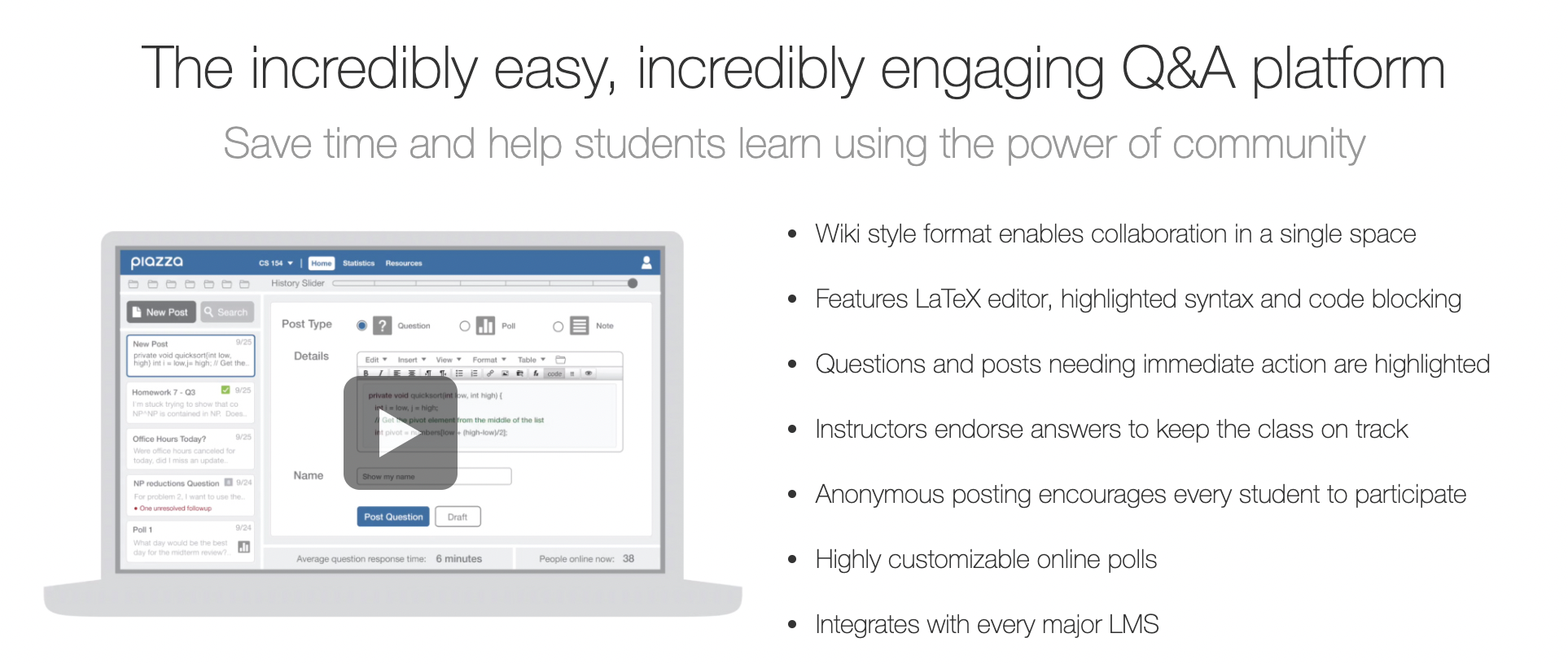
<p>But on Piazza’s homepage the word <em>forum</em> does not appear.
It describes itself as a “Q&#x26;A platform”.
And if you read the rest of the description, particularly the focus on saving time and immediate action, the true design goals become more clear.</p>
<p>Piazza isn’t the only tool with similar aims, even if it is dominant in the educational space.
Sites like Quora, Stackoverflow, Reddit, and others; and software like Discourse; also aim to help create communities centered around problem solving and information sharing.
And to a great degree what distinguishes these tools from each other are design choices, particularly regarding their user interface.
So it’s worth examining Piazza’s user interface to get a sense of its true aims.</p>
<p><img src="https://www.geoffreychallen.com/mdx/essays/2021-06-17-why-i-don&#x27;t-use-piazza/02.png" alt="Sample Piazza user interface"></p>
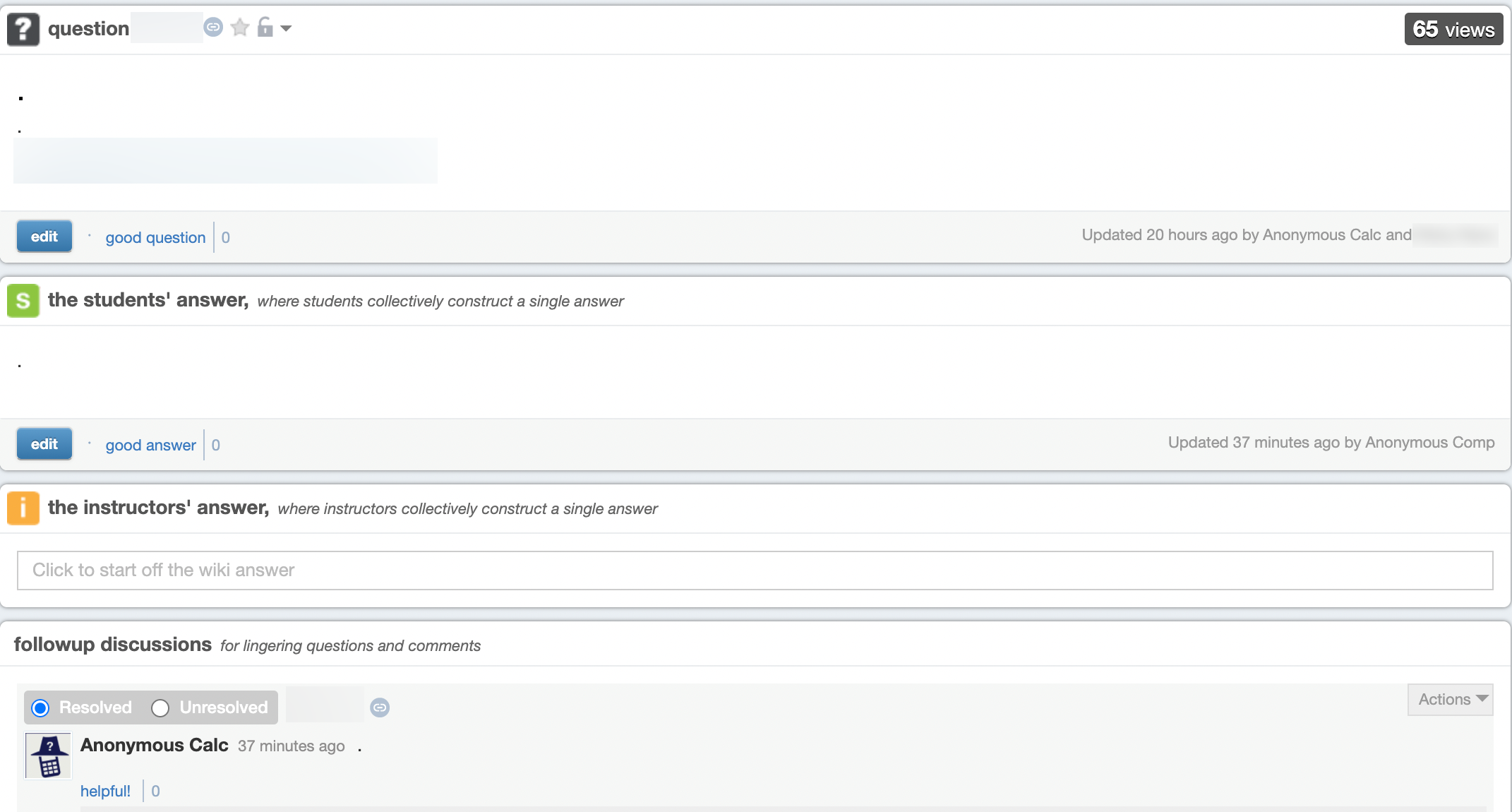
<p><em>
Believe it or not, someone on a Piazza forum I have access to posted a blank question and even some blank discussion recently.
How convenient!</em></p>
<p>At the top is a box where students can enter a question.
That’s pretty standard.
Once the question is posted, below it there are two additional text boxes: the first for a student answer, which in my experience is usually blank.
Below it is where the action is: “the instructor’s answer”.<sup><a href="#user-content-fn-2" id="user-content-fnref-2" data-footnote-ref aria-describedby="footnote-label">2</a></sup></p>
<p>Below the Q&#x26;A components is a section for “followup discussions” where you can post “lingering questions and comments”.
Note that there is no indication that this area is used as part of answering the original question.
That’s supposed to fit entirely into one of the answer boxes at the top, below the original question.
Instead, this area is for lingering questions—meaning, if you are a student and you didn’t understand the answer, here is your chance to make that known.</p>
<p>It’s a tell that, by default, any reply attached to the original question in this section is marked as <em>unresolved</em>.
Unresolved questions are highlighted in angry red in the UI, and counted as problems to solve in the instructor overview page.</p>
<p>With these design choices in mind, I think it’s best to describe Piazza as an answer extraction system.
Students have questions and want answers.
Fast!
They do not want to engage in a discussion about the answer.
They just want you to put it in the answer box—the one marked for the instructor.
Right away!
And if you’re not clear enough, they’ll let you know via an <em>unresolved follow-up</em>.</p>
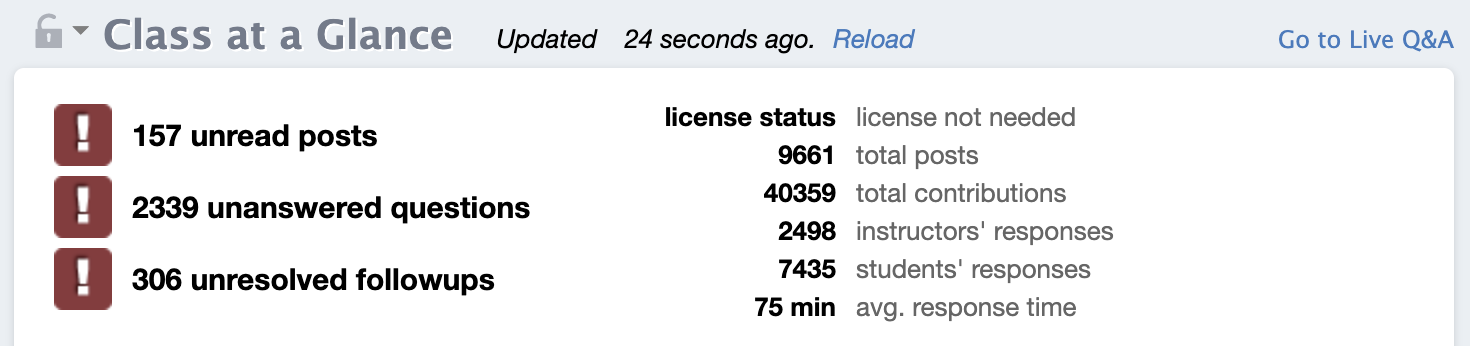
<p>Piazza’s own promotional materials stress this rapidity as a feature, not a bug. One of the first bits of the Wikipedia page about Piazza notes how quickly student questions are answered. And did I mention that statistics about response time are posted prominently across the UI?</p>
<p><img src="https://www.geoffreychallen.com/mdx/essays/2021-06-17-why-i-don&#x27;t-use-piazza/03.png" alt="Piazza instructor statistics view"></p>
<p><em>
Piazza’s metrics focus on rapid replies, not quality conversation.</em></p>
<p>But is this focus on response time a good thing? Consider the joke structure that I’ve seen used multiple times by faculty:</p>
<ul>
<li>Student: Hey Prof, I have a question!</li>
<li>Professor: Great! What would you like to know?</li>
<li>Student: Is the answer to Question 8 on the homework A, B, C, or D?</li>
<li>Professor: Well, what is the question asking?</li>
<li>Student: It says, (insert subject-appropriate question here).</li>
<li>Professor: Right. So do you remember our discussion of that topic last week during class?</li>
<li>Student: So are you saying the answer is C?</li>
<li>Professor: No, not quite. I might suggest that you review Chapter 7 in the textbook which covers this topic in depth.</li>
<li>Student: So it’s D then?</li>
<li>…</li>
</ul>
<p>The reason this joke lands is that it highlights a common source of tension between students and course staff.
Students want answers.
Fast!
Staff want students to learn.
Frequently that means slowing them down, engaging them in dialogue, and instructing them in how to learn the material, rather than just coughing up an answer.
The tension isn’t usually quite this stark—that’s what makes the joke funny.
But it’s ever present.</p>
<p>Finding the right balance here is tricky.
The extremes are not good.
A course where students cannot ever get help—or where doing so requires hunting down the professor and sitting through a discursive stem-winder—is not a good course.
However, a course where helping students means just showing them the answers is also not a good course.</p>
<p>I talk a lot about this with my course staff.
We run a help site where students can come to get help with their daily programming tasks and our longer multi-week assignments.
It allows students to display their code to staff and receive verbal assistance.</p>
<p>The UI already does not allow course staff to drive—meaning actually type into the student’s machine—which is itself helpful at limiting their tendencies to want to just take over.
We’ve also emphasized this in the past when we worked face-to-face with students.
Never touch a student’s computer!
But when the line of students waiting gets long, it can be tempting to rush, and just point out what the student is doing wrong rather than guiding them towards identifying the problem themselves.</p>
<p>Even the word <em>help</em> is somewhat problematic.
We should probably call it the tutoring site, rather than the help site.
I remind my staff that their ultimate goal is not to help students.
That we could accomplish by just fixing their problem.
But this isn’t the Genius Bar.
Their goal is to <em>teach</em> students.
That requires a slower pace, a lot more patience, and a completely different interaction pattern.</p>
<p>This points to another serious problem with Piazza. It’s UI doesn’t support even the limited back-and-forth needed to turn a question into a learning opportunity.</p>
<p>On our forum that back-and-forth frequently goes like this:</p>
<ul>
<li>Student: I’m having a problem with my code.</li>
<li>Staff: What’s the problem?</li>
<li>Student: It’s not working.</li>
<li>Staff: In what way is it not working?</li>
<li>Student: (Pastes error output.)</li>
<li>Staff: Can you explain the error message to me? What’s going wrong?</li>
<li>…</li>
<li>Staff: What have you tried so far?</li>
<li>…</li>
<li>Staff: What happened when you tried that? Did the same error occur again, or did something else happen?</li>
<li>…</li>
</ul>
<p>And so on and so on toward an eventual resolution.<sup><a href="#user-content-fn-3" id="user-content-fnref-3" data-footnote-ref aria-describedby="footnote-label">3</a></sup>
This dialog serves several purposes. First, more often than not it’s necessary, since staff actually don’t know what the student’s problem is. Contrary to popular belief, we’re not omniscient.</p>
<p>But more importantly, it demonstrates the thought process that actual programmers go through when solving problems and debugging programs.
So it teaches students how to think about these problems themselves, rather than just relying on the course staff for answers.
Sometimes by the time we arrive at a solution, it’s fairly specific to this student’s particular problem, and may not be that useful to others.
But the problem solving process itself is very general, and so other students who are watching the exchange can and do benefit.</p>
<p>Could you do something like this on Piazza?
Sure.
By fighting it’s UI through a bunch of “unresolved followups” running out to the right margin, each by default considered a problem to be solved rather than part of the solution to an actual problem.</p>
<p>And at the end, what do you put in the answer box?
Here the solution is a process, not an answer—<em>active learning</em>, not passive answer extraction.
I guess you could fill every applicable answer box with a link to common problem-solving and debugging strategies.
Or links to the course resources that students can use to find the answer themselves.
I doubt students would appreciate that very much, since it doesn’t help them answer their question.
Fast!</p>
<p>Honestly, I can’t think of many questions where my primary goal in answering them would be speed.
I suspect that most of these would fall into the category of things about the course structure or administration that students tend to ask even though they could find it on the syllabus.
For any question about the course content—design questions, conceptual questions, debugging questions—speed is <em>not</em> the goal or even <em>a</em> goal, and rushing is frequently the enemy of learning. I want to be able to engage in a discussion, not just facilitate answer extraction. I want an actual forum, not Piazza.</p>
<p>Happily actual forums are not hard to come by.
I’ve been using <a href="https://discourse.org/">Discourse</a> for my courses for years.
It’s forum software that facilitates discussion, learning, and community.
It’s open-source and extremely simple to self-host on-prem. And it’s great.
If you want help getting started using it for your course, feel free to get in touch, or ask on <a href="https://meta.discourse.org/">Discourse Meta</a>.
There’s also a great community behind this tool.</p>
<p>Discourse also addresses many of the technology concerns I have with Piazza.
To put it bluntly, Piazza is poor technology—which is probably why it’s almost never used outside of academia.
The UI is ugly and doesn’t update properly.
It’s mobile solution is a separate app.<sup><a href="#user-content-fn-4" id="user-content-fnref-4" data-footnote-ref aria-describedby="footnote-label">4</a></sup>
Deep linking is broken.
The Markdown editor took forever to arrive and is still worse than most.
Being free doesn’t mean that your tech stack should stagnate for decades.
And it’s not even free anymore!</p>
<p>Piazza is also a closed-source product in a position to harvest massive amounts of sensitive student information.
Although, given the speed at which their development team deploys new features, I guess I’m not terribly worried that they are doing sophisticated evil things with user data.</p>
<p>I teach a course on technology. Even if it did a better job of supporting student learning, I would still be reluctant to require that students use a poorly-designed poorly-aging piece of closed-source web technology. We can do better than Piazza. A lot better.</p>
<p>I’m also in a position to be able to deploy an alternative. Sadly, this is less common than you might think. Running Discourse requires shell access to a small machine, a publicly-routable IP address, a DNS entry, and email. You wouldn’t think that these would be particularly hard to come by at a modern university.</p>
<p>But even as someone teaching computer science, it turns out that gaining access to the basic computational resources to install a simple web application is quite difficult. Today, campus IT are more likely to “help” you install a real forum by telling you to use Piazza like everyone else—rather than helping you find the resources you need, or better yet installing an alternative and maintaining it.<sup><a href="#user-content-fn-5" id="user-content-fnref-5" data-footnote-ref aria-describedby="footnote-label">5</a></sup> These are topics for another time.</p>
<p>So it’s nice to see at least some campus-approved options that don’t require self-hosting start to arrive, like Campuswire.
I haven’t used Campuswire myself, and will probably continue to use Discourse as its open source and more configurable.
But Campuswire probably has good odds of being better than Piazza, since it would be hard to be worse.
Maybe the technology community is finally realizing that there are massive opportunities in just selling halfway-decent educational web technologies to universities.
You just don’t have to try that hard to compete with what we’re already being told to use.
But this is yet another topic for another time.</p>
<p>Until better alternatives arrive, my suggestion is to not use Piazza if you can avoid it.
And if you teach computer science or in a technical discipline, you <em>can</em> avoid it.
No, Piazza is not good enough—I hear that a lot.
It encourages behaviors that inhibit student learning, and there are better alternatives that don’t.
Also our students will probably be more excited about building a better future through technology if we stop endorsing such terrible software.</p>
<p>If you can’t avoid it, at least treat Piazza as poorly-design and possibly even adversarial. It’s probably better than having no online forum-like site. But it is not a forum, and it does not create community, or foster the learning that accompanies dialog.</p>
<section data-footnotes class="footnotes"><h2 class="sr-only" id="footnote-label">Footnotes</h2>
<ol>
<li id="user-content-fn-1">
<p>Although still, for real, it’s 2021 and you don’t have a decent Markdown editor. Something is wrong… <a href="#user-content-fnref-1" data-footnote-backref="" aria-label="Back to reference 1" class="data-footnote-backref">↩</a></p>
</li>
<li id="user-content-fn-2">
<p>Piazza sophomorically refuses to capitalize titles properly, probably due to college-age e.e. cummings-esque capitalization preferences. I went through that phase myself. I’m glad it’s over. <a href="#user-content-fnref-2" data-footnote-backref="" aria-label="Back to reference 2" class="data-footnote-backref">↩</a></p>
</li>
<li id="user-content-fn-3">
<p>Note that we do at least try and get students a bit farther down the field initially by using topic templates that encourage them to post details about their problem, including relevant output and error messages, so that we can skip over the first few round-trips. <a href="#user-content-fnref-3" data-footnote-backref="" aria-label="Back to reference 3" class="data-footnote-backref">↩</a></p>
</li>
<li id="user-content-fn-4">
<p>Given that Piazza seems to have only one or two developers, maintaining separate mobile apps does not seem like a good strategy. <a href="#user-content-fnref-4" data-footnote-backref="" aria-label="Back to reference 4" class="data-footnote-backref">↩</a></p>
</li>
<li id="user-content-fn-5">
<p>I maintain multiple Discourse installations for different courses and purposes. It’s extremely not hard. <a href="#user-content-fnref-5" data-footnote-backref="" aria-label="Back to reference 5" class="data-footnote-backref">↩</a></p>
</li>
</ol>
</section>]]></content>
    </entry>
    <entry>
        <title type="html"><![CDATA[Quantity Over Quality]]></title>
        <id>https://www.geoffreychallen.com/essays/2021-06-24-quantity-over-quality</id>
        <link href="https://www.geoffreychallen.com/essays/2021-06-24-quantity-over-quality"/>
        <updated>2021-06-24T00:00:00.000Z</updated>
        <summary type="html"><![CDATA[Programming is a skill, and if you want students to get better at it, you need to encourage them to practice. A lot. But also discourage them from focusing too much on quality too early.
]]></summary>
        <content type="html"><![CDATA[<p>One of my favorite stories about teaching goes like this.</p>
<p>A ceramics instructor provided students in their studio class two grading options.
They could be evaluated based on the single highest <em>quality</em> piece that they produced during the semester.
Or, they could be evaluated based on the <em>quantity</em> of work that they produced—literally the weight of everything they created, broken shards, failed experiments, all of it.</p>
<p>At the end of the semester the class convened to share their work.
Unsurprisingly, the students who elected the quantity grading option had produced a lot more pieces.
But, perhaps surprisingly, they had also produced higher quality work.</p>
<p>There are two lessons here that I reflect on when designing CS1 and the early computer science curriculum.</p>
<p>Perhaps the more obvious one is that quantity matters.
Practice makes perfect.
Programming is a skill, and if you want students to get better at it, you need to encourage them to practice. A lot.</p>
<p>Starting in Fall 2018 we began requiring students to complete a daily homework problem in CS1.
We also included several small programming problems on the weekly quizzes given in our <a href="https://cbtf.engr.illinois.edu/">computer-based testing facility</a>.<sup><a href="#user-content-fn-1" id="user-content-fnref-1" data-footnote-ref aria-describedby="footnote-label">1</a></sup>
In Fall 2018 students completed 108 small programming problems in both proctored and unproctored environments, writing approximately 14,000 non-commenting lines of code per student, or around 133 lines per student per day over a 15-week semester.
By Spring 2020 that number had risen a bit to around 19,000 lines-per-student.</p>
<p>Students start the semester writing snippets that merely declare and initialize variables, but finish by implementing Quicksort partition and sophisticated recursive algorithms on binary trees.
Students never lose points for incorrect submissions.
The focus is always on practice, fixing mistakes, and eventually getting it right.</p>
<p>We’ve also invested significant time and energy into developing new systems for authoring and evaluating small problem submissions.
More on these soon.
But I consider creating more opportunities for students to practice to be one of the highest-value activities I engage in when supporting my CS1 course.
I try to write new problems every day.<sup><a href="#user-content-fn-2" id="user-content-fnref-2" data-footnote-ref aria-describedby="footnote-label">2</a></sup></p>
<p>A lot of the CS1 courses I see just don’t give students enough opportunities to practice.
Sometimes when I tell people that we require students do daily work they look at me like I’m crazy.
This is college!
But not only does it work, but it’s also extremely well-tolerated.
By asking students to do a bit each day, we can actually help them accomplish a lot more over the course of the semester than if we used larger less-frequent assignments.
The psychology behind this approach is worth exploring separately.</p>
<p>But the second lesson from our story is equally important, if a bit obscured by the primary lesson.</p>
<p>There are at least two ways to interpret the fact that the quantity-focused group produced higher quality work.
The first is simply that, by creating more pieces, they were more likely to create something decent—the sort-of monkeys typing Shakespeare theory.
But note that there was no restriction on the amount of work that the quality-focused group could produce.
Nobody said that they had to produce only one high-quality piece.
They just weren’t incentivized to produce a large amount of work.</p>
<p>I don’t think that the quantity-focused students produced better work by oversampling their output curve.
While I also suspect that practicing developed their critical eye at least somewhat, I also don’t think that this was the explanation.
Presumably all of the students in the ceramics studio were able to distinguish high-quality work, even if they couldn’t reliably produce it.</p>
<p>Instead, I think that, by focusing on quality, the quality-driven group ended up inhibiting their ability to create excellent pieces.
This isn’t as strange as it might sound.
There is an entire school of Chinese thought focused on the idea of <a href="https://en.wikipedia.org/wiki/Wu_wei">“trying without trying”</a>.
It also aligns with <a href="https://www.goodreads.com/quotes/309485-nobody-tells-this-to-people-who-are-beginners-i-wish">Ira Glass’s well-known advice for beginners</a> to try and avoid focusing on quality early until their capabilities begin to catch up with their expectations.</p>
<p>What lessons does the quality angle of this story have for CS1?
We <em>do</em> want to teach students to write good code, not just a lot of code.
What is the right way to do that?</p>
<p>Just like early CS courses frequently don’t do enough quantity, I think that there is a temptation to do too much code quality too early.
At best, students aren’t ready for it until they have done more work and written more programs.
At worst, early obsession over code quality produces timid programmers that neither produce high-quality code nor are able to enjoy the process of just building things and getting them to work.</p>
<p>Before continuing the discussion, we should consider what we mean when we talk about code quality in early CS courses.</p>
<p>A useful way to organize code quality for this discussion is on a spectrum, with things that computers can correct and fix automatically at one end and aspects that only a human can evaluate on the other.
The reason that this is particularly useful is that aspects on one end of the spectrum can be identified and sometimes even corrected automatically, whereas at the other end of the spectrum we require a fair amount of person-power and, more importantly, human wisdom.
This impacts teachability.</p>
<p>As an example of one extreme, the Go programming language provides <a href="https://blog.golang.org/gofmt">a formatting tool</a> that can reformat Go code to match its language style specification.
Many other linters fall into this category.
A lot of what we are correcting at this level might be referred to as style, but linters can also be configured to examine things like cyclomatic complexity, method length and return count, and other metrics that at least hint at design.</p>
<p>As an example of the other extreme, imagine the kind of high-level code review that might take place in industry.<sup><a href="#user-content-fn-3" id="user-content-fnref-3" data-footnote-ref aria-describedby="footnote-label">3</a></sup>
Conversations with a senior software developer are not going to waste time on brace placement, file layout, swallowed exceptions, or test coverage.
The code will be assumed to be working, passing all tests, and meeting all internal code quality metrics.</p>
<p>Instead, there will be ongoing discussions of high-level design decisions and tradeoffs.
What happens if we want to support this other use case later?
What’s the worst-case performance of this code path?
Is there a way to further generalize a particular problem-solving approach that might currently handle multiple cases using similar but not identical methodologies?
What are current sources of technical debt and plans to retire them in the future, if needed?
Note that while these conversations are about the code, they are at such a high level that examining actual lines of code may not even be necessary—assuming that developers with a sufficient understanding of it are involved.</p>
<p>Courses that aim to teach code quality usually imagine that students will be engaged in this kind of high-level design discussions.
But this is a fantasy.
Early in the program, students just aren’t ready for this kind of conversation.
They can’t write programs large enough to run into these kinds of tradeoffs and considerations.
Trying to organize code review at this point usually ends up meaning having conversations about things that a linter could pretty easily catch automatically, representing a fairly serious waste of human attention.</p>
<p>Another outcome is that course staff are instructed to push a fixed set of guidelines about intermediate aspects of code quality, like that rulesets you can find in books like <em>Clean Code</em>.
Some of these rules have value, to be sure.
But they lose a lot of their impact when they are applied too rigidly, or by course staff that haven’t really written enough code to understand the reasoning behind them.
Students don’t learn much from “Because I said so” or “Because Clean Code” said so.</p>
<p>Even later in the program after students have started to write larger programs, I remain highly skeptical that we can really create courses that engage them in high-level design conversations.
Because the next problem that immediately arises is who do you recruit to play the experienced senior developer?
Graduate students?
I’m giggling.
Faculty?
Now I’m laughing.
And recruit undergraduate course staff and now it’s the blind leading the blind.</p>
<p>I do think that we should do more with the low-end code quality aspects described above, the ones that we can identify automatically.
When I started teaching CS1 I began requiring running all student code through the <a href="https://checkstyle.sourceforge.io/"><code>checkstyle</code></a> Java linter.
Our <code>checkstyle</code> configuration is based on the original Sun rules and mainly checks style, enforcing rules related to whitespace, brace placement, indentation, and the like.</p>
<p>We do this for several different reasons.
First, I think that students should learn to write code using a consistent style.
There seems to be good reasoning behind the Sun rules in terms of improving readability, so it’s as good a set of rules as any.
Consistency is the key.
I usually get a few students that want to argue about brace placement, but they tend to fall in line quickly.</p>
<p>The second more pragmatic reason is that it really helps the course staff
Reading lots of unfamiliar code is hard enough for inexperienced course staff.
There’s no reason to make it harder by letting every student make their own choices about formatting.
Go really gets this right by having a language standard.
Java doesn’t, but by using <code>checkstyle</code> we make sure that all student code looks as similar as possible.
Downstream instructors have also thanked me for the same reason, since basic formatting habits learned in Java carry over to similar languages.</p>
<p>We let students get used to <code>checkstyle</code> rules for a few weeks and then start running it on all submissions—both to our unproctored homework problems and on proctored quiz questions.
I remember someone here incredulously asking: “You’re going to run a linter during quizzes?”
Yup.
Students internalize the rules quickly and this quickly becomes a non-issue.
It just works.</p>
<p>A lot of the CS1 courses I examine don’t seem to do much with linting.
I suspect that this is because they are afraid of further frustrating students.
But I think this is a mistake.
If we want to improve code quality, let’s start with the low-hanging fruit.</p>
<p>We’ve also experimented with evaluating and incentivizing other aspects of code quality in my class.
Midway through several past semesters we began reserving a small number of points on each homework for correct code that passed two simple code quality checks.
First, the submission must not include any <a href="https://en.wikipedia.org/wiki/Dead_code">dead code</a>.
Second, it should have a <a href="https://en.wikipedia.org/wiki/Cyclomatic_complexity">cyclomatic complexity</a> within some delta of the reference solution.
Both of these are quantitative metrics that can be evaluated automatically.
We’ll probably continue to utilize these kind of hints going forward to help encourage students to not submit overly-complex solutions.</p>
<p>Past the easy stuff, can we do much more about code quality early? And should we?</p>
<p>I think that the answer to both questions is no.
Early CS courses should use a properly-configured linter to enforce formatting and other basic code-quality metrics.
I think it’s worth experimenting with other metrics that are both quantitative and where there is a clear right and wrong.
Dead code is bad, as is overly-complex code.
Neither requires a human in the evaluation loop.</p>
<p>Past that point, I’m skeptical that we can actually do useful code review at scale.
Even once students are ready for it, staffing these courses with enough qualified guides is difficult to impossible.</p>
<p>But this also doesn’t really matter that much, because I don’t think that an early focus on quality is healthy anyway.
Just focus on quantity, and let students enjoy the journey, make their mistakes, and become better programmers.</p>
<p>The danger here is that we create beginning programmers who can write clean code but can’t actually build anything or solve real problems—like writers that can craft a perfect sentence but can’t tell a story.
In the process, we risk losing students who signed up to change the world, not to endlessly refactor code that doesn’t even do anything particularly exciting to conform to guideline they don’t understand.
Students need to start and keep building real things to retain their motivation, even if what they create is a bit ugly.</p>
<p>And the uncomfortable truth is that sloppy, messy, ugly, and slow code has, does, and will change the world.
Focus on quantity, and quality will come.
But please at least run a linter.</p>
<section data-footnotes class="footnotes"><h2 class="sr-only" id="footnote-label">Footnotes</h2>
<ol>
<li id="user-content-fn-1">
<p>More on this facility soon. It’s the single most effective tool I’ve found for teaching CS1. <a href="#user-content-fnref-1" data-footnote-backref="" aria-label="Back to reference 1" class="data-footnote-backref">↩</a></p>
</li>
<li id="user-content-fn-2">
<p>Like <a href="https://cs.stanford.edu/people/nick/">Nick Parlante</a>, I’m a reps guy. <a href="#user-content-fnref-2" data-footnote-backref="" aria-label="Back to reference 2" class="data-footnote-backref">↩</a></p>
</li>
<li id="user-content-fn-3">
<p>Note that I have never participated in this process first-hand. <a href="#user-content-fnref-3" data-footnote-backref="" aria-label="Back to reference 3" class="data-footnote-backref">↩</a></p>
</li>
</ol>
</section>]]></content>
    </entry>
    <entry>
        <title type="html"><![CDATA[One For All]]></title>
        <id>https://www.geoffreychallen.com/essays/2021-07-02-one-for-all</id>
        <link href="https://www.geoffreychallen.com/essays/2021-07-02-one-for-all"/>
        <updated>2021-07-02T00:00:00.000Z</updated>
        <summary type="html"><![CDATA[Teaching large courses can have enormous impact. But it's easy for an instructor's effectiveness to decrease as the number of students grows. The trick to avoiding this is to focus on the things that benefit all students—one for all—and avoid those that only benefit a few students—all for one.
]]></summary>
        <content type="html"><![CDATA[<p>Teaching large courses offers the potential for huge impact.
If you can teach 1,000 students as effectively as 100, you’ve increased your impact by an order-of-magnitude.
Multipliers like that don’t come around too often in life.
And in a day where college costs and inequality are both skyrocketing, teaching more students more efficiently can also be very  meaningful.
In <a href="https://en.wikipedia.org/wiki/Capital_in_the_Twenty-First_Century"><em>Capital in the Twenty-First Century</em></a>,
Piketty identifies technology and education as the two primary factors pushing back on inequality.
Using technology to educate more students more efficiently is my (small) way of joining this important effort.</p>
<p>But of course there’s a catch.
As class sizes increase, it’s common for instructor impact to actually decrease.
Avoiding this is the key to effective teaching at scale.</p>
<p>An effective way to think about this dynamic is to divide the work that you do as an instructor into two parts: things that benefit all of the students in your class, and things that benefit a single student.
Of course there are things that fall somewhere in the middle.
But this is a useful dichotomy for considering what happens when courses scale.
It’s one for all versus all for one.</p>
<p>When a course size grows, the things that you do that benefit all of the students in your class scale to benefit even more students.
If you spend an hour preparing lesson materials, then it benefits 100 students if the class size is 100 but 1000 if the class size is 1000.
<strong>One for all scales.</strong></p>
<p>But when your course gets big, you may also find yourself needing to spend more time on the things that benefit only a single student.
If you spend one hour answering student email for a class size of 100, you’re going to be in big trouble when that class grows to 1000.
<strong>All for one doesn’t scale.</strong></p>
<p>So here’s the one quick trick for effective teaching at scale.
Control the amount of time you spend helping individual students, so that you can preserve time to spend on things that help all of your students.
Minimize all-for-one so you can maximize one-for-all.
Do that, and you can teach larger and larger courses with ease, and have more and more impact as you do.</p>
<p>Last year I was the single instructor assigned to a 1200-student course in the fall and a 600-student course in the spring.
I had a blast!
My goal here is to share some tips with you that you can use to help improve your own ability to teach large courses and increase the impact of your own teaching.</p>
<p>Figuring out things to do that benefit all of your students isn’t usually that hard: creating new instructional content, updating assignments and assessments, monitoring student performance, studying your own course to glean new insights about how to improve.
This category also rightly includes work outside your assigned courses, including longer-term projects that improve the educational experience for students in ways that touch multiple courses or address the entire curriculum.
These are extremely valuable activities and equally vulnerable to all-for-one demands.</p>
<p>In any case, I’m going to guess that you already know what one-for-all activities to pursue. Let’s focus on how to keep the all-for-one activities from taking over your schedule.</p>
<p>I should note that one of the tools I employ here is my technological prowess.
There are definitely places where I’ve created software to address all-for-one scaling bottlenecks.
That approach may or may not be available to you.<sup><a href="#user-content-fn-1" id="user-content-fnref-1" data-footnote-ref aria-describedby="footnote-label">1</a></sup></p>
<p>However, in my experience the most valuable approaches for addressing all-for-one scaling bottlenecks are not technological.
They comprise policy and behavioral solutions that you can and probably should deploy if you are or plan to teach a large course.
These are the ones that I’ll list here. And while I’ve used them to allow me to happily teach 1000 students per semester, they should be equally valuable if your goal is to teach 100.</p>
<p>Let me also point out that no one quick trick replaces sufficient staffing.
There is important instructional work that does scale with the number of students in a course—particularly some of the most valuable student-facing components, like providing one-on-one support.
That said, reducing the administrative burden of the all-for-one tasks will leave your entire staff with more time to assist students and work on more meaningful instructional tasks.
Since this is what your staff signed up to do, freeing them to do more of it improves staff motivation and morale.
And, inevitably, even if you hire a fantastic course staff, there can be certain tasks that you just can’t delegate, and will find their way up the food chain.<sup><a href="#user-content-fn-2" id="user-content-fnref-2" data-footnote-ref aria-describedby="footnote-label">2</a></sup></p>
<p>When I tell colleagues that I teach 1000 students, frequently a look of horror passes over their face.
“Wow. I’m so sorry…” they stammer as they start backing slowly out of my office.
I have a feeling that I know what immediately comes to mind, what they think I must need to get back to right away, and what they worry would rule their life when teaching huge courses.
Email.</p>
<p>Answering individual student email is a great example of an all-for-one task that simply doesn’t scale as the number of students in a class grows.
And things can get ugly quickly.
If you are spending 15 minutes per day on student email with a 100-student class, look forward to spending <em>2.5 hours</em> per day on student email once that class grows to 1000 students.
Yes, you can find more people to help answer email with you—and perhaps this explains why some institutions feel the need to throw more instructors at large courses, just to help answer email.
But wouldn’t it be better for everyone if we could just reduce the amount of student email, rather than recruiting an expensive army of course staff to reply?</p>
<p>As it happens, I do get a handful of student emails. But not per minute, per hour, or per day.
<em>Per week.</em>
I do get more earlier in the semester.
But it turns out that training students to not use email as the primary form of course communication is surprisingly easy.</p>
<p>When students email me early in the semester, 99% of my replies are one of two things: a link to the syllabus, or a link to our course forum with a message politely asking them “Please ask questions like this on the forum.”
These replies identify the two core strategies that you can use to drive email to near zero.</p>
<p>First, you need good online materials that address most if not all student questions.
That includes a detailed syllabus, course calendar, and anything else needed to address contents of the emails you receive.
There’s a fairly simple approach to take to the questions that relate to course policies: if a student asks, redirect them to the appropriate part of the syllabus or other online materials.
If that part doesn’t exist, write it, and then redirect them to it.</p>
<p>Your goal should be to make it easier for students to find what they need rather than email you directly.
So you’ll probably also need to address other usability issues with your online materials.
Are they buried behind a confusing LMS system that is difficult to navigate, or that requires some complex login process?
Do they require downloading and opening a PDF?
Are they searchable—nothing fancy necessary, just using standard Control-F?
If not, then I would suggest that you improve the accessibility of critical information about your course.
This is not rocket science, and there is no reason getting huffy about it.
Yes, a student could have found that answer themselves.
But the question that matters is: <em>Will they</em>.</p>
<p>Making it easier for them also allows you to respond more directly.
Sometimes all I send in reply is a link to the syllabus.
That’s both faster for me, and also carries the implicit message: Maybe you should have looked this up yourself?<sup><a href="#user-content-fn-3" id="user-content-fnref-3" data-footnote-ref aria-describedby="footnote-label">3</a></sup></p>
<p>The second thing that you need to help decrease email is a good forum.
(Sadly, <a href="https://www.geoffreychallen.com/2021-06-17-why-i-don&#x27;t-use-piazza/">Piazza is neither a forum nor good</a>.)</p>
<p>Redirecting student email to a forum does two things.
First, it teaches them the right way to ask that kind of question. That’s valuable in and of itself.</p>
<p>But it also accomplishes something even better: It transforms an all-for-one activity (responding to an individual email) into a one-for-all activity (responding to a post on the forum).
I will even use this trick when students ask me an interesting question in person.
I’ll respond: “Post this on the forum and I’ll answer!”
That frees me to write to devote more time to a thoughtful response, since I know it benefits all students, rather than just the one standing in front of me or involved in a specific email exchange.</p>
<p>And by redirecting questions to the forum, I also pull in my excellent course staff, which frequently chime in with their responses. Frequently by the time I arrive the student’s original question that I received over email has been answered multiple times in way more depth and detail than I would have, and all I need to do is do some clapping and maybe further endorse the existing responses.
Teamwork really does make the dream work.</p>
<p>Do these strategies work?
Yes.
Do students tolerate them?
Yes.</p>
<p>It also helps to have very clear policies regarding course communication.
We have very specific guidelines about when students are allowed to directly email the course staff in our syllabus.
More importantly, we also have language <em>explaining</em> these policies, and how they end up benefiting the entire class.
It’s not really that hard to explain to students that me spending 40 hours a week responding to email is not a good use of my time, or the best way for me to teach them all as effectively as I can.</p>
<p>But there is another reason that I don’t get much email, and it leads us to the second strategy for limiting the impact of all-for-one interactions.
I almost never make exceptions.
I provide absolutely zero exceptions on homework deadlines (30%), few-to-no makeup quizzes (40%), and very few extensions on our long programming assignment (30%).
As you would expect, this reduces the number of these requests, and since handling these requests is another all-for-one activity, it leaves me more time for one-for-all work.</p>
<p>I can already hear you thinking.
But!
But!
But!
But what if a student gets sick?
Or has a death in the family?
Or is out of town for a school-sponsored event?
Or oversleeps?
Refusing to consider requests for exceptions seems like a heartless choice that ignores the vicissitudes of life that students experience each semester.</p>
<p>But instead of providing individual exceptions, I’ve developed an <em>exception policy</em>.
When grading we drop multiple low homework and quiz scores.
Typically we’ll drop 12 out of the 75 daily homework problems—essentially meaning students don’t need to complete them, since these are all-or-nothing grading—and the lowest 3 out of 15 quiz scores.
I can’t claim credit for this particular policy.
But I love pretty much everything about how it works—particularly when teaching large courses.</p>
<p>First and foremost, it’s efficient.
Students don’t need to request a drop, they are simply automatically applied when we compute grades.
I’ve heard of courses requiring a part-time staff member at least in part to handle requests for extensions and exceptions.
To me, this is insane, and completely unnecessary.</p>
<p>It’s also fair.
Having to consider exception requests requires staff make strange choices.
A student wants to miss a quiz so that they can participate in an e-gaming tournament.
A second student wants to miss a quiz so that they can participate in a golf tournament with the university team.
The second student has a letter on official university stationery.
The first student does not.
Why am I making this choice again?
Is the official letterhead significant?
Is golf (which I find boring) more exception-worthy than e-gaming (which I also find boring)?
Would I give a drop if the student was traveling to see <a href="https://www.flockofdimes.com/">Flock of Dimes</a>, which I don’t find boring?</p>
<p>The drop policy takes me and my course staff out of the business of making these decisions entirely.
Not only does this free up time, but it is also psychologically healthy.
You hear a <em>lot</em> of cynicism among faculty surrounding student excuse-making.
Grandparents who die but then, miraculously, show up for graduation.
Doctors notes with suspicious misspellings.
The fact that the university employs people to write excuse letters for athletes.</p>
<p>I’ve had students who contact me about a death in the family.
Should I be keeping a spreadsheet to track how many of their relatives are still living?
But maybe they are adopted but then found their real family later in life, and so actually have some extra relations?
And shouldn’t my primary response in this kind of situation be, simply: I’m so sorry for your loss.
I love teaching and my students, and don’t want to be dragged down by this kind of paranoia.
I’ll believe all of your excuses.
But then redirect you to the drop policy.</p>
<p>This policy is also easy to justify.
There is a limit to the amount of work a student in my course can miss before I am no longer confident that they have met the learning objectives.
The drop policy represents that limit.
Dropping low scores also helps reduce testing anxiety by eliminating outliers that might result from exogenous factors, and by allowing students a bit of leeway in learning how to prepare for our assessments and do their best in the quiz format.</p>
<p>When you look at the data you find that most students don’t utilize all of their drops.
This is both good, and makes sense, since students will naturally save their drops in case they need them later in the semester.
I also remind students that their drops are a hard limit on the number of homework and quizzes that they can miss.
It doesn’t mean that you can just <em>skip</em> out on three quizzes, since if you do and then get sick later, you’re out of luck.</p>
<p>It’s important to acknowledge that the effectiveness of our drop policy at nearly eliminating requests for exceptions is connected to our use of frequent low-stakes assessment: in this case, 15 quizzes together worth 40% of the student’s grade, and no high-stakes assessments like a summary midterm or final exam.</p>
<p>When you give high-stakes assessments, you don’t give many, so it’s hard to have a policy allowing students their three lowest scores.
You end up needing to make exceptions for students to take those high-stakes exams.
And it’s also worth pointing out that you may end up encouraging students to find ways to delay those high-stakes assessments to try and achieve a competitive advantage, either through a bit more study time or information about the exam from students who took it on schedule.</p>
<p>Things can spiral downhill here rapidly in ways that really highlight the all-for-one versus one-for-all divide.
Writing good assessments takes time.
If a handful of students misses your high-stakes midterm, what do you do?
You can give a makeup, and just accept the unfairness inherent to that approach.
Meanwhile, as the students who missed the exam stall for time, the entire class is prevented from reviewing the exam questions and answers which would really benefit their learning.
Or you can write an additional exam, at which point you are repeating all of the work that you put into the first exam for the entire class for just a handful of students: one-for-all has become all-for-several.
And usually the make-up exam is similar to the original, so you may still not be able to release information about the exam to students who have already completed it.
It’s just a mess.
No wonder faculty get cynical and frustrated by excuses, even when they are perfectly legitimate.</p>
<p>There really is a problematic tendency for faculty to abandon the collective in favor of the individual in situations like this.
I think that the reasons are clear: Helping one student has specific direct interpersonal benefits for the faculty member, whereas helping the collective typically does not provide the same emotional payoff.
I’ve witnessed colleagues expend indefensible amounts of time and energy implementing exceptions for individual students in the midst of teaching a large course, time and energy that could easily have been put to better use.
We tend to valorize this kind of behavior, rather than challenge it.
But that doesn’t make it right.</p>
<p>But if the promise of not having to read doctors’ notes encourages you to give frequent low-stakes assessments a try, then great!
Whatever works!
Frequent low-stakes assessment has a lot of benefits.
This is definitely one of them.</p>
<p>The next all-for-one activity to discuss is recommendation letters. This topic has a bunch of sharp edges. Let me see if I can cut myself on all of them.</p>
<p>My policy is that I do not write letters of recommendation for students that I have only had in class.
I just don’t know them well enough.</p>
<p>I used to say yes and prepare a form letter, which didn’t really say much more than what someone could have easily found on the course website.
But here the problem is that the systems that are used are incredibly disrespectful of faculty time.
If all I had to do was write a letter, I’d probably do it.<sup><a href="#user-content-fn-4" id="user-content-fnref-4" data-footnote-ref aria-describedby="footnote-label">4</a></sup>
But there are endless accounts to create and stupid similar-but-not-the-same forms to fill out.
It quickly becomes a bigger time sink than it should be.</p>
<p>I do write straightforward letters for the hundreds of students who have served on my course staff.<sup><a href="#user-content-fn-5" id="user-content-fnref-5" data-footnote-ref aria-describedby="footnote-label">5</a></sup>
And I will write excellent, strong, and very detailed letters for senior course staff who I know well and whose contributions I have had a chance to observe directly.
I once wrote one so strong for an internal award that someone emailed me to complain about it.<sup><a href="#user-content-fn-6" id="user-content-fnref-6" data-footnote-ref aria-describedby="footnote-label">6</a></sup></p>
<p>It’s hard to raise this topic without commenting on the insane proliferation of letter requirements which now seem to accompany applications for almost <em>everything</em>—or at least everything in academia.
Does a rising sophomore applying for a summer research experience really need multiple or even a single faculty letter?
How, exactly, are they supposed to obtain that letter?
I think we’re well past the point where recommendation requests are just generating more mad-lib letters that add nothing to the students resume and transcript.
This insanity seems also designed to enforce the myth that the most valuable relationships that students can form in college are with faculty, which is flattering but absolutely false.</p>
<p>As you teach larger courses, you also recognize the fundamental paradox at the heart of this economy of recommendation letters.
As you receive more letter requests due to teaching large courses, your letters are inherently less valuable.</p>
<p>I can’t unilaterally stop this madness.
But I can control how I choose to participate.
My responsibility is to all of the students that enroll in my course.
Writing pro forma recommendation letters just robs too much time from my one-for-all activities.</p>
<p>Those are my three primary strategies for reducing all-for-one activities that don’t scale as the course size grows:</p>
<ol>
<li>Eliminate email.</li>
<li>Excise exceptions.</li>
<li>Refuse recommendation requests.</li>
</ol>
<p>Together, these put me in a position to devote more time to one-for-all activities that benefit all of my students and let my course scale further.
I think I could comfortably teach 10,000 students per semester.
I’d like to try that one day.</p>
<p>Maybe this all seems a bit or even quite impersonal to you.
Maybe you enjoy interacting with students and worry that you’ll miss that if nobody is emailing you about anything.
A lot of us got into teaching because we like working with students one-on-one.
Scaling your course does involve foregoing some of that kind of interaction in favor of one-for-all work.
But surrendering all of it seems like a very high price to pay.</p>
<p>But here’s the best part: By reducing low-value all-for-one activities you create space for more meaningful all-for-one activities without jeopardizing your one-for-all goals.</p>
<p>As an example, I still hold a few office hours a week.
Very few students attend, but that’s fine, since it creates the opportunity to actually get to know the ones that do that much better.
From the perspective of our all-for-one versus one-for-all framing, this is clearly more on the all-for-one side of the scale.
Even if it’s open to all students, only a few are actually benefiting.
And yes, I could use those hours to work on things that would benefit the entire class.</p>
<p>So this is hard to justify from our all-for-one versus one-for-all optimization perspective.
But that’s OK!
Because I enjoy office hours and the chance to meet and interact with students in my class.
I’m in my class, too, and feel free to arrange at least a few things for my own benefit and enjoyment.
And I feel even more comfortable engaging in this kind of indulgence knowing that I’ve created enough time for the one-for-all activities that benefit everyone: even the students I’ll never meet or hear from.</p>
<p>I remind myself of this a few times each semester: Optimizing the 99% means that I have more time and energy to spend on the 1%.
So when I get an unusual or interesting email from a student, I have time to respond fully and thoughtfully.
I have time to write excellent recommendation letters for students I do know well.
I have time to have great conversations with students who stop by my office during office hours.
And I have time to work on higher-level issues like working with colleagues to improve the entire curriculum.
And I have time to write a lot of code!
Meanwhile I’m teaching 1000 students extremely well, and enjoying every minute.</p>
<section data-footnotes class="footnotes"><h2 class="sr-only" id="footnote-label">Footnotes</h2>
<ol>
<li id="user-content-fn-1">
<p>But if it is, by all means, use it! <a href="#user-content-fnref-1" data-footnote-backref="" aria-label="Back to reference 1" class="data-footnote-backref">↩</a></p>
</li>
<li id="user-content-fn-2">
<p>Dealing with plagiarism is one particularly unfortunate example. <a href="#user-content-fnref-2" data-footnote-backref="" aria-label="Back to reference 2" class="data-footnote-backref">↩</a></p>
</li>
<li id="user-content-fn-3">
<p>For bonus points,
if you reply fast enough, students might actually think that your reply was automated. This has happened to me. <a href="#user-content-fnref-3" data-footnote-backref="" aria-label="Back to reference 3" class="data-footnote-backref">↩</a></p>
</li>
<li id="user-content-fn-4">
<p>And probably automate it. <a href="#user-content-fnref-4" data-footnote-backref="" aria-label="Back to reference 4" class="data-footnote-backref">↩</a></p>
</li>
<li id="user-content-fn-5">
<p>Like any human, I do sometimes miss emails and not respond in time to requests. So if you are a staff member who asked for a letter and didn’t get one, I’m sorry. <a href="#user-content-fnref-5" data-footnote-backref="" aria-label="Back to reference 5" class="data-footnote-backref">↩</a></p>
</li>
<li id="user-content-fn-6">
<p>The letter’s length was at least in part a workaround to stupid and shortsighted eligibility criteria for this particular award that the student didn’t completely meet. In the end, they won the award, which they richly deserved. <a href="#user-content-fnref-6" data-footnote-backref="" aria-label="Back to reference 6" class="data-footnote-backref">↩</a></p>
</li>
</ol>
</section>]]></content>
    </entry>
    <entry>
        <title type="html"><![CDATA[Creating Course Community]]></title>
        <id>https://www.geoffreychallen.com/essays/2021-07-09-creating-course-community</id>
        <link href="https://www.geoffreychallen.com/essays/2021-07-09-creating-course-community"/>
        <updated>2021-07-09T00:00:00.000Z</updated>
        <summary type="html"><![CDATA[Not every course needs a community. But I've found that building one among my course staff has made my course both more effective for students and rewarding for myself. Here's how and why we create community in CS1.
]]></summary>
        <content type="html"><![CDATA[<p>Recently I was invited to participate in a <a href="https://ae3.engineering.illinois.edu/2021/07/08/summer-2021-faculty-development-workshop/">summer teaching workshop</a> run by our
<a href="https://ae3.engineering.illinois.edu/">Academy for Excellence in Engineering Education (AE3)</a>.
I was asked to help lead a session on the topic of “Building Community in the College Classroom”.
To be honest, I was a bit taken aback at first by this invitation.
I’m really proud of a lot of things about my course, but course community would not have been high on my list.
It might not have even made the list!</p>
<p>But once I started thinking about it, I realized that this was a case where outsiders—AE3 leaders <a href="https://ae3.engineering.illinois.edu/staff/">Jay Mann and Chris Migotsky</a>—had identified something about what I was doing that was actually really important but that I hadn’t yet recognized or at least identified in the same way.
So I’m going to share some thoughts on how we’ve created a community in <a href="https://www.cs124.org/">my CS1 course</a>.
Hopefully you find a few of these tips useful.</p>
<p>Part of why I was taken surprised when the community surrounding my course was identified is that I don’t think that building a community should be seen as a primary goal for <em>any</em> course.
I don’t think that every course needs a community, or at least not the kind of community that requires effort to build.</p>
<p>Every course will naturally create <em>some</em> community.
Maybe it only extends to a small number of staff, and maybe it doesn’t outlast the single semester in which the course is taught.
That might be completely OK!
Whether you build course community should be determined by your learning goals and how the community contributes to student success.
It’s not required, and if it’s not the best way to improve your class, work on something else.</p>
<p>Let me pause for a minute to make an important distinction.
During the COVID year<sup><a href="#user-content-fn-1" id="user-content-fnref-1" data-footnote-ref aria-describedby="footnote-label">1</a></sup>, there was some pressure on courses to try to facilitate <em>social</em> communities among students.
A lot of administrative hand-wringing seemed to attach itself to the idea that without in-person classes to attend, students would have no way to meet each other and make friends.</p>
<p>I don’t deny that residential life offers college students a lot of ways to expand their social networks.
But I think that the role of classroom contact—and from large classes in particular—in this process is usually exaggerated, compared with all of the other ways students have to meet—roommates, meals, extracurriculars, events, parties, shared spaces, and pre-existing friendships.
This is why, had it been up to me, I would have followed Harvard’s model and brought as many students back to campus as possible to recapture some of the benefits of residential life, but kept instruction online.</p>
<p>But without residential life, a lot of the benefits of residential life just weren’t going to happen.
I suspect that students did their best to connect with each other virtually.
I also suspect that this produced fewer meaningful connections than had they been colocated on campus.
Residential life really is a central part of the college experience, and not something that we can or should move online.
Students are clearly eager to get back to campus this fall, and I’m excited about that too.
But I think they are mostly excited to get back <em>together</em>, not to get back to classrooms.</p>
<p>The emphasis on building social communities as we prepared for COVID was doubly-frustrating given that many courses—including mine—were working hard to figure out how to meet their educational objectives and didn’t need the distraction of yet another task.
I chose to focus on changes and improvements intended to meet my course’s learning goals, stay in my lane, and largely ignore the ambient push to turn my class into a first-year social mixer.
Students will have a chance to restart their social relationships once we return to campus.
But any educational gaps will to haunt them for years to come.</p>
<p>At the end of the day, more students than ever took my course over the past year, and as a group they did better than ever before. They may have fewer friends, but I’m not sure we could have really done anything about that. But they should know basic computer science.</p>
<p>I’ll also note that my course involves very little collaborative work done by students.
I think that’s appropriate given the subject matter, the level, and in the context of our overall approach—which is highly-interactive but with the interaction taking place with our materials, not with other students.
Some courses rely on building small communities<sup><a href="#user-content-fn-2" id="user-content-fnref-2" data-footnote-ref aria-describedby="footnote-label">2</a></sup> within the classroom as a way to encourage students to interact with the material.
We don’t really need to do that as much.
And, given that the course was delivered entirely asynchronously during the COVID year, we also had no synchronous lectures or other meetings set aside for group work.</p>
<p>For Fall 2020 we did experiment with filling our calendar with a large number of office hours, which we imagined might create opportunities for students to form study groups and work together.
But that effort turned out to be a huge failure—those office hours went almost entirely unutilized and were and dropped for Spring 2021.
If students needed to form study groups to succeed in my course, they must have found ways to do so without our help.
Count me as incredibly unsurprised.</p>
<p>But if the way that the course succeeded wasn’t due to building social community among <em>students</em>, it was in large part due to having created a great community among the <em>staff</em>.
Building a course staff community is almost always a much more effective way to support course learning objectives.
A welcoming staff community can also help create a sense of community among students.
Even those that don’t choose to actively participate in that community get the sense that the course is a good place to be.</p>
<p>Compared to students, staff are much more likely to form a natural community.
Students are constantly arriving and leaving, while staff stick around longer.
Student motivations for taking a course can vary significantly, while staff are usually motivated around the idea of helping students learn.
So staff more likely comprise a stable group with common interests—almost like a student organization.</p>
<p>Thinking about your course staff as a club can be helpful, since a lot of the things that clubs do to help create community work equally well for course staff.
We’re starting with a shared mission—to help students learn.
Courses also tend to provide built-in events for staff, like holding tutoring hours and running review sessions.</p>
<p>What else do we need? How about:</p>
<ol>
<li>A place to meet</li>
<li>Good leaders and leadership opportunities</li>
<li>Shared values</li>
<li>A visible identity</li>
<li>Criteria for membership and advancement</li>
<li>Community decision making</li>
<li>Opportunities for members to make meaningful contributions</li>
</ol>
<p>Let’s go through each of these briefly in turn, and I’ll share what I’ve done in my course to support each community-building objective.</p>
<h2>A Meeting Place</h2>
<p>A meeting place could be either physical or virtual.
Today it’s probably best to have both.
During face-to-face semesters, my staff are heavily involved in running our tutoring space, which is open to all students for long stretches each day.
During the pandemic, we moved this activity online, creating <a href="https://www.cs124.org/best/#help-site">a novel help site</a> that allowed students to receive one-on-one assistance while allowing staff to efficiently handle with large groups of students.</p>
<p>But a bigger part of this for my course is our course forum.
I’ve written about why <a href="https://www.geoffreychallen.com/essays/2021-06-17-why-i-don&#x27;t-use-piazza">Piazza is not a forum</a>.
While it may support Q&#x26;A—although I tend to think of it as enabling answer extraction—Piazza is particularly poorly-suited to serving as a community meeting space.</p>
<p><a href="https://discourse.org/">Discourse</a>, which we use, is designed to create community.
And it does.
We set up private topics for staff to communicate with each other, and for discussions of course policies and community decision making.
I also know that my staff have set up a separate Discord server for their own use, which is fine by me.
Discourse is the official forum and shared with students.
So being on the forum feels like being on duty, and they deserve a place to blow off steam and connect privately.<sup><a href="#user-content-fn-3" id="user-content-fnref-3" data-footnote-ref aria-describedby="footnote-label">3</a></sup></p>
<h2>Leaders and Leadership Opportunities</h2>
<p>When I took over CS1 in 2017, the course already had a great staff community of several hundred students who signed up to help students in exchange for course credit as part of a training program.
What it <em>didn’t</em> have were opportunities for leadership and advancement.
And when you don’t have leadership opportunties, you don’t have leaders.</p>
<p>Circa 2021 we now have three levels of undergraduate course staff positions.
We still allow anyone who completes the course to enter a staff training program for course credit in the following semester.
However, in addition to those staff-in-training (Course Assistants), we now have two new tiers: a large number of paid staff (Course Associates) and a few leaders (Head CAs).<sup><a href="#user-content-fn-4" id="user-content-fnref-4" data-footnote-ref aria-describedby="footnote-label">4</a></sup>
To provide some sense of the numbers involved, in the fall for a class with ~1200 students we would usually have between 100 and 200 Course Assistants, 30–60 Course Associates, and a handful of Head CAs.<sup><a href="#user-content-fn-5" id="user-content-fnref-5" data-footnote-ref aria-describedby="footnote-label">5</a></sup></p>
<p>This has worked out really well for many reasons.
From the perspective of staff community, it has created leadership and advancement opportunities.
This encourages good staff to stick around, and allows us to value and incorporate the wisdom that returning staff provide as they gain experience and confidence.</p>
<p>However, regardless of how many levels you create in your staff hierarchy, it’s important to remember that the instructor is always the ultimate course leader and responsible for setting an example for the rest of the staff to follow.
You can and should delegate as much as you can to staff that you trust, and try to make decisions as a community.
But the buck stops with you.</p>
<h2>Shared Values</h2>
<p>On some basic level my staff are united by their desire to help other students.
On its own, this is already quite special.
I don’t know if it’s unique to computer science, but I have always felt that my field is in certain ways uniquely supportive of new members.
It’s also really rewarding to see students who have learned just a bit themselves ready to pay it forward so quickly.
My staff also do learn a lot from helping students, but I think their primary motives are altruistic.</p>
<p>But past that point, with the support of great leaders, we’ve also worked together to develop shared values that reflect how we help students learn:</p>
<ul>
<li>Emphasizing a growth mindset.</li>
<li>Staying positive and supportive at all times.</li>
<li>Remembering that the computer is always playing bad cop, and it’s our job to take the other role.</li>
<li>Expecting equitable outcomes for students from diverse groups and working to make this a reality.</li>
<li>Expecting proportional representation from these groups on course staff and in leadership roles, and applying best practices during hiring and promotion.</li>
<li>Treating both students and other staff with respect at all times.</li>
<li>Seeking feedback on important decisions and being willing to listen to our community.</li>
</ul>
<p>Some of this is written down.
Some of it is passed down.
But we do try to create a shared sense of the values we want our community members to uphold.</p>
<h2>Branding and Identify</h2>
<p>Branding is easy.
Does your course have a logo?
Create one!
Better yet, have your staff run a logo competition.</p>
<p>Once you have a logo, put it on your website.
And on your forum.
And on your printed materials.
If you have the funding, print it on things and give them to your staff and students.
Stickers.
T-Shirts.
Hats.
Masks.
Nametags to wear when helping students.
Give your community a banner to rally around.
And trust me—particularly if you teach a large course, you’ll see these totems around for years and years, some in the most unlikely places.</p>
<p><img src="https://www.geoffreychallen.com/mdx/essays/2021-07-09-creating-course-community/01.png" alt="Photo of a CS 124 branded rubber duck."></p>
<p><em><a href="https://en.wikipedia.org/wiki/Rubber_duck_debugging">Rubber duck debugging.</a><br>
It’s a thing!</em></p>
<p>You can have as much fun with this as your budget can sustain.
Personally, I have 2,000 rubber ducks with the logo for my new CS1 course waiting to be distributed next year.
I also have a neon sign with the logo for my old CS1 course sitting at home.<sup><a href="#user-content-fn-6" id="user-content-fnref-6" data-footnote-ref aria-describedby="footnote-label">6</a></sup></p>
<p>It’s also critical to enumerate who is on your staff.
Put them on your website so all your students can see them.
And try to keep old members visible for as long as you can.</p>
<h2>Membership and Advancement</h2>
<p>Communities are at least partly defined by what it means to be a member.
When establishing a staff community you’ll want to consider what’s required to join, what’s required to maintain membership, and what kinds of things mark a member as someone worthy of more responsibility or leadership.</p>
<p>I teach an introductory course, and one of our most important community values is being welcoming.
We extend that to our staff.
Anyone who completes my course is eligible to join the course staff and be trained as a Course Assistant.
We do not consider the grade that a student earned.
I think that students who struggled frequently make better course staff.
They are definitely more able to empathize with other students who are struggling.</p>
<p>However, while we welcome everyone to join the course staff, we do have expectations for staff members.
Unfortunately, we haven’t always been good at enforcing these expectations.
In the past I was too willing to just ignore staff who stopped showing up for their shifts or other responsibilities.
This was at least partly because it was hard to quantify.
But also because I was worried about how it would go over if we started dropping people.</p>
<p>Moving all of our support systems online for COVID made everything much easier to quantify.
And so, for the first time last spring, we dropped a substantial number of Course Assistants midway through the semester.
We only removed staff who had pretty literally done nothing up to that point—hadn’t helped a single student, or contributed any content to the site.
Overall the process went smoothly.
For staff who are showing up and putting in the work, freeloaders devalues their efforts.
I anticipate that we’ll continue to monitor and uphold our expectations for staff going forward.</p>
<p>Quantifying staff work with students has also made it a lot easier to identify who to move into paid roles and leadership positions.
And I’ve also been very happy to find that this approach has naturally led to a remarkably gender-balanced group, even if we are still struggling with other aspects of diversity.</p>
<h2>Community Decision Making</h2>
<p>Part of what makes our staff community effective is that we make decisions together.
Pretty much every change we’ve made to the course—large and small—has been proposed, debated, and discussed on our forum.</p>
<p>Don’t worry: I’m still in charge.<sup><a href="#user-content-fn-7" id="user-content-fnref-7" data-footnote-ref aria-describedby="footnote-label">7</a></sup>
There are times when I propose something that we are probably definitely going to do, and so I’m not really asking for help making the decision.
But it’s still really valuable to hear input from staff, because they tend to be very good at predicting how students will react, and helping us prepare for the process of making the change.</p>
<p>At other times I’m genuinely curious about something and toss ideas out there just for us to bat around.
Sometimes I’m intentionally moving the Overton Window to prepare the ground for a future change I can already see coming.
Staff can and do get attached to the course, and to the ways that we did things when they took it.
I try to preempt this when we bring new staff into our community by reminding them that the course will grow and change and try to improve and they are expected to embrace and support these changes.
Not every change ends up representing an improvement, but if we don’t experiment, we can never improve.</p>
<p>On the other hand, there is a limit to the speed at which the course can change.
It’s big, important, complicated, and built on top of sophisticated infrastructure.
Sometimes changes that staff propose are good ideas but just can’t be done on the time scales they expect—particularly once the semester starts and I’m loath to make potentially-damaging changes to systems that are under continuous use.
I’ve gotten better about explaining this, and also at pointing out cases where changes proposed by staff eventually <em>did</em> get made once we had the time to successfully execute them.</p>
<p>There have also been times when staff have pushed me in uncomfortable directions and forced me to change things about the course that I liked and thought were working.
I can be stubborn!
But generally these challenges come from senior staff, which gives them legitimacy and helps me consider them carefully.</p>
<h2>Contribution Opportunities</h2>
<p>My staff have lots of ways to contribute to our shared goal of teaching computer science to thousands of students each year.
They have primary responsibility for almost all student contact, including staffing our drop-in tutoring hours, holding online office hours, and answering questions on the forum.
Staff also review all course content and assessments before they are completed by students.
These are incredibly valuable activities, and I think also deeply rewarding for course staff.</p>
<p>However, over the past few years I’ve also been working to create opportunities for larger numbers of staff to make more permanent contributions.
We’ve always had small numbers of more motivated course staff involved in developing materials, building and maintaining course systems, and analyzing data generated by the class.
But it’s been hard in the past to involve more than a handful of students in these activities.
Typically they require a pretty deep commitment by the staff member, and a high level of trust on my part that what they contribute will be something that we can deploy to thousands of students.
I also just don’t have a huge amount of time to supervise student work.</p>
<p>So I’ve been particularly excited by two new projects that have opened up new opportunities for large number of students to make smaller contributions—rather than requiring a large contribution from what ends up being a smaller number of students.</p>
<p>The first opportunity is highly-visible on the <a href="https://www.cs124.org/lessons/">lessons on our course website</a>.
As part of the process of transforming the course to be taught asynchronously online during the pandemic, we created <a href="https://www.cs124.org/best/#walkthroughs">a system allowing staff to record small live coding demonstrations</a>.
These are heavily used by our new online lesson format: roughly 300 of these small demos are interspersed across around 75 daily lessons that take students from variable initialization to generics and stream operations.</p>
<p>I distinctly remember developing this new tool over the summer of 2020 and realizing, happily, that the same tool that I was creating for my own use would be very easy to open up to staff.
And at this point <a href="https://www.cs124.org/contributors">over 100 staff members have made almost 400 explanatory contributions to the course website</a>.
At this point pretty much every interactive walkthrough has at least one alternate explanation created by a course staff member to supplement mine.
I don’t want to spend too much time on this particular aspect of my course, but it’s both novel and incredibly effective.
And, from a community perspective, it both allows staff to make a permanent if small contribution to the course and, in doing so, significant diversify the voice with which the course speaks.
So even the course content itself starts to feel like the work of a community, rather than one individual.</p>
<p>Sometimes creating opportunities for staff to make lasting contributions is pretty straightforward, as in the previous example.
Any staff member can log on to the website and record their own explanation of any concept.
It’s simple and easy.</p>
<p>For other types of content, things may not be quite so simple.
Another exciting tool that we’ve created to support my CS1 course is <a href="https://www.cs124.org/best/#homework">a new system for rapidly authoring small homework problems</a>.
Giving students lots of practice problems is pretty much the cornerstone of our approach to teaching computer science.
At the same time, keeping our online assessments fresh in the face of Chegg and other online cheating sites means being able to continuously generate new problems.
And because these problems are being used on assessments, they need to be as close to perfect as we can make them the first time a student sees them.</p>
<p>Most CS1 courses support practice problems using standard software test suites.
However, this represents a missed opportunity, since normal software testing doesn’t assume the availability of a solution.
We’ve developed a new approach that builds a testing strategy from a solution and then validates that strategy using mutation to incorrect examples are rejected.
Compared to writing test suites, it produces much stronger problems much more quickly.</p>
<p>It’s also a system that was designed for staff to use.
A few have started to.
But, compared with our interactive walkthroughs, I suspect that we’ll end up with fewer staff writing homework problems, since the learning curve for that system is unavoidably steeper.
But it’s another way that we’ve established for staff to make lasting contributions to the class.</p>
<hr>
<p>So that’s how we build staff community in my CS1 course.
And I have to say: the staff community is probably my favorite interpersonal thing about the class.
Not only does it really help make the course work, but it’s also a lot of fun for the instructors.
Rather than having a completely new set of faces every semester, I look forward to seeing familiar staff back year after year, building relationships with them, and watching them grow into leadership roles and really find their voice in helping shape and run the course.</p>
<p>For anyone teaching a large course, this sense of staff community can also be very meaningful.
It’s true that, when teaching large numbers of students, it’s unlikely that you’ll get to know any individual student that well.
That can make teaching massive courses seem cold and impersonal.
But what counterbalances that, for me, is the chance to interact with senior course staff.
They’re my small community within the crowd of my huge course.
And that alone might be enough reason for you to consider building your own course staff community.</p>
<section data-footnotes class="footnotes"><h2 class="sr-only" id="footnote-label">Footnotes</h2>
<ol>
<li id="user-content-fn-1">
<p>Hopefully not the <em>first</em> COVID year… <a href="#user-content-fnref-1" data-footnote-backref="" aria-label="Back to reference 1" class="data-footnote-backref">↩</a></p>
</li>
<li id="user-content-fn-2">
<p>Although are pair-and-share groups really communities? I’m not sure. <a href="#user-content-fnref-2" data-footnote-backref="" aria-label="Back to reference 2" class="data-footnote-backref">↩</a></p>
</li>
<li id="user-content-fn-3">
<p>And, I’m sure, complain about me! <a href="#user-content-fnref-3" data-footnote-backref="" aria-label="Back to reference 3" class="data-footnote-backref">↩</a></p>
</li>
<li id="user-content-fn-4">
<p>It’s intentional that all of these roles abbreviate to CA, since the distinctions here are frequently lost on students. <a href="#user-content-fnref-4" data-footnote-backref="" aria-label="Back to reference 4" class="data-footnote-backref">↩</a></p>
</li>
<li id="user-content-fn-5">
<p>Some of the ranges here may seem quite large. That’s for several reasons. We let anyone who completed the course sign up to be a Course Assistant. For Course Associates, the number we can hire depends on the number of Graduate Teaching Assistants that we appoint, and we’ve been moving toward hiring fewer Teaching Assistants and more Course Associates. I may come back and explain why in a separate essay. <a href="#user-content-fnref-5" data-footnote-backref="" aria-label="Back to reference 5" class="data-footnote-backref">↩</a></p>
</li>
<li id="user-content-fn-6">
<p>The neon sign was purchased with personal funds. <a href="#user-content-fnref-6" data-footnote-backref="" aria-label="Back to reference 6" class="data-footnote-backref">↩</a></p>
</li>
<li id="user-content-fn-7">
<p>The inmates aren’t running <em>this</em> asylum, although I have heard about staff takeovers in other courses… <a href="#user-content-fnref-7" data-footnote-backref="" aria-label="Back to reference 7" class="data-footnote-backref">↩</a></p>
</li>
</ol>
</section>]]></content>
    </entry>
    <entry>
        <title type="html"><![CDATA[Quantifying CS1]]></title>
        <id>https://www.geoffreychallen.com/essays/2021-07-16-quantifying-cs1</id>
        <link href="https://www.geoffreychallen.com/essays/2021-07-16-quantifying-cs1"/>
        <updated>2021-07-16T00:00:00.000Z</updated>
        <summary type="html"><![CDATA[Finding ways to measure success or failure is important when teaching any course, but particularly when teaching CS1. I outline five metrics that I use to evaluate CS1, describe how and why to collect them, and present results from my own course.
]]></summary>
        <content type="html"><![CDATA[<p>Recently <a href="https://cacm.acm.org/magazines/2021/5/252164-teaching-other-teachers-how-to-teach-cs-better/fulltext">Mark Guzdial published a piece describing how he evaluates teaching portfolios</a>.
It’s a good article, and you should certainly read it.
I found myself nodding along with the following points:</p>
<ul>
<li>He doesn’t think much of student evaluations of teaching</li>
<li>He points out that overreliance on assistance from the instructor or course staff can indicate problems with the course design and materials</li>
<li>He looks for evidence of instructors creating a positive and inclusive climate</li>
<li>He supports building and evaluating new pedagogical tools</li>
</ul>
<p>But by the end I was struck less by what was included in his criteria than by what was excluded: Any consideration of actual results and data.
While his post does focus on process and best practices, merely mimicking things that might have been shown to work elsewhere without validating them in your own environment dangerously skirts the definition of <a href="https://en.wikipedia.org/wiki/Cargo_cult_science">cargo cult science</a>.</p>
<p>So in this essay I’m going to list some of what I consider important <em>quantitative</em> measures for evaluating CS1 instruction.
Some of these are specific to CS1, others are more general.
These are all ways that I would want my own course to be evaluated.
Uncoincidentally, they are all metrics I’ve used to assess my own attempts to improve my class.
I’ll share some of those results as we go.</p>
<p>To start, let me send off a few common objections to quantifying CS1 and data-driven analysis.</p>
<p><strong>First, none of these measures should be taken out of context.</strong>
A common response by people who aren’t collecting data seems to be a fear that, if the data existed, other people wouldn’t understand it.
Well, to start, until the data exists, nobody can understand it, or act on it.
And second, usually it’s the instructor that is going to collect, interpret, and present it—allowing them to place it in proper context.
I would certainly expect this to be true on a promotion portfolio.
Overall if you are really sure that any attempts at data analysis will be used against you in bad faith, you probably have other problems to focus on—like finding a new job.</p>
<p><strong>Second, any data collection required to answer these questions should be expected of instructors.</strong>
Too often I hear that we can’t expect already busy teachers to collect or process even the data required to explore some of these questions.
But tracking these metrics is far more important than many of the other things that they are doing.
Without data you are flying blind, and incapable of making the larger structural changes required to achieve a truly successful course.
Lacking representative data can also make instructors oversensitive to outliers—particularly to complaints from struggling students or flattery from successful ones.
You need to know where the mass of the distribution is, not just sample the louder ends.</p>
<p>Most of the metrics I list below can and should be based on data collected and analyzed by individual instructors.
A few do require some level of departmental or multi-instructor coordination.
But lacking those shouldn’t prevent us from analyzing the data we do have.
This also has the effect of putting the instructor in the driver’s seat, which is likely to make them more comfortable and help assure that the data is not taken out of context, as it might be if analyzed by a third party.</p>
<p>Without further ado, what measurements should we use to quantify CS1? Here are my suggestions:</p>
<ul>
<li><strong>What and who is the course trying to teach?</strong> This is not always quantifiable, but is measurable and comparable to a degree, and important to put other numbers in context.</li>
<li><strong>How many students are meeting the learning goals?</strong></li>
<li><strong>What performance gaps exist between cohorts?</strong></li>
<li><strong>Do students succeed in downstream courses?</strong></li>
<li><strong>How much programming practice are students receiving?</strong></li>
</ul>
<p>Let’s go through each in turn.</p>
<h2>What and who is the course trying to teach?</h2>
<p>Of the metrics I’ve listed, this is the one that is the hardest to quantify.
However, it’s also probably one of the most important, and should be considered before examining other data points.</p>
<p>Why?
Because the umbrella term CS1 hides massive differences between CS1 courses across different institutions, which range in pace from brutally fast to stultifyingly slow, even after you control for differences in the incoming student population.
In my CS1 course we do loops and selection structures in the first few weeks.
I’ve seen other courses that don’t cover these language features until almost the end of the semester.</p>
<p>To be fair, there <em>is</em> a range of potential speeds at which CS1 can be taught, even if some seem clearly too fast or too slow.
Choosing the right one requires considering a lot of different factors, including the strength of the student population and expectations of downstream courses.
It also frequently requires making tradeoffs between multiple objectives.
For example, for courses that teach both CS majors and non-majors, the majors may be able to move much faster at the risk of increasing frustration among non-majors.
And the course may need to prepare majors for later coursework, unlike non-majors who may not usually proceed past CS1.</p>
<p>Simply making CS1 easier and easier seems too often to be the approach to these tradeoffs.
But it’s not a solution.
It simply shifts the problem downstream, as continuing students arrive unprepared to succeed in later courses.</p>
<p>CS1 courses that are too easy also seem likely to exacerbate feelings of not belonging from students who start with little to no experience with CS.
Before they take a single course, they shouldn’t expect to know any computer science!
But after they take a CS course, if they still don’t know much due to a course that was not rigorous enough, it makes it easier for them to conclude—incorrectly—that they just aren’t cut out for the field.
We do need to get students moving in CS1.
Simply patting them on the head and sending them onward is not a solution.</p>
<p>These tensions and the decision-making surrounding them deserve separate treatment,
and I’ll return to this topic.
But for now, consider an understanding of both the audience and ambitiousness of CS1 to be critical for contextualizing the metrics that follow.</p>
<p>For my own CS1 course, this calibration has been one of the bigger challenges.
The problem here is exacerbated by Illinois’ <em>selectivity gap</em>—a wide difference in admissions rates between our CS majors and the rest of the university population.
Illinois admits 62% of its applicants.
But Computer Science at Illinois admits only 15%!<sup><a href="#user-content-fn-1" id="user-content-fnref-1" data-footnote-ref aria-describedby="footnote-label">1</a></sup>
This 47% selectivity gap is more than twice that of other elite CS programs: including CMU (17%), Berkeley (8.5%), University of Washington (18%), and the University of Texas (21%).</p>
<p>My course serves both as the first course for majors and potential minors and as a service course for non-majors with a strong interest in the material.
The tension is palpable.
The vast majority of my students—over 80% each year—are non-majors.
But the course is taught in computer science and has a responsibility to prepare students for the rest of our program.
The drop rate among majors is near zero, whereas among non-majors it’s non-zero.
I suspect I could cover much more without affecting the majors.
But at the price of increasing the non-major drop rate further.</p>
<p>To make matters worse, until recently my CS1 course was followed by a second programming course before data structures—<strong>but only for majors</strong>!
And yet, a lot of the non-majors, including students trying to transfer into the major, did proceed to our data structures course without that extra semester of programming practice.
So my job was to prepare the less-prepared students for a challenging data structures course without the extra practice that the already more-prepared students received.
If that sounds insane to you, trust your instincts.</p>
<p>I’ve done my best to find a pace for my course that balances these competing objectives.
I’ve also worked outside my course to improve the early curriculum for non-majors—specifically by opening the follow-on programming course to all students, not just majors.
But this is a tough challenge and an optimization problem that I’m not convinced has a stable solution.</p>
<p>It’s also important to note that we do offer many other slower-paced CS1-like options, including one in Python, one designed specifically for engineers, another that focuses on data science—and all those just in computer science.
And a bunch of other ones that seem to crop up across the university like weeds.
Still, my course is the elephant in the room, with the highest profile and largest enrollments—over 1200 for Fall 2020 and over 1400 for Fall 2021.</p>
<h2>How many students succeed?</h2>
<p>I define a course <em>success rate</em> as the number of students who are earning a satisfactory grade in the class.
Note that this does <em>not</em> mean the number who are passing, since usually a department does not consider a D to be a suitable grade in CS1.
Sure, you can move on, and nobody can stop you.
Ds get degrees!
But most advisers look for a stronger signal early that a student is prepared to succeed.
C’s and D’s in CS1 are very likely to turn into F’s in CS2 and later courses, putting a student’s academic progression at risk.
Better to hold them back early than let them fail later.</p>
<p>My understanding is that my departmental advisers will contact any student who receives lower than an A- in my CS1 course.
Not all of them will retake the class.
But a B grade or lower is seen as an early sign of trouble and a reason to check in.
What happens next depends on a student’s circumstances, but it’s not uncommon for these students to retake early courses to make sure that they have a solid foundation before continuing with the program.</p>
<p>As a result, I define the success rate for my course as the percentage of students who receive an A- or above, with the denominator the number of students in the course two weeks into the semester.
But that definition may vary depending on your program’s expectations.</p>
<p>It’s fairly obvious how to interpret success rates.
However, this is one of the measures I’ve included that is more openly subject to instructor manipulation, since they are assigning grades.
It’s worth keeping that in mind. The success rate should also be considered in the context of what the course is trying to accomplish.
Courses that introduce more material may end up having lower success rate than a course that doesn’t end up covering that much or effectively prepare students for success in later coursework.</p>
<p>Note that success rates are <em>not</em> the same as 1 - DFW, where DFW is the drop-fail-withdraw rate.
While students that earn a C in my course have passed, I don’t consider them to have succeeded.
On some level, for many students a C or even a B can be more damaging than a drop, since it ends up on their transcript and affects their GPA, which we’re now apparently requiring students to maintain at incredibly inflated levels.
So it seems strange to consider a C a better outcome than a drop when students themselves don’t share that assessment.</p>
<p>And, as it turns out, it’s also possible for the success rate to increase even as the DFW rate goes up.
But that’s a story for later.</p>
<p>For my CS1 course our Fall 2020 success rate was 69% and in Spring 2021 it was 63%, both during a year when the course was offered entirely asynchronously online.
Success rates for CS majors are much higher: over 95 percent in most semesters.</p>
<p>I think that these numbers are decent, given the objectives that the course is charged with accomplishing; the variation in the student population; and that my students can walk linked lists, recurse over binary trees, implement Quicksort partition, and definitely finish off FizzBuzz.
They’ve also done some simple Android development.
But I’ll admit that I don’t have a lot of comparison points here.
If you have numbers you’d like to share, please <a href="mailto:geoffrey.challen@gmail.com">get in touch</a>.</p>
<p>It’s also worth considering the rate at which your course produces bad outcomes: specifically low grades and failures.
Again, I don’t necessarily consider drops to be a bad outcome, although they do get more costly as the semester progresses.
Most of the students who leave my class drop, which is in large part due to our transparent and incremental grading policies.
Only 7% in Fall 2020 and 13% in Spring 2021 earned a C grade or below.
If we calculate the same metrics used in <a href="https://dl.acm.org/doi/10.1145/3372782.3406274"><em>A Longitudinal Evaluation of a Best Practices CS1</em></a>, we achieved a Fail Rate (D or below) of 3.2% in Fall 2020 and 6.5% in Spring 2021, both substantially lower than the 9.9% fail rate considered a success in that study.</p>
<p>Finally, given that these data were collected during the COVID year, it’s important to consider the potential impact of university grading policies.
In both semesters of the 2020–2021 academic year the University of Illinois provided students with a P/F option.
However, this option was provided <em>after</em> the drop deadline in Fall 2020 but <em>before</em> the Spring 2021 semester began.
I suspect that this may have had a role in reducing our success rate in Spring 2021, with more students willing to take the pass and not do all of the work required to get an A.
At the same time, pretty much all of our overselected majors take my course in the fall, and numbers from that semester always look a bit better due to their influence.</p>
<p>As a side note, I would love to permanently offer my course with either a pass-fail option or entirely pass-fail.
But the people in charge tell me that I can’t.</p>
<h2>What performance gaps exist between different cohorts?</h2>
<p>While grades are inherently subjective, looking at the performance of different cohorts within the same course can be extremely illuminating.
Because while faculty can and do inflate (and deflate) student grades, manipulating the performance of different cohorts requires adjustments that I’m pretty sure would be flagged as capricious grading pretty much anywhere.</p>
<p>Inter-cohort performance can quantify several aspects of effectiveness for CS1, depending on the cohorts that are compared.
Gender gaps may indicate that a course is not doing a good job of creating a welcoming atmosphere, or is—hopefully unintentionally—reinforcing cultural stereotypes about who is good at computer science.
Courses with persistent gender gaps may also have assessment structures that are unintentionally favoring male or female students.
Gaps between different racial or ethnic groups may hint at similar problems.
This is one quantitative aspect of course performance that we should always be measuring and paying attention to, each and every semester.</p>
<p>Gaps between students with more and less prior experience are harder to interpret.
If a CS1 course welcomes students with no prior experience, they need to be able to succeed.
However, it’s also unrealistic to expect students with prior experience to have to work as hard as complete beginners.
I took advanced beginning French in college.
There were people in that class who <em>clearly</em> came in already speaking some French.
They did better than I did!<sup><a href="#user-content-fn-2" id="user-content-fnref-2" data-footnote-ref aria-describedby="footnote-label">2</a></sup></p>
<p>So small experience gaps are probably acceptable.
Larger ones start to create questions about whether the course is really calibrated properly for its student population, or perhaps not teaching the material well enough to support students without prior experience.</p>
<p>One of the things that I’m the most proud of with my CS1 course is how we’ve closed our gender gap over the past few years.
A median final grade gap that was 8 percent in Fall 2018 dropped to zero by Fall 2019 and has been at most a point over the past few semesters.
Drop rates are also equivalent across genders, so this isn’t something that we’re achieving through attrition.</p>
<p>I’ll write more at some point about how we accomplished this—or at least, what I think has helped.
Because it’s possible that it’s all due to better admissions!
But one strategy that I have found helpful is to assume that any gender gaps that arise indicate a problem with that assessment that needs to be fixed.
I fundamentally don’t believe that we should observe gender performance differences in CS1.
So when we do, we assume it’s a problem with the course, and work to correct it.</p>
<p>Our experience gap is also quite small: only 1% between students that self-identified as 1 (no prior experience) versus 2–5 (some to a lot of prior experience) during Spring 2021.
I think that this has a lot to do with the fact that we’ve created excellent materials, and don’t create unnecessary competition between students for grades.</p>
<h2>Do students succeed downstream?</h2>
<p>This might be the hardest for a single instructor to measure.
It also introduces a bunch of different potential confounders.
But it’s probably one of the more valuable metrics to keep an eye on.</p>
<p>Unfortunately gaining access to this data requires some help—either from a downstream instructor, or from your department.
My colleagues are always quite willing to share their data with me, and I’ve engaged in a few useful collaborations surrounding cross-course design based on this information.
And it can be helpful to work with raw grading data, rather than with the letter grades themselves, where a lot of precision has been lost.
But it’s also great if someone in your department has this data or is paying attention to these kinds of cross-cutting metrics.
If you work in a department like this, please <a href="mailto:geoffrey.challen@gmail.com">get in touch</a>!
I’d love to know more.</p>
<p>If you can do this, it also helps to have a sentinel course.
For CS1 this is frequently the downstream data structures and algorithms class, which in many departments represents the end of the early programming sequence and a gateway into the rest of the program.</p>
<p>In my case I’ll admit that I was not tracking this measure, despite excellent relationships with the faculty teaching the downstream data structures course. I need to do better here.</p>
<p>I did finally get to see some of this data when we assembled some numbers for a site visit to support a grant application.
My heart was racing as I process the raw data.
But it turned out that I was happy with what I discovered.
Since I took CS1, the DFW rate for CS majors in our data structures course dropped from 12% to 6%.</p>
<p>However, recall that our CS students do take a second-semester programming course before proceeding to data structures.
And that course itself had gone through some substantial changes.
So I was further gratified to see that the DFW rate for non-majors had also fallen by from 19% to 13%.</p>
<p>Clearly there is a lot of additional context you have to bring to these analyses, some of which is missing here.
For example, an excellent CS1 course may inspire less-prepared students to continue their studies in CS, and they may end up struggling in later courses.
This is particularly true if there is a big difference in experience or general academic preparation between CS majors and non-majors, which is true here and I’m sure also at least some other universities.
It can also take a while to observe changes in downstream courses and complete this feedback loop.
During that time a bunch of other things may have changed, making it hard to pinpoint what caused things to improve or regress.</p>
<p>All that said: We really need to be doing more of this kind of longitudinal data analysis. At best it can produce some very useful insights. And at worst it brings the right group of people together and can start some very useful discussions and collaborations.</p>
<h2>How much programming are students doing?</h2>
<p>The numbers above measure student success or failure.
But it’s equally important to measure <em>effort</em>.
So we’ll close with something near and dear to my heart—the amount of programming that students are actually doing in CS1.</p>
<p>This is particularly important for introductory computer science, which is one of a small set of college classes that teaches a skill.<sup><a href="#user-content-fn-3" id="user-content-fnref-3" data-footnote-ref aria-describedby="footnote-label">3</a></sup>
When learning to program, <a href="https://www.geoffreychallen.com/essays/2021-06-24-quantity-over-quality">practice makes perfect</a>.</p>
<p>Now, obviously there are limits to which you can increase the amount of programming students are doing. At some point the course starts being far too difficult, and students get discouraged.</p>
<p>But I think that many CS1 courses are not even close to that point of diminishing returns.
My experience has been that students are highly-motivated to learn computer science and programming, and relish opportunities to improve.
We’ve put a lot of effort recently into both building and using new systems allowing us to rapidly author new programming problems for them to solve, to keep up with their desire for more practice.</p>
<p>How the course is structured can also makes a huge difference here.
A larger number of smaller programming tasks is more effective at encouraging practice and learning than a small number of larger assignments.
Students tend to procrastinate, and so many will try and finish off the entire weekly assignment in one sitting—usually right before the deadline.
Not only does this create frustration, but it also means that, rather than five or more practice sessions in a week that they might receive through daily assignments, they’re only getting one.
There’s a limit to how much you can learn in one sitting, and for beginners that limit can be fairly small.
Spreading the work out increases learning, reduces student frustration, and allows you to assign even more practice and help students learn even more.</p>
<p>A straightforward way to quantify this is to just count the number of lines of code that students write each semester.
It can also make sense to break that down further by the environment or task that they are working on: unproctored versus proctored, small programming tasks versus larger projects.</p>
<p>I’ve written previously about <a href="https://www.geoffreychallen.com/essays/2021-06-24-quantity-over-quality">quantity versus quality in CS1 and the early programming curriculum</a>. But as a recap:</p>
<blockquote>
<p>Starting in Fall 2018 we began requiring students to complete a daily homework problem in CS1. We also included several small programming problems on the weekly quizzes given in our computer-based testing facility. In Fall 2018 students completed 108 small programming problems in both proctored and unproctored environments, writing approximately 14,000 non-commenting lines of code per student, or around 133 lines per student per day over a 15-week semester. By Spring 2020 that number had risen a bit to around 19,000 lines-per-student.</p>
</blockquote>
<p>We collected slightly-different numbers for Spring 2021, but they tell the same story: Our CS1 students are getting a <em>lot</em> of practice.
And note that, through effective course design, we’ve been able to achieve this without spiking the drop rate or causing student perceptions of the course to plummet.
Your CS1 students may be willing to do a lot more work than you think!
But why would that surprise us?
Programming is the most powerful and high-impact creative skill that you can learn.</p>
<hr>
<p>In summary—I guess I’ve written another long bullet-point-delimited essay.
I promise that the next thing I post will be in story form, rather than list form.</p>
<p>Overall, even four years later I continue to find trying to teach CS1 effectively an enormous and fulfilling challenge.
The design space is huge and was expanded further by the pandemic.
There are all kinds of tradeoffs to make and, due to autograding, CS1 courses can explore various types of course assessment design that simply aren’t available to other courses: For example, assigning over 75 daily homework problems without placing any burden on human graders.
There’s also huge technology gaps and opportunities in this space to create better and more engaging content and materials.</p>
<p>Making good choices here inevitably involves experimentation that should be guided by data.
So I hope that people evaluating courses start to ask for quantitative evidence that they are succeeding.
Even just gathering the data to be able to start answering these questions has a tendency to guide you in the right direction.</p>
<section data-footnotes class="footnotes"><h2 class="sr-only" id="footnote-label">Footnotes</h2>
<ol>
<li id="user-content-fn-1">
<p>And I think our latest round of admissions pushed this below 10%. <a href="#user-content-fnref-1" data-footnote-backref="" aria-label="Back to reference 1" class="data-footnote-backref">↩</a></p>
</li>
<li id="user-content-fn-2">
<p>I was also a bad student, and was particularly bad at this particular course, which met at an ungodly early hour, particularly for a college-age computer scientist. <a href="#user-content-fnref-2" data-footnote-backref="" aria-label="Back to reference 2" class="data-footnote-backref">↩</a></p>
</li>
<li id="user-content-fn-3">
<p>Most of the others are also CS courses or courses that teach a human language. <a href="#user-content-fnref-3" data-footnote-backref="" aria-label="Back to reference 3" class="data-footnote-backref">↩</a></p>
</li>
</ol>
</section>]]></content>
    </entry>
    <entry>
        <title type="html"><![CDATA[Computerized Testing for CS1]]></title>
        <id>https://www.geoffreychallen.com/essays/2021-07-23-computerized-testing-for-cs1</id>
        <link href="https://www.geoffreychallen.com/essays/2021-07-23-computerized-testing-for-cs1"/>
        <updated>2021-07-23T00:00:00.000Z</updated>
        <summary type="html"><![CDATA[Nothing has been more transformative for my CS1 course than frequent computerized assessments. Including programming questions on weekly proctored quizzes keeps students on track while also helping support many other unproctored assessments. Initially facilitated by an on-campus testing center, we've now successfully transitioned that component of the course online. I'll talk about how and why to use computerized assessments in CS1.
]]></summary>
        <content type="html"><![CDATA[<p>I authored the initial version of this essay after the COVID year.
But it still definitely represents pre-pandemic thinking about the importance of physical space.
I’ve decided to publish it largely unaltered, mainly because I still think that physical testing centers are an incredibly useful innovation to support education, and I wanted to show appreciation for all of the hard work that went in to establishing ours here at Illinois.</p>
<p>But our experiences during the pandemic have led me to question the need for physical space for giving regular proctored exams.
So I’ve added a postscript discussing what I’ve learned during the pandemic on this topic, and what our plans are moving forward.</p>
<p>In the basement of the Grainger Engineering library at the University of Illinois is an inconspicuous room labeled the <a href="https://cbtf.engr.illinois.edu/">Computer-Based Testing Facility</a>.
It would be easy to mistake it for a computer lab.
In some ways, it kind of <em>is</em> a computer lab.
But it’s also what enabled the most important transformation in teaching CS1 that I have participated in: The usage of regular computerized assessments to establish programming proficiency.
If you teach CS1, you should consider this approach as well.</p>
<p><img src="https://www.geoffreychallen.com/mdx/essays/2021-07-23-computerized-testing-for-cs1/01.jpeg" alt="The Illinois CBTF."></p>
<p><em>
The Illinois Computer-Based Testing Facility. A bunch of computers in a room. Thrilling!</em></p>
<p>The Computer-Based Testing Facility—CBTF for short—is pretty much what it’s name implies: a facility that supports computer-based testing.
Its rows upon rows of identical computer workstations resemble a garden-variety computer lab, similar to those that are still squatting in the basements of many campus buildings, increasingly-empty now as students arrive with laptops more powerful than the lab machines.
But if you look closely there are signs of its intended purpose: prominent numbering identifying each workstation, monitor screens, cameras discreetly placed on the ceiling, a check-in desk near the entrance.</p>
<p>At Illinois, courses that want to give computerized exams sign up to use the CBTF before the semester starts.
The testing center supports multiple computerized testing platforms, including both home-grown LMS systems and more widely-used options. Course staff are responsible for authoring assessments and configuring them properly so that they are available in the testing center.</p>
<p>I don’t have precise numbers about how many courses are using the CBTF, but this is a popular testing option for engineering courses here.
Many of our introductory computer science courses give computerized exams using the CBTF, with varying frequency.
The testing center is popular enough that capacity has become an issue.</p>
<p>Students enrolled in courses that use the CBTF sign up to take each exam using an online scheduling system.
The testing center has limited capacity, meaning that exams for large courses must be spread out over multiple days.
This causes some challenges with exam security, but also ends up providing students with more flexibility in exam scheduling, allowing them to find a time that does not conflict with their other classes or activities.
The center is open 7 days a week and for long hours each day: 9AM to 9PM typically during the week.
At their appointed time students check in at the testing center, and are led by a CBTF proctor to a computer where they complete their exam.
Exams are usually one hour in length, although they can be longer.</p>
<p>Exam security is established in several ways.
Human proctors and cameras monitor students as they complete their exams to ensure that they are not accessing forbidden materials or devices, or attempting to view the work of nearby students.
Because the CBTF is used by many courses, it is likely that students seated nearby will be working on exams for different courses anyway.</p>
<p>Access to the internet by CBTF workstations is restricted to only allow connections to machines required to complete assessments.
Students cannot perform general internet searches, access materials on course websites, or communicate with people outside the CBTF using email, chat, or other methods.
In addition, CBTF workstations use a published range of internet protocol (IP) addresses, allowing requests originating from inside the CBTF to be identified.
This allows exam servers to provide students with access to exams only when they are in the CBTF, and not before or afterward.
Software on the CBTF workstations themselves is limited to only programs that are requested for use by courses that give exams in the testing center—typically tools like calculators.</p>
<p>It should be mentioned that this entire facility represents a significant investment by the Grainger College of Engineering in terms of space, staffing, and software.
But it pays off in a huge way, particularly for CS1.
Nothing has transformed how I teach more than being able to give students regular computerized assessments.</p>
<p>Let me briefly describe how we use computerized assessments in my CS1 course.</p>
<p>My students take 15 one-hour weekly proctored assessments worth 30%<sup><a href="#user-content-fn-1" id="user-content-fnref-1" data-footnote-ref aria-describedby="footnote-label">1</a></sup> of their final grade.
In the past, 12 of them have been quizzes largely focused on the prior week’s material, and 3 have been more cumulative midterms.
Students were allowed to drop several low quiz scores, but no midterm grades.
But in terms of format they are pretty much indistinguishable from each other, and we’re planning to drop the label midterm going forward.
We’ve found that calling something a midterm seems to stress students out unnecessarily, even when it’s worth a very small percentage of their grade.</p>
<p>Each assessment comprises a mixture of multiple-choice and programming questions.
A representative quiz might have 15 multiple-choice questions on concepts and terminology together worth 60 points and 3 programming questions together worth 40 points.
Students have a limited number of attempts on the multiple-choice questions, but unlimited penalty-free attempts on the programming problems.
Everything—including programming tasks—is done in the browser, in an environment that students are familiar with from unproctored daily homework problems.
We used to use a home-grown LMS system, but recently moved to <a href="https://www.cs124.org/best/#quiz-system">our own bespoke quiz system</a>.
Both multiple-choice and programming questions are graded within seconds.
On programming questions students receive detailed feedback about what went wrong on failed attempts, including information from the linter, compiler, or testing and analysis harness needed to correct and resubmit their answer.</p>
<p>But the technical details of our quiz system are really somewhat irrelevant.
The point is that, each week, students must solve small programming problems using a computer in a controlled environment.
That’s where the magic happens.</p>
<p>Why is this such a transformative tool for teaching computer science?</p>
<p>First and foremost, regular assessments encourage students to practice.
Students in my CS1 course also complete a daily homework problem in an unproctored environment.
But when teaching CS1, these problems are typically fairly trivial: For example, write a method that sums all of the elements in an array.
This is code that is easy to find solutions for online.</p>
<p>Without a weekly assessment in a controlled environment, our daily homework would have much less pedagogical value.
Students would be less likely to take them seriously, and more likely to just look up answers online or copy off a friend.
These problems are also usually too small to effectively check for plagiarism.</p>
<p>So the primary value of being able to give programming problems in a proctored environment is to support learning in <em>unproctored</em> environments.
Students that want to do well on the quizzes are more likely to take the daily homework seriously, and return to those questions for practice before each quiz.
All of this practice helps them internalize the concepts and patterns needed to become a better programmer and improve their computational thinking.
I frequently tell students: if I could get you to practice this much without giving quizzes, I would.
But I haven’t come up with anything else that works this well.</p>
<p>The success of this approach is also due to assessment frequency.
Testing students every week means that each assessment is lower-stakes, reducing the incentives to cram-and-forget.
Multiple lower-stakes assessments also allow us to implement generous drop policies, further reducing student exam anxiety and allowing us to filter out the effect of bad luck or bad days.
Frequent assessment also allows us to more quickly identify students who are struggling, and for students themselves to more quickly identify material that they have not completely understood, making it less likely that they get too far behind to catch up.</p>
<p>There are several aspects of a computerized testing center that may help support frequent assessment.
Quizzes are taken outside of class time, eliminating the competition between content and assessment for limited classroom hours.
The CBTF also allows instructors to offload a lot of the logistics associated with exams: including scheduling and rescheduling, identity verification, implementing exam-related policies, and accommodating students with testing accommodations.
To some degree, frequent assessment in large courses can be onerous just due to some of these headaches.
Outsourcing them to a dedicated center is really helpful.</p>
<p>So far the benefits I’ve outlined are just as applicable to non-CS as to CS courses.
But the biggest benefit of computerized testing for CS1 is that computers are much, much, much better at grading code than humans.</p>
<p>When comparing computers to human graders, there are a few dimensions of goodness that we should consider.
For answers that computers can evaluate, they are obviously going to win hands-down in terms of speed and precision.
Nobody would argue that there is any benefit to human-grading a SCANTRON exam.</p>
<p>Whether a computer is also better at evaluating whether an answer is correct depends a lot on the question we’re asking.
In some cases, the answer is that humans are better, and sometimes so much so that using computers is inappropriate—for example, to grade essays or other complex written responses.
Hopefully someday we’ll develop AI solutions for these problems, but early results indicate that we aren’t there yet.
In other cases the result is roughly a draw.
If the questions ask for the numeric result of a mathematical calculation, computers and humans perform equally well at gauging correctness—at least assuming the computer isn’t expecting insane numbers of significant figures, for example.</p>
<p>But for evaluating the correctness of code, computers are simply much better graders than humans.
This is at least partly because humans are so bad at it.
My course staff spend a lot of time debugging code with our students, a related task that even others with a lot more experience perform poorly at.
I’ve been doing it for a long time, and I’d like to think that I’m decent at it.
But I’m also not available to grade 3,000 submissions to small programming problems each week, nor would this be the best or even a good way for me to support students in my course.
Plus, before I’m even done reading the first line, the computer has run thousands of test cases and found a failing input.</p>
<p>However, there’s a small catch.
Computers are great at determining whether code is correct.
However, they are terrible at determining whether code is <em>almost</em> correct.
Miss a semicolon?
Wrong.
Swap the capitalization of one character in the name of your method?
Wrong.
Fat-finger a variable name?
Wrong!
These are errors that a human might not even notice and could easily ignore.
Computers cannot.</p>
<p>But this limitation is easily outweighed by the fact that computerized testing allows the computer to be in the loop, providing feedback as students complete the problem.
The compiler will catch the missing semicolon and misnamed variable and provide a line number, and our testing tool will inform you that your method doesn’t match the name or signature we’re expecting.
This is also why I consider it to be crucial to allow students unlimited penalty-free attempts when completing problems in CS1—under any conditions.<sup><a href="#user-content-fn-2" id="user-content-fnref-2" data-footnote-ref aria-describedby="footnote-label">2</a></sup></p>
<p>Note also that the programming errors that students experience on computerized assessments are identical to those that they encounter during normal programming practice.
Everyone makes silly mistakes, even really experienced programmers.
What you get better at is fixing them, quickly.
Our computerized quizzes give students that practice, and help train them to become much better at understanding and fixing their mistakes once they start working on larger programming projects.</p>
<p>I will admit that the amount of student complaining regarding not getting partial credit for “tiny” errors has never fully dropped to zero.
However, even a single character error <em>isn’t</em> actually tiny if you can’t correct it given useful output and unlimited attempts.</p>
<p>There’s also a degree of surreality regarding having humans grade computer code.
The code has to be able to be run by a computer!
Having humans grade computer code is expensive, error-prone, and doesn’t facilitate students learning how to actually program a real computer—the exact skill that we’re trying to teach in CS1.
It’s time to relegate this approach to the dustbin of history.</p>
<p>I can hear what you’re thinking.
Isn’t this already what’s being done in most CS1 courses?
Are people really still giving programming problems on paper exams?
Sadly, the answer is yes.
I’m not going to out anyone publicly, but you don’t need to look at too many other CS1 courses to find ones that are still have students complete high-stakes assessments that include writing code on paper.
In 2021.</p>
<p><img src="https://www.geoffreychallen.com/mdx/essays/2021-07-23-computerized-testing-for-cs1/02.png" alt="A paper computer science exam."></p>
<p><em>
An example of how programming is evaluated at another “top-tier” university.</em></p>
<p>Despite the transformative effect of our testing center, it’s been tough to get anyone to pay much attention.
It’s starting to catch on in a few places, but very slowly.
I’m definitely not holding my breath about reading about this in the Times.</p>
<p>I think there are a couple of reasons for this.
First, we at Illinois aren’t really that good at advertising.
Our messaging has a tendency to get muddled and miss the main point.
We pivot too quickly to discussing the exam software tools that have been developed here that are used in the CBTF.
Those tools are themselves somewhat interesting, but not as transformative as just the testing center itself, or just giving frequent computerized exams, or even just giving frequent exams, and how the testing center supports these practices.
Or we overemphasize the fact that the testing center gives students flexibility about when they take their exams.
Again, not really the point.
Frequency matters.
On a computer matters.
Flexibility is at best a workaround for limited capacity, and at worst creates problems since information about the exam tends to filter out and provide an advantage to unscrupulous students.</p>
<p>Perhaps the testing center itself is also so simple and obvious that it seems like it can’t represent true innovation.
It’s just a room with some computers in it!
Yes.
And it will completely transform how you teach computer science.
You should try it.</p>
<p>And you can.
In fact, I bet you have a perfect space on campus for your computerized testing center right now.
It’s already packed with computers.
It’s woefully underutilized.
It’s your campus computer lab!
A relic of a time gone by when most students <em>didn’t</em> arrive on campus with a laptop that can run circles around your lab workstations.
Even if you think you still need some computer labs<sup><a href="#user-content-fn-3" id="user-content-fnref-3" data-footnote-ref aria-describedby="footnote-label">3</a></sup>, your campus probably has a lot more than it needs.
Grab one and get started.</p>
<p>Even without a dedicated space, there are other ways to support computerized testing in CS1.
My course is actually going to have to figure this out, since we’ve outgrown our campus testing center—at least for now.
With our enrollment well over a thousand they didn’t want to continue to allow us to run weekly assessments.
Hopefully campus will commit more resources to our testing center and we’ll be back.
But for now we need to make other arrangements.
I’ll discuss what we did during the pandemic, and how it informs our thinking going forward, in the postscript below.</p>
<p>Whatever we do, continuing to be able to perform regular computerized assessments is absolutely critical.
It really has become a cornerstone supporting student learning in my course.</p>
<h2>Postscript: After the Pandemic</h2>
<p>As noted above, this is an essay that I had wanted to share for some time.
But it’s largely based on my experiences prior to the COVID-19 pandemic that altered the 2020–2021 academic year.</p>
<p>One of things that I learned from the pandemic is both the importance and the irrelevance of physical space.
There are aspects of <a href="https://www.geoffreychallen.com/essays/2021-07-09-creating-course-community">course community</a> that have been difficult or impossible to preserve without students on campus.
But, at the same time, there are a lot of aspects of my course that we were able to transition <a href="https://www.geoffreychallen.com/essays/2021-07-16-quantifying-cs1">very successfully online</a>.
Proctored assessments were one of them.</p>
<p>Without access to our on-campus testing center, we began giving our weekly proctored quizzes over Zoom, with groups of students proctored by course staff.
Luckily, while the rest of the course ran asynchronously online, students had still scheduled a single hour for a weekly lab.
We used this as quiz time, since it was the only time each week that we had reserved on student schedules.</p>
<p>Overall this worked out well.
We were able to continue to give the regular assessments that are so critical to my course, but without needing the on-campus space that we had utilized previously.</p>
<p>Some things about the online setting were actually more convenient.
For example, we were able to each quiz entirely on one day, rather that spread out over multiple.
This both made it easier to secure the quiz contents, while also allowing us to start quiz review a lot earlier than we had in the past, which I think increased the pedagogical value of the quizzes even further.</p>
<p>Supporting this approach did require building some new tools, including our own <a href="https://www.cs124.org/best/#quiz-system">new quiz authoring tool</a> and proctoring integration.
At the time that the pandemic started, the homegrown LMS that we had been using previously for homework and quizzes had no way to allow proctors to control assessment access during the quiz—meaning that a student could take it at their assigned time regardless of whether they joined the proctoring call.
Clearly this was not acceptable.<sup><a href="#user-content-fn-4" id="user-content-fnref-4" data-footnote-ref aria-describedby="footnote-label">4</a></sup></p>
<p>Another tool that was critical to the success of online quizzes was <a href="https://www.cs124.org/best/#homework">a new framework we’ve created for rapidly authoring new programming questions</a>.
I was able to use that in Spring 2021 to write new questions for each quiz, usually only one or two days before.
A fresh set of questions makes it harder for students to gain an advantage by figuring out what’s on the exam beforehand.</p>
<p>But what about cheating?
Obviously it’s a concern with online assessments.
And overall it’s hard to determine how much is happening.
However, I will note that the score distributions for our online assessments were quite similar to what we had observed previously when using our highly-secure on-campus testing center.
Were some students cheating in ways that they couldn’t before?
Probably.
Was it endemic?
I don’t think so.</p>
<p>Moving forward we’re presented with an interesting tradeoff.
At least for Fall 2021 we’ll be continuing to run all exams online.
As described above, our on-campus testing center wasn’t able to support us at full capacity.
Plus, we’re still anticipating needing to support remote students, and it seems unfair to give the exams differently to on-campus and remote students.</p>
<p>But assuming we can get back into our testing center at some point, we have two options with different tradeoffs.
Our testing center is more secure and relieves us of some of the overhead of testing arrangements, but it requires scheduling the exam over multiple days which causes scheduling problems and requires all students to be on campus.
In contrast, online proctored exams require more work on our part and are less secure, but can be run on our own schedule, scale more easily, and allow us to support students regardless of location.</p>
<p>To me there’s not a clear winner here—at least not yet.
We’ll use the next few semesters to do a few things.
First, try and further improve the security of our own online quiz system.
Second, try and collect behavioral evidence of cheating or at least suspicious behavior during quizzes.
Even if this isn’t something that we can use to charge students with academic integrity violations, it should still help us estimate how much cheating is actually taking place.</p>
<p>And, on a more exciting note, we’re also working on new types of questions that will work better in <em>both</em> environments—specifically ones where we can easily create lots of variants so that no two students ever see the same version.
This has been tough to do in the past for CS1 courses, but we have a very exciting new approach that we’re working on.
More on that—and everything else—soon.</p>
<section data-footnotes class="footnotes"><h2 class="sr-only" id="footnote-label">Footnotes</h2>
<ol>
<li id="user-content-fn-1">
<p>40% starting in Fall 2021 <a href="#user-content-fnref-1" data-footnote-backref="" aria-label="Back to reference 1" class="data-footnote-backref">↩</a></p>
</li>
<li id="user-content-fn-2">
<p>This also requires good test suites. If they can be easily memoized, you have other problems. <a href="#user-content-fnref-2" data-footnote-backref="" aria-label="Back to reference 2" class="data-footnote-backref">↩</a></p>
</li>
<li id="user-content-fn-3">
<p>You don’t. <a href="#user-content-fnref-3" data-footnote-backref="" aria-label="Back to reference 3" class="data-footnote-backref">↩</a></p>
</li>
<li id="user-content-fn-4">
<p>They may have fixed this since, but I haven’t checked. <a href="#user-content-fnref-4" data-footnote-backref="" aria-label="Back to reference 4" class="data-footnote-backref">↩</a></p>
</li>
</ol>
</section>]]></content>
    </entry>
    <entry>
        <title type="html"><![CDATA[Poorly Structured]]></title>
        <id>https://www.geoffreychallen.com/essays/2021-07-30-poorly-structured</id>
        <link href="https://www.geoffreychallen.com/essays/2021-07-30-poorly-structured"/>
        <updated>2021-07-30T00:00:00.000Z</updated>
        <summary type="html"><![CDATA[Why are college courses structured so differently from classes in high-school? And does introducing more structure help our students learn better?
]]></summary>
        <content type="html"><![CDATA[<p>I received a few boxes from my Mom recently containing high school detritus.
One in particular was packed solid with papers generated by classes I took in high school, neatly organized into manilla envelopes labeled AP Comp 5, AP Stats, AP US History.</p>
<p>Thinking back on high school made me wonder: Why is the instructional model of college so different from high school?
And is it possible that we could help students succeed in college by simply making college courses more like high school courses?</p>
<p>I was a good high-school student.
I was a terrible college student.
Some of my troubles in college were surely due to trying to punch above my weight.
I was an above-average student in a decent upper middle-class public high school who, probably at least partly due to a lucky break on a standardized test, ended up at Harvard, surrounded by people who were genuinely smart.
And nice too.<sup><a href="#user-content-fn-1" id="user-content-fnref-1" data-footnote-ref aria-describedby="footnote-label">1</a></sup></p>
<p>But part of my problems were also structural.
I led a highly-structured existence in high school.
This was partly due to my parents who erected and enforced very strict rules about what I was allowed to do.
It’s a lot easier to focus on your homework every night when hanging out with friends, watching TV, and surfing the internet are not options.<sup><a href="#user-content-fn-2" id="user-content-fnref-2" data-footnote-ref aria-describedby="footnote-label">2</a></sup>
It set me back socially.
But it did keep me on track academically.</p>
<p>To the degree that my parents helped keep me on track, the fact that there was a track at all was because high school itself was much more structured than college.
Most classes met daily, and I remember most nights having something that I needed to complete for the next day: a problem set, or a response paper, or assigned reading.
My parents really just had to create time for me to do the work.
I always had something to do.
And I always knew what needed to be done.</p>
<p>Classes where I learned something—particularly math and science courses, but also the better English and literature classes—expected you to complete your homework and employed a lot of strategies to make sure you did.
If the assignment itself wasn’t directly graded, there might be a short quiz in class, or a group activity at least partly designed to embarrass unprepared students.
Classes where I <em>didn’t</em> learn much—such as four years of fruitless Spanish—tended to accommodate students that hadn’t completed the homework.</p>
<p>A good portion of class time was usually spent engaged in some kind of supervised activity.
Not everything was that elaborate.
Teachers would regularly just give us 10 or 15 minutes at the end of class to start our homework while they circulated, returning graded work and providing feedback and support.</p>
<p>When I arrived at college I found all of these structural supports suddenly kicked out from under me.
Not only were my parents not around to help make sure that I did my assigned work each night and didn’t just while away the hours downloading MP3s or playing hearts with my roommates—it also wasn’t always clear what I should be doing on any given night.</p>
<p>Some nights it <em>was</em> clear.
Those nights tended to be rough, since they meant that there was something due the next day and usually something that really needed a lot more than single night I had allocated.
My room freshman year sat astride the Red Line tracks leading into Harvard Square Station.
Not everybody knows this, but at around 4AM the MBTA sends a first round of empty trains down the tracks to test the lines before service begins.
The reason I know this is because I took the calculus course intended for math majors.</p>
<p>Clearly I struggled in college at least partly because I was terrible at self-discipline and time management.
I take full responsibility for this.
It really wasn’t until the end of graduate school, a full decade later, that I was mature enough to return to some of the productive habits that had been imposed on me as a high-school student.
I have very few regrets about my life.
But I do find myself wishing I could go back to college and start again, armed with the ability to take it seriously and get the most out of experience.</p>
<p>My struggles to succeed in college were entirely my fault.
But aren’t they also fairly predictable?
I was surely <em>not</em> the first college freshman to be living on their own without parent supervision for the first time.
Nor was I the first to be distracted by the many temptations and new experiences presented by college life.</p>
<p>On campus we usually describe this process as adjusting to college.
Some places now try to ascribe a more generalized nature to this transition by referring to it as <em>learning how to adult</em> or <em>adulting</em>.<sup><a href="#user-content-fn-3" id="user-content-fnref-3" data-footnote-ref aria-describedby="footnote-label">3</a></sup>
There is definitely something healthy and inevitable about this change.
For many students, college is the first real chance to establish adult independence.
College represents both a chance to break free from family patterns of acting or thinking, but also opportunities to meet people from different backgrounds with different ideas, values, and belief systems.
This opportunity itself is one of the most valuable things that college provides, and it happens completely outside of the classroom and independently from student coursework.
It may actually be more valuable than anything students learn in class.</p>
<p>But adjusting to college is also problematic, witnessed by the fact that many students fail to complete this transition.
Some fail out or drop out, often not before incurring significant costs.
Others, like me, simply don’t get nearly as much out of college as they could.</p>
<p>While failure to adjust to college may involve difficulty establishing effective routines and habits that allow students to succeed in the classroom, it is expressed entirely in terms of academic performance.
Students fail college because they fail their classes, even if they might be in the midst of a very productive personal transition into independent adult life.
So even while students are learning how to adult, they better keep those grades up.</p>
<p>Which returns us to our original question: Why is college structured so differently than high school?
And is this structural change actually beneficial, particularly given its interaction with the other significant changes that students are going through as they enter college?</p>
<p>Let’s pause for a minute to try and define the high-school instructional model and the college instructional model.</p>
<p>It’s worth noting that the high school instructional model is also fairly similar to what is used throughout the rest of K–12 education, even if it reflects a gradual transition towards additional independence and expectations appropriate to older students.
But given that my point is to highlight the substantial break between high school and college, it’s worth focusing on the model used in high school, rather than in earlier K–12 years.</p>
<p>In addition, while colleges offer many different types of classes, I’m choosing to describe large lecture-style courses.
At most universities, many if not all of the courses taken by first-year students will fall into this model.
This is because many courses taken by freshman are introductory, many introductory courses are large, many large courses use this model.
However, I will argue below that large courses do not <em>have</em> to be structured this way, and probably should not if they want their students to succeed.</p>
<p>I see two substantial differences between the high school and college instructional models.
The first involves how class time is used.
In college, class time involves largely passive participation by students: lectures that they are expected to attend, although attendance is frequently not enforced.
In high school class time is more likely to involve a mixture of passive and active participation: not only listening to the teacher talk, but also participating in the discussion, engaging in group activities, completing homework or an assessment, or other forms of active engagement.</p>
<p>The second involves frequency of assessment.
Many college courses utilize a small number of assessments: maybe one midterm, one final, and a paper.
Assessments are few, far-between, and necessarily high-stakes, since each must be worth a substantial portion of the overall grade.
In contrast, most high-school courses utilize a larger number of assessments: nightly homework, assigned readings followed by quizzes, short response papers, and so on.
With fewer assessments, each one is usually lower-stakes.</p>
<p>Giving frequent assessments has another important impact on a class and leads to another key difference between the high-school and college instructional models.
Each assessment requires telling students what they need to know to prepare, and so frequent assessment naturally requires breaking the course material down into much smaller pieces.
The timing of the assessments combined with their instructions and expectations together produce a fine-grained schedule that students can use to plan their work.</p>
<p>In college, it wasn’t uncommon for a professor to distribute an enormous reading list and simply expect students to pace themselves to be ready for the high-stakes assessments at the middle and end of the semester.
In contrast, in high school you’d be assigned one or two chapters from a longer book and discuss or be quizzed on them the next day.</p>
<p>I should pause and point out that the latest educational hotness referred to as <em>active learning</em> or <em>peer instruction</em> is not much more than a rebranding of the high-school instructional model.
Expecting students to prepare for and actively engage in class only seems novel after you’ve spent decades lecturing at them.
It’s also pretty much what they were doing for a decade before they arrived at college.
Which is why it’s not surprising that active learning works, particularly compared with the alternative.</p>
<p>Clearly what is presented above are stereotypes.
Not every college course is a large lecture-style course.
Not every high-school course involves classroom participation and frequent assessment.
There are high-schools that intentionally try to emulate the college model of instruction in order to help prepare students for success at college.
Frequently these high-schools are private.
And there are colleges that, while they tend not to describe it this way, emulate the high-school model.
Usually this is advertised as small classes and more contact with faculty, and accompanied by higher tuition.
Frequently these colleges are also private.</p>
<p>But I think that these stereotypes do a reasonable job of describing the most common transition from high-school to college.
Specifically, a move from senior year at a public high school to freshman year at a large university.
What results is a sudden and dramatic shift from a highly-structured highly-engaging instructional environment to a poorly-structured less-engaging instructional environment.
Managing this transition becomes one more challenge that first-year students face, alongside all of the other ones previously described.</p>
<p>Why do we put our students through this?
Is there actually something better about the college instructional model?</p>
<p>College faculty and administrators will usually claim that they are preparing students for the real world and life after college—teaching them <em>how to adult</em>.
I find this laughable.
If anything, good working environments strive to provide employees with far more structure than a typical large university course.
There isn’t anything completely analogous to class or assessments after college.
But as a software developer, I see open-plan offices and stand-up meetings as ways of creating daily engagement, and unit and integration testing as ways of providing small frequent assessments.
I’m sure there are analogs in other fields as well.
Leaving someone to complete a large make-or-break task with no support or intermediate check-ins is usually considered bad management.
So there’s no real reason to do so in college.</p>
<p>It’s also telling that many professional schools seem to actually run their courses in a much more structured manner, combining daily engagement with frequent assessment.
Or at least other ways of ensuring that students are performing assigned work outside of class—like the fear of being cold-called as a 1L.</p>
<p>Even if you accept the claim that learning to succeed in the college instructional model helps students in the long run—which I don’t—there are two other problems.
First, we actually need to <em>teach</em> them how to do it, not just suddenly expect it from freshmen on Day 1.
Suddenly throwing a bunch of students into the deep end isn’t a swim class—it’s a swim test.</p>
<p>The other problem is that teaching students how to learn without structure or engagement needs to be balanced against other objectives.
Like, for example, actually teaching the course content.
But too frequently courses taught in the college model fail to do either.
They expect, rather than teach, that students can work with a high degree of independence, and in so doing they limit the ability of students to actually learn the material.
But assuming the former, you end up with neither: a complete lose-lose.</p>
<p>I suspect the real reasons for the ubiquity of the college instructional model are harder to defend.
One is simple inertia.
Do you want to lecture on MWF or TR?
Actually I’d like to teach daily to help keep my students on track and engaged.
Do you want to lecture on MWF or TR?
That’s what’s in the drop-down menu.
Nobody knows why.
And if you try to do something different, you will cause massive scheduling headaches for the students in your course.
You wouldn’t want to do that, now, would you?
Just be a good professor.
Do you want to lecture on MWF or TR?</p>
<p>Another reality is that many college faculty don’t want to teach at all.<sup><a href="#user-content-fn-4" id="user-content-fnref-4" data-footnote-ref aria-describedby="footnote-label">4</a></sup>
High-school teachers are teachers first.
Most college faculty are researchers first.
Highly-structured and highly-engaging courses require more time and energy to teach.
If your goal is to avoid teaching, then the college instructional model might seem like a great fit.
Because it’s less work.</p>
<p>But what about size?
Clearly one difference between large lecture courses and high-school classes is that large lecture courses are, well, large.
Sometimes much, much larger than any course a student would take in high school.
Do large college courses inevitably require utilizing the unstructured, low-engagement college instructional model?</p>
<p>It’s certainly easier.
Assembling even 100 students together for one class makes it very hard to engage the entire class in a dialog as a good high-school teacher might with a class of 30.
Lecture halls are also designed for—you guessed it—lecturing!
That frequently makes them awkward or even downright unsuitable for other kinds of activities like discussion or group work.
Grading is another challenge.
Requiring nightly assignments from a huge number of students creates an enormous amount of grading, which might easily overwhelm even an appropriately-sized course staff.
Given these challenges, it might seem impossible to replicate the core engagement and structure-through-assessment features of the high-school instructional model.</p>
<p>These difficulties are real.
And, as an instructor of a large course, I can confirm that there are few resources and little flexibility provided to instructors that want to challenge the status quo.
This may start with “Do you want to teach MWF or TR?”, but the rigidity extends to staffing, space, computational resources, and limits you in all kinds of ways that make it hard to offer a large course in a highly-structured and engaging fashion.</p>
<p>But I’ve found a few workarounds that have worked for my class, and might work for yours as well.</p>
<p>First, let me acknowledge that I have a huge advantage here.
I don’t grade.
Neither do my teaching assistants, or my undergraduate course staff.
All of my assignments and assessments are autograded.
100%.
I’m sure you hate me now, at least a bit.</p>
<p>This alone allows me to recreate the high-school instructional model regarding frequent, low-stakes assessments.
My students complete daily homework, weekly quizzes, and a longer-term project complete to weekly checkpoints.
Throughout the course, they invariably have something to complete every single day.</p>
<p>We introduced daily homework in Fall 2018.
Students have tolerated it extremely well.
While many other CS1 courses utilize autograded assignments, few require daily homework.
I’ve sensed reluctance to do this even from people that are in a position to do so easily.
My suspicion is that this is due to fears that students will rebel against something so highly-structured, and so different from the instructional model used in their other courses.
All I can say about this is that I have not found it to be true.
We receive few to no complaints about the assessment structure.</p>
<p>It took me longer to restructure the content delivery portion of the course.
Moving away from the lecture model is really, really hard, given the degree to which it’s embedded in the policies and physical plant of the university.
Honestly, I wasn’t brave enough to try it.
I also feared that I would get a lot of pushback if I did, and I wasn’t completely sure what else to do.
There aren’t a lot of choices on the menu.
Would you like to teach MWF, or TR?</p>
<p>But then the pandemic hit, and new options were suddenly available.
Did I want to teach synchronously, or asynchronously?
Nobody had ever asked that before!
Even if a crisis doesn’t represent both danger and opportunity, it does augur both danger and change.
This was an opportunity to try something new.</p>
<p>For Fall 2020 I restructured our course content into a series of daily lessons, each accompanied by a programming problem, in a sequence borrowed from the series of homework we had been using since Fall 2018.
Our daily lessons are designed to be highly-engaging, and combine text, runnable code playgrounds, video, and a new animated editor component that we refer to as interactive walkthroughs that combine the best features of video and playgrounds for live code examples.</p>
<p>I’m extremely proud of the transition that we performed.
But let me be clear about what I did: I simply redesigned my course to move away from the college instructional model and toward the high-school instructional model: Daily learning, daily practice, highly-engaging, highly-structured.</p>
<p>Did it work?
I think so.
Drop rates went down, while the success rate for students that complete the course remained the same, even during the strange and challenging pandemic year.
In addition, I was able to single-handedly teach almost 2000 students over two semesters.<sup><a href="#user-content-fn-5" id="user-content-fnref-5" data-footnote-ref aria-describedby="footnote-label">5</a></sup>
There are also a bunch of other really wonderful things about this new instructional model that I’ll comment on elsewhere.</p>
<p>About the only thing that I’m uncomfortable with is the sense that I may not be preparing students for the rest of college.
But I think I’ve made my peace with that.
Because, if anything, the rest of college should probably be a lot more highly-structured.</p>
<section data-footnotes class="footnotes"><h2 class="sr-only" id="footnote-label">Footnotes</h2>
<ol>
<li id="user-content-fn-1">
<p>It’s completely unfair. <a href="#user-content-fnref-1" data-footnote-backref="" aria-label="Back to reference 1" class="data-footnote-backref">↩</a></p>
</li>
<li id="user-content-fn-2">
<p>Yes, you could surf the internet a bit back then, although in our house only for your share of as many minutes as were left on the latest free AOL CD-ROM that came in the mail. <a href="#user-content-fnref-2" data-footnote-backref="" aria-label="Back to reference 2" class="data-footnote-backref">↩</a></p>
</li>
<li id="user-content-fn-3">
<p>Both of which sound more than faintly ridiculous to me. <a href="#user-content-fnref-3" data-footnote-backref="" aria-label="Back to reference 3" class="data-footnote-backref">↩</a></p>
</li>
<li id="user-content-fn-4">
<p>In my department there is fierce competition for the TR schedule. Three guesses as to why. <a href="#user-content-fnref-4" data-footnote-backref="" aria-label="Back to reference 4" class="data-footnote-backref">↩</a></p>
</li>
<li id="user-content-fn-5">
<p>And to be honest, I spent a lot of the spring semester engaged in developing new course materials for Fall 2021, with my course running largely on autopilot. <a href="#user-content-fnref-5" data-footnote-backref="" aria-label="Back to reference 5" class="data-footnote-backref">↩</a></p>
</li>
</ol>
</section>]]></content>
    </entry>
    <entry>
        <title type="html"><![CDATA[Grade Uncertainty]]></title>
        <id>https://www.geoffreychallen.com/essays/2021-08-13-grade-uncertainty</id>
        <link href="https://www.geoffreychallen.com/essays/2021-08-13-grade-uncertainty"/>
        <updated>2021-08-13T00:00:00.000Z</updated>
        <summary type="html"><![CDATA[Grade uncertainty represents the amount of uncertainty students have about how they are doing in a course. Reducing grade uncertainty has proven positive in my courses, even if it has had some interesting side effects.
]]></summary>
        <content type="html"><![CDATA[<p>I define <em>grade uncertainty</em> to refer to the degree to which a student can accurately predict, at a given point in time, their final grade in the course.
I consider grade uncertainty to be negative and have taken steps in my CS1 course to reduce it.
The results have been both positive but also surprising.</p>
<p>While thinking this all over I realized that I actually had been exposed to the idea of grade uncertainty a long time ago.
By <a href="https://en.wikipedia.org/wiki/Robert_M._Pirsig">Robert Pirsig</a>, in <a href="https://en.wikipedia.org/wiki/Zen_and_the_Art_of_Motorcycle_Maintenance"><em>Zen and Art of Motorcycle Maintenance</em></a>.</p>
<p>In the book Pirsig describes a writing class he taught where students received qualitative feedback on their essays, but no grades were given until the end of the semester.
He reports that this improved the classroom atmosphere.
Students who were only motivated by their grade tended to drift off without the reinforcement of a continuous stream of marks.
Students who were genuinely engaged with the material but who might have been lulled into complacency by their own success stayed engaged.
He considered this experiment a success, essentially arguing that <em>increasing</em> student grade uncertainty was a good thing.</p>
<p>I’m arguing the opposite.
Pirsig is definitely a better storyteller.
I’ll let you decide who to believe.</p>
<p>When you ask a student what grade they are going to make<sup><a href="#user-content-fn-1" id="user-content-fnref-1" data-footnote-ref aria-describedby="footnote-label">1</a></sup> in a course and they answer “I don’t know”, that’s grade uncertainty.
When you ask a failing student what grade they are going to make and they answer “probably an A”, that’s grade uncertainty.
When you ask a student who legitimately is doing well at that point what they are going to make, and they answer “probably an A-”, and then end up with a C—that’s also grade uncertainty.
So grade uncertainty encompasses both the ability to make a prediction, and the accuracy of the prediction itself.</p>
<p>Clearly grade uncertainty decreases over the course of the semester, even if the starting point may differ between students.
Someone with prior experience may have less grade uncertainty at the outset than a beginner.
But, inevitably, at the end of the semester, final grades are released and grade uncertainty collapses to zero.</p>
<p>Given the temporal progression of grade uncertainty, choosing a consistent measurement point when comparing courses or course structures is important.
And, as a practical matter, grade uncertainty also matters more at certain times.
For example, there is usually a deadline for students to drop a course without receiving a mark on their transcript, or to avoid paying full tuition.
High grade uncertainty around this point can lead to poor decisions—either students who are doing well choosing to drop and lose their investments of time and treasure, or students who are not doing well continuing and ending up with a grade they are unhappy with.
Given the importance of this decision, I usually consider grade uncertainty at the drop deadline, although it’s progression over the course of the semester is also worth examining.</p>
<p>Grade uncertainty is also reduced when students know their current grade in the course with reasonable accuracy. Providing this information—including performing the calculations required to convert scores on individual assessments to a total score—is straightforward, and supported by all learning management systems.
If you’re not providing this information to students already, you probably don’t care much about reducing grade uncertainty<sup><a href="#user-content-fn-2" id="user-content-fnref-2" data-footnote-ref aria-describedby="footnote-label">2</a></sup>.
So let’s assume students can check their current grade and that it is accurate.</p>
<p>What aspects of course design increase or reduce grade uncertainty?
Let’s consider some examples.</p>
<p>A dominant factor is grading structure.
A small number of higher-stakes exams increases grading uncertainty.
A larger number of lower-stakes exams reduces it.</p>
<p>Consider a course with a single assessment worth 100% of the student’s grade.
Of course this assessment will be comprehensive and located at the end of the semester.
As a result, students will spend the entire semester not really knowing how they are actually doing, until all grading uncertainty is collapsed in one fell swoop.</p>
<p>It’s hard to design a course with more grade uncertainty.
There are also many other reasons why such a grading structure is
unhealthy—most obviously that it encourages cram-and-forget to the greatest
possible degree.
And yet, there are educational systems that still deliver courses using this model.
The mind reels.</p>
<p>Frequently one of the causes of grade uncertainty is the burden of grading itself.
I have met few instructors or course staff that enjoy grading<sup><a href="#user-content-fn-3" id="user-content-fnref-3" data-footnote-ref aria-describedby="footnote-label">3</a></sup>.
One 100% exam allows an instructor to produce a grade while performing as little grading as possible.</p>
<p>Now consider a <em>small</em> modification where we split the single exam into two smaller exams: one given at mid-semester and a second at the end.
The relative point totals aren’t always balanced but also aren’t particularly important, so let’s optimistically say that they are both worth 50%.
This is actually a fairly common grading model for many university courses in the states, even if the first midterm exam is usually weighted less heavily that the final.</p>
<p>At this point a student knows 50% of their grade at midterm.
And we only have two exams to grade rather than one, which is not <em>too</em> much additional grading.
Great!
So we’re done, right?</p>
<p>Not so fast.
In fact, this example points to several other aspects of grade uncertainty that we need to consider.</p>
<p>Assessment is a sampling process.
A student’s performance on a single exam is inevitably the result of many factors beyond their knowledge of the
subject matter.
The exam may focus on material that the student did not focus on during their preparation.
They may struggle with the exam format or with time management.
The exam may take place during a particularly busy or stressful week, impacting their ability to prepare.</p>
<p>Or the student may not have prepared well for the exam.
While we expect students to study, there is a tendency by instructors to discount this aspect of student performance.
So it is certainly possible that a student may feel well-prepared for an exam and that they will do well.
Their understanding of the material may in fact be significant.
But if they are not prepared for the exam format, environment, or the way in which it tests their understanding, they may end up doing poorly.
Or they just had a bad day.
All to say that exams are an imperfect way of measuring student understanding.</p>
<p>Now consider the student after completing the first 50% exam.
It is true that they have more information at mid-semester than the student in a course with a single summary assessment.
So this is a bit better.
But their grade on the midterm may not be a good predictor of their grade on the final.
Students that overperform their actual level of knowledge may acquire a false sense of confidence, while those that underperform may acquire a false sense of despair.
Some poorly-performing students may choose to drop, falsely validating the predictive power of the exam.</p>
<p>Of course, with only two assessments, it’s also possible that a poor showing on one <em>can</em> harm a student’s final grade beyond repair.
Which is yet another great reason not to employ this structure.</p>
<p>At the end of the day, two assessments is too few to both establish how much a student actually knows and provide them with certainty about how things will turn out in the end.
But perhaps, if two is better than one, more is better than two?</p>
<p>Yes!
More assessments are better!
There are a variety of reasons for this, many if not all of which intersect with reducing grade uncertainty.</p>
<p>Obviously more assessments mean more data points.
Given the sampling error inherent in each assessment, we can reduce our overall error in measuring student knowledge by collecting more samples, and even further by rejecting outliers, which we can’t do until we have enough data points.</p>
<p>However, it should also be obvious that what we are trying to measure is not a constant.
We are teaching students and they are learning, meaning that what we expect them to know is changing day to day and week to week.</p>
<p>More importantly, assessments are <em>not</em> just for the purposes of evaluation.
They are equally if not more important as part of the feedback loop that students use to gauge how well they are learning the material.
Each one provides them an opportunity to reevaluate their study strategies.
If you didn’t do as well as you wanted, consider how you prepared and try something different next time.</p>
<p>More assessments also usually means that each is lower stakes.
High-stakes assessments increase grade uncertainty.
A student may not be sure how they will do on the single assessment worth 50% of their grade.
But if each assessment only contributes 10% or less, students can survive a few bad days without ruining their overall score.
Lower-stakes assessments also have the benefit of reducing incentives to cram-and-forget.</p>
<p>Student familiarity with how to prepare and take exams itself also helps reduce grade uncertainty.
If a student knows what they need to do to improve their current grade, they are more likely to be able to make a confident prediction about how things will end up.</p>
<p>10 evenly-spaced 10% assessments is already much better than two high-stakes tests.
20 would be even better.
Is there a limit?
In terms of reducing grade uncertainty, I don’t think so.
But of course, in practice we hit other limits fairly quickly—such as the amount of assessments that our staff
can grade or the amount of proctoring that we can provide.
But if you want to reduce grade uncertainty, adding more assessments is the best way to start.</p>
<p>So far we’ve identified assessment frequency as the primary contributor to grade uncertainty.
The timing of assessments is also important, particularly when considered alongside important deadlines for grade-related decisions like dropping a course.</p>
<p>As a simple example, a course that gave 10 10% exams all during the last week of class has not really reduced grade uncertainty.
Maybe this is a bit better than one 100% exam, although packing them together doesn’t allow students to make adjustments to ensure that they are learning throughout the semester.</p>
<p>Many low-stakes assessments also don’t help with grade uncertainty if they don’t amount to much of the total grade.
Consider a course with a 40% midterm, 50% final, and 10 evenly-spaced quizzes worth 1% each.
Students may glean some benefit from the quizzes in terms of adjusting and improving their learning and study strategies.
But they are still aware that their grade is largely based on undersampling via a small number of high-stakes exams.
Increasing the number of low-stakes assessments doesn’t help much as long as grades are dominated by a small number of high-stakes assessments.</p>
<p>Other factors also influence grade uncertainty.
But rather than continuing this somewhat wonky exposition, let’s examine a case study that will identify a few more salient points.</p>
<p>When I took over my CS1 course in Fall 2017, the course grading structure looked like this:</p>
<ul>
<li>45% 15 weekly quizzes</li>
<li>25% comprehensive final exam</li>
<li>15% 5 large programming assignments</li>
<li>10% participation</li>
<li>5% ~50 smaller programming homework problems</li>
</ul>
<p>This is not a particularly unusual grading structure for a CS1 course.
If anything, it already incorporates more low-stakes assessment than many similar courses, given the 15 weekly quizzes that replaced a high-stakes midterm.</p>
<p>Continuing to estimate grade uncertainty by considering the amount of a student’s grade they would have earned by mid-semester, which is also the drop deadline at Illinois, we can perform the following calculation for the 2017 edition of my course:</p>
<ul>
<li>21% on the quizzes +</li>
<li>6% on the programming assignments +</li>
<li>5% participation +</li>
<li>2.5% on the smaller programming problems</li>
<li>= <strong>34.5%</strong> earned by midterm.</li>
</ul>
<p>Not bad for a course with a 25% final exam!</p>
<p>However, the truth was a bit grimmer, due to some policy choices that also need to be considered when evaluating grade uncertainty.
There were no deadlines on the small homework problems.
Students can and did complete all of them at the very end of the semester.
In addition, the penalty for late submissions on the larger programming assignments was 1% off per week.
Given that the first larger programming assignment was not released until 10 weeks before the end of the semester, the maximum penalty on any programming assignment was 10%, a small amount that did not necessarily represent a strong incentive to start the work on time.</p>
<p>Instructors are all familiar with student tendencies to procrastinate and engage in magical thinking about how much they’ll get done in the waning weeks of the semester.
So it’s fair to say that <em>at best</em> students in this course would have earned 34.5% of their grade by the mid-semester drop deadline.
But at worst they would have earned <strong>only 26%</strong>, if we remove the assessments that students had no real incentive to complete as scheduled.</p>
<p>Now let’s consider the information available to a student at mid-semester.
At best they would have taken a few quizzes, completed the first few programming assignments, and kept up with the homework.
That would give them a sense of how well they performed on those course components, and how well they would do in the ones remaining in the second half of the semester.</p>
<p>But what about that 25% final exam lurking at the end?
Here we identify another critical component of grade uncertainty, particularly when
high-stakes assessments are used.
The final exam was the <em>only</em> assessment in the entire semester where students had to write  code on their own in a controlled environment.
None of the quizzes contained programming questions, and other programming assignments were not done in controlled environments.</p>
<p>When low- and high-stakes assessments are used together, it is important for reducing grade uncertainty that the low-stakes assessments help students predict how they will do on the higher-stakes assessments.
If they do not, the high-stakes assessment can introduce as much grade uncertainty as if the low-stakes assessments
were not present.
So even though the Fall 2017 version of the course included low-stakes assessments (good), a combination of overly-lenient course deadline policies (in this context, bad) and a comprehensive exam that was not similar to other
assessments (bad) left the course with what I consider to be a moderate level of grade uncertainty.
There was room to improve.</p>
<p>I modified the grading structure as follows.
The percentages have changed slightly over the preceding years, but don’t stray too far from the following:</p>
<ul>
<li>40% 12 weekly one-hour quizzes and 3 one-hour midterms</li>
<li>30% 75+ daily homework problems</li>
<li>30% larger multi-part programming assignment</li>
</ul>
<p>Deadlines for quizzes and homework are strictly enforced.
But students are provided with a generous number of drops allowing them to skip a few homework or alleviate the effect of a few poor quiz scores—one of the nice features of using many smaller assessments.</p>
<p>Reducing grade uncertainty was an explicit goal of this grading approach.
So, unsurprisingly, students have earned almost exactly 50% of their grade at midterm.
In addition, the progression from 0% on Day 0 to 100% at the end of the semester is as smooth as possible.
There are some bumps for each weekly quiz and near deadlines for the multi-part programming assignment—I’m not naive enough to expect students to start these when they are released.
But the goal is for students to both learn a bit every day and earn a bit of their grade every day.</p>
<p>Compared with the previous approach, we’ve taken the following steps to reduce grade uncertainty.
First, we dropped the summary final exam, replacing it assessments that support continuous practice and learning.
Second, we’ve removed policies that allowed students to defer work until the end of the semester.
These are bad choices for grade uncertainty, student mental health, and for a bunch of other reasons.</p>
<p>Third, we’ve established a consistent weekly schedule and format that ensures students understand our assessment formats and how to prepare.
Every quiz and midterm has the same format, combining multiple-choice questions and programming problems done in a proctored environment.
Every week has the same format, with a sequence of lessons and homework problems culminating in a quiz.
Quiz programming problems are highly-related to programming problems that students have done as homework.
We try to make it as obvious as possible how to succeed in the course.
Which also makes it as obvious to students when they are <em>not</em> succeeding in the course and need to get more help.</p>
<p>The effects of these changes have been interesting to observe.
Let me share some interesting observations and results.</p>
<p>First, a disclaimer.
Obviously these changes were part of a complete overhaul that altered many other course components.
I’m highly-wary of causal claims made outside of a controlled experimental environment.
So consider yourself warned!
I will try to argue that specific changes are related to reducing grade uncertainty.
You are welcome to reject these claims.
You should at least be skeptical.</p>
<p>One of the most obvious changes was that the drop rate increased.
Significantly.
As someone who wants students to succeed in computer science, I’m sensitive to that number, and it hurts when it goes up on my watch.
However, there was evidence that the course that I inherited was not demanding enough, and that students were drifting on to trouble in later courses.
Drop-failure-withdraw (DFW) rates in one of our sentinel downstream courses did eventually drop substantially, which I interpreted as a good sign
<sup><a href="#user-content-fn-4" id="user-content-fnref-4" data-footnote-ref aria-describedby="footnote-label">4</a></sup>.</p>
<p>But the increase in the drop rate is not the whole story.
Because when I compared the percentages of students who enrolled that earned an A grade (A- and higher) before and after I arrived, they were the same!
The percentage of students completing the course with a failing grade had also held steady.
Instead, the increase in drops was almost <em>exactly</em> mirrored by a drop in students earning middling passing grades: Bs, Cs, and Ds.</p>
<p>Let me point out a few more salient bits of the story.
First, our advising office considers anything below an A grade in my course to be a sign of early trouble for our majors.
A B will at least get you a sit down.
Anything lower, probably a strong recommendation to retake the course, even with a passing grade.
Overall majors do extremely well in my class—but they make up a small minority of the total student population, which includes students drawn from all across the university.</p>
<p>At least some of those students may have been trying to transfer into computer science or a related major.
For these students, anything below an A is equally problematic, but for a different reason: It might drop their GPA below our insanely-high transfer cutoff, and can completely scuttle their chances.</p>
<p>So rather than looking at the failure rate, it makes more sense to me to look at the <em>success rate</em>, where success is defined by the expectations of our advising office and transfer process: as an A-level grade.
Even if the drop rate rose, the success rate of my course did not change after I took over, even as it improved student performance in downstream courses.</p>
<p>Where did all of the Bs and Cs go?
I think that they dropped because we reduced grade uncertainty.
With more knowledge about how they were doing at mid-semester, students are able to avoid earning a mark that was unacceptable to them.</p>
<p>I can already hear you admonishing these poor students: “C’mon, a B is not a bad grade. Stop being so grade obsessed!”
Maybe that’s true.
Maybe I think so, too.
But maybe if students are choosing to drop mid-semester rather than earn a B, we should be asking why, and thinking about what we already know.
Students may be overly anxious about their grades, but that anxiety is grounded in real fears about the impact of poor grades on their academic and professional futures.
If we want them to worry less, we need to examine and address the roots of their fears, not just dismiss them.</p>
<p>My hypothesis is that, by reducing grade uncertainty, I’m enabling students to
make more informed choices.
My evidence for this is that the number of B and C grades I hand out has dropped, with the increase almost exactly matched with an increase in the number of drops.
As another piece of evidence, I’ll also note that the number of students retaking my course for grade replacement has also dropped, hinting that fewer students end up with a grade in my class that they are unsatisfied with.</p>
<p>Are there other possible explanations?
Of course!
We changed a bunch of things all at once, and when you do that it’s hard to pin any specific result on any specific change.
This post is long enough as it is, so I won’t enumerate all of the other hypotheses that might be running through your mind right now.
But one obvious one is that our grading scale is much more completion- and effort-based, might naturally produce more bi-modal distributions.</p>
<p>You also might not like the result.
By reducing grade <em>uncertainty</em>, are we also exacerbating grade <em>anxiety</em>?
Maybe.
Maybe Robert Pirsig was right, and students knowing their grade is a bad thing.
But it’s hard to accept the premise that either intentionally or unintentionally misleading students about their grade is either good or right.
I agree that students choosing to drop rather than risk getting a B is a problem, but the solution is not to fool them into getting a grade they aren’t satisfied with.</p>
<p>If you want to reduce grade uncertainty in your course, here are four steps that you can take.</p>
<ol>
<li>Replace few high-stakes assessments with more appropriately-paced lower-stakes assessments.
There <em>are</em> ways to do this without introducing a huge amount of additional grading.</li>
<li>Make sure your policies encourage students to work at an appropriate pace and not defer a lot of work
until the end.</li>
<li>Utilize consistent assessment formats so that students know what to expect and can learn how to prepare.</li>
<li>Make sure that you have a consistent definition of <em>success</em> that you can use to evaluate the results.</li>
</ol>
<p>A lot of these steps are also good for other reasons and will lead to other positive outcomes in your course.</p>
<p>Be prepared for your drop rate to rise, even if your success rates also rise.
But be confident that your changes are helping students develop more effective study strategies that will help them learn the material in your course.
And that you are helping them make good decisions, which might include dropping your course.</p>
<section data-footnotes class="footnotes"><h2 class="sr-only" id="footnote-label">Footnotes</h2>
<ol>
<li id="user-content-fn-1">
<p>My former Ph.D. adviser Matt Welsh introduced me to the formulation of <em>making</em>—rather than <em>earning</em>—a grade. I’ve always liked it and found it more accurate. <a href="#user-content-fnref-1" data-footnote-backref="" aria-label="Back to reference 1" class="data-footnote-backref">↩</a></p>
</li>
<li id="user-content-fn-2">
<p>If you do, this is an obvious first step. Come back when you’re done. <a href="#user-content-fnref-2" data-footnote-backref="" aria-label="Back to reference 2" class="data-footnote-backref">↩</a></p>
</li>
<li id="user-content-fn-3">
<p>The ones that really do, you worry about a bit… <a href="#user-content-fnref-3" data-footnote-backref="" aria-label="Back to reference 3" class="data-footnote-backref">↩</a></p>
</li>
<li id="user-content-fn-4">
<p>There’s a whole additional post coming about the difficulties in calibrating CS1, particularly at Illinois.
I’ve also worked to tackle the problem at the curricular level, by introducing a new required second-semester programming course for all students proceeding to our data structures course. <a href="#user-content-fnref-4" data-footnote-backref="" aria-label="Back to reference 4" class="data-footnote-backref">↩</a></p>
</li>
</ol>
</section>]]></content>
    </entry>
    <entry>
        <title type="html"><![CDATA[CS1 in Kotlin]]></title>
        <id>https://www.geoffreychallen.com/essays/2021-11-21-cs1-in-kotlin</id>
        <link href="https://www.geoffreychallen.com/essays/2021-11-21-cs1-in-kotlin"/>
        <updated>2021-11-21T00:00:00.000Z</updated>
        <summary type="html"><![CDATA[In Fall 2021 we began offering Kotlin as a language option in my CS1 course. Kotlin has proven to be a great choice, and represents a substantial improvement over other popular options like Python and Java.
]]></summary>
        <content type="html"><![CDATA[<pre><code class="language-kotlin">println("CS1 in Kotlin")
</code></pre>
<p><a href="https://www.youtube.com/watch?v=X8Az9X0mwUE">Video on YouTube</a></p>
<p>This semester<sup><a href="#user-content-fn-1" id="user-content-fnref-1" data-footnote-ref aria-describedby="footnote-label">1</a></sup> I began offering <a href="https://kotlinlang.org/">Kotlin</a> as a language option in <a href="https://cs124.org">my CS1 course</a>—alongside Java, which we had been using previously for many years.
When I began using Kotlin three years ago, it seemed like an ideal language for teaching CS1.</p>
<p>And so far our experiences with it in my course have been extremely positive!
Out of around 1300 enrolled students, around 20% are using Kotlin, and they are doing really well.
Even with only 20% of the class using Kotlin, I suspect that this represents one of the larger current deployments of Kotlin for CS1.
I’ll share how we got here, why I think Kotlin is such a great choice—particularly compared to Python and Java—and some early results from our use of Kotlin alongside Java.</p>
<p>Note that I wrote this in anticipation of a <a href="https://www.youtube.com/watch?v=X8Az9X0mwUE">JetBrains education webinar that I joined as a guest</a>.
<a href="https://tinyurl.com/m7x23myd">Here’s a link to my slides</a>.</p>
<h3>What is Kotlin?</h3>
<p>According to <a href="https://en.wikipedia.org/wiki/Kotlin_(programming_language)">Wikipedia</a>, Kotlin is “a cross-platform, statically typed, general-purpose programming language with type inference.”</p>
<blockquote>
<p>Kotlin is designed to interoperate fully with Java, and the JVM version of Kotlin’s standard library depends on the Java Class Library, but type inference allows its syntax to be more concise.
Kotlin mainly targets the JVM, but also compiles to JavaScript (for e.g. frontend web applications using React) or native code (via LLVM), e.g. for native iOS apps sharing business logic with Android apps.
Language development costs are borne by JetBrains, while the Kotlin Foundation protects the Kotlin trademark.</p>
</blockquote>
<p>In addition, Kotlin has also been chosen by Google as the <a href="https://techcrunch.com/2019/05/07/kotlin-is-now-googles-preferred-language-for-android-app-development/">preferred language for Android development</a>,
expanding its usage to the 12 million app developers worldwide—half of the worldwide developer community—half of who develop for Android first.</p>
<p>There are many great online resources for learning about Kotlin, including an official <a href="https://play.kotlinlang.org/">Kotlin Playground</a>
<a href="https://kotlinlang.org/docs/tutorials/">tutorials</a>
and <a href="https://play.kotlinlang.org/koans/overview">exercises</a>.
We’re also planning on publishing our own CS1 materials for Kotlin soon, which you <a href="https://www.cs124.org/lessons/">can preview here</a>.</p>
<h2>Discovering Kotlin</h2>
<p>When I arrived at Illinois in Fall 2017, my first teaching assignment was as a co-instructor for CS1.
I took over that course in Spring 2018, and have continued to teach it since.</p>
<p>When I arrived, the course was taught in Java.
I do a lot of programming, and at the time was heavily involved in development projects using JavaScript, Go, and Python.
But Java was a language that I hadn’t used regularly for a long time.</p>
<p>Returning again to the language with the benefit of some perspective, as I began building tools to support my course, I was reminded of all of the things that people hate about Java.
Syntax clutter.
Excessive ceremony.
Awkward collections.
Organizational ridgity.
<code>null</code>.
And when considering the language from the perspective of a beginner, tack on weaknesses like an intimidating “Hello, world!”, avoidable confusion regarding equality, a character-heavy print statement, and the uncompromising objects-first requirement<sup><a href="#user-content-fn-2" id="user-content-fnref-2" data-footnote-ref aria-describedby="footnote-label">2</a></sup>.
To me, Java just didn’t seem like a great choice for CS1.</p>
<p>But changing the language in CS1 is itself a herculean and dangerous task.
I was new, and was doing my best to go along and get along.
And Python, the other popular choice, has its own set of serious weaknesses.
So I stuck it out with Java, and found a few ways around some of the languages more problematic features from a CS1 perspective.
One workaround is that our interactive playgrounds support what we call <em>snippet mode</em>, relaxed Java syntax that supports top-level loose code and method declarations:</p>
<pre><code class="language-java">int addOne(int input) {
  return input + 1;
}
int i = 0;
System.out.println(addOne(i));
</code></pre>
<p>This allows us to work incrementally through the basics of imperative programming without needing to mumble away all of the normal concepts and keywords Java students encounter in just “Hello, world!”: classes (<code>public</code>, <code>class</code>), methods (<code>main</code>, <code>void</code>), arrays (<code>String[]</code>), and even <code>static</code>.</p>
<p>But no number of tricks would make some of the more fundamental problems with Java go away—I’m looking at you, <code>.equals</code>.
So I kept thinking about alternatives.</p>
<p>As it turned out, <a href="https://buildingrainbows.com/">Bill Chapman</a>, my co-instructor my first semester teaching CS1, ended up dropping an important hint.
He was the first person to suggest Kotlin, only a few weeks before retiring<sup><a href="#user-content-fn-3" id="user-content-fnref-3" data-footnote-ref aria-describedby="footnote-label">3</a></sup>.</p>
<p>I had never heard of the language, and I’m not sure exactly when I began experimenting with it.
But by the time I began rebuilding some of my teaching tools a few years later, in the summer of 2019, Kotlin was the language of choice.
<a href="https://github.com/cs125-illinois/jeed">Jeed</a>, our high-performance Java and Kotlin toolkit and playground backend, is the first large project that I began in Kotlin, and is something that we continue to use and improve today.
Kotlin is now my primary development language for non-frontend tasks, and I maintain a bunch of different tools in the language—including our containerized autograder, course plugins for both <a href="https://github.com/cs125-illinois/gradlegrader">Gradle</a> and <a href="https://github.com/cs125-illinois/intellijlogger">IntelliJ</a>, our new small-problem authoring system (<a href="https://github.com/cs125-illinois/jenisol">1</a>, <a href="https://github.com/cs125-illinois/questioner">2</a>), a small library of <a href="https://github.com/cs125-illinois/libcs1">basic CS1 data structures</a>, and greenfield projects like a new <a href="https://github.com/cs124-illinois/playground">polyglot playground backend</a><sup><a href="#user-content-fn-4" id="user-content-fnref-4" data-footnote-ref aria-describedby="footnote-label">4</a></sup>.</p>
<p>As I began working in Kotlin I noticed something right away.
I liked it.
A lot!
Kotlin bills itself as a language that “makes developers happier”.
Not to be a shill, but that has actually been my experience.
Minute for minute, hour for hour, day by day, I enjoy working in Kotlin a <em>lot</em> more than in Java, Python, TypeScript, or any other languages I use regularly.</p>
<p>Over my two-decade career as a software creator, the programming languages that I’ve used seem to just keep getting better.
On one hand, that’s quite remarkable.
But on the other, it’s rather unsurprising.
Newer languages <em>should</em> be better!
Not only have we learned a lot about language design, but computers have changed in quite astonishing ways.
The designers of older languages like Java or Python could hardly anticipate how much faster computers would get, and so it’s hard to fault them for failing to put those capabilities to work to aid software creation.</p>
<p>Or, as I put it recently in an email to a student: Always bet on the future.
If you’re not willing to, it’s hard to enjoy a life in technology.</p>
<p>Even if you’re ready to bet on the future, not everyone else is.
Currently we are teaching Kotlin <em>alongside</em> Java in my CS1 course.
Perhaps I’ll write something else at some point about the language wars that erupt whenever you want to try something new in CS1.
At this point I’ll let the outcome speak for itself.
I wanted to move to Kotlin, and we ended up with both Kotlin and Java.
And while that might sound like a compromise, it’s a compromise that required someone (me) to do a ton of extra work to try something new while supporting the status quo.
But was it worth it?
Yes.</p>
<h2>Maximizing Fun, Minimizing Frustration</h2>
<p>Obviously the fact that I happen to like Kotlin doesn’t make it a great choice for CS1.
So let’s step back and consider what makes a language a good choice for introductory courses.</p>
<p>Let me start with an important point.
Choosing a good language doesn’t, by itself, create a good introductory course.
No programming language can make up for other more important elements of good course structure and design.
A badly designed course will still be ineffective even if taught in a great language.</p>
<p>It’s equally true that you <em>can</em> teach a decent CS1 course even using a not-so-good language, since a well-designed course can at least partially overcome the weaknesses of a poor language.
But this is no excuse for continuing to use languages that are hard on beginners!
It frustrates me to no end to see introductory courses continue to use languages like C and C++ that represent <em>extremely</em> poor choices for introducing computer science to a general audience.</p>
<p>My approach to evaluating languages for CS1 is simple: Maximize fun, minimize frustration:</p>
<ul>
<li>
<p><strong>Fun</strong> represents the ability for students to create things that connect with their lived experience of computing.
It lights the path from “Hello, world!” to making a difference in the world.
You might also call it impact.
In 2021, writing a command-line program or text-based game is just not that fun.
Creating a graph from some data might be a bit more fun, at least for a certain population of students.
But to get to maximum fun you need to show students how to create something they use every day—meaning either a website or an app.</p>
</li>
<li>
<p><strong>Frustration</strong> goes hand and hand with creating software, and teaching students how to cope with frustration has to be a core consideration of CS1.
But when we’re just getting started, we don’t want the <em>language</em> itself to introduce added frustration!
Beginners naturally struggle with translating their ideas about how to solve a problem to working code.
This is good frustration.
Language idiosyncracities, confusing compiler errors, problems with the development environment, limited compile-time error checking, and other similar problems represent unnecessary frustration that can be overwhelming for students learning to program.</p>
</li>
</ul>
<p>Note that, at least for beginners, <em>fun</em> is largely a property of what you can <em>do</em> with the language, while <em>frustration</em> is bound up in the syntax of the language and its development environment.
I think that this makes sense until students get to the point where they are intrisically motivated.
At this stage in my career, I find Kotlin’s elegant syntax and idioms to be inherently enjoyable, but I’m approaching projects with the attitude: I’m definitely going to build this, I’m not just not sure how.
Beginners aren’t there yet.</p>
<p>I consider Kotlin the best choice for CS1 today because it does a great job of both maximizing fun and limiting frustration.
Now, let me try to convince you.
As described above, we’ll make the case for fun primarily based on what you can create with Kotlin, and the case for frustration primarily based on Kotlin’s syntax and features of the language itself.
And as we go, I’ll draw out comparisons to Java and Python, which are probably the two most widely-used alternatives for CS1.</p>
<h2>Frontend Fun</h2>
<p>Students get excited about computer science when they can create the same things they use every day.
Projects that consist entirely of command-line text interfaces or other backend components are unlikely to excite students who entered the field hoping to solve problems and change the world.
Nor is it necessary or healthy for students to spend years and years “mining code deep underground”<sup><a href="#user-content-fn-5" id="user-content-fnref-5" data-footnote-ref aria-describedby="footnote-label">5</a></sup> before creating something that they can recognize, or demo to a parent or friend.
My course has successfully used Android projects for the last several years, allowing students to build entire apps including UI design and implementation.</p>
<p>Kotlin is fully-supported for Android development since May 2019.
All of Google’s tutorials provide both Kotlin and Java examples, with Kotlin being the default and preferred language.
Not only does Kotlin allow students to learn by building real apps, but its support from Google ensures that the language is here to stay.
Kotlin also has support for compiling to JavaScript, allowing it to be run in the browser and support both frontend and full-stack web development.
And like Java, it can also be used to build standalone desktop apps<sup><a href="#user-content-fn-6" id="user-content-fnref-6" data-footnote-ref aria-describedby="footnote-label">6</a></sup>.</p>
<p>Compared to Java, students can have as much fun in Kotlin due to Java inter-op, and even more due to Kotlin’s ability to support web frontend development.
Doing any frontend development in Python requires bringing in all the rest of the web stack, requiring that students learn not only CSS and HTML, but JavaScript, an entirely separate programming language.
And while data science is the new hotness—and particularly inside the university—creating graphs doesn’t quite connect to a student’s lived experience of computer science.
Courses focused on data science also often do a poor job of teaching basic computer science, a topic <a href="https://www.geoffreychallen.com/essays/2021-06-03-recipe-programming">I’ve written about before</a>.</p>
<h2>Minimizing Frustration: Pythonic Clarity, Java’s Type Safety</h2>
<p>As many CS1 courses progressed from Java to Python, strong typing was abandoned in favor of syntactic clarity.
Perhaps that was a necessary tradeoff at the time, given the limitations of Java and Python.
But Kotlin type inference now gives you much of the best of both worlds: the clarity and conciseness that are particularly useful for small programming examples in CS1, but the added benefit of strong type checking to catch common mistakes and mimimize frustration.</p>
<p>Put another way—the compiler should be a great friend and aid to CS1 students.
Unfortunately older compilers required so much syntactic noise that this got in the way of CS1 instruction.
Happily, newer compilers—like most other computer software—have become more powerful and effective.
Today, the small amount of additional syntax the Kotlin compiler requires from CS1 students is worth it for the kinds of mistakes it will help them identify and correct.</p>
<p>Let’s examine some code examples to see how Kotlin combines some of the best features of both Python and Java.</p>
<h3>Clarity</h3>
<p>Kotlin is more user-friendly right out of the gate.
Here is the minimal syntactically-correct “Hello, world!” in all three languages.</p>
<p>Java’s “Hello, world!” is positively terrifying to beginners, full of syntax clutter and unfamiliar concepts:</p>
<pre><code class="language-java">// Java
public class Example {
  public static void main(String[] unused) {
    System.out.println("Hello, world!");
  }
}
</code></pre>
<p>Even just trying to explain what <code>System.out.println</code> is to a beginner is daunting.
The result is a lot of hand-waving and under-rug-brushing that leaves students with the sense that programming is full of arcane secret knowledge, rather that straightforward and ultimately quite comprehensible.</p>
<p>Both Python and Kotlin do much better:</p>
<pre><code class="language-python"># Python
print("Hello, world!")
</code></pre>
<pre><code class="language-kotlin">// Kotlin
fun main() {
  println("Hello, world!")
}
</code></pre>
<p>And Kotlin also supports scripts that contain top-level code, just like Python:</p>
<pre><code class="language-kotlin">// Kotlin script
println("Hello, world!")
</code></pre>
<h3>Type Safety and Inference</h3>
<p>But Kotlin’s clarity does not come at the cost of type safety.
Compare and contrast the following examples of basic type errors in Java, Python, and Kotlin.
In Java, type information is scattered everywhere, even in this simple example.
But at least it works:</p>
<pre><code class="language-java">// Java
int x = 0;
String y = "test";
y = 10;
System.out.println(y);
</code></pre>
<p>Python is cleaner, but at the cost of no type checking:</p>
<pre><code class="language-python"># Python
x = 0
y = "test"
y = 10
print(y)
</code></pre>
<p>And yes, I am aware that newer version of Python have introduced type hints.
But nobody seems to use them, at least not in the CS1 courses I’ve reviewed.
I’m sure that they are coming, and that will be a great improvement!
Done right, gradual typing tools like TypeScript can be pretty fantastic.</p>
<p>Kotlin allows us to omit types from our declarations, but can still infer variable types and examine operations properly:</p>
<pre><code class="language-kotlin">// Kotlin
var x  = 0
var y = "test"
y = 10
println(y)
</code></pre>
<p>I think there’s an interesting open question about whether Kotlin introductory programmers will actually learn to think more effectively about types, since their own brain has to do the type inference when reading with even simple examples above, rather than being able to rely on the type duplication that Java provides.
This would be a fascinating question to examine at some point.</p>
<h3>Equality</h3>
<p>Now let’s discuss possibly <em>the worst</em> Java footgun for introductory computer science: the difference between <code>==</code> and <code>.equals</code>.</p>
<p>It’s reasonable to start beginners in Java working with primitive types.
So when you teach them about equality, you teach them <code>==</code>, which is the correct way to compare primitive types:</p>
<pre><code class="language-java">int i = 0;
int j = 0;
System.out.println(i == j);
</code></pre>
<p>It’s also reasonable to have Java <code>String</code>s be the first object that you discuss in CS1, since they are both useful and also the only Java object you can create with a literal:</p>
<pre><code class="language-java">String s = "test";
String m = "me";
System.out.println(s + m);
</code></pre>
<p>When you introduce objects, you are careful to remind students that, <strong>when you compare two objects, you must use <code>.equals</code></strong>!
Yes, it’s ugly, you say.
But you must.
Really.
Trust me.
All the time!
Try it.</p>
<pre><code class="language-java">String s = "test";
String m = "test";
System.out.println(s == m);
System.out.println(s.equals(m));
</code></pre>
<p>%$^&#x26;!
What is happening here?
Unfortunately, Java also implements <a href="https://en.wikipedia.org/wiki/String_interning"><code>String</code> interning</a>, meaning that two <code>String</code> literals will also be <em>referentially</em> equal.
Meaning that our first chance to practice with objects (<code>String</code>) is also a terrible source of confusion regarding equality.</p>
<p>Yes, I know.
Everyone knows this about Java.
Everyone—except people that don’t know Java yet!
I <em>cannot tell</em> you how many times I see students making this mistake, or variants of it.
I cannot tell you how many times <em>I’ve</em> made this mistake myself.
And yes, a decent IDE will also warn you about this, but introductory students aren’t always programming in an IDE, and sometimes it’s better for them not to.</p>
<p>So you can plan on fighting this particular bug all semester long.
Or just use Kotlin, where <code>==</code> works properly, and calls <code>.equals</code> behind the scenes:</p>
<pre><code class="language-kotlin">val s = "test"
val m = "test"
println(s == m)
</code></pre>
<p>When you actually want referential equality—and you rarely ever do in CS1—you can break out the triple-barrel:</p>
<pre><code class="language-kotlin">// required to defeat String interning
val s = String("test".toCharArray())
val m = "test"
println(s === m)
</code></pre>
<p>Python also seems to work properly in this regard:</p>
<pre><code class="language-python">s = "test"
m = "test"
print(s == m)
</code></pre>
<h3>Containers</h3>
<p>Things get worse for Java when using containers, such as lists, that you really want to have in CS1.</p>
<p>Before you can start working with lists in Java you need to discuss <code>import</code> and type parameters,
and you’ll also need to be prepared to answer questions about the difference between interfaces (<code>List</code>) and their implementations (<code>ArrayList</code>)<sup><a href="#user-content-fn-7" id="user-content-fnref-7" data-footnote-ref aria-describedby="footnote-label">7</a></sup>.
Manipulating lists requires awkward calls to <code>.set</code> and <code>.get</code>, which clutter the code and are visually extremely distinct from the bracket notation used by arrays, even though they behave identically.</p>
<pre><code class="language-java">// Java
import java.util.List;
import java.util.Arrays;

List&#x3C;String> list = Arrays.asList("test", "me");
list.set(0, "another");
System.out.println(list);
</code></pre>
<p>So much for computational thinking.
And as if that weren’t bad enough, Java list literals created with <code>Arrays.asList</code> are actually immutable by default!</p>
<pre><code class="language-java">import java.util.List;
import java.util.Arrays;

List&#x3C;String> list = Arrays.asList("test", "me");
list.add("Oh noes"); // doesn't work
</code></pre>
<p>Here’s the right way, which requires yet another import and more type clutter:</p>
<pre><code class="language-java">import java.util.List;
import java.util.ArrayList;
import java.util.Arrays;

List&#x3C;String> works = new ArrayList&#x3C;>(Arrays.asList("test", "me"));
works.add("another");
System.out.println(works);
</code></pre>
<p>This is one great example of a major Java footgun that primarily affects introductory programming courses.
It’s rare in <em>real</em> code to actually want to create a list literal, since usually you’re going to populate it with data flowing in from some other part of the program.
But when <em>teaching</em> CS1 it’s extremely <em>common</em> to want to create list literals, as you demonstrate to students how lists works using small examples with prepopulated data.</p>
<p>In contrast, Python gets this right—no imports, bracket notation:</p>
<pre><code class="language-python"># Python
list = ["test", "me"]
list[0] = "another"
print(list)
</code></pre>
<p>And Kotlin does as well, particularly when working with list literals where we can utilize type inference:</p>
<pre><code class="language-kotlin">// Kotlin
val list = mutableListOf("test", "me")
list[0] = "another"
println(list)
</code></pre>
<p>I actually tend to think that operator overloading is not a great language feature, since it’s easy for people to get overly excited about and start to abuse.
But it’s use in Kotlin to facilitate array-like lists and maps might actually make it worth it.</p>
<h3><code>null</code> And <code>null</code> Safety</h3>
<p><code>null</code> is both a poor idea and a common stumbling block for novice programmers.
So the fact that Kotlin places so much attention on improving <code>null</code> safety is both great for the language and for CS1.</p>
<p>Kotlin also chooses a middle ground here—neither eliminating <code>null</code> nor allowing you to ignore it, as you can in Java, C++, Python, and pretty much every other older language.
This is an ideal stance pedagogically, given that CS1 students will need to wrestle with <code>null</code> values in other languages for the foreseeable future.
Kotlin allows you to introduce and discuss <code>null</code> while still enabling beginners to write <code>null</code>-safe code.
And of course this is also another great argument for using a compiler.</p>
<p>Again, compare the following code in Java, Python, and Kotlin.
Java lets you shoot yourself directly in the foot:</p>
<pre><code class="language-java">// Java
// Ready...
String s = null; // aim...
System.out.println(s.length()); // ...fire!
</code></pre>
<p>Python isn’t much better.
<code>null</code> by any other name is still <code>null</code>:</p>
<pre><code class="language-python"># Python
s = None
print(s.length)
</code></pre>
<p>Kotlin’s ability to allow you to safely work with <code>null</code> is one of its selling points, and a great feature:</p>
<pre><code class="language-kotlin">// Kotlin
// This is a non-nullable String
var s = "test"
// This will fail, since s cannot be null
s = null
// This can never fail, since s cannot be null
println(s.length)

// This declares a nullable String variable
var t: String? = null
// Kotlin won't allow me to use an unsafe call on a
// variable that could be null
println(t.length)
// But I can use a safe call, which returns null if any of // the properties encountered are null
println(t?.length)
// Chaining also works
println(t?.trim()?.length)
</code></pre>
<p>About the only place I’ve seen <code>null</code>-safety in Kotlin fall down is when working with maps, but that’s a fundamentally hard problem.</p>
<h3>Classes</h3>
<p>One way to introduce objects naturally in CS1 is to present them as a way to represent more complex data than can be stored using primitive types: a person has both a name and an age.
Students can get a fair amount of mileage out of objects as records even before introducing the idea of object methods—particularly when working with data.</p>
<p>Kotlin’s data classes are a perfect fit for this use of objects.
In only a few lines, students can be introduced to simple compound types and begin using them to store and manipulate data.
At some point later data classes can easily be transitioned to classes that provide methods.
Kotlin’s data classes are more convenient that Java’s very ceremony-forward classes, or Python’s classes, even incorporating recent support for <a href="https://docs.python.org/3/library/dataclasses.html">Python <code>@dataclass</code> annotations</a>.</p>
<p>Compare Java, Python, and Kotlin’s approach to create a simple class to model data—one that acts purely as a record linking multiple fields together.
Java requires a <em>ton</em> of ceremony even to just link two values together:</p>
<pre><code class="language-java">// Java
public class Person {
  private String name;
  private int age;
  Person(String setName, int setAge) {
    name = setName;
    age = setAge;
  }
  public String getName() {
    return name;
  }
  public void setName(String setName) {
    name = setName;
  }
  public int getAge() {
    return age;
  }
  public void setAge(int setAge) {
    age = setAge;
  }
}
// Now we can (finally) write:
Person person = new Person("Geoffrey", 42);
person.setAge(person.getAge() + 1);
</code></pre>
<p>Python is a bit better, and even more so you use recent support for data classes:</p>
<pre><code class="language-python">from dataclasses import dataclass

class Person:
    def __init__(self, name, age):
        self.name = name
        self.age = age

@dataclass
class Person:
    name: str
    age: int
person = Person("Geoffrey", 42)
person.name = "Geoffrey Challen"

# Although it's always tempting to just abuse a dictionary...
# person = { "name": "Geoffrey", "age": 42 }
print(person)
</code></pre>
<p>Kotlin’s primary-constructor syntax on even normal classes already eliminates almost all of Java and Python’s excessive ceremony.
Data classes also come with sensible <code>toString</code> and copy methods, and support destructuring assignment:</p>
<pre><code class="language-kotlin">data class Person(var name: String, var age: Int)
val person = Person("Geoffrey", 42)
person.age++
println(person)
val (name, age) = person
</code></pre>
<p>You want CS1 students to reach for a class when they need to work with structured data, and not be tempted to commit dictionary abuse or an even worse solution<sup><a href="#user-content-fn-8" id="user-content-fnref-8" data-footnote-ref aria-describedby="footnote-label">8</a></sup>.
Java’s classes require enormous amounts of syntactic ceremony, and top-level classes much be separated into their own file.
This causes even simple record-like classes to feel like a heavyweight abstraction.</p>
<h3>Natural Progression from Blocks to Functions to Classes</h3>
<p>One weakness of Java and other non-pedagogical programming languages is that the minimum runnable example forces CS1 students to squint at concepts that they have not been introduced to yet.
As show above, in Java if I want to print “Hello, world!” I need to wrap that in both class and method declarations.</p>
<p>Because Kotlin supports both scripts (<code>.kts</code> files) and top-level method declarations it naturally supports introducing CS1 students to programming by building up from blocks to methods to classes.
Note that it shares this desirable feature with Python, so many Python examples used in CS1 should port to Kotlin easily.</p>
<p>We have already compared the simplest possible class between Java, Python, and Kotlin above.
But also compare Java, Python, and Kotlin in the progression from loose code to functions.
In Java absolutely everything has to be surrounded by unintelligible class clutter:</p>
<pre><code class="language-java">// Java
// Simplest possible statement
public class Simplest {
  public static void main() {
    System.out.println(1 + 2);
  }
}
// Simplest possible function
public class Main {
  // (Good luck explaining why this has to be static...)
  public static int add(int x, int y) {
    return x + y;
  }
  public static void main() {
    System.out.println(add(1, 2));
  }
}
</code></pre>
<p>Python allows you to work from the ground up, seamlessly:</p>
<pre><code class="language-python"># Python
# Simplest possible statement
print(1 + 2)
# Simplest possible function
def add(x, y):
    return x + y
print(add(1, 2))
</code></pre>
<p>And, with support for scripts, you can do the same in syntactically-valid Kotlin:</p>
<pre><code class="language-kotlin">// Kotlin
// Simplest possible statement
println(1 + 2)
// Simplest possible function. (Kotlin allows top-level functions)
fun add(x: Int, y: Int) = x + y
// Somewhat more traditionally...
fun add2(x: Int, y: Int): Int {
  return x + y
}
println(add(1, 2))
println(add2(2, 3))
</code></pre>
<p>As described previously, we have used templating tricks in my CS1 course to work around Java’s limitations in this area.
While this can help, it does engender some mild confusion—particularly as you begin to remove the templates and have them write more complete pieces of code.
Overall it is desirable to have students writing code that is valid without requiring any magic behind the scenes.</p>
<h2>Other Considerations</h2>
<p>In addition to being more fun than and less frustrating than Java or Python, there are several other things that make Kotlin a great choice for an introductory programming course.</p>
<h3>Leveling the Playing Field</h3>
<p>Many CS1 courses—including mine—mix students with a variety of programming backgrounds: from no to substantial prior experience.
Many incoming freshman acquired that experience through high school AP CS courses—either AP CS A or AP CS Principles.
Those courses tend to be taught in Java (AP CS A) or Python (AP CS Principles).</p>
<p>As a result, many students that do enter college CS1 with prior experience know either Java or Python.
By teaching CS1 in a language that is neither Java nor Python, we can level the playing field and provide value to students that already know some programming.
Learning a second language is admittedly easier than learning a first programming language, but is also definitely harder than reviewing a language that you already know.</p>
<p>For this reason Kotlin is a better fit for both beginners (it is more beginner-friendly for reasons outlined below) and for students with some prior experience (it is different than what they already know).</p>
<p>Exacerbating existing skills gaps by teaching CS1 in a language that many students already know—like Java or Python—also makes calibrating the difficulty level of CS1 more challenging.
Students that already know Java may provide the instructor with a false sense that most students are following the material, when in fact they are relying on prior knowledge and true beginners are struggling.
A few times in my CS1 course we’ve noticed a big experience gap in performance on a particular quiz, a sure sign that we haven’t taught a particular concept well to students that didn’t already know it, but also a sign that is very easy to miss without appropriate cohort analysis.</p>
<p>Kotlin is both an excellent introductory language and one that, at least for now, will be unfamiliar to most incoming students—both beginners and those with prior programming experience.
This makes it an ideal choice for CS1 and a great way to address the incoming skill gap.</p>
<h3>High Quality Online Resources</h3>
<p>While all programmers benefit from good online resources, they are particularly important for CS1 students.
Not only will CS1 students inevitably search for help online, but as less experienced programmers they are less able to judge the quality of the answers that they find.
Given that they can also ask their course staff for help when needed, it may actually be preferable for CS1 students to <em>not</em> find an answer online than to find a bad one.</p>
<p>Modern languages just seem to have a leg up in this area—probably because they know that they are competing for fickle developers in a crowded space.
But Kotlin has all of what you expect these days: <a href="https://kotlinlang.org/docs/reference/">attractive documentation</a> incorporating embedded runnable code snippets, and tutorials for beginners and more advanced programmers.
The quality of the code used in their documentation and examples is excellent—which is not always the case with Java.</p>
<p>The fact that Kotlin is both new and rapidly increasing in popularity also seems like the sweet spot for finding help on forums like StackOverflow.
Searching for help for languages like C, C++, Java, JavaScript, and (increasingly) Python too often turns up ancient answers that use ugly or outdated language idioms.
Searching for help with Kotlin easily yields idiomatic examples (due to its rapid increase in popularity) but the overall quality level of those examples is also high (due to Kotlin being relatively new).</p>
<p>JetBrains is also providing <a href="https://kotlinlang.org/education/">resources and systems specifically tailored to educators</a> that should allow us to design our own Kotlin-based course while leveraging a fair amount of their infrastructure.</p>
<h3>Support for Multiple Programming Paradigms</h3>
<p>CS1 courses may rotate between instructors with different ideas about how to introduce students to programming.
Best practices also change over time.
So it is helpful to have a language that naturally supports multiple programming paradigms and styles—without having to resort to specialized libraries or approaches that violate established language norms.</p>
<p>At minimum Kotlin supports what seem to be the most common CS1 programming styles: imperative, object-oriented, and functional.
Obviously this is because it is less opinionated than say Java (about objects-first) or Haskell (about purely functional).
There are straightforward migration paths to Kotlin for CS1 courses taught in Java, Python, C, C++, and many functional languages.
It’s less clear for functional languages with Scheme-like syntax, since the syntax is just so different. But the concepts should translate.</p>
<p>Kotlin’s syntactic flexibility also makes is a great choice for a multi-course sequence that introduces students to different programming styles along the way.
You can image a first course in Kotlin that focused on imperative and object-oriented patterns, and then a second course that leverage it’s support for functional styles.
Or you could flip the order!
Paradigm shifts in many curricula are accomplished by switching languages, but a new language introduces a bunch of other distractors that might drown out the stylistic differences.
Kotlin allows you to illustrate the differences between an iterative and functional approach to list summation within a few lines in the same language:</p>
<pre><code class="language-kotlin">val numbers = listOf(1, 2, 4)
// Imperative
var sum = 0
for (i in numbers) {
  sum += i
}
println(sum)
// Functional
println(numbers.reduce { it, sum -> it + sum })
</code></pre>
<p>We’ve been building out a toolchain for supporting Kotlin in our course, and as part of it we’ve developed some feature analysis tools.
So it may also be possible to even <em>enforce</em> a functional style in Kotlin, by prohibiting looping and certain selection statements.
That would be fun to try.</p>
<h3>And, Of Course, Great Tools</h3>
<p>I would be remiss if I didn’t mention that <a href="https://www.jetbrains.com/">JetBrains</a>, the company that maintains Kotlin, is in the business of selling developer tools.
And it shows.
Kotlin support in the IntelliJ IDE is fantastic, and JetBrains seem to be launching a lot of other exciting tools as well—such as <a href="https://www.jetbrains.com/code-with-me/">Code With Me</a>, which we’re going to continue to evaluate for use in CS1.</p>
<h2>Experiences with Kotlin in CS1</h2>
<p>This is fairly long already, and the semester isn’t quite over.
So I’ll postpone a full examination of our experiences with Kotlin in my CS1 course for another post.</p>
<p>But as a brief summary, and to whet your appetite.
We’ve released Kotlin alongside Java as a first-class language citizen in <a href="https://www.cs124.org/">CS 124</a>, my CS1 course.
Students complete 70 <a href="https://www.cs124.org/lessons/">daily lessons</a>, all available in Java and Kotlin. In almost all cases, the topics of the Java and Kotlin lessons are the same each day, with only the languages used in the examples and on the problems being different.</p>
<p>The daily lessons include hundreds of <a href="https://www.cs124.org/best/#playgrounds">interactive playgrounds</a> along with 446 videos and <a href="https://www.cs124.org/best/#walkthroughs">interactive walkthroughs</a> created by 17 different authors, with primary contributions from me and <a href="https://cs.illinois.edu/about/people/faculty/colleenl">Colleen Lewis</a>.
Our Java materials have a two-semester head start and are still more comprehensive—1116 videos and interactive walkthroughs from 135 contributors. But our Kotlin content is catching up quickly.</p>
<p>We build programming proficiency through daily practice and homework problems and on weekly proctored quizzes. Our current materials include 58 practice problems, 63 graded homework problems, 37 practice quiz questions, and 36 graded quiz questions, for a total of 194 programming challenges.
But this is only a subset of our full library of 480 small programming problems, created and graded using our <a href="https://www.cs124.org/best/#homework">custom problem authoring framework</a>—which is, of course, written in Kotlin!
Students also complete a <a href="https://www.cs124.org/MP/">multi-part Android development project</a>, which is available in both languages.</p>
<p>We have <a href="https://www.cs124.org/info/people/">201 staff</a> who know only Java, 13 who know only Kotlin, and 91 able to help students in both languages.
And, out of 1282 current students, 259 are using Kotlin (20%) and the remainder Java.
At this point the Kotlin students are doing <em>a bit better</em> than the Java students, overall, but I suspect that this is due to the fact that Kotlin attracted a slightly more experienced group of students.</p>
<p>All in all, the results are fairly easy to summarize.
Kotlin works for CS1!
And the fact that it <em>already</em> works this well, in our first semester, when we still have a lot more staff, materials, and institutional knowledge supporting Java, makes me very excited about the future.</p>
<p>If you would like to use Kotlin in your CS1 course, either alongside Java or on its own, I would love to help!
We have <a href="https://www.cs124.org/best/">all kinds of cool tools</a> that I’d love to share with you and work on together, and the format of our materials opens up the possibility for exciting cross-institution collaborations.
Please <a href="mailto:geoffrey.challen@gmail.com">get in touch</a>.</p>
<section data-footnotes class="footnotes"><h2 class="sr-only" id="footnote-label">Footnotes</h2>
<ol>
<li id="user-content-fn-1">
<p>Fall 2021, if you are reading this in the future… <a href="#user-content-fnref-1" data-footnote-backref="" aria-label="Back to reference 1" class="data-footnote-backref">↩</a></p>
</li>
<li id="user-content-fn-2">
<p>I have a strong suspicion that the objects-first educational movement really arose from the fact that instructors just couldn’t find any other way to teach Java. <a href="#user-content-fnref-2" data-footnote-backref="" aria-label="Back to reference 2" class="data-footnote-backref">↩</a></p>
</li>
<li id="user-content-fn-3">
<p>He’s off now creating educational materials in Swift, so clearly he was tired of Java too… <a href="#user-content-fnref-3" data-footnote-backref="" aria-label="Back to reference 3" class="data-footnote-backref">↩</a></p>
</li>
<li id="user-content-fn-4">
<p>Which is getting a bit of a debut on this page… <a href="#user-content-fnref-4" data-footnote-backref="" aria-label="Back to reference 4" class="data-footnote-backref">↩</a></p>
</li>
<li id="user-content-fn-5">
<p>quoting the inimitable <a href="https://mfleck.cs.illinois.edu/">Margaret Fleck</a> <a href="#user-content-fnref-5" data-footnote-backref="" aria-label="Back to reference 5" class="data-footnote-backref">↩</a></p>
</li>
<li id="user-content-fn-6">
<p>But do people use those anymore? <a href="#user-content-fnref-6" data-footnote-backref="" aria-label="Back to reference 6" class="data-footnote-backref">↩</a></p>
</li>
<li id="user-content-fn-7">
<p>Or just declare your variables as <code>ArrayList</code>s, and look like you don’t <em>understand</em> the difference between interfaces and implementations… <a href="#user-content-fnref-7" data-footnote-backref="" aria-label="Back to reference 7" class="data-footnote-backref">↩</a></p>
</li>
<li id="user-content-fn-8">
<p>synchronized arrays, anyone? <a href="#user-content-fnref-8" data-footnote-backref="" aria-label="Back to reference 8" class="data-footnote-backref">↩</a></p>
</li>
</ol>
</section>]]></content>
    </entry>
    <entry>
        <title type="html"><![CDATA[Windows Line Ending]]></title>
        <id>https://www.geoffreychallen.com/essays/2021-11-26-windows-line-ending</id>
        <link href="https://www.geoffreychallen.com/essays/2021-11-26-windows-line-ending"/>
        <updated>2021-11-26T00:00:00.000Z</updated>
        <summary type="html"><![CDATA[In today's advertures in maintaining your own CS1 infrastructure, how Windows line endings and a persistent student combined to bring down our entire homework grading backend.
]]></summary>
        <content type="html"><![CDATA[<p>I have a lot of fun creating and maintaining our CS1 backend infrastructure, which now comprises <a href="https://www.cs124.org/best">multiple novel services</a> deployed on our own private cloud.
When you teach thousands of students, the expectation becomes that things students need to use are going to work most of the time—particularly when you teach the course asynchronously.
And when they <em>do</em> go down, you tend to hear about it—quickly.</p>
<p>As our systems have matured and stabilized, my “pager”<sup><a href="#user-content-fn-1" id="user-content-fnref-1" data-footnote-ref aria-describedby="footnote-label">1</a></sup> has gone off less and less regularly.
But there’s still the occasional outage.
At best, they make for a few good stories.
This one definitely did.
It also provides a nice overview of how we deploy and maintain course systems and infrastructure.
So keep reading to find out how Windows line endings and a single persistent student managed to crash our homework grading backend for several hours.</p>
<p>When my class is in session I usually spend a few hours each day on my course forum.
With the course running asynchronously online, our <a href="https://www.discourse.org/">Discourse forum</a> serves as the hub of activity.
I like to hang around to answer questions and interact with students.
It’s also a great way to keep an eye on things, since when something breaks, the forum is where you hear about it first.</p>
<p>But when I need to get some deep work done, I turn the forum off.
On this particular Monday I was happily hacking away creating something new, when I noticed an email from one of my senior course staff.
Students in the class know that the best way to contact me is to use the forum, since I tend to redirect email there aggressively during the early part of the semester.
Most of my course staff also use the forum for course-related communication.
But my Head Course Assistants know that, when something is broken, email can be a good way to get my attention quickly.</p>
<p>My Head CA Ahmed relayed that students were reporting that our homework grader was down and returning error messages.
So I stopped what I was doing to take a look.</p>
<p>My first step was to check on the status of this particular part of our course backend.
To do this I ran the following commands:</p>
<pre><code class="language-sh">$ kubectl config use-context questioner
$ kubectl get pods
</code></pre>
<p>As some background, I deploy my course services to a private cloud managed by Kubernetes.
Currently our cloud consists of 16 4-core 8GB RAM virtual machines running on on-premise hosts.
We have a pair of machines with publicly-routeable IP addresses that serve as proxies, and another trio of machines running a MongoDB cluster.
But otherwise all of the services that I deploy to support my course run on Kubernetes, a list that currently includes backends for several different analytic services, our help site, our quiz system, both homework and project autograders, website playground and editor synchronization, student enrollment management, and a bunch of other things that combine to support my CS1 students.</p>
<p>I’ll write up something separately about our experiences with Kubernetes<sup><a href="#user-content-fn-2" id="user-content-fnref-2" data-footnote-ref aria-describedby="footnote-label">2</a></sup>.
But overall I find it tremendously convenient for deploying and monitoring our infrastructure—particularly as a mostly-solo developer with a lot of other things to do.</p>
<p>I’ve found it helpful to separate each of our different services into its own Kubernetes namespaces, which might not be considered a best practice but helps me work effectively with our multiple separate systems.
So the following two commands (1) switch to a local context that only displays information about the <code>questioner</code> namespace, and then (2) display information about all of the pods in that namespace.
In this case, <code>questioner</code> is the namespace that I deploy our homework autograder into.</p>
<p>When things are running normally—like now—here’s what the output of this command looks like:</p>
<pre><code class="language-sh">$ kubectl config use-context questioner
$ kubectl get pods
NAME                                              READY   STATUS    RESTARTS   AGE
questioner-backend-deployment-6f49fb665c-4ns67    1/1     Running   0          9d
questioner-backend-deployment-6f49fb665c-rq5v5    1/1     Running   0          17d
questioner-backend-deployment-6f49fb665c-t72b2    1/1     Running   0          9d
questioner-backend-deployment-6f49fb665c-vrt6z    1/1     Running   0          9d
questioner-frontend-deployment-7b69b8b97c-6ltsn   1/1     Running   0          13d
</code></pre>
<p>For this particular service we deploy both a thin non-replicated proxy as <code>questioner-frontend-deployment</code> and a replicated backend <code>questioner-backend-deployment</code>, here shown replicated across four containers.
The proxy (TypeScript) is responsible for authenticating and logging all incoming requests, while the backend (Kotlin) which is not publicly-exposed is what is actually doing the real work.
I’ve found that this pattern helps keep the backend simpler, easier to test, and more reusable, and I find interacting with MongoDB and authentication easier to do in TypeScript with access to the NPM ecosystem.</p>
<p>Questioner is our <a href="https://www.cs124.org/best/#homework">custom system for small-problem authoring and autograding</a>.
It’s backend server provides an API that allows homework descriptions to be retrieved and submissions to be evaluated.
Students write and submit code through our <a href="https://www.cs124.org">CS 124</a> website.
Submissions issue a <code>POST</code> request to the appropriate <code>questioner</code> API endpoint, which grades their code and returns the results.
By utilizing the secure sandbox provided by our <a href="https://cs125-illinois.github.io/jeed/">Jeed</a> JVM compilation and execution toolkit, we can lint and compile student code and run hundreds of test cases in only a few seconds.
But the most interesting part of <code>questioner</code> is how problems are authored and test cases are generated, which I won’t get into here.
The whole system definitely deserves—and will get—it’s own post.</p>
<p>But none of this matters one bit when it’s not working.
And that’s what was happening on that fateful Monday afternoon.
Rather than healthy, the output when I ran <code>kubectl get pods</code> contained entries that looked more like this:</p>
<pre><code class="language-sh">NAME                                              READY   STATUS    RESTARTS   AGE
questioner-backend-deployment-6f49fb665c-4ns67    1/1     Error     43          9d
questioner-backend-deployment-6f49fb665c-rq5v5    1/1     Running   21         17d
...
</code></pre>
<p>I immediately noticed two problems.
First, the restart counts were skyrocketing.
Second, some of the pods had been marked in error status by Kubernetes—which can happen when pod containers are crashing soon after being started.
Both reflected the same problem—something was causing the graders to restart frequently.</p>
<p>The next step was to try and figure out what was happening.
I have yet to deploy any sophisticated log capture or analysis tools to my cloud.
But that’s mainly because I haven’t needed it.
In this case, Kubernetes keeps log data around for at least one previously-crashed instance of each pod.
So I was able to examine those logs using the following command:</p>
<pre><code class="language-sh">$ kubectl logs questioner-backend-deployment-6f49fb665c-4ns67 --previous
</code></pre>
<p>When I did this, the problem became more clear.
Since the last message emitted by each container before crashing was a complaint from the embedded Kotlin compiler about… Windows line endings!</p>
<p>As a brief explanation for those that may not know or have forgotten, UNIX uses the character <code>\n</code> indicate a line ending in multi-line text, while Windows uses the pair of characters <code>\r\n</code>.
Nobody knows why this is, but <a href="https://en.wikipedia.org/wiki/Newline#Issues_with_different_newline_formats">it makes everyone sad</a>.</p>
<p>How we got here requires a bit more explanation.
Previous editions of my course were taught in Java.
But this semester—Fall 2021—was the first time that we were offering <a href="https://www.geoffreychallen.com/essays/2021-11-21-cs1-in-kotlin">Kotlin as another language option</a>.</p>
<p>Getting to Kotlin took several years.
And one of the first steps we took was adding support for in-memory Kotlin compilation to our <a href="https://cs125-illinois.github.io/jeed/">Jeed JVM compilation and execution toolkit</a>.</p>
<p>Kotlin is a younger language than Java, and while I’m a huge fan of Kotlin, at times its youth presents challenges.
For example, Java ships with a stable compilation toolkit that allows Jeed to compile strings containing Java code to a classloader which can then be executed in our secure sandbox.
Getting this to work took some doing, but this is one place where Java’s love of abstraction helps, since you just need to figure out how to create something that is file-like enough but stores data in memory.
My implementation of our in-memory compiler was heavily guided by the reference compiler used by <a href="http://janino-compiler.github.io/janino/">Janino</a>, an alternate Java compiler.</p>
<pre><code class="language-java">System.out.println("And our Jeed Java compiler works well!");
</code></pre>
<p>In contrast, our in-memory Kotlin compiler implementation was created largely by skimming the <code>kotlinc</code> source code and trial-and-error and requires opening a private interface.
I hacked this together in a few late-night sessions a few years ago, and it worked well enough to support playgrounds used by a few initial experiments teaching Kotlin.</p>
<pre><code class="language-kotlin">println("Our Jeed Kotlin compiler is also pretty great!");
</code></pre>
<p>One of my definitions of production code is a prototype that hasn’t given me trouble in a while.
So as I moved forward incorporating Kotlin into my CS1 course, what had been a lightly-used experiment suddenly found itself a critical component of several student-facing services, including both our playgrounds and homework autograder.
And, as became clear fairly quickly, this was a problem, because our Kotlin compiler was leaking memory.</p>
<p>The memory leak in our Kotlin compiler manifested itself in the backend containers that were supporting our playgrounds and homework system running out of memory.
The best thing to do at that point was to crash, and so I had initially added a <code>catch</code> block to the code surrounding the testing process to make sure that errors would cause the container to restart immediately.</p>
<pre><code class="language-java">// Heavily simplified
try {
  call.respond(Questions.test(submission))
} catch (e: Error) {
  e.printStackTrace()
  exitProcess(-1)
} catch (e: Exception) {
  call.respond(HttpStatusCode.BadRequest)
}
</code></pre>
<p>Unfortunately, I also realized that the service would grind to a halt first, since the garbage collector would desperately thrash a bit before failing, and so eventually I added a low-memory monitor to ensure that the containers would restart proactively once memory dropped below a threshold.
I had convinced myself that this was OK because,
I mean, hey, it’s the cloud, right?
Machines are restarting all the time!<sup><a href="#user-content-fn-3" id="user-content-fnref-3" data-footnote-ref aria-describedby="footnote-label">3</a></sup></p>
<p>So when the entire backend caught fire that day, I did consider memory exhaustion a possible culprit.
But the speed at which containers were failing was surprising, since usually the out-of-memory errors would take longer to occur—particularly since only Kotlin submissions would trigger the problem.</p>
<p>And even before I saw the log message indicating that Windows line endings were somehow involved, I had reason to believe that low memory was not the root cause.
Because, just a few weeks prior, I had spent a few days instrumenting our in-memory compiler and addressed the memory leak.</p>
<p>For those wondering how Kotlin can leak memory, the problem in this case was my code forgetting to make an appropriate call to <a href="https://github.com/cs125-illinois/jeed/blob/227d844c2dfebb94e31e785ab4747483aea64e75/core/src/main/kotlin/Kompile.kt#L231"><code>Disposer.dispose</code></a>.
If I hadn’t spent a good portion of my adult life hunting down bugs like this, I would probably be upset.
But this is what happens when you use and abuse code that is itself complex, poorly-documented, and not intended for extension.
I was just relieved that I had fixed it.
And I had fixed it—at least, as far as I can tell at this point.
Memory usage has been stable since then.</p>
<p>But what I <em>hadn’t</em> done yet was remove some of the workarounds I had added.
The first was that the containers were still restarting immediately on <code>Error</code>.
For those not familiar with Java, there are two types of <code>Throwable</code> that can be thrown and caught: <code>Exception</code>s, which are more common, and <code>Error</code>s, a much smaller category that includes <a href="https://docs.oracle.com/javase/7/docs/api/java/lang/Error.html">“serious problems that a reasonable application should not try to catch”</a>.
So restarting on <code>Error</code> isn’t a completely unreasonable thing to do—in fact, it would happen naturally assuming the common catch-all <code>try-catch</code> that catches <code>Exception</code>s but not <code>Error</code>s.</p>
<p>This meant that, the fact that the Kotlin compiler chose to respond to inputs containing Windows line endings by throwing an <code>Error</code>—which seems like a bit of an overreaction to me—would cause the grading container to restart.</p>
<p>But unless our grading system was suddenly under attack from a barrage of submissions containing Windows line endings, this still didn’t explain why so many pods were restarting so quickly.
I suspect that anyone who has built a system like this knows exactly what I’m going to mention next.
Retries.</p>
<p>As part of my multi-pronged attempt to mask the effect of the Kotlin compilation memory leak, I had introduced retries in the autograder proxy.
The intention was, if an unlucky student submission happened to be trapped on a container that restarted due to memory pressure, the proxy would automatically retry that submission until it succeeded, avoiding the need for the student to retry manually.
Of course, students are perfectly capable of resubmitting around failures—and in fact, that was about to become part of the problem.
But I thought I’d give them a bit of help.</p>
<p>The assumption behind the retry logic was that single submissions did not cause crashes.
But, if the submission contained Windows line endings, it <em>would</em> crash every backend autograder that touched it.
And as the proxy retried, it would repeatedly crash containers until it gave up, with a retry count high enough for a single bad submission to have a good shot at crashing every backend replica.
This accounted both for the rate at which the pods were restarting, and for the fact that some were marked in the “Error” state, since some would reboot fast enough to be crashed again as part of the same set of retries, or by the next attempt from a student just trying to finish their homework.</p>
<p>At this point my first step was clear: Strip the windows line endings!
This required a small fix to Jeed, and then updates to the core Questioner code.
I normally publish everything using <a href="https://jitpack.io/">JitPack</a>, but in this case <a href="https://www.baeldung.com/maven-local-repository">Maven local</a> came in very handy to get a hot fix deployed quickly.
I used <code>kubectl</code> to update the deployment description to use the new version, and the restarts stopped.
With the hot fix in place I took the time to write some test cases to make sure that we didn’t run into this issue again.</p>
<p>As a post-mortem, I was still curious about several things.
First, where were the Windows line endings coming from?
A few quick database queries later and I was able to identify the student who, at some point that afternoon, had begun issuing the problematic submissions.
As I suspected, it was one student.
And, as I suspected—but was still bemused to discover—they had been completely unaware of their role in the outage.
They had continued to resubmit their code along with all of the other students for the same reason—because the homework system was down and Geoff hadn’t gotten around to fixing it yet.</p>
<p>I was also bewildered by how these poisonous line endings were making their way to our backend in the first place.
My students author their solutions to our small problems through our website using the <a href="https://ace.c9.io/">Ace in-browser editor</a>.
It uses UNIX line endings.
And, on editors used for homework, we disable copy-and-paste to and from the editor as a basic security measure.
When I ran my query looking for Windows line endings, only a small handful of submissions prior to that day had contained any.</p>
<p>I had initially suspected that this submission had been written in an IDE and pasted into the editor, and was able to confirm this by communicating with the student.
But how were they able to paste in their code?
It turned out that they had actually already solved the problem, and were viewing one of the <a href="https://www.cs124.org/best/#walkthroughs">solution walkthroughs</a> we make available to students after they complete each homework.
As you’ve guessed, in <em>those</em> editors copy-and-paste was <em>not</em> disabled.</p>
<p>So there you have it—the comedy of errors that brought our homework autograding system down for several hours one Monday in October. The ultimate chain of events:</p>
<ol>
<li><a href="https://www.geoffreychallen.com/essays/2021-11-21-cs1-in-kotlin">We decided to use Kotlin for CS1</a></li>
<li>The Kotlin compiler decided to throw an <code>Error</code> on code containing Windows line endings</li>
<li>That error crashed a single container to restart, behavior that was intended to work around another problem</li>
<li>Retry behavior at a higher level caused the failure to spread horizontally across the entire service</li>
<li>And then retry at an even higher, human level, cause the failure to spread temporally across the entire afternoon</li>
</ol>
<p>First folly, then <code>Error</code>, and then retries all the way up.
I’m lucky that my students are so patient with me.
But at least it made for an interesting day.</p>
<p>PS: Does this kind of thing sound like fun to you? If so, please consider <a href="https://go.cs.illinois.edu/teaching-faculty-hiring">applying to be a teaching faculty at Illinois!</a></p>
<section data-footnotes class="footnotes"><h2 class="sr-only" id="footnote-label">Footnotes</h2>
<ol>
<li id="user-content-fn-1">
<p>I don’t actually carry a pager, although I’ve considered it… <a href="#user-content-fnref-1" data-footnote-backref="" aria-label="Back to reference 1" class="data-footnote-backref">↩</a></p>
</li>
<li id="user-content-fn-2">
<p>This post is going to have several forward references… <a href="#user-content-fnref-2" data-footnote-backref="" aria-label="Back to reference 2" class="data-footnote-backref">↩</a></p>
</li>
<li id="user-content-fn-3">
<p>Obligatory link to <a href="https://vimeo.com/95066828">funny James Mickens talk</a> <a href="#user-content-fnref-3" data-footnote-backref="" aria-label="Back to reference 3" class="data-footnote-backref">↩</a></p>
</li>
</ol>
</section>]]></content>
    </entry>
    <entry>
        <title type="html"><![CDATA[My CS1 Backend]]></title>
        <id>https://www.geoffreychallen.com/essays/2022-04-08-my-cs1-backend</id>
        <link href="https://www.geoffreychallen.com/essays/2022-04-08-my-cs1-backend"/>
        <updated>2022-04-08T00:00:00.000Z</updated>
        <summary type="html"><![CDATA[I've created an interactive, immersive, and effective online learning experience for my CS1 students. As the first installment in a multi-part series, I'll provide an overview of my course infrastructure, and discuss a bit about how I got to this crazy place.
]]></summary>
        <content type="html"><![CDATA[<p>This post is first in a series.
Here’s an index of the rest:</p>
<ol>
<li><a href="https://www.geoffreychallen.com/essays/2022-06-17-the-need-for-jeed">The Need for Jeed</a>: How and why we run untrusted Java code in a secure in-process sandbox. (tl;dr: It’s fast.)</li>
</ol>
<hr>
<p>I’ve created an interactive, immersive, and effective online learning experience for my CS1 students.
Students experience the website frontend first-hand—where they <a href="https://www.cs124.org/best/#playgrounds">play with code</a>; learn <a href="https://www.cs124.org/best/#walkthroughs">directly from instructors and course staff</a>; complete <a href="https://www.cs124.org/best/#homework">programming</a> and <a href="https://www.cs124.org/best/#stumpers">debugging</a> exercises; <a href="https://www.cs124.org/best/#quiz-system">take quizzes</a>; <a href="https://www.cs124.org/best/#help-site">get help</a>; and view the results.
But I’ve never documented the backend infrastructure that supports this online educational experience.</p>
<p>It’s time!
Over a series of future posts, I’ll share all of the <em>gor</em>ious<sup><a href="#user-content-fn-1" id="user-content-fnref-1" data-footnote-ref aria-describedby="footnote-label">1</a></sup> details of how I created this learning environment.</p>
<p>I’m doing this now for several reasons.
First, in my fifth year teaching CS1, and fourth semester teaching online during the pandemic, I finally have time.
Many of the tools and systems that I’ll describe emerged over multiple years, with some of the earliest dating back to the summer of 2019.
Summer and fall 2020 was a huge push to transition the course into the new online format, and more work went into adding Kotlin as a language option in fall 2021.
But at this point the course materials and systems are as stable as they have been in several years, so it seems like a good time to document what I’ve done.</p>
<p>Second, I’m also starting to make the transition from “What have I done?” to “Look what I’ve done!”
The push to the new online format that I created for Fall 2020 and creating all of the new content for that semester nearly crushed me.
There were some very dark days, and I wondered at times if I had taken on way more than I was capable of.
I’ve gotten used to little fires everywhere in my course infrastructure, but Fall 2020 was a conflagration.
I thought that I had done enough prep work so that adding Kotlin as a language option for Fall 2021 would be straightforward.
It wasn’t, and the semester became another tough slog.</p>
<p>And then, all of a sudden, things calmed.
A lot of the course content is set up already, and although we’re still making changes and improvements, they’re new sentences, not entire chapters.
At this point the systems I’ve created to support the class are well-tested, stable, and relatively—if <a href="https://www.geoffreychallen.com/essays/2021-11-26-windows-line-ending">definitely not entirely</a>—bug-free.
I no longer sit nervously by my computer during our Tuesday quizzes waiting for the quiz system to crash<sup><a href="#user-content-fn-2" id="user-content-fnref-2" data-footnote-ref aria-describedby="footnote-label">2</a></sup>, or wonder why the homework autograder keeps running out of memory and restarting<sup><a href="#user-content-fn-3" id="user-content-fnref-3" data-footnote-ref aria-describedby="footnote-label">3</a></sup>.
(Of course, between drafting and releasing this essay, we had another brief hiccup with the homework autograder. Doh!)</p>
<p>It helps that my class is smaller in the spring—700 students now instead of the 1400 I had last fall.
But overall things are just working.
Although I’m at least partially convinced that the simple act of stating this publicly will cause my Kubernetes cluster to throw a certificate error, my database backups to vanish, and all my students to drop the course.
Knock on wood!</p>
<p>But my main motivation for delving into these details is that
I’d like to show other tech-savvy educators what’s possible, and maybe inspire them to get out there and create and build.</p>
<p>Most of what I’m going to describe are things that I built myself.
I did have some help from some very talented students, and I’m excited to highlight their contributions.
But most of these tools and systems are designed, implemented, and maintained by me.</p>
<p>I’m not saying this (entirely) to brag.
I am proud of what I’ve created, and know how much work went into it.
But it is also truly remarkable what one determined developer can accomplish today—supported by the tools, frameworks, libraries, and community of modern technology and the open-source movement.
So even if I’ve authored most of the code, I didn’t do this alone.</p>
<p>Overall I create teaching tools for the same reason that I teach computer science.
I tell my students that, by learning computer science, they can create things that change the world.
I don’t just say that—I believe it.
And, as someone who knows computer science, I have the opportunity to change it as well.</p>
<p>But why?
Not why <em>now</em>—just… why?
I suspect some of you are asking yourselves that question.
Technology <em>has</em> come a long way.
Aren’t there great tools for teaching introductory computer science?
Why not just use them, rather than creating your own?
Wouldn’t it be a better use of your time to spend less time writing code, and more time working directly with students?</p>
<p>These are fair questions.
As I continue this series of posts and examine each system that I’ve created in turn, I’ll try and highlight how it compares with the alternatives.
However, overall I’ve created new tools and systems for four primary reasons:</p>
<ol>
<li>
<p><strong>Nothing similar existed</strong>.
While there is a lot of overlap between teaching technology and using technology, there are certain problems that are unique to educational settings.
I’ve spent a fair amount of time on several problems that are somewhat unique to introductory computer science, including how to run small pieces of untrusted Java code written in the browser quickly and safely, now publicly available at <a href="https://jeed.run">https://jeed.run</a>; how to accelerate authorship of the kind of small programming problems we write in CS1; how to provide good code <em>quality</em> feedback so that students can learn to write good code, not just correct code; and so on.</p>
</li>
<li>
<p><strong>Existing solutions aren’t great or miss opportunities.</strong>
Could we do embed live coding videos in our materials, like everyone else does<sup><a href="#user-content-fn-4" id="user-content-fnref-4" data-footnote-ref aria-describedby="footnote-label">4</a></sup>?
Sure.
But building our <a href="https://www.cs124.org/best/#walkthroughs">own animated editor component</a> has both made our live coding walkthroughs more interactive, while also allowing course staff to contribute to the course content in new ways.
Could we just use Zoom or some other videoconferencing solution to help students remotely?
Sure.
But building our <a href="https://www.cs124.org/best/#help-site">own help system on top of Jitsi</a> has allowed our staff to work more efficiently, made student queueing more fair, and allowed us to experiment with new online support policies and procedures.</p>
</li>
<li>
<p><strong>My time is valuable.</strong>
Creating course content is one of my primary responsibilities as an instructor, and several major development efforts have helped make my creation processes much more efficient.
It is now easier for me to create high-quality interactive online materials, and <em>way</em> easier for me to create new small programming exercises.
I have the good fortune to be able to make long-term investments into my CS1 course, allowing me to invest the time and energy needed to make existing approaches much more efficient.</p>
</li>
<li>
<p><strong>I’m sort of good at this.</strong>
Different people bring different talents and abilities to their teaching.
I’ve been fortunate that the last two decades of my training in technology have left me with the skills and abilities that I need to create new things for my courses.
That’s my superpower, and I think it’s important for me to use it.
I’m also very fortunate to have the autonomy and infrastructure support at the University of Illinois I need to support my work.
Surprisingly, that’s not true everywhere!
Talk to a few techy univeristy educators and you’ll quickly hear stories of critical infrastructure running on retired personal laptops, university mandates requiring the use of poor-quality education technology<sup><a href="#user-content-fn-5" id="user-content-fnref-5" data-footnote-ref aria-describedby="footnote-label">5</a></sup>, institutional resistance to new ideas, and a lot of other barriers to innovation.
There’s probably enough here for a separate essay, but suffice to say for now that I’m very lucky to be at an institution that both allows and supports my creative vision for computer science education.</p>
</li>
</ol>
<p>It’s also worth pointing out that, once you start to aggregate all the different services you need for a course together, the opportunity to create a fully-integrated experience does encourage you to just finish the job.
A few things that I’ve built were inspired by the idea of simply being able to more tightly integrate them with the rest of our site.
Sometimes I find ways to customize them to the needs of my class.
But I’m not going to claim that our containerized autograder is <em>that</em> different than anyone else’s containerized autograder<sup><a href="#user-content-fn-6" id="user-content-fnref-6" data-footnote-ref aria-describedby="footnote-label">6</a></sup>.
It’s not.</p>
<p>At this point I’m using only the following off-site services or third-party tools during production, with a strong preference for things that are open source, can be self-hosted, and if not, are at least free or cheap:</p>
<ul>
<li><a href="https://developers.google.com/identity/sign-in/web/sign-in">Google login</a> for authentication</li>
<li><a href="https://www.youtube.com/">YouTube</a> for video embedding</li>
<li><a href="https://discourse.org/">Discourse</a> for <a href="https://www.geoffreychallen.com/essays/2021-06-17-why-i-don&#x27;t-use-piazza">my course forum</a><sup><a href="#user-content-fn-7" id="user-content-fnref-7" data-footnote-ref aria-describedby="footnote-label">7</a></sup></li>
<li><a href="https://gravatar.com/">Gravatar</a> for student and staff photos</li>
<li><a href="https://jitsi.org/">Jitsi</a> as the backend for our online help site</li>
<li><a href="https://otter.ai/">Otter.ai</a> to caption our interactive walkthroughs</li>
</ul>
<p>All these are examples of great low-cost tools that I have no interest in trying to replicate.
They all do one thing, and do it well.
Just to be clear, my course infrastructure also leverages many more open-source libraries and software tools, and I use a bunch of other tools and services during development.</p>
<h2>Hosting, Frontend, Database</h2>
<p>I’ll start by providing an overview of how backend is hosted, and then briefly describe the database and frontend components.</p>
<p>My CS1 backend is currenly deployed on 21 cloud servers.
All servers are virtual machines with 4-core virtual CPUs and 8GB of RAM.
They constitute three distinct groups based on their function:</p>
<ul>
<li><strong>2 frontend machines</strong> with public IP addresses and moderate amounts of storage.
One serves static content for the course website and proxies into our private cloud.
The second runs our Discourse forum and Discourse forums for a few other things.
These are the only two machines that are publicly routeable.</li>
<li><strong>3 database machines</strong> with larger amounts of storage joined into a MongoDB replica set.</li>
<li><strong>16 cloud workers</strong> with small amounts of storage joined into a single Kubernetes cloud.
This is where I deploy and manage all backend services, which receive requests via the frontend and persist state in the database.
The small drives on these machines support a distributed filesystem created using <a href="https://rook.io/">Rook Ceph</a>, to provide persistent storage to a few services that need it.</li>
</ul>
<p>This is more than enough compute to support thousands of students, while leaving enough left over to support experiments and useful public-facing systems.
Could I get by with fewer machines?
Probably.
But machines are cheap, and optimization time is expensive, and so overprovisioning here seems like the right move.
Spare capacity provides me with the opportunity to try new things and supports useful public services and tools like <a href="https://jeed.run">https://jeed.run</a> and <a href="https://learncs.online">https://learncs.online</a>.</p>
<h3>Database</h3>
<p>I use <a href="https://mongodb.com/">MongoDB</a>.
So shoot me.
I take nightly backups.</p>
<h3>Frontend</h3>
<p>With a few exceptions, all student interaction is through the main course website: <a href="https://www.cs124.org/">https://www.cs124.org/</a>.
That’s where students log on to work through the daily lessons, experiment with code, complete the homework problems and other exercises, take quizzes, and view their project scores.
Students in my class do most of their programming directly in the browser, including all of the daily homework problems and weekly quizzes.
They do complete an <a href="https://www.cs124.org/best/#machine-project">Android development project</a> during the second half of the semester, which is done in Android Studio.</p>
<p>The course website is a completely static site built using <a href="https://www.gatsbyjs.com/">Gatsby</a>.
I’m fed up with Gatsby and am in the process of transitioning to <a href="https://nextjs.org/">NextJS</a>, which I’ve been using for this site, as well as the forthcoming public version of CS 124, <a href="https://learncs.online">https://learncs.online</a>.
But the site will remain largely static.
I author most content using <a href="https://mdxjs.com/">MDX</a>.
I’ll write this up in more detail in another post.</p>
<h2>Backend Services</h2>
<p>Now let’s get to the fun stuff!
My CS1 backend consists of the following microservices, both described and using their internal development names.
Here are the ones that are directly involved in supporting the web frontend:</p>
<ol>
<li><strong>Site usage tracking</strong> (<code>element-tracker</code>), a fine-grained site activity logger</li>
<li><strong>Identity management</strong> (<code>personable</code>), including both periodic tasks and a web API, because it’s frustratingly difficult even to just figure out who’s in my class at any point in time</li>
<li><strong>Content delivery</strong> (<code>shareable</code>), which allows instructors and staff to update recorded content for our interactive walkthroughs and videos</li>
<li><strong>Homework autograding</strong> (<code>questioner</code>), one of the more novel systems we’ve created that includes both innovative authoring and evaluation components making it easy to write and deploy Java and Kotlin homework problems, and provides both correctness and code quality feedback to students</li>
<li><strong>Debugging challenge grading</strong> (<code>stumper</code>), a new component supporting a new style of debugging question that we are using for the first time this semester</li>
<li><strong>Quiz delivery and proctoring</strong> (<code>questionable</code>), an appropriate name for a system that I <em>probably</em> shouldn’t have built myself but which works well enough, and makes it much easier to write, deploy, and proctor online quizzes</li>
<li><strong>Editor synchronization</strong> (<code>mace</code>), which saves student work in many of the embedded online editors used heavily throughout our site—a must if you are going to have students doing most of their work online</li>
<li><strong>Online help site</strong> (<code>helpable</code>), which maintains a queue of student help requests and connects students and staff via the Jitsi videoconferencing system</li>
<li><strong>JVM playground backend</strong> (<code>jeed</code>), our fast online Java and Kotlin code runner, which supports all of the many playgrounds embedded throughout the site, the interactive walkthroughs recorded by our course staff, and our homework autograder (discussed in <a href="https://www.geoffreychallen.com/essays/2022-06-17-the-need-for-jeed">Part 1 of the series</a>)</li>
<li><strong>And the miscellaneous API server</strong>, a dumping ground for course-specific endpoints and small experiments that don’t and might never require their own microservice</li>
</ol>
<p>In addition, there are a few services and data pumps that aren’t accessed directly through the website, but are still crucial to the student experience:</p>
<ol start="11">
<li><strong>Project autograding</strong>, our containerized autograder, triggered by GitHub webhooks</li>
<li><strong>Data pumps</strong> for logging messages generated by our Gradle and IntelliJ plugins, which provide increased visibility into student work on the Android project</li>
</ol>
<p>In the essays that follow, I’ll go through most of these services one by one.
Behind pretty much every one, is an interesting story—some about new opportunities, some about institutional dysfunction, some about deployment challenges or fun debugging experiences.</p>
<h2>How It All Comes Together</h2>
<p>Before finishing, I wanted to show an example that involved as many of our backend services as possible.
Given that I teach a course on computer science and programming, and students do their development in the browser, many of our services converge at the <a href="https://ace.c9.io/">Ace</a> in-browser editors that appear throughout the site.</p>
<p>Here’s one example, taken from a practice problem that appears in our first lesson on recursion.
Note that this is the staff view, not the student view.
A small bit of the problem description is not visible at the top of the screen.</p>
<p><img src="https://www.geoffreychallen.com/mdx/essays/2022-04-08-my-cs1-backend/01.png" alt="Screenshot showing homework problem and solution walkthrough"></p>
<p><em>
At least four backend services contributed to this screenshot.</em></p>
<p>Visible above are integrations with at least four of our twelve backend services:</p>
<ul>
<li>(1) <code>mace</code> is synchronizing the editor contents, as shown by the green check mark and undo icons in the top right</li>
<li>The play button triggers autograding by our (2) <code>questioner</code> service, itself built on top of (3) <code>jeed</code>, and providing code quality feedback as shown in the output window</li>
<li>The solution walkthrough and in-browser recording capabilities are provided by (4) <code>shareable</code></li>
<li>And, making less visible contributions, user and role management is being done by (5) <code>personable</code>, site usage data tracked by (6) <code>element-tracker</code>, and if the student needs help, there’s a big “Get Help” button just offscreen that can connect them to our course staff via (7) <code>helpable</code></li>
</ul>
<h2>Next Up</h2>
<p>In the <a href="https://www.geoffreychallen.com/essays/2022-06-17-the-need-for-jeed">next installment of this series</a>, I’ll dive into one of the oldest and most central parts of our backend: <code>jeed</code>, our fast Java and Kotlin execution sandbox and overall code analysis toolkit.
Jeed is also something I’ve been able to split out for independent usage, and you can find and use it here: <a href="https://jeed.run/">https://jeed.run/</a>.</p>
<hr>
<p>This post is first in a series.
Here’s an index of the rest:</p>
<ol>
<li><a href="https://www.geoffreychallen.com/essays/2022-06-17-the-need-for-jeed">The Need for Jeed</a>: How and why we run untrusted Java code in a secure in-process sandbox. (tl;dr: It’s fast.)</li>
</ol>
<section data-footnotes class="footnotes"><h2 class="sr-only" id="footnote-label">Footnotes</h2>
<ol>
<li id="user-content-fn-1">
<p>glorious and gory <a href="#user-content-fnref-1" data-footnote-backref="" aria-label="Back to reference 1" class="data-footnote-backref">↩</a></p>
</li>
<li id="user-content-fn-2">
<p>Tuesdays turn out to be a great day to grocery shop <a href="#user-content-fnref-2" data-footnote-backref="" aria-label="Back to reference 2" class="data-footnote-backref">↩</a></p>
</li>
<li id="user-content-fn-3">
<p>Dumb bug, my fault <a href="#user-content-fnref-3" data-footnote-backref="" aria-label="Back to reference 3" class="data-footnote-backref">↩</a></p>
</li>
<li id="user-content-fn-4">
<p>At super high-resolution, because that drives learning! <a href="#user-content-fnref-4" data-footnote-backref="" aria-label="Back to reference 4" class="data-footnote-backref">↩</a></p>
</li>
<li id="user-content-fn-5">
<p><a href="https://www.geoffreychallen.com/essays/2021-06-17-why-i-don&#x27;t-use-piazza">Piazza</a>, anyone? <a href="#user-content-fnref-5" data-footnote-backref="" aria-label="Back to reference 5" class="data-footnote-backref">↩</a></p>
</li>
<li id="user-content-fn-6">
<p>Although we did get it to run on Kubernetes using Docker-in-Docker, which is kind of cool. <a href="#user-content-fnref-6" data-footnote-backref="" aria-label="Back to reference 6" class="data-footnote-backref">↩</a></p>
</li>
<li id="user-content-fn-7">
<p>Please <a href="https://www.geoffreychallen.com/essays/2021-06-17-why-i-don&#x27;t-use-piazza">stop using Piazza…</a> <a href="#user-content-fnref-7" data-footnote-backref="" aria-label="Back to reference 7" class="data-footnote-backref">↩</a></p>
</li>
</ol>
</section>]]></content>
    </entry>
    <entry>
        <title type="html"><![CDATA[Eliminate Final Exams]]></title>
        <id>https://www.geoffreychallen.com/essays/2022-04-17-eliminate-final-exams</id>
        <link href="https://www.geoffreychallen.com/essays/2022-04-17-eliminate-final-exams"/>
        <updated>2022-04-17T00:00:00.000Z</updated>
        <summary type="html"><![CDATA[A single exam isn't the solution to assessment. It's the problem.
]]></summary>
        <content type="html"><![CDATA[<p>Parrhesia makes the argument that <a href="https://parrhesia.substack.com/p/make-final-exams-worth-100-of-students">a single final exam should be worth 100% of a student’s grade</a>.
Dynomight responds to that argument in an essay entitled <a href="https://dynomight.net/teaching/">“Teaching is a slow process of becoming everything you hate”</a>.</p>
<p>Parrhesia is wrong.
Dynomight’s meandering response raises some reasonable concerns, but also whiffs on the original essay’s most problematic arguments.
And its apologetic tone makes it sounds like Parrhesia should be right—but then reality intervened.</p>
<p>So here’s a more full-throated rebuttal to the idea that it is accurate, ethical, conducive to learning, and less stressful to have a student’s entire grade based on a single repeatable assessment.</p>
<p>Let’s consider accurate, ethical, and less stressful first.
Then we’ll address learning.</p>
<p>It’s questionable to begin with whether a single assessment can ever accurately measure student understanding.
Given only a few hours, determining whether someone has developed a comprehensive understanding of weeks of material is difficult to impossible.</p>
<p>To be effective, most summary assessments rely on the element of surprise.
Because students aren’t sure precisely what will appear on the exam, they must engage in a broader review of the course material.
Unfortunately, when you make an exam repeatable, students will engage in targeted preparation based on their knowledge of the exam contents, further reducing the effectiveness of the exam as a comprehensive assessment.</p>
<p>Perhaps we now expect instructors to generate an unlimited stream of fresh assessments to allow multiple retakes without allowing overfitting.
First, this is fairly unrealistic—good exams are hard to write!
But now you’re further sacrificing accuracy, since different exams will naturally end up testing different subsets of the material.</p>
<p>Now think about how a student prepares for that comprehensive exam.
Confronted with a single summary assessment, the logical approach is a study strategy colloquially known as cramming.
This comprises trying to load as much information into short-term memory as possible immediately prior to the exam, to maximize performance without doing the harder and more continuous work required to more deeply internalize the content.
Because it takes more work to remember things for a long amount of time than a short amount of time, this is the optimal study strategy in this situation.
It’s also what students tend to do, as evidenced by centuries of observation.</p>
<p>Making the exam repeatable makes the situation worse.
As pointed out above, repeatable exams are less accurate and prone to overfitting.
But they also encourage students to engage in what let’s call <em>bar-clearing behavior</em>.
Study a bit, then take the exam.
Didn’t do well enough?
Study a bit more, focus on what you missed last time, and then repeat the exam.
Continue until you achieve the desired result.
At the end of this process, do we really know how much the student has learned?
And, of course, the entire process is even worse if the exam contents don’t change, since iterating allows students to focus their cramming on questions that they know appear on the assessment, or things that they did poorly on last time.
From a learning perspective, targeted cramming is even more useless than regular cramming.</p>
<p>There are high-stakes exams that are repeatable: For example, the <a href="https://en.wikipedia.org/wiki/Bar_examination">Bar Exam</a> taken by prospective lawyers.
However, these exams impose significant penalties on test takers who must repeat them multiple times that serve to deter bar-clearing strategies—including delays in entering the workforce, reputational damage, and monetary fees.
These aren’t really replicable in a university setting.</p>
<p>Single exams are inherently inaccurate and unrepresentative single data points.
Making them repeatable makes the situation worse.
Cramming for exams is stressful.
Incentivizing cramming is unethical, particularly given to the lengths students have been known to go to pack their brains before the test—caffeine at best, less legal drugs at worst.
Giving exams that reward cramming both incentivizes an ineffective study strategy, while also rewarding those students who are willing and able to engage in unhealthy behavior—such as marathon all-night pre-exam study sessions.</p>
<p>And all this so that students can temporarily demonstrate knowledge that they will immediately forget.</p>
<p>Oddly enough, <a href="https://parrhesia.substack.com/p/make-final-exams-worth-100-of-students">Parrhesia’s essay</a> seems to acknowledge this, concluding:</p>
<blockquote>
<p>What matters is the knowledge the student has at the end of the course, rather than the knowledge they had at one point but forgot.</p>
</blockquote>
<p>But there’s nothing magical about the end of the semester: It’s just another “one point” in time.
What actually matters is the knowledge that students <em>retain</em>, not just what they happen to know during one three-hour interval at the end of the course.
And a single 100% exam, repeated or not, is very likely to encourage students to behave in ways that allow them to feign knowledge at one point in time—the end of the course—but then immediately forget what they temporarily learned.
The original essay rebuts itself:</p>
<blockquote>
<p>If you’ve forgotten the content <del>before you have even finished</del> immediately after you finish the course, what good was the course?</p>
</blockquote>
<p>(Edits mine.)</p>
<p>If we want students to actually learn the material, we need to support continuous engagement with course content and concepts.
That means multiple assessments<sup><a href="#user-content-fn-1" id="user-content-fnref-1" data-footnote-ref aria-describedby="footnote-label">1</a></sup>.</p>
<p>One way to frame this goal is to ask: How would I want my students to study?
I don’t think that educators who give a 100% final exam are intending to encourage cramming or bar-clearing behavior, even if that’s what will inevitably happen.
They’d probably say that students should study a bit each day, or at least every few days, over the course of the semester, and regularly check their learning and understanding through self-assessment.
Parrhesia’s essay includes nods at this type of continuous learning support.
But of course, this isn’t what happens when you give a single 100% assessment.
Cramming happens.</p>
<p>At this point many educators will resort to the argument that, well, students just need to learn how to self-regulate!
It’s this kind of exasperation that seems to underlie the tone of responses like Dynomight’s.
A single 100% final exam would be great.
But these lousy students can’t self-regulate, and so we can’t have nice things.</p>
<p>Amusingly, the same educators making this argument are frequently the same ones you find scrambling at the last minute to meet paper and grant deadlines, complete required university trainings, submit promotional materials, prepare for meetings, and so on.
Procrastination is our human reality, and pretty much every functional workplace finds structural approaches to help people work steadily, incrementally, and in healthy ways toward long-term goals—weekly check-ins, daily stand-up meetings, milestones and sprints, and all kinds of other workspace-specific variants.
No sane organization would give a junior employee a big project and say: “Good luck, see you in four months!”
So why do we expect this from students?
Effectively supporting student learning requires a lot more structure than what’s provided by a single final exam.</p>
<p>It’s also worth noting that university instructors are doubly unrepresentative here, in that they (1) usually succeeded in college at least in part due to unusual abilities to self-regulate, and (2) are employed in the knowledge occupation with an unusually small amount of workplace structure.
There’s a branching point into another essay here, but for now let’s just say that these factors may cause faculty to have unrealistic expectations about the degree to which their students can learn in unstructured environments.</p>
<p>If we want to help students truly learn something, we need to support repeated engagement with the material over a long period of time.
In practice, this means rather than a single assessment, effective courses use more than one assessment.</p>
<p>Potentially a lot more.
Two assessments—the traditional midterm and final—are better than one, but still not enough to discourage cramming or support more representative sampling of student understanding.
What’s better than two assessments? Three. But four is even better, but worse than five. You see the pattern.</p>
<p>Obviously there is a limit here, but it’s probably a large enough number that most courses don’t come close to reaching it.
In my CS1 course we give 15 weekly 1-hour quizzes together worth 40% of a student’s grade.</p>
<p>This has enormous benefits.
Rather than 3 hours to assess all the course content, we have 15 hours, allowing us to test more concepts and test central ones repeatedly in a form of <a href="https://en.wikipedia.org/wiki/Spaced_repetition">spaced repetition</a>.
Because each assessment is worth a much smaller percentage of a student’s grade, they are less stressful, and because we have more time, each individual assessment can be more relaxed.
Rather than earning 100% of their grade in 3 hours—33% per hour!—they earn 40% over 15 hours, or ~3% per hour.
A temporary brain freeze or bit of forgetfulness at the wrong moment is much less likely to ruin their entire grade.
And students are less likely to walk away from a single bad assessment with the misimpression that they don’t understand anything.
To make the sampling of their knowledge more fair, we can and do drop low scores.</p>
<p>A much larger set of assessments also turns the quizzes into something that helps guide each student’s learning process.
I tell students—if you do poorly on a quiz, that’s a sign that you need to adjust your study habits and overall approach to the material.
Given that material in my course is quite cumulative, we now also offer a catch-up grading policy, allowing students to earn some points back on a previous quiz if they can display that they understand the material on a later assessment.</p>
<p>To me there’s also something unethical about not giving students a chance to learn from their mistakes and improve, which is unlikely to happen when too few assessments are used.
And yes, it’s true that you could provide students with the opportunity to turn in ungraded work during the semester to receive feedback, as Parrhesia suggests.
But now we’re back to making wildly unrealistic claims about students’ abilities to self-regulate.</p>
<p>One way to think about all this is that frequent low-stakes assessment just generates <em>a lot more information</em> about how well each student understands the course material—more data points, collected at multiple points in time, and giving students the chance to improve their study strategies on their journey to comprehension.
Given an abundance of data, it’s a lot easier to design accurate, low-stress, and ethical policies mapping assessment results to a student grade.
Fewer and fewer data points means more student stress and less assessment accuracy, and as a result is less ethical.</p>
<p>Compared to a single assessment, multiple assessments have a lot of advantages.
This is particularly true once the number of assessments gets fairly large.
Frequent small assessments produce a more accurate picture of what a student actually knows, not just what they crammed.
And frequent assessments are inherently lower-stakes and less stressful, while also enabling other ethical assessment policies such as dropping low scores.</p>
<p>But multiple assessments also have one big disadvantage—they’re more work to grade.
The specter of more grading hangs uneasily over these conversations about ethical and equitable grading.
Should we be surprised when faculty who don’t like to grade—read, all faculty—seem quite eager to agree that a single 100% final exam is the most ethical, most accurate, less stressful, and overall best approach to grading?
The same approach that also just happens to be the least work for the instructor?
Let’s at least be suspicious.</p>
<p>I’ll admit that I am very fortunate here: All of the assessments for my course are autograded.
So I don’t want to be overly dismissive of grading burden.
Allocating staff time <em>is</em> a zero-sum game.
As the number of assessments goes up, the amount of staff time needed to grade also increases, reducing the amount of staff time available for other staff activities including direct student support.
That said, I suspect that staff for a course with a single 100% final exam won’t have much direct student support to do during the semester anyway, since most students won’t do much of anything until a few days before the single assessment.</p>
<p>So there is a tradeoff here, particularly with human-graded assessments.
But it’s hard to believe that a single 100% exam is ever the right point in this design space.
And, given properly designed assessments, grading can provide students with useful and actionable feedback about how to improve their understanding of the material and their study and learning processes.
Grading may be unpleasant, but feedback should be valuable.</p>
<p>A subject that probably deserves a lot more discussion is how to create assessments that are both easy to grade but still valuable for students.
A great deal of the learning that is supported by frequent small assessments occurs due to student preparation—the act of studying—not due to the assessment itself.
I tell my students: If I could figure out a way to get you to study without the quiz, we’d skip the quiz.
I just haven’t figure out how to do that yet.
Students still do expect the quiz itself to be fair and accurately marked.
But there’s probably a sweet spot here—which definitely varies based on the material—allowing students to receive timely feedback and the benefits of regular preparation and engagement, while minimizing the amount of grading and leaving the course staff with as much time for direct student support as possible.</p>
<p>Frequent small assessments are more effective in supporting student learning than one large assessment.
However, they also raise a variety of questions related to scheduling, flexibility, pace, makeups, and so on—none of which I want to get into now.</p>
<p>But before concluding, I do want to speak to the title of this essay.
First, obviously I don’t mean it literally—any series of exams will result in a “final exam”, meaning the only way to eliminate them entirely would be to have no assessments.
That’s probably not wise.</p>
<p>When I say final exam, I’m referring to any high-value summary assessment conducted at the end of the semester.
We give a 15th and final quiz, but it’s only worth ~3% of the student’s grade like every other quiz, and so doesn’t qualify as a final exam.
The point cutoff is debatable, but I’d usually consider any late-semester assessment worth 20% or more of the student’s grade as qualifying as a final exam.</p>
<p>Combined with frequent small assessments that structure learning during the semester, I’m less concerned with a 20% final exam<sup><a href="#user-content-fn-2" id="user-content-fnref-2" data-footnote-ref aria-describedby="footnote-label">2</a></sup>.
However, once you begin to increase the percentage of the grade allocated to the final, I become less convinced that there isn’t some better way to reallocate those points to smaller assessments to support student learning and reduce the stress and incentives to cram created by a high-stakes assessment.
To paraphrase one of my favorite films, I’d be excited to see you get that high-stakes final exam off of your gradebook.
<a href="https://youtu.be/TpBcwGOvO80?t=93">I think it would open up all kinds of interesting possibilities</a><sup><a href="#user-content-fn-3" id="user-content-fnref-3" data-footnote-ref aria-describedby="footnote-label">3</a></sup>.</p>
<p>I’ve heard a few reasonable arguments for a higher-point summary assessment.
One is that it can allow students to integrate everything they’ve learned during the semester.
This is probably best when the course content is somewhat fragmented.
When you teach material that builds on itself, assessments later in the semester will tend to naturally reinforce earlier concepts and skills.</p>
<p>Another argument is that frequent small assessments allow students to check out once they’ve earned a grade that they are happy with, and potentially miss out on important material covered later in the semester.
This is a valid concern.
But I’ve been on the lookout for evidence of this effect in the data we collect from my class, and so far haven’t seen enough of it to justify bringing back a true final exam.
This may be one of the few places where grade inflation is working in our favor, since at least at Illinois, the number of students who seem satisfied with passing my course with a C is very small.
However, I’d love to move to Pass/Fail grading at some point, and if we did I think there’d be a stronger argument for a summary assessment to help keep students engaged with the material all the way until the end of the semester.</p>
<p>Overall, while I strongly disagree with Parrhesia’s position, I’m happy to see more consideration of this facet of instructional design.
Typical course assessment focuses <em>way</em> too much on the learning theater that happens in the classroom, and far too little on structural components of course design that support student engagement and knowledge retention.</p>
<p>The educators I know are very much in agreement about our core goals—assessment that is accurate, ethical, not unduly stressful, and overall support of student learning.
I just don’t see how even the traditional midterm and final exam model effectively supports these objectives, much less a single 100% final exam.</p>
<p>Autograding and computerized testing has also made it possible for computer science educators to more easily explore new points in the assessment design space.
So far my results support the position that more assessments are better.</p>
<section data-footnotes class="footnotes"><h2 class="sr-only" id="footnote-label">Footnotes</h2>
<ol>
<li id="user-content-fn-1">
<p>Once you have enough, you don’t have to call them exams, a term that itself tends to increase student stress levels. <a href="#user-content-fnref-1" data-footnote-backref="" aria-label="Back to reference 1" class="data-footnote-backref">↩</a></p>
</li>
<li id="user-content-fn-2">
<p>But if it’s a 20% final exam combined with two 40% midterms, we need to talk. <a href="#user-content-fnref-2" data-footnote-backref="" aria-label="Back to reference 2" class="data-footnote-backref">↩</a></p>
</li>
<li id="user-content-fn-3">
<p>And yes, educational thinking on this topic is fairly medieval, both literally and figuratively. <a href="#user-content-fnref-3" data-footnote-backref="" aria-label="Back to reference 3" class="data-footnote-backref">↩</a></p>
</li>
</ol>
</section>]]></content>
    </entry>
    <entry>
        <title type="html"><![CDATA[The Need for Jeed]]></title>
        <id>https://www.geoffreychallen.com/essays/2022-06-17-the-need-for-jeed</id>
        <link href="https://www.geoffreychallen.com/essays/2022-06-17-the-need-for-jeed"/>
        <updated>2022-06-17T00:00:00.000Z</updated>
        <summary type="html"><![CDATA[How and why we run untrusted Java bytecode in a secure in-process sandbox. (tl;dr: It's fast.)
]]></summary>
        <content type="html"><![CDATA[<p>To kick off a <a href="https://www.geoffreychallen.com/essays/2022-04-08-my-cs1-backend">series of essays</a> describing my course systems and infrastructure, there’s really only one place to start: <a href="https://github.com/cs125-illinois/jeed">Jeed</a>, our fast Java and Kotlin execution and source analysis toolkit.
Jeed was one of the first serious pieces of courseware that I started working on, and has the most intersection with the other tools and systems that we use today in my courses.
Jeed is also by far the most mature—with almost 700 test cases and almost three years of semi-continuous development and almost 1000 commits behind it.</p>
<p>So let’s discuss <a href="https://www.youtube.com/watch?v=7O1ZhHts8MI">the need for Jeed</a><sup><a href="#user-content-fn-1" id="user-content-fnref-1" data-footnote-ref aria-describedby="footnote-label">1</a></sup>.</p>
<p>Let me start by pointing out two things.
First, Jeed has sprawled from its original goals into a gathering point for a lot of generally-useful tools and functionality, particularly for source analysis and manipulation.
Jeed now contains methods for counting non-commenting lines of source code, detecting bad words in student submissions, computing cyclomatic complexity, identifying syntactic features, and performing source-level mutation of Java and Kotlin code.</p>
<p>Many of these capabilities are interesting and important.
But I’m going to focus here on the original goal of Jeed, the most interesting bit, and the place where we’ve invested the most technical effort: safely and <em>quickly</em> executing untrusted Java bytecode.
Jeed is a portmanteau of Java and speed, and, as the title of this essay hints, speed turns out to be a pretty important design goal, in ways that I’ll discuss below.</p>
<p>Second, while I’ve independently built and maintain a great deal of my own courseware, Jeed has benefited from contributions from multiple students.
<a href="https://www.linkedin.com/in/ben-clarage-856820202/">Ben Clarage</a> and <a href="https://www.mymozaic.com/hdziurdzik">Hania Dziurdzik</a> contributed to Jeed’s feature analysis and mutation capabilities.</p>
<p>But the person who has had a real significant impact on Jeed—and, through his work, on <a href="https://www.cs124.org/">CS 124</a> and <a href="https://learncs.online/"><code>learncs.online</code></a>—is <a href="https://github.com/Fleex255">Ben Nordick</a>.
His knowledge of Java internals and bytecode far outstrips my own, and I’m not sure that I would have ever been willing to develop such a deep expertise in that area.
So it’s safe to say that, without Ben’s contributions, Jeed would not exist.
And without Jeed, my courses would not exist in their present form.
It’s been a game changer.</p>
<p>To avoid stealing Ben’s thunder and also making this essay far too technical, I’m going to only hint at some of the bytecode magic used to achieve what we’ve accomplished.
I hope Ben writes up a detailed description himself sometime.
I’d love to read it.</p>
<p>Like many interesting tools, Jeed began as a solution to a problem.</p>
<p><img src="https://www.geoffreychallen.com/mdx/essays/2022-06-17-the-need-for-jeed/01.png" alt="I have terrible handwriting!"></p>
<p><em>I have terrible handwriting! (What, you can’t read that?)</em></p>
<p>Honestly, it might be more accurate to say that I can’t write, given that there’s little recent evidence to support the claim that I can produce any amount of legible text using a pen and paper.
At some point during college, probably around the time that I was learning to LaTex up even my mathematically-notated problem sets for computer science courses<sup><a href="#user-content-fn-2" id="user-content-fnref-2" data-footnote-ref aria-describedby="footnote-label">2</a></sup>, my handwriting jumped the shark from basic block printing into whatever you want to call that scrawl above.
Perhaps someday I can get a job as a calligrapher doing fancy party invitations for Brooklyn hipsters.</p>
<p>And to think I used to know cursive.</p>
<p>You might be wondering: Why is this a problem?
After all, if my writing facilities have declined—and wow, they have—it’s largely because, as a computer scientist and software creator, I don’t write.
Ever.
I type.
Always.
And I was surprised as you might be when this suddenly became a liability as a computer science professor.</p>
<p>But here’s the thing.
When I arrived at the University of Illinois in 2017 and began teaching introductory computer science, the course was using <em>paper worksheets</em> and handwritten live coding in class.
Somehow I neglected to notice this during my interview—otherwise I might have never arrived to teach computer science at the University of Illinois in 2017.</p>
<p>I don’t <em>want</em> to launch into a long rant about why I think paper worksheets are a terrible way to conduct live coding demonstrations.
I’ll just mention that they encourage terrible programming habits.
Oh, and they prevent students from being able to compile and run their code and learn to see and fix small mistakes.
And, on top of that, they turn class into watching some guy’s huge hand projected onto a large screen<sup><a href="#user-content-fn-3" id="user-content-fnref-3" data-footnote-ref aria-describedby="footnote-label">3</a></sup>.
They also punish students with poor handwriting.
OK, so that was the short version of the rant.
But as much as I dislike this approach pedagogically, I had a more practical problem.</p>
<p>I can’t write.</p>
<p>So when I suddenly found out that I was going to be teaching the class solo for the first time in Spring 2018<sup><a href="#user-content-fn-4" id="user-content-fnref-4" data-footnote-ref aria-describedby="footnote-label">4</a></sup>, I knew I needed to find another participatory way to complete live coding exercises in class.
Because, say what you want about the paper worksheets, but some percentage of students <em>would</em> fill them out.</p>
<p>Now one option is to bust out an IDE and hope for the best.
But this approach is only slightly better than paper worksheets.
IDEs tend to be impossible to read from more than a few feet away, even when projected on a large screen, even in presentation mode.
Fundamentally they are designed to enable data-dense displays that don’t work in a classroom.
You also lose students in the transition between your other materials and the IDE.
And there’s the issue of providing them with starter code or an example to edit.</p>
<p>I knew exactly what I wanted.
I wanted online slides where, on some slides, you’d have editable code.
The editable code would be as big as possible, and it would run when you clicked a button.
Simple!
I was already familiar with creating HTML slides, so all I needed was a way to edit and run the code on the slide.</p>
<p>The <em>Java</em> code on the slide.</p>
<p>Uh-oh.</p>
<p>You see, a million years ago, when dinosaurs roamed the Earth, browsers had support for running Java code through something called <a href="https://en.wikipedia.org/wiki/Java_applet"><em>applets</em></a>.
Raise your hand if you remember applets?
Just another way of telling me you were born before 1980.
Applets were slow and ugly, and fairly quickly died off as JavaScript took over as the way to build interactive web sites and applications.
By 2017, applets were so over that Chrome didn’t even support them anymore.
Like, at all—not even behind a flag or something, or after <a href="https://cybercafe.dev/thisisunsafe-bypassing-chrome-security-warnings/">forcing you to type “iwantapplets”</a>.
Web technologies tend to die a slow death, but by that point applets were done.
I mean, even <a href="https://en.wikipedia.org/wiki/Java_applet">the Wikipedia page</a> starts “Java applets <em>were</em>…”.
Burn.</p>
<p>The nice thing about running code in the user’s own browser is that, if they write something dumb or malicious, they’re only impacting their own machine.
But Java doesn’t run in the browser<sup><a href="#user-content-fn-5" id="user-content-fnref-5" data-footnote-ref aria-describedby="footnote-label">5</a></sup>.
So if we want to run it from a web page, we need to send it somewhere else to be compiled and executed. Meaning that the server will be compiling and executing untrusted Java code.</p>
<p>Let me stop and point out that there’s a standard way of doing this that works for any programming language.
You move the code into some kind of secure sandbox and compile and run it inside.
In the past the sandbox was potentially an entire OS-level virtual machine, which worked but was terribly slow.
And there were various levels of operating system support for lower-overhead isolation as well, the one I remember being <a href="https://en.wikipedia.org/wiki/FreeBSD_jail">BSD jails</a>.</p>
<p>A modern solution is to use a container.
Containers provide a similar level of isolation to a separate virtual machine, but have the advantage of starting much faster and consuming fewer resources.
This is the approach that we took to create a simple polyglot playground backend that could run untrusted code written in a variety of languages<sup><a href="#user-content-fn-6" id="user-content-fnref-6" data-footnote-ref aria-describedby="footnote-label">6</a></sup>.</p>
<p>While this works, there are still performance concerns with this approach.
Containers themselves are still not free to launch.
And we quickly encounter another problem with the compilation and execution steps, which is that most compilers and runtime environments have a minimal if not significant startup cost.</p>
<p>Every time you run the Java compiler or Java virtual machine from a cold start, that program has to do some amount of initialization before it can begin useful work.
Normally this isn’t a huge problem—if you’re compiling a bunch of Java files, or starting a long-lived Java program, those startup costs—including container boot—are quickly amortized.</p>
<p>But if you’re compiling and running “Hello, world!” and other similarly small and short-lived introductory student programs, that startup cost can start to rule everything around you.
And this isn’t a case that you’d expect compiler and runtime developers to optimize, since most programs are more substantial and are expected to run for more than a fraction of a second.
(Happily, container startup time <em>has</em> been the subject of a fair amount of optimization recently, to better support functions-as-a-service and similar approaches.)</p>
<p>So you can just compile and run untrusted code in a container.
That works pretty well, although it can have significant overhead when you compare resources needed to useful work done.
Particularly when running the kind of tiny bits of code that we use when teaching introductory computer science.</p>
<p>For many other languages, this essay would stop right here.
Because that is, generally speaking, just the best you can do!
Few languages have even a wisp of support for running untrusted code safely.</p>
<p>But Java is one of those languages!
Remember that whole backstory about how Java used to run in the browser?
One of the results of that misadventure is that Java has some degree of support for sandboxing itself via a feature called the <a href="https://docs.oracle.com/javase/tutorial/essential/environment/security.html">security manager</a>.</p>
<p>Installing a security manager enables runtime checks that are triggered by a variety of different program behaviors.
If the program tries to read from a file, for example, your installed security manager can examine that read request and determines whether to allow it to proceed.
Failures cause the operation to throw, and don’t necessarily crash the entire program unless the exception is unhandled.</p>
<p>Java’s security manager architecture itself is fairly powerful and includes checks in many useful places.
For example, Jeed allows you to control what libraries untrusted code can access, which turns out to be very useful when grading small programming submissions.
It can do this because Java loads classes via a hierarchical class loading mechanism, and the security manager can prevent untrusted code from altering the class loaders it uses.
Meaning that, if I don’t want a particular piece of student code to use <code>java.util.List</code>—maybe a piece of code that is supposed to be implementing a list itself—I can do that<sup><a href="#user-content-fn-7" id="user-content-fnref-7" data-footnote-ref aria-describedby="footnote-label">7</a></sup>.</p>
<p>On top of being able to install a security manager, we also need to be able to distinguish trusted and untrusted code.
Jeed needs trusted code to be able to perform actions that would be completely unsafe to allow untrusted code to complete—for example, accessing the Java compilation framework, using reflection, and manipulating bytecode, among other things.</p>
<p>To do that you need to be able to identify the untrusted code, which you can do in several ways.
Jeed’s approach is to run untrusted code in separate thread groups and use thread group membership to distinguish trusted code or from untrusted code.
And, yes, we can use the security manager to prevent untrusted code from changing thread groups and escaping the sandbox.</p>
<p>So we can achieve a great degree of control over untrusted code via the security manager.
In fact, we can use the security manager to prevent untrusted code from doing pretty much all of the nasty things that we’d like it not to do—stuff like trashing the file system, performing network requests, or shutting down the entire server.</p>
<p>But, unfortunately, we’re not quite done.
Because there’s one really important thing that we have to make sure that every piece of untrusted code always does.
Stop running!
And it’s here that we need to utilize a more powerful tool: bytecode rewriting.</p>
<p>Let’s pause for a bit of chronology.
I hacked together a previous iteration of Jeed called Janini that was based on the <a href="http://janino-compiler.github.io/janino/">Janino alternative Java compiler</a>.
It wasn’t a terribly secure or serious attempt, but it worked well enough to demonstrate the potential of this approach to enable live participatory coding from Spring 2018 through Spring 2019.
The slides that I was using at the time are still online (<a href="https://cs125-old.cs.illinois.edu/learn/2020_04_01_trees_and_recursion/#2">here’s an example</a>), although at this point the code examples are powered by Jeed.
I also relied on Janino’s codebase to help me understand how to utilize the Java compiler framework, which came in handy later.</p>
<p>Initial work on Jeed started in summer 2019. I had hired Ben Nordick and a few other undergraduates, and we spent a wonderful summer few months together in one of the glass-walled Siebel conference rooms.
It was tremendous fun, and I remember cycling back and forth to work each day feeling a deep sense of technical enjoyment.
We were also all learning Kotlin together, which was also really fun.
Jeed is entirely implemented in Kotlin.</p>
<p>We were making steady progress on the Java sandbox using existing security manager features.
Ben had suggested bytecode rewriting to solve several other problems, but I was hesitant to use it if we didn’t absolutely have to.
But eventually we absolutely had to.
Because we couldn’t reliably stop untrusted code, for one simple reason: <a href="https://docs.oracle.com/en/java/javase/17/docs/api/java.base/java/lang/ThreadDeath.html"><code>ThreadDeath</code></a>.</p>
<p>Java has a cooperative threading model, meaning that threads aren’t expected to need to be forcibly stopped.
The normal thing to do is to interrupt a thread, which is supposed to cooperate and check periodically for interrupts—for example, a the top of a long-running loop—and then exit cleanly.
But, of course, we didn’t expect untrusted code to do that.</p>
<p>Thankfully, Java does provide a (deprecated) method called <a href="https://cr.openjdk.java.net/~iris/se/17/latestSpec/api/java.base/java/lang/Thread.html#stop()"><code>stop</code></a>, which you can use to initiate a more forcible shutdown.
When you call <code>stop</code>, a <code>ThreadDeath</code> exception is triggered in the target thread, which is usually unhandled and will cause a thread to exit.</p>
<p>But, because this is Java, we also have <code>try-catch</code>.
And if you’re wondering, can <code>try-catch</code> be used to catch and ignore <code>ThreadDeath</code>?
Of course it can!</p>
<p>And so here’s the snippet of code—pulled from the Jeed test suite—that finally convinced me that we had to do at least a bit of bytecode rewriting to stop threads in our sandbox:</p>
<pre><code class="language-java">public class Example implements Runnable {
    public void run() {
        while (true) {
            try {
                recursive(8);
            } catch (Throwable t) {}
        }
    }
    private void recursive(int depthToGo) {
        while (true) {
            try {
                Thread thread = new Thread(new Example());
                thread.start();
                if (depthToGo > 0) {
                  recursive(depthToGo - 1);
                }
                thread = new Thread(new Example());
                thread.start();
            } catch (Throwable t) {}
        }
    }
}
Thread thread = new Thread(new Example());
thread.start();
// Give time for things to get NASTY
try {
    Thread.sleep(Long.MAX_VALUE);
} catch (Throwable t) { }
</code></pre>
<p>Note that this is recursive because, if you wrap a loop around your <code>try-catch</code>, there is a <em>tiny</em> moment when the untrusted code is catching the exception, and so a well-timed <code>ThreadDeath</code> sent by a determined shutdown process can still cause it to exit.
The recursive version doesn’t suffer from that “weakness”.</p>
<p>And so the Pandora’s Box of bytecode rewriting was opened.
Ben wrote code that examines all <code>try-catch</code> blocks in compiled bytecode and, if it finds ones that would catch <code>ThreadDeath</code>, rewrites them to prevent that<sup><a href="#user-content-fn-8" id="user-content-fnref-8" data-footnote-ref aria-describedby="footnote-label">8</a></sup>.
Meaning that any code that we load into the sandbox can always be stopped.</p>
<p>Astute readers will note at this point that what we have actually performed is what is called an unclean shutdown.
The reason that Java’s <code>stop</code> method is deprecated—which the documentation is quick to point out—is because <code>stop</code> is fundamentally unsafe.
Yes, you can stop a thread.
But if it was in the middle of doing something that needed to be completed and left a mess behind, that polluted state may cause problems later.
The only way to avoid this <em>is</em> for threads to cooperate.</p>
<p>We’ve seen this problem crop up in a few places and had to address it.
In one case, stopped threads were leaving stale characters behind in a print buffer, which would be flushed by the next unrelated task.
That we fixed with some ugly but straightforward refactoring.</p>
<p>A more difficult case involves Java’s static initializers.
Classes can provide <code>static</code> blocks which run the first time the class is loaded.
If a static initializer throws an exception—including <code>ThreadDeath</code>, if it gets stopped during initialization—that exception is cached and rethrown each time the initializer is reached, essentially preventing the class from ever loading.
At this point there’s really nothing left to do other than restart the entire program, and that’s what we do.
Happily this problem is both rare and detectable.</p>
<p>Let’s step back and examine what we’ve accomplished through all of this engineering.</p>
<p>Through a combination of existing security manager features and bytecode rewriting, we can compile and execute untrusted Java code—and other JVM languages, definitely Kotlin, probably others—in a secure sandbox created <em>inside</em> a running Java program.
The Jeed server itself runs inside a container for an extra level of isolation and for ease of deployment.
So we’ve eliminated the per-submission container, compiler, and JVM startup costs.</p>
<p>As another performance optimization, Jeed also avoids touching the filesystem whenever possible, and all program inputs and outputs are held in memory.
It’s surprisingly hard to get certain tools that we use—specifically <code>checkstyle</code> and the Kotlin compiler—to deal with code stored in memory, and we’ve had to add a few ugly hacks or open testing interfaces to work around their determination to start with filesystem inputs.</p>
<p>And so, is it fast?
It’s fast.
Compiling Java code takes on the order of 30 ms.
Kotlin’s compiler is slower, so on the order of 130s ms.
Execution times obviously depend on what the code does, but simple examples with no looping can complete in under a millisecond.</p>
<p>Here’s Jeed, which you can still run yourself:</p>
<pre><code class="language-java">// Jeed
public class Example {
  public static void main(String[] unused) {
    System.out.println("Hello, world!");
  }
}
</code></pre>
<p>The equivalent <code>javac</code> and <code>java</code> invocation wrapped in a container used to sit right next to it, so you could feel the difference for yourself.
It wasn’t quite slow enough to prevent interactive use.
But that small but noticeable increase in wait time hid a lot of extra resource consumption for our servers, large enough to make deploying that approach at scale a real challenge.
More on that in a minute.</p>
<p>At some point as a proof of concept I created a containerized execution backend for Jeed, allowing compiled code to be ejected into a container and run.
For simple examples that approach introduced as much as a 1000x slowdown—from 1ms in our in-process sandbox to 1000ms in a container.
And note that this is on pre-compiled code.
It’s true that that container initialization is one-time, but the JVM is fast enough that you need to do a lot of work before it catches up with that startup cost, and a <em>ton</em> of work before you amortize it.
We’ve built a sophisticated homework grader on top of Jeed, and even running hundreds of tests on student submissions still only takes on the order of hundreds of milliseconds<sup><a href="#user-content-fn-9" id="user-content-fnref-9" data-footnote-ref aria-describedby="footnote-label">9</a></sup>.
So that 1000ms hurts.</p>
<p>But let’s take another step back and ask—do we really have a need for Jeed’s speed?
Wouldn’t it be OK to just run untrusted code in a container?
That’s what everyone else does!
That speed boost wasn’t free—it took a lot of technical effort.
Is it worth it?</p>
<p>Let me answer that question indirectly.</p>
<p>First, I’ll point out that we’ve made our introductory computer science materials publicly available at <a href="https://www.learncs.online/">https://www.learncs.online/</a>.
Every <a href="https://www.learncs.online/."><code>learncs.online</code></a> playground, walkthrough, and programming exercise is powered by and accelerated by Jeed.
I hope people find it helpful as they begin their journey in computer science and programming, and I know I can support a ton of usage with a small number of backend machines.
I wouldn’t feel comfortable publishing these materials if they required a more expensive backend.
Speed makes it possible to share things.</p>
<p>Second, because our Jeed-powered homework autograder can establish correctness so quickly, we have time to examine other aspects of code quality.
You can find a growing list and examples <a href="https://www.beyondgrader.com/demo">here</a><sup><a href="#user-content-fn-10" id="user-content-fnref-10" data-footnote-ref aria-describedby="footnote-label">10</a></sup>.
And the bytecode manipulation skills that Ben began acquiring through his work on Jeed underlie a lot of our new code quality analysis capabilities—like the ability to count the number of executed source lines or total memory allocations.
If testing alone was already slow, adding code quality analysis on top of it might not make sense. Speed makes it possible to do more.</p>
<p>Finally, on <a href="https://www.learncs.online/"><code>learncs.online</code></a> you can find examples of a <a href="https://www.learncs.online/best#debugging-challenges">new debugging problem</a> that we created to help beginning programmers learn to fix mistakes.
Creating those problems required regrading over <em>8 million</em> mutated homework submissions—which, using a toolchain based on Jeed and a beefy machine, completed in around 48 hours.
(The way we generated these challenges is pretty cool—I’ll write it up separately.)
This idea would probably have been a non-starter with even a single order-of-magnitude slower homework grader, much less two or three.
Speed makes it possible to try new things with large amounts of data.</p>
<p>And Jeed’s impact goes beyond just speed.
Being able to compile and execute code in an in-process sandbox has really changed the way that we think about working with student code.
Building systems that have to integrate with the filesystem and shell-based tools is, I’ll argue, fundamentally difficult and produces brittle results.
Can it be done?
Sure.
And containerization should make it much easier to do this kind of thing cleanly, without worrying about what kind of mess they are going to make on disk.
But it’s not quite the same level of “code as data” that we can accomplish using Jeed, even when working with languages like Java that don’t lend themselves naturally to this kind of metaprogramming.</p>
<p>At this point Jeed is largely done.
I’m still slowly puttering away on some new things—recently new mutators and completing feature analysis for Kotlin code.
But the core components described here are stable.
There’s an <a href="https://cs125-illinois.github.io/jeed/">online demo here</a> demonstrating a few of Jeed’s source analysis capabilities, although it’s a bit out of date at this point.
There’s also a nicer web frontend at <a href="https://jeed.run">https://jeed.run</a>.</p>
<p>Here’s an example of how to compile and run a short “snippet” of code, which Jeed supports as a relaxed version of Java syntax supporting top-level code and method declarations:</p>
<pre><code class="language-kotlin">Source.fromSnippet("""System.out.println("Hello, world!");""")
  .compile()
  .execute()
  .also {
    println(it.output) // prints "Hello, world!"
  }
</code></pre>
<p>If you’d like to use it in your own project, you can find the source code <a href="https://github.com/cs125-illinois/jeed">on GitHub</a>.
We also publish Docker containers for our Jeed-based playground backend on <a href="https://hub.docker.com/r/cs125/jeed/">Docker Hub</a>.
When you need help, feel free to get in touch.
Documentation is not our strong suit.</p>
<p>On a longer-term horizon Jeed will be impacted by the <a href="https://openjdk.org/jeps/411">imminent removal of the Java security manager</a> beginning after Java 17.
Happily, Java 17 is a LTS release and supported through 2029.
Meaning that we get to look forward to 7 years of angry warnings about the security manager being “terminally deprecated”.
I can live with that.</p>
<p>I guess there’s a small possibility that one of the newer Java releases will add some really nice language feature that I’d like to teach, but based on recent releases I find that unlikely.
Plus, it’s somewhat dangerous to teach some of the more advanced Java syntax to students.
A lot of Java developers seem stuck on syntax circa Java 8, and you run the risk of a student bewildering an interviewer by trying to use something new-fangled like the <a href="https://docs.oracle.com/en/java/javase/14/language/pattern-matching-instanceof-operator.html"><code>instanceof</code> pattern matching operator</a><sup><a href="#user-content-fn-11" id="user-content-fnref-11" data-footnote-ref aria-describedby="footnote-label">11</a></sup> during a coding interview.
Which we do teach, although it’s a poor substitute for actual flow typing, and it’s quadripartite syntax is awkward.</p>
<p>Ben has also assured me that we could establish a similar level of sandboxing by combining bytecode rewriting with a <a href="https://www.baeldung.com/java-instrumentation">Java agent</a>—another powerful feature of Java that he’s been utilizing recently.
Given how good he’s gotten at this stuff, I don’t doubt it.
I’ve learned not to doubt him when he claims something is possible.
And a lot will change over the next seven years, so I find it hard to worry too much about this transition.</p>
<p>One final note.
<a href="https://github.com/Fleex255">Ben Nordick</a> is on the job market!
If you’re looking to hire someone who’s a real pleasure to work with, and deeply technically gifted, consider reaching out to Ben.</p>
<hr>
<p>As a reminder, this essay is a part of a series I’m writing sharing details about the infrastructure that powers my courses.
You can find the overview <a href="https://www.geoffreychallen.com/essays/2022-04-08-my-cs1-backend">here</a>.</p>
<p>For the next installment I’ll describe our novel homework autograder, and how I’ve rapidly and happily authored almost 600 programming exercises without writing a single test case.</p>
<section data-footnotes class="footnotes"><h2 class="sr-only" id="footnote-label">Footnotes</h2>
<ol>
<li id="user-content-fn-1">
<p>Sorry, couldn’t resist. Have not seen the latest installment. <a href="#user-content-fnref-1" data-footnote-backref="" aria-label="Back to reference 1" class="data-footnote-backref">↩</a></p>
</li>
<li id="user-content-fn-2">
<p>the programming assignments were always typed out <a href="#user-content-fnref-2" data-footnote-backref="" aria-label="Back to reference 2" class="data-footnote-backref">↩</a></p>
</li>
<li id="user-content-fn-3">
<p>Most faculty are not hand models. <a href="#user-content-fnref-3" data-footnote-backref="" aria-label="Back to reference 3" class="data-footnote-backref">↩</a></p>
</li>
<li id="user-content-fn-4">
<p>another story, but the short version is that the current professor quit and I was the next person up <a href="#user-content-fnref-4" data-footnote-backref="" aria-label="Back to reference 4" class="data-footnote-backref">↩</a></p>
</li>
<li id="user-content-fn-5">
<p>Yes, I suspect that there are a few hobby projects out there for transpiling Java so that I can run in the browser, maybe even into WASM! But they didn’t look production-ready in 2017 and might not be even now. <a href="#user-content-fnref-5" data-footnote-backref="" aria-label="Back to reference 5" class="data-footnote-backref">↩</a></p>
</li>
<li id="user-content-fn-6">
<p>That backend has since been retired, so the containerized examples that used to run in this essay are gone. The timings below are from when both were live side by side. <a href="#user-content-fnref-6" data-footnote-backref="" aria-label="Back to reference 6" class="data-footnote-backref">↩</a></p>
</li>
<li id="user-content-fn-7">
<p>Similar checks are also applied by Jeed during compilation, but other classes may be loaded during execution and so this mechanism complements the compile-time checks. <a href="#user-content-fnref-7" data-footnote-backref="" aria-label="Back to reference 7" class="data-footnote-backref">↩</a></p>
</li>
<li id="user-content-fn-8">
<p>Ben continues to claim that <em>I</em> wrote the original version of that bit of bytecode manipulation, which I guess is technically possible, although he very clearly owns that part of the project at this point. <a href="#user-content-fnref-8" data-footnote-backref="" aria-label="Back to reference 8" class="data-footnote-backref">↩</a></p>
</li>
<li id="user-content-fn-9">
<p>And we have more optimizations to complete there. <a href="#user-content-fnref-9" data-footnote-backref="" aria-label="Back to reference 9" class="data-footnote-backref">↩</a></p>
</li>
<li id="user-content-fn-10">
<p>And yes, we’re working towards commercializing these tools and our small problems. <a href="#user-content-fnref-10" data-footnote-backref="" aria-label="Back to reference 10" class="data-footnote-backref">↩</a></p>
</li>
<li id="user-content-fn-11">
<p>introduced in Java 14 <a href="#user-content-fnref-11" data-footnote-backref="" aria-label="Back to reference 11" class="data-footnote-backref">↩</a></p>
</li>
</ol>
</section>]]></content>
    </entry>
    <entry>
        <title type="html"><![CDATA[Evaluating Teaching Faculty Positions]]></title>
        <id>https://www.geoffreychallen.com/essays/2022-10-28-evaluating-teaching-faculty-positions</id>
        <link href="https://www.geoffreychallen.com/essays/2022-10-28-evaluating-teaching-faculty-positions"/>
        <updated>2022-10-28T00:00:00.000Z</updated>
        <summary type="html"><![CDATA[There's a ton of variation between teaching faculty positions. If you want a good one, here are some of the important questions to ask.
]]></summary>
        <content type="html"><![CDATA[<p>It’s beautiful fall weather out here on the prairie.
And that’s a sure sign that hiring for academic positions is starting up again<sup><a href="#user-content-fn-1" id="user-content-fnref-1" data-footnote-ref aria-describedby="footnote-label">1</a></sup>.
So it’s a good time to consider what makes a good teaching faculty position, and provide some advice for candidates who might be evaluating different institutions.</p>
<p>This post is directed at applicants for teaching faculty positions at research universities.
It’s probably not as helpful if you’re applying to a small liberal arts college.
It’s also focused on evaluating institutions, not on preparing your application.
If you’re looking for advice about how to apply, I’d be happy to prepare some thoughts from my vantage point of evaluating applicants.
Send me a note if this would interest you.</p>
<p>I’m also writing this from my vantage point in computer science, a field that is unequivocally a leader in establishing and professionalizing teaching faculty positions.
My sense is that good teaching positions in other fields are fewer and farther between.</p>
<p>Because this started getting long, I’m breaking it into multiple parts.
This is part one of three parts: <a href="https://www.geoffreychallen.com/essays/2022-10-28-evaluating-teaching-faculty-positions">Part 1</a>, <a href="https://www.geoffreychallen.com/essays/2022-11-18-evaluating-teaching-faculty-positions:-part-2">Part 2</a>, and <a href="https://www.geoffreychallen.com/essays/2022-12-27-evaluating-teaching-faculty-positions:-part-3">Part 3</a>.
And, at the suggestion of a reader, you can also access all three parts <a href="https://tinyurl.com/464nf359">as a single shareable and commentable document</a>.</p>
<h3>Evaluating Teaching Faculty Positions</h3>
<p>As a teaching faculty applicant, you really do have to consider differences between institutions.
Much moreso than research faculty applicants!
(Note that I use <em>research faculty</em> to refer to what most people call tenure-track faculty jobs, partly to avoid deficit framing (non-tenure-track), partly because there are tenure-track teaching faculty positions, and mainly because it’s accurate.)</p>
<p>That’s because expectations for research faculty are fairly standardized, with most of the variation between institutions being of degree rather than kind.
For example, to be promoted and tenured you have to write lots of top-tier conference papers at a top-tier school but fewer papers and at less-selective venues at a lower-tier institution.
But at almost every research university the promotional goals for research faculty are the same: Raise money, write papers.
You get an office, and a printer, and an assistant, and some startup funding, and maybe some equipment and lab space.
Overall, job parameters for research faculty positions just don’t really vary that much between institutions, and even less between institutions in the same reputational tier.</p>
<p>In contrast, teaching faculty positions vary quite widely between institutions, even institutions at the same tier, and even between departments within the same university!
If you’re applying, you’ll notice this immediately due to the bevy of titles used for teaching faculty jobs—Teaching Professor, Lecturer, Professor of the Practice, Industry Professor, Practice Professor<sup><a href="#user-content-fn-2" id="user-content-fnref-2" data-footnote-ref aria-describedby="footnote-label">2</a></sup>, and so on.
But that’s just the tip of the iceberg.
At best, teaching faculty are treated as first-class citizens alongside research faculty.
At worst, they are little more than adjuncts with a different title.
Usually, the reality is somewhere in between.</p>
<p>As a result, if you are applying for teaching faculty positions, you need to do more work during the interview process to determine whether a certain institution is a good fit for you, or even a good fit for anyone.
Even among institutions that treat teaching faculty well, there’s a lot of variation in how that’s expressed—some offer some tenure-like job security, others pay well, others offer more freedom and institutional support.
At the moment, I’m not aware of any single institution that checks <em>all</em> of these boxes.
So the right fit for you will depend on what you care about more or less.
And you certainly want to avoid institutions entirely that are setting you up for failure, disappointment, or overwork.</p>
<p>Below are the questions that I wish I had considered when I was on the teaching faculty academic job market.
Having already obtained a research faculty position, I thought I knew how to evaluate faculty jobs.
But during my time as a teaching faculty, I’ve realized that there are important differences between what research and teaching faculty need to feel supported and be successful.
I didn’t ask a lot of the right questions, and asked a bunch of the wrong ones.</p>
<p>That’s not to say that I feel that I made the wrong choice!
<a href="https://cs.illinois.edu/">Computer Science at Illinois</a> is, in many ways, a great place to be a teaching faculty member, even if we also have room to improve.
And, <a href="https://go.cs.illinois.edu/teaching-faculty-hiring">we’re hiring this year</a>!
I’m the outgoing chair of the search committee, and I will certainly be prepared to answer these questions if you apply for a job in my department.</p>
<p>In summary, here are some questions to ask and things to consider when evaluating a teaching faculty job:</p>
<ol>
<li>How many teaching faculty are there in the department? (Covered here.)</li>
<li>How does the department evaluate teaching, and how are teaching faculty evaluated for promotion? (Covered here.)</li>
<li>What are the details regarding contract length and security of employment? (Covered in <a href="https://www.geoffreychallen.com/essays/2022-11-18-evaluating-teaching-faculty-positions:-part-2">Part 2</a>.)</li>
<li>Does the department pay teaching faculty and research faculty equivalently at the same rank? (Covered in <a href="https://www.geoffreychallen.com/essays/2022-11-18-evaluating-teaching-faculty-positions:-part-2">Part 2</a>.)</li>
<li>Are there departmental leadership opportunities available to teaching faculty? (Covered in <a href="https://www.geoffreychallen.com/essays/2022-11-18-evaluating-teaching-faculty-positions:-part-2">Part 2</a>.)</li>
<li>How are teaching assignments done? (Covered in <a href="https://www.geoffreychallen.com/essays/2022-12-27-evaluating-teaching-faculty-positions:-part-3">Part 3</a>.)</li>
<li>Ask for details about the department’s commitment to broadening participation in the discipline. (Covered in <a href="https://www.geoffreychallen.com/essays/2022-12-27-evaluating-teaching-faculty-positions:-part-3">Part 3</a>.)</li>
<li>What type of institutional support for innovative instruction is the department willing to provide? (Covered in <a href="https://www.geoffreychallen.com/essays/2022-12-27-evaluating-teaching-faculty-positions:-part-3">Part 3</a>.)</li>
</ol>
<p>These are only loosely ordered.
And I make no claim that this is an exhaustive list.
But I think it’s a pretty good starting point, and will lead your thinking in the right direction.</p>
<p>Let’s go through each item in turn, starting with the first two in this post and continuing on in later installments.</p>
<h3>Teaching Faculty Size</h3>
<p>Generally speaking, departments that already have a good number of teaching faculty are going to be safer bets than those that have few to none.
I realize that this does create a bootstrapping problem, and so I’ll include things to consider if you’d be one of the first teaching faculty to join a department as we go.</p>
<p>There are a bunch of reasons why a department already having a bunch of teaching faculty is a good sign.
The first is simple: Hiring a bunch of teaching faculty is one way that departments express a commitment to teaching and education.
That money could have been spent on research faculty, who are incentivized to focus on research and not on teaching.
But the department chose to hire teaching faculty. That’s good.</p>
<p>More teaching faculty makes it more likely that the department will have developed decent answers to a bunch of the other questions on my list.
If you’re not the first, and particularly if there are teaching faculty at higher ranks, that means that they’ve sorted out or at least had to think about things like evaluating teaching, promotional criteria, and so on.
If you <em>are</em> the first, then expect them to make things up as they go along, with predictably unpredictable results.
You’re the guinea pig.</p>
<p>Put another way, an existing group of teaching faculty makes it easier to evaluate how the department treats teaching faculty and what your future there would look like.
If they have a bunch of teaching faculty, but they are all trapped at lower ranks, poorly paid, not considered for leadership opportunities, and pushed around from course to course to cover research faculty absences—run the other way!
But, honestly, this type of treatment is a lot more common in departments with only a few teaching faculty.</p>
<p>With a small number of teaching faculty it’s also a lot easier for a department to claim that “Oh, well, we would have a teaching faculty member on the teaching faculty promotion committee, but we just don’t have any senior teaching faculty!”
If you join that department expecting that first person to be you someday, you may wind up disappointed.</p>
<p>In departments with a small number of teaching faculty, it’s also not uncommon to discover that these people are unicorns.
A research faculty’s former Ph.D. student who everyone liked and was able to teach a course when the department was shorthanded and ended up being popular and sticking around and at some point we found some semi-appropriate title for them and they’re still here.
I can think of several top-tier departments with situations like this.
As an outsider, you’re just never going to have that same relationship with the institution or department.
I’d think several times about accepting a position alongside or to replace a unicorn, unless the department is very intentional about the situation.</p>
<p>I’d issue a similar warning about departments where most of their teaching faculty are former students.
Having a few people like that in the mix is fine, but an inability to attract teaching faculty from the outside usually means that something is wrong.</p>
<p>But the most important reason to join an existing group of teaching faculty is that it’s fun! You’ll be joining a group of colleagues who are passionate about the same thing you are—teaching. This is the same reason that people form research groups spanning multiple faculty. Most of my interactions with colleagues and the vast majority of my meaningful ones are with my teaching faculty colleagues.</p>
<p>An existing group of teaching faculty also makes it more likely that they’ve developed their own subculture and responsibilities within the department.
That might mean ownership over a certain set of courses or a portion of the curriculum, or input into hiring and promotion.
There really is something to be said for critical mass.</p>
<p>One important way in which teaching faculty are different than research faculty is that most of your interaction and validation is going to come from <em>within</em> the department.
A lot of research faculty validation is from external sources—you get awarded a grant, or get a paper accepted, or your student gets a good job.
Research faculty rightly see themselves as part of a research community spanning institutions, timezones, and continents.</p>
<p>But as a teaching faculty, the people who will be cheering you on, commenting when you do something effective or impressive, working with you on improving the curriculum, and generally able to support your professional development are teaching faculty colleagues in your department.
Good teaching faculty work together in ways that research faculty usually don’t.
There’s also value to establishing teaching faculty communities that cross institutional boundaries, but a teaching faculty’s primary community in within their own department.
And teaching faculty working together to improve education even within one small department can have more than enough impact to justify their positions.</p>
<p>That’s decent segue into the next consideration we’ll discuss: evaluation and promotion.</p>
<h3>Evaluation and Promotion</h3>
<p>I’m assuming the reason that you are interested in a teaching faculty position is that you are interested in excellence in education.
So it’s important to consider two things when evaluating teaching faculty positions.
First, how does the department evaluate teaching?
Second, what are the expectations for promotion?</p>
<p>Evaluating teaching is hard, and I’m certainly not going to propose a solution here.
But what you’re really listening for here is an acknowledgement that evaluating teaching <em>is</em> hard, and a willingness to devote time and effort to the challenge.
Evaluating research impact is also hard, and promotional decisions for research faculty are at least supposed to be made thoughtfully with a lot of human input, and not just based on metrics like citation counts and grant award totals</p>
<p>Similarly, a good department for teaching faculty will be willing to think holistically about teaching faculty evaluation, and not base promotion decisions on factors known to be highly unreliable like student evaluations.
Those are harmless to use to populate the silly campus lists of “excellent” teachers.
But if a department is going to rely entirely on student evaluations to determine if you are teaching well, my suggestion is to find another place to work.</p>
<p>The dirty underbelly here is that many research-focused departments <em>don’t</em> usually spend a lot of time evaluating teaching or care much about doing it well.
The bar that research faculty seem to need to clear for promotion frequently doesn’t seem to be much higher than: Have students broken out the pitchforks?
But educational innovation can and does require trying things that sometimes don’t work out, and even things that do end up working can irritate students initially.
If you want to be an effective educator, you can’t be chained to whether students like you or not.</p>
<p>Unfortunately, you also need to ask about promotion.
Unfortunately because, at some schools, promotion may not have much to do with how well you teach!
You would think that this would be true for a teaching-focused position.
You would be wrong.</p>
<p>Here’s why.
At many institutions, particularly ones with few teaching faculty, promotional guidelines are still being written by research faculty.
Research faculty are focused on research and grant writing.
That’s their jam!
So when they sit down to come up with teaching faculty promotional criteria, here’s what seems to be their thought process, at least based on the results:</p>
<ul>
<li>I really like publishing papers and writing grants. Fun!</li>
<li>OMG, imagine they assigned me to teach that <em>huge</em> <strong>awful</strong> introductory course in my department… The horror! I’d have so little time for research!</li>
<li>OK, so we’ll expect teaching faculty to write <em>fewer</em> grant proposals and <em>fewer</em> papers than research faculty. That seems fair since they are stuck teaching these terrible courses.</li>
</ul>
<p>An understandable mistake, even if one resulting from a somewhat remarkable lack of imagination.
Who could imagine that someone would love to teach!
But a mistake that can cause trouble for you at promotion time.
Because if you <em>are</em> passionate about teaching, and you <em>are</em> in a teaching-focused role, and you <em>are</em> putting your time and energy into creating and delivering excellent courses, and you <em>are</em> succeeding at those tasks, the last thing you want to find out when you go up for promotion is that you were supposed to be doing all of these other “research faculty lite” things the whole time.
Things that may not interest you, or may rob time from you primary goal of excellence in education.</p>
<p>So you need to ask.
And listen carefully to the answers.
Some departments are aware that they have problematic language lurking in their official university guidelines, but are confident that they can guide you through the process, even if you focus on teaching.
Maybe you trust them, maybe you don’t.
Other people will say: Well, that’s not a problem, just publish a few SIGCSE papers!
That’s easy, right?
(It’s not.)
Or, just jam out a few papers in (insert name of regional conference that does in fact accept everything).
But do you really want to do that?
Will that make you feel proud of yourself, and that the core work that you are focusing on is valued and appreciated?
Something to consider.</p>
<p>You should also be careful about expectations for external impact.
As discussed above, research faculty are naturally part of a globally-distributed community, and spend a lot of time interacting with and trying to impress that external audience.
So when it comes time to demonstrate external impact, they can say: Hey, there’s someone (a faculty member studying the same thing) in Singapore who’s read my papers.
External impact!
But as a teaching faculty a lot of your impact is inherently internal, and so a strong requirement for demonstrating external impact can require that you engage in relatively low-value activities—like publishing meaningless papers at zero-impact venues.</p>
<p>Another reason to avoid “research faculty lite” promotional guidelines is that universities frequently provide little to no research support to teaching faculty—for example, startup funds to hire graduate students and purchase equipment while you write your first few proposals, or access to grant-writing support staff and other resources.
So you’re expected to do a decent-sized chunk of the job of a research faculty, without access to the same resources, and while also spending a lot more time teaching.
(Oh, and they’re going to try and underpay you as well.
We’ll get there!)
Does this still sound like a good job?
You can do better.</p>
<p>Lurking behind some of this dysfunction is an awkward reality that I suspect nobody will actually state directly—many institutions just don’t take teaching faculty promotion that seriously!
That’s why their actual official guidelines don’t matter.
Because nobody cares.
And this is even more likely to be true because, at most institutions, teaching faculty promotion doesn’t grant permanent job security.
So the stakes are lower.</p>
<p>It’s possible that lowering the bar here isn’t a terrible idea.
Tenure is stressful and high-stakes enough to encourage all kinds of bad behavior.
But lower it too far, and it’s hard to feel like you and your contributions are being taken seriously.
Departments that take teaching faculty serious don’t just throw titles around, but they also have a sane promotional process that’s aligned with the value that teaching faculty bring to a department.</p>
<p>Overall, regardless of whether a department is successful at navigating “research faculty lite” expectations for teaching faculty, having these on the books is still one of several signs that you may pick up that an institution hasn’t quite fully accepted teaching faculty or isn’t quite sold on their value.
And the reality is, because computer science is really leading the way in this area, you’re likely to find some vestiges of this uneasiness at most institutions.
Mine included<sup><a href="#user-content-fn-3" id="user-content-fnref-3" data-footnote-ref aria-describedby="footnote-label">3</a></sup>.
So you probably can’t have any whiff of this be a dealbreaker.
Not yet.
Hopefully we’re moving in that direction.</p>
<p>As a final note, by asking these questions during your interview, you’ll be doing your part to advance the professionalism of teaching faculty positions—something that will benefit you now and throughout your future career.
A big part of how we move this role forward is by propagating expectations and best practices across different departments.
And, frankly, by making it harder for departments to lure good people into bad positions.
More applicants asking the right questions means more departments doing the right things.
That’s good for everyone.</p>
<p>Next time we’ll look at several other important elements of teaching faculty positions—job security, pay, and leadership opportunities.</p>
<p>Best of luck with your teaching faculty search!
And if you’re in computer science, I hope that <a href="https://go.cs.illinois.edu/teaching-faculty-hiring">you apply to the University of Illinois</a>.</p>
<section data-footnotes class="footnotes"><h2 class="sr-only" id="footnote-label">Footnotes</h2>
<ol>
<li id="user-content-fn-1">
<p>Assuming it ever actually stops… <a href="#user-content-fnref-1" data-footnote-backref="" aria-label="Back to reference 1" class="data-footnote-backref">↩</a></p>
</li>
<li id="user-content-fn-2">
<p>Quite a head scratcher, this one. <a href="#user-content-fnref-2" data-footnote-backref="" aria-label="Back to reference 2" class="data-footnote-backref">↩</a></p>
</li>
<li id="user-content-fn-3">
<p>Titles are another illuminating example of this, and one where there’s even less at stake. <a href="#user-content-fnref-3" data-footnote-backref="" aria-label="Back to reference 3" class="data-footnote-backref">↩</a></p>
</li>
</ol>
</section>]]></content>
    </entry>
    <entry>
        <title type="html"><![CDATA[Evaluating Teaching Faculty Positions: Part 2]]></title>
        <id>https://www.geoffreychallen.com/essays/2022-11-18-evaluating-teaching-faculty-positions-part-2</id>
        <link href="https://www.geoffreychallen.com/essays/2022-11-18-evaluating-teaching-faculty-positions-part-2"/>
        <updated>2022-11-18T00:00:00.000Z</updated>
        <summary type="html"><![CDATA[There's a ton of variation between teaching faculty positions. If you want a good one, here are some additional important questions to ask, related to contracts, pay, and leadership opportunities.
]]></summary>
        <content type="html"><![CDATA[<p>Winter has arrived as a step function out here on the prairie.
So it’s time to return to the topic of evaluating teaching faculty positions.</p>
<p>Because this started getting long, I broke it into multiple parts.
This is part two of three parts: <a href="https://www.geoffreychallen.com/essays/2022-10-28-evaluating-teaching-faculty-positions">Part 1</a>, <a href="https://www.geoffreychallen.com/essays/2022-11-18-evaluating-teaching-faculty-positions:-part-2">Part 2</a>, and <a href="https://www.geoffreychallen.com/essays/2022-12-27-evaluating-teaching-faculty-positions:-part-3">Part 3</a>.
For more context, please see the <a href="https://www.geoffreychallen.com/essays/2022-10-28-evaluating-teaching-faculty-positions">first post</a> in the series. And, at the suggestion of a reader, you can also access all three parts <a href="https://tinyurl.com/464nf359">as a single shareable and commentable document</a>.</p>
<p>As a brief reminder, here are eight questions I would consider when evaluating teaching faculty positions:</p>
<ol>
<li>How many teaching faculty are there in the department? (Covered in <a href="https://www.geoffreychallen.com/essays/2022-10-28-evaluating-teaching-faculty-positions">Part 1</a>.)</li>
<li>How does the department evaluate teaching, and how are teaching faculty evaluated for promotion? (Covered in <a href="https://www.geoffreychallen.com/essays/2022-10-28-evaluating-teaching-faculty-positions">Part 1</a>.)</li>
<li>What are the details regarding contract length and security of employment? (Covered here.)</li>
<li>Does the department pay teaching faculty and research faculty equivalently at the same rank? (Covered here.)</li>
<li>Are there departmental leadership opportunities available to teaching faculty? (Covered here.)</li>
<li>How are teaching assignments done? (Covered in <a href="https://www.geoffreychallen.com/essays/2022-12-27-evaluating-teaching-faculty-positions:-part-3">Part 3</a>.)</li>
<li>Ask for details about the department’s commitment to broadening participation in the discipline. (Covered in <a href="https://www.geoffreychallen.com/essays/2022-12-27-evaluating-teaching-faculty-positions:-part-3">Part 3</a>.)</li>
<li>What type of institutional support for innovative instruction is the department willing to provide? (Covered in <a href="https://www.geoffreychallen.com/essays/2022-12-27-evaluating-teaching-faculty-positions:-part-3">Part 3</a>.)</li>
</ol>
<p>Here I’ll pick up where we left off last time, and discuss contracts, pay, and leadership opportunities.</p>
<h3>Contract Length and Security of Employment</h3>
<p>As most people reading this are likely aware, most universities offer a form of job security to research faculty called <a href="https://en.wikipedia.org/wiki/Academic_tenure">academic tenure</a>:</p>
<blockquote>
<p>A tenured post is an indefinite academic appointment that can be terminated only for cause or under extraordinary circumstances, such as financial exigency or program discontinuation.</p>
</blockquote>
<p>It requires a <em>great</em> deal of self control, but I am going to avoid discussing all the ways in which the tenure system has failed.
I’ll save that for some other time.</p>
<p>There are some institutions that provide tenure-like indefinite appointments to teaching faculty—notably the University of California system, the University of Toronto, and a few others.
However, not all of them will call it tenure, because apparently you can fool ostensibly brilliant research faculty and overpaid administrators into providing tenure to teaching faculty simply by employing a synonym.
The UC system refers to their tenure equivalent as Security of Employment.
Toronto calls it Continuing Status.
Whatever it takes to fool those crafty administrators!</p>
<p>Personally I think that lifetime employment produces pretty negative outcomes, and so tenure isn’t something that matters that much to me.
If an indefinite appointment is attractive to you, focus your search on the small number of institutions that provide this guarantee.
Or consider applying to jobs at small liberal arts colleges (SLACs) instead, where teaching is typically more highly valued and research expectations are substantially reduced.</p>
<p>But providing tenure-like guarantees to teaching faculty is still pretty unusual, and so at most schools you’ll be on a contract.</p>
<p>At the risk of coming off as too inured in the academic hiring system—yes, there are many other options for employment agreements on the broad spectrum between contract employment (little to no security) and lifetime tenure (infinite security).
I remember my father being mystified by this system.
“Why can’t they just hire you like a normal employee?”
Great question.
Honestly, I don’t know.</p>
<p>Among contract teaching faculty positions, there’s still a fair amount of variation in the contract details.
At the bad end, you have your 10-month deals—which frequently won’t even be renewed before the academic year begins.
Before my department moved to multi-year contracts, it was common for teaching faculty to be several months into the fall semester before receiving confirmation that they were, in fact, employed for the rest of the year.
You can do better than this kind of annual sign of disrespect.</p>
<p>Many departments are now offering multi-year contracts, with the longest I’ve heard of being a ten-year contract<sup><a href="#user-content-fn-1" id="user-content-fnref-1" data-footnote-ref aria-describedby="footnote-label">1</a></sup>.
These are definitely a step in the right direction compared to one-year deals.</p>
<p>Departments that are doing better in this area are usually finding ways to work this into their ad.
So you may not need to ask about their current contract policies during the interview process.
However, it never hurts to ask whether they can do better!
You may or may not find this surprising, but it turns out that frequently nobody in the department has actually spent the time and energy to figure out whether longer contracts or different contract structures are even possible.</p>
<p>I’ll use my own department as an example here.
When I arrived in 2017 they were just starting to explore the idea of multi-year contracts.
If I remember correctly, some people in the department were not sure whether these were possible under the current university bylaws.
Which I found fairly interesting, since I happened to know that one of my teaching faculty colleagues had <em>already</em> negotiated a multi-year contract.
It would seem strange if such a formal agreement was, in fact, illegitimate.</p>
<p>And, sure enough, we discovered that multi-year contracts were possible.
Great news!
But there’s more.
The department also realized that it could renew these contracts annually, providing teaching faculty in the department with a bit more stability, and more notice of any intention by the university to terminate our employment.
Now we’re on three-year contracts renewed annually, and there’s some talk of trying to extend those to five years at the full Teaching Professor rank.
So rolling contracts are another thing to ask about.
My sense is that this mainly involves the paperwork to submit new contracts each year—extra work that I’m very pleased that the department is willing to do on our behalf.</p>
<p>I don’t know exactly what else went into this change, but I credit our department head <a href="https://cs.illinois.edu/about/people/faculty/namato">Nancy Amato</a> for being willing to continue to ask questions and press the issue.
It goes to show how teaching faculty can benefit from having a strong advocate within their department, particularly when it comes to issues like contracts and pay that need to be hashed out at higher levels of university administration.</p>
<h3>Pay and Pay Equity</h3>
<p>That brings us to the topic of salary.
I was going to add nicely, but I don’t want to give the wrong impression about what follows.</p>
<p>Unlike contract details, which most universities will be happy to discuss during the hiring process and provide details about in their ad, salary information can be harder to obtain before or even during the interview process.
Many institutions will expect you to wait patiently for a formal offer, which will be the first time that salary details are disclosed during the protracted interview process.</p>
<p>Overall there’s a distinct reticence to discussing salary during academic hiring—both for research faculty and teaching faculty positions.
One reason for this is that, at least for assistant and associate faculty positions, salaries are usually largely determined by rank and years of seniority.
There may be a bit of room to negotiate, but departments are usually sensitive to inverting the salaries of their current faculty.
(The salary range at full professor seems to expand quite a bit, perhaps reflecting the fact that more senior faculty have more bargaining power, or just end up sticking around longer.)</p>
<p>Another reason that salary is treated as an afterthought is that it just doesn’t play that big of a role in competition between institutions during faculty hiring.
Junior research faculty seem to choose a department based on factors like prestige, ranking, and the presence of a strong research group and senior faculty in their area—and much less based on salary.
The salary gaps between institutions in the same reputational tier just don’t appear to be large enough to sway candidate decision making, and I’m not aware of any lower-tier institution that has made a public effort to climb the rankings by luring faculty with high salaries<sup><a href="#user-content-fn-2" id="user-content-fnref-2" data-footnote-ref aria-describedby="footnote-label">2</a></sup>.</p>
<p>There’s also the perception—particularly in computer science—that all junior faculty are turning down lucrative careers in industry to work in academia.
There’s some truth to this—starting salaries in industry are definitely higher than most of the faculty salaries in my department, and the pay for senior people in industry is much, much higher.
But of course the industry positions that we’re comparing against are very different from academic jobs, so it’s far from an apples-to-apples comparison.
I mean, I could earn more money as a software developer—but then I wouldn’t be a teacher.</p>
<p>I also suspect that salary isn’t discussed openly because it goes against the Portrait of the Scientist as a Young Person—motivated by the search for truth and discovery, not by grubby worldly concerns like cold hard cash.
It’s true that completing a doctorate requires at least a semi-conscious decision to surrender an enormous amount of potential income.
And, to a newly-minted Ph.D. used to earning just enough to keep body and soul together, even a low faculty salary offer can seem generous.</p>
<p>All to say—salary isn’t a significant factor in research faculty hiring.
Which is why it doesn’t come up naturally during the hiring process.
But this poses a problem for teaching faculty.
Because, at most institutions, teaching faculty are systematically underpaid compared to their research faculty colleagues.</p>
<p>How much depends on the institution.
At some places the gaps are small.
That may seem better, but it does make you wonder—why not just close them, and eliminate the two-tier system that treats teaching faculty as second-class citizens?</p>
<p>But at other institutions the gaps between research and teaching faculty are massive—huge, yawning monuments to indifference to education.
I’ve had teaching faculty colleagues at prestigious institutions disclose their salaries to me and wanted to laugh, cry, and scream all at once.
(Then <a href="https://go.cs.illinois.edu/teaching-faculty-hiring">I try to hire them</a>.)</p>
<p>I’ve also been on the receiving end of this myself.
When I interviewed for teaching faculty positions in 2016, one of the front-runners was a highly-ranked expensive private school, with a beautiful campus located in a desirable location, with a great local music and Ultimate frisbee scene.
Suzanna and I were very tempted.
But I’ll never forget receiving their salary offer in my letter.
I was stunned.
It was less than I was currently making as a research faculty member at a lower-tier much cheaper public institution in an area with a significantly lower cost of living.
Because the institution is private, there was no way to determine what the pay gaps were or still are between teaching and research faculty.
But it’s hard for me to believe that they’d be able to hire or retain any research faculty in computer science at the salary they offered me.</p>
<p>The question you want to be able to ask is: Do you pay research and teaching faculty equivalently at the same rank?
But you may not even need to, because the question is almost always no.</p>
<p>Asking a potential university employer <em>why</em> they systematically underpay teaching faculty is an ever riskier move, and not one that I’d recommend to teaching faculty candidates.
And the answers to this question are usually nonsense anyway, a lot of which reduces to: we don’t consider teaching to be as valuable as research.
Plus some hemming and some hawing and some awkwardness and some “I can’t believe I need to say this out loud because everyone knows!”</p>
<p>My response is: Go tell it on the mountain!
Put it in the glossy brochures: Our university values research more highly than teaching, and systematically underpays the instructors that teach most of our students.
Announce it on your tours and in your information sessions: Our teaching faculty are underpaid and poorly treated, so don’t expect much from them, despite the fact that they’ll be teaching most of the courses your children will take.</p>
<p>Oh, are you worried that students and their families who are making substantial financial investments in higher education would prefer not to discover that you’re not particularly interested in education?
Then start paying instructional faculty fairly.</p>
<p>I don’t want to spend pages playing whack-a-mole with other dumb reasons that people trot out in support of underpaying teaching faculty.
But briefly:</p>
<ul>
<li>Yes, teaching faculty also frequently have marketable technical skills, and could also earn more in industry<sup><a href="#user-content-fn-3" id="user-content-fnref-3" data-footnote-ref aria-describedby="footnote-label">3</a></sup>.</li>
<li>No, the fact that you <em>can</em> hire poorly-paid teaching faculty doesn’t mean that you <em>should</em> if you care about education.
You can also hire poorly-paid research faculty.
They also might not be as good at it.</li>
<li>Yes, teaching faculty generate a ton of revenue—particularly those teaching large courses.</li>
<li>No, if you don’t pay them equitably, you can’t continue to claim that teaching faculty are “first-class citizens” in your department just because they can vote at faculty meetings and sit on committees and write grants.</li>
</ul>
<p>Unfortunately, I’ve only heard two people state that they are offering equal salaries to teaching and research faculty at the same rank.
The first was <a href="https://www.khoury.northeastern.edu/people/carla-brodley/">Carla Brodley</a> at Northeastern.
The second was <a href="https://cs.illinois.edu/about/people/faculty/namato">Nancy Amato</a> here at Illinois.
(There may be others!
If you work at one, let me know.)
Unsurprisingly, both Northeastern and Illinois are establishing themselves as leaders in computer science instruction, and have assembled excellent teams of teaching faculty—in my completely unbiased opinion.</p>
<p>Given that asking directly about pay equity can be risky, how can a job candidate ascertain this information?</p>
<p>Happily, some institutions—particularly public universities—provide online salary databases that you can use to conduct your own research.
Illinois publishes something called the <a href="https://www.bot.uillinois.edu/resources/gray_book">Gray Book</a>, which contains salary data for academic and administrative appointments<sup><a href="#user-content-fn-4" id="user-content-fnref-4" data-footnote-ref aria-describedby="footnote-label">4</a></sup>.
I’ve found similar information with various levels of usability for other public universities.
Detecting small salary gaps may require summary statistics, but a few minutes of poking around should be sufficient to identify more problematic inequity.</p>
<p>If you do end up needing to ask, my suggestion is to ask other teaching faculty, and to ask about fairness and equity.
Because this isn’t really about money at all.
It’s about establishing that the department values your work as an educator and displays a balanced commitment to both research and instruction.</p>
<h3>Leadership Opportunities</h3>
<p>Pay is one sign of respect for teaching faculty.
Elevating them into leadership roles in the department is another.
And so this is another thing to pay attention to as you evaluate teaching faculty positions.
Compared to salary, it’s a less taboo topic, and you can learn a fair amount through a cursory examination of the department roster.</p>
<p>Not every leadership role is created equal.
Most departments will happily stick teaching faculty with certain jobs that research faculty don’t care about or consider a nuisance—for example, supervising accreditation, or managing undergraduate advising or other aspects of the undergraduate program.
That’s not to say that teaching faculty aren’t ideally suited for these roles, or that these roles don’t provide meaningful opportunities to contribute to the institution.
Just that finding them filled by teaching faculty isn’t necessarily meaningful.
In fact, <em>not</em> finding these roles filled by teaching faculty may be a red flag.</p>
<p>At this point I would also expect to see teaching faculty running the teaching faculty hiring process.
Hiring is something that research faculty do tend to care about—quite a bit, actually.
But there’s also the realization that it looks pretty bad to have teaching faculty hiring run by research faculty—particularly given that the hiring committee is frequently the first point of contact for potential colleagues during the interview process.
I was actually the first teaching faculty to chair the hiring committee in my department here at Illinois, just last year.
And that came about at least in part because we had several rounds of new hires who mentioned, after they joined, that we were pretty much the only department that interviewed them where teaching faculty recruiting was being chaired by a research faculty.</p>
<p>More meaningful leadership roles for teaching faculty to hold are more senior-level positions at the department, college, or university level.
For example, many departments have an associate chair level position responsible for academics and instruction.
This is a natural position for a senior teaching faculty to hold.
And maybe someday—maybe even someday soon—we’ll see teaching faculty regularly serve as department chairs.
One can hope!</p>
<p>There are a few reasons to consider leadership opportunities when evaluating teaching faculty positions.
Obviously, one good reason is if you’re interested in serving in a leadership role yourself at some point in your career.
Departmental leadership positions are also frequently the first step to other higher-level leadership roles in the university.
If your department won’t consider you for an associate chair position, it’s pretty unlikely that you’ll ever end up as a dean or provost.</p>
<p>As much fun as it is to roll our collective eyes at some of the people holding these roles, some university leadership positions have the potential to have a significant impact on education.
Currently many decisions that affect teaching faculty or instruction are made without any input from actual teaching faculty.
Just having one instructor in the room can make a huge difference.
Maybe one day that person will be you!
And don’t worry—I’ll still be rolling my eyes at you once you have your deanship.</p>
<p>Like pay gaps, reluctance to elevate teaching faculty to significant leadership roles can also stem from an underlying belief in a department that research is more important and more valuable than teaching.
This can manifest as an unwillingness to put teaching faculty in positions of authority—and particularly to put teaching faculty in positions of authority <em>over</em> research faculty.
Having a committee of largely research faculty evaluate teaching faculty promotion cases?
Totally OK, and usually what happens today.
Having a committee of largely teaching faculty evaluate research faculty promotion cases?
Unthinkable.</p>
<p>Many people will trot out tenure as the excuse here, in the sense that it’s not fair to put untenured teaching faculty in a position where they might end up at odds with a colleague with a lifetime appointment.
Of course, there’s one simple solution to that problem!
But even if you don’t grant tenure to teaching faculty, tenured faculty have to work together with all kinds of university employees that lack the same level of job security.
The way to respond to tenured research faculty who are using their job security to make life miserable for everyone around them is <em>not</em> to put them in charge of things.
And, as a teaching faculty candidate, if you catch a whiff of this kind of dynamic, stay far, far away.</p>
<p>What many departments are missing here is that frequently teaching faculty are much better suited to academic leadership roles.
For example, our jobs naturally involve more management than typical research faculty roles.
I regularly teach a course with over 100 <em>staff</em>, and have to cope with all of the associated challenges of hiring, training, and management.
I am not claiming that I am good at these things!
But I am getting a lot of practice.
In my experience, the inherent focus of teaching faculty on education within their institution also drives a lot more natural curiosity about how the university works—including things like admissions, academic support systems, student progress and retention, university infrastructure, and other topics relevant to academics.
Of course, it also helps that teaching faculty interact with many of these systems on a day to day basis.</p>
<p>Teaching faculty are probably not the right choice for research-focused leadership roles—and there are plenty of those at most universities.
But teaching faculty are not just capable of holding leadership roles related to academics and instruction—we’re probably going to outperform research faculty in those positions.
Given the chance.</p>
<p>To close, I’ll reiterate something from the conclusion to <a href="https://www.geoffreychallen.com/essays/2022-10-28-evaluating-teaching-faculty-positions">the first post in this series</a>:</p>
<blockquote>
<p>(B)y asking these questions during your interview, you’ll be doing your part to advance the professionalism of teaching faculty positions—something that not only benefits you now, but will throughout your future career.
A big part of how we move this area forward is by propagating expectations and best practices across different departments.
And, frankly, by making it harder for departments to lure good people into bad roles.
More applicants asking the right questions means more departments doing the right things.
And that’s good for everyone.</p>
</blockquote>
<p>I’ll return with a final installment, covering three more questions—how teaching assignments are done; departmental commitment to diversity, equity, and inclusion; and institutional support for innovative instruction.</p>
<p>Best of luck with your teaching faculty search!
And if you’re in computer science, I hope that you <a href="https://go.cs.illinois.edu/teaching-faculty-hiring">apply to the University of Illinois</a>.
(Our full consideration date has passed, but we are still accepting applications.)</p>
<section data-footnotes class="footnotes"><h2 class="sr-only" id="footnote-label">Footnotes</h2>
<ol>
<li id="user-content-fn-1">
<p>Producing the crack: I don’t have tenure, I have <em>ten-year</em>. <a href="#user-content-fnref-1" data-footnote-backref="" aria-label="Back to reference 1" class="data-footnote-backref">↩</a></p>
</li>
<li id="user-content-fn-2">
<p>I’m not sure why nobody has tried that though. It might work. <a href="#user-content-fnref-2" data-footnote-backref="" aria-label="Back to reference 2" class="data-footnote-backref">↩</a></p>
</li>
<li id="user-content-fn-3">
<p>But also, who cares? See apples-to-apples above. <a href="#user-content-fnref-3" data-footnote-backref="" aria-label="Back to reference 3" class="data-footnote-backref">↩</a></p>
</li>
<li id="user-content-fn-4">
<p>Yup, I’m in there! <a href="#user-content-fnref-4" data-footnote-backref="" aria-label="Back to reference 4" class="data-footnote-backref">↩</a></p>
</li>
</ol>
</section>]]></content>
    </entry>
    <entry>
        <title type="html"><![CDATA[Evaluating Teaching Faculty Positions: Part 3]]></title>
        <id>https://www.geoffreychallen.com/essays/2022-12-27-evaluating-teaching-faculty-positions-part-3</id>
        <link href="https://www.geoffreychallen.com/essays/2022-12-27-evaluating-teaching-faculty-positions-part-3"/>
        <updated>2022-12-27T00:00:00.000Z</updated>
        <summary type="html"><![CDATA[There's a ton of variation between teaching faculty positions. If you want a good one, here are some additional important questions to ask, related to teaching assignments, broadening participation, and institutional support.
]]></summary>
        <content type="html"><![CDATA[<p>An arctic blast arrived in time for the holidays out here on the prairie.
So it’s time to wrap up the topic of evaluating teaching faculty positions<sup><a href="#user-content-fn-1" id="user-content-fnref-1" data-footnote-ref aria-describedby="footnote-label">1</a></sup>.</p>
<p>Because this started getting long, I broke it into multiple parts.
This is part three of three parts: <a href="https://www.geoffreychallen.com/essays/2022-10-28-evaluating-teaching-faculty-positions">Part 1</a>, <a href="https://www.geoffreychallen.com/essays/2022-11-18-evaluating-teaching-faculty-positions:-part-2">Part 2</a>, and <a href="https://www.geoffreychallen.com/essays/2022-12-27-evaluating-teaching-faculty-positions:-part-3">Part 3</a>.
For more context, please see the <a href="https://www.geoffreychallen.com/essays/2022-10-28-evaluating-teaching-faculty-positions">first post</a> in the series.
And, at the suggestion of a reader, you can also access all three parts <a href="https://tinyurl.com/464nf359">as a single shareable and commentable document</a>.
However, I may add a fourth installment evaluating my own institution along these same lines.
Stay tuned.</p>
<p>As a brief reminder, here are eight questions I would consider when evaluating teaching faculty positions:</p>
<ol>
<li>How many teaching faculty are there in the department? (Covered in <a href="https://www.geoffreychallen.com/essays/2022-10-28-evaluating-teaching-faculty-positions">Part 1</a>.)</li>
<li>How does the department evaluate teaching, and how are teaching faculty evaluated for promotion? (Covered in <a href="https://www.geoffreychallen.com/essays/2022-10-28-evaluating-teaching-faculty-positions">Part 1</a>.)</li>
<li>What are the details regarding contract length and security of employment? (Covered in <a href="https://www.geoffreychallen.com/essays/2022-11-18-evaluating-teaching-faculty-positions:-part-2">Part 2</a>.)</li>
<li>Does the department pay teaching faculty and research faculty equivalently at the same rank? (Covered in <a href="https://www.geoffreychallen.com/essays/2022-11-18-evaluating-teaching-faculty-positions:-part-2">Part 2</a>.)</li>
<li>Are there departmental leadership opportunities available to teaching faculty? (Covered in <a href="https://www.geoffreychallen.com/essays/2022-11-18-evaluating-teaching-faculty-positions:-part-2">Part 2</a>.)</li>
<li>How are teaching assignments done? (Covered here.)</li>
<li>Ask for details about the department’s commitment to broadening participation in the discipline. (Covered here.)</li>
<li>What type of institutional support for innovative instruction is the department willing to provide? (Covered here.)</li>
</ol>
<p>In Part 3 I’ll pick up where we left off last time, and discuss teaching assignments, broadening participation, and institutional support for innovation.</p>
<h3>How Teaching Assignments Are Done</h3>
<p>While I’ve left these final three considerations for the end, that does not indicate that they are unimportant.
In fact, the first on the list—how teaching assignments are done—may be one of the most important factors in determining whether teaching faculty can be successful in a given department, and the degree to which a department is able to make good use of dedicated instructors.</p>
<p>This consideration can be simply framed.
There are courses in a department that need to be taught.
There are faculty in the department available to teach.
But who decides who teaches what, and how does that assignment process work?</p>
<p>The process of assigning faculty to courses is somewhat interesting, because despite academic departments’ tendencies toward loose confederation, making sure all courses that need to be taught are covered usually requires a strong central authority.
A good process will incorporate faculty preferences.
But it may not be possible to give everyone their first choice or even something desirable—particularly given that many research faculty may prefer not to teach at all<sup><a href="#user-content-fn-2" id="user-content-fnref-2" data-footnote-ref aria-describedby="footnote-label">2</a></sup>, or if it’s absolutely required, to teach a tiny seminar on whatever they happen to be thinking about that term.
Teaching is also one of the few things that departments can make checked-out research faculty do—not that this works out well for students.</p>
<p>As a prospective teaching faculty, your goal should be to set yourself up to teach well and to improve your skills and abilities over time.
I’ve seen two ways that the teaching assignment process can get in the way of that goal—either because teaching faculty are assigned to teach <em>too many</em> courses, or because their teaching assignments are changed <em>too often</em>.
Both have the effect of reducing even spirited teaching faculty to the worst incarnation of an instructor—someone just fronting someone else’s materials.
And both practices also hint at a departmental culture that doesn’t value high-quality education.</p>
<p>The results of assigning teaching faculty to teach too many courses are probably a bit more straightforward to understand. With way too much on their plate, an instructor in that position is likely to end up doing a fairly mediocre job. Yes, they’ll be doing a mediocre job at teaching a bunch of classes—but people don’t tend to feel fulfilled by doing a mediocre job, even if they know they are doing a lot of mediocre.
Mediocre never adds up to great.</p>
<p>It’s probably worth pausing to mention how stressful even having a single course going can be during term time.
Even after doing this for years, I find myself surprised by how relaxed I feel at the end of each semester—once my grades are in and the thousands of students I’ve been responsible for are moving on in their academic journey.
(And once the dozen-or-so software systems I build and maintain don’t need to be working 24-7.
And I can get back to some of my side projects!)</p>
<p>Part of the problem is that the academic calendar is extremely inflexible.
The end of the semester isn’t like a proposed release date, or like any other deadline that can be shifted slightly if needed.
It’s firm.
Really firm!
For people teaching in a lecture-style format, students expect you to show up at the appointed time, say intelligent things, and probably even manage to answer a few of their questions.
Every time.</p>
<p>So even just standing in front of someone else’s slides and using existing materials can be draining—and even more so when the content of course is unfamiliar or itself somewhat challenging.
There are courses in my department that I would be downright terrified to teach
And a bunch of other ones that I know that I could manage, but would require a ton of effort and guile to pull off, particularly the first time.</p>
<p>Now imagine you’re trying to do something new, different, or innovative, and the stress level rises even farther.
Because that new, different, or innovative thing will probably break or fail a few times, or need an input of time and energy at an unexpected moment during the semester, requiring that you drop everything to attend to it<sup><a href="#user-content-fn-3" id="user-content-fnref-3" data-footnote-ref aria-describedby="footnote-label">3</a></sup>.
It’s hard enough when everything else is just the course where you’re trying something new—and starts to sound downright impossible when it also includes a bunch of other courses as well.</p>
<p>All to say that teaching is hard, teaching unfamiliar material is very hard, and innovating in the classroom is harder still.
Loading up teaching faculty with too many courses can stifle their creative urges—which is neither good for them nor their department.</p>
<p>Putting teaching faculty in a position to excel means allowing them to get comfortable enough with their courses to try new and exciting things.
And that brings us to the second common problem with teaching assignments for teaching faculty—constantly-changing assignments.</p>
<p>Constantly-fluctuating teaching assignments are usually the result of an assignment process that preferences research faculty.
If the department’s algorithm is: first assign all research faculty to courses based on their preferences, and then use teaching faculty to mop up what’s left, then the courses that you are assigned may change unpredictably from semester to semester, often at the last minute.</p>
<p>Even if your teaching load is reasonable, constantly-fluctuating teaching assignments are not good.
This will usually result in having to teach unfamiliar courses, and teaching an unfamiliar course for the first time is a lot of work.
But to make matters worse, it also makes it hard to get familiar with any given course.
You’ll teach it once, get your sea legs under you, and then be rotated on to something else a semester later.</p>
<p>Being constantly shuttled from course to course also makes it unlikely that teaching faculty will invest in significant course improvements or changes.
These invariably take multiple semesters to complete, and there is frequently some initial investment of added effort required to achieve some desirable outcome later.
If you’re not around to reap the benefits, why do the initial work?</p>
<p>As an example, we invested a lot of effort in my CS1 course to create <a href="https://www.learncs.online/best#homework">a novel system to make it much (much) easier to author programming problems</a>.
That software required over a year of development effort, and of course the stress of rolling out something new to thousands of students / beta testers.
At this point it’s completely worth it—because I can author new problems an order-of-magnitude faster, and my students benefit from the practice provided by our library of over 700 programming challenges.
But this is not the kind of thing that a teaching faculty does when they aren’t sure whether they are going to be teaching the course again next semester.</p>
<p>In summary, a good department for teaching faculty will allow you to teach a course that you’re excited about and give you enough time to teach it well—meaning both within each semester (reasonable load) and across multiple semesters (little to no rotation).
If you see signs that teaching faculty are overworked, or shuffled from course to course to cover holes created by research faculty, my suggestion is to consider joining another department.</p>
<p>Note that this is also something that you can examine fairly easily by perusing the departmental and faculty websites, since most teaching faculty will indicate what courses they have taught recently.
Some teaching faculty will <em>claim</em> that they like to bounce around and teach a ton of different things each term, and I think some actually mean it<sup><a href="#user-content-fn-4" id="user-content-fnref-4" data-footnote-ref aria-describedby="footnote-label">4</a></sup>.
But if it looks like everyone is constantly rotating, it’s probably the result of policies, not preferences.
At Illinois, given the option, most of my colleagues choose to remain in the some course for multiple years at a time.</p>
<p>There’s another level at which allowing teaching faculty to get good at a small number of courses is also an important sign of respect from a department that values education.
First, because they believe that you <em>can</em> get good at teaching.
But also because, by allowing you to get really proficient at one course, they are acknowledging that you will then acquire some amount of say and ownership over the format and the future of that class.
Not to say that that means that you can or should unilaterally alter important aspects of how the course is taught or what it covers—there are important ways in which courses need to work together as part of the curriculum.
But you’ll be able to initiate those conversations, and be considered the expert on how to teach that particular topic within your department.</p>
<p>This may seem like it goes without saying—that a department would defer to teaching faculty in matters of, well, teaching!
But I can definitely think of cases where the design of a particular course is captive to a research faculty, even if they haven’t taught it in years.
And no teaching faculty ever feels empowered when they are just keeping the podium warm for a research faculty who happens to be unavailable that term, which is what may be happening in departments when assignments rotate frequently.</p>
<p>Put another way—a department that forces teaching faculty to teach too much or switch courses too often is making it difficult for them to ever become more than just a lecturer—someone just standing in front of someone else’s slides.
You’re probably looking for teaching faculty positions because you think that you can do better than that.</p>
<p>Two final asides before moving on.
First, being able to continue teaching the same course doesn’t mean you <em>have</em> to teach it forever.
I’m wrapping up my 13th semester teaching CS1 here at Illinois, and I still find it fun and challenging.
But I also know that, if I do want to try something else, I have that opportunity as well.</p>
<p>Second, in addition to load and permanence, you may also want to ask about how the assignments are done.
Here at Illinois, for many years teaching faculty assignments were negotiated between individual instructors and the department’s Associate Head for Academics—at least until now, invariably a research faculty.
This worked out in most cases, but it was different than how teaching assignments worked for research areas, which were assigned relevant courses to cover and then allowed to determine their teaching assignments internally.</p>
<p>With the creation of a new instructional area here at Illinois, teaching faculty are now collectively responsible for coming up with our course assignments by working together with our colleagues.
I think that’s a better approach.</p>
<h3>Commitment to Broadening Participation in Computing</h3>
<p>There are two reasons to ask about a department’s commitment to broadening participation in computing (BPC) and diversity, equity, and inclusion (DEI).</p>
<p>The first is that these are tremendously important initiatives, particularly for a field with as troubled a history in this area as computer science.
I’m not going to go on for pages and pages about this, but there are a lot of great resources available to learn more about these issues and the challenges our field is facing with both representation and treatment of certain groups.</p>
<p>The second and perhaps less obvious reason to ask about BPC and DEI when considering a teaching faculty position is that one of the most important places that a department’s commitment to these issues should be reflected is in the undergraduate program.
Yes: There are issues later in the pipeline as well—graduate student recruitment and retention, faculty hiring, and so on.
In computer science, if the pipeline has a stage, that stage probably has a diversity problem.</p>
<p>But there are also incredibly important opportunities to create educational experiences that introduce computer science in ways that appeal to students from diverse backgrounds.
For many students, college is still the first place that they are exposed to computer science.
Meaning that early college courses are our first chance to make a first impression.
There are a ton of great questions to ask here, and departments that truly care about these issues will be able to provide accurate and thoughtful responses.</p>
<p>A department’s success in improving representation and retention from diverse groups is also directly connected to the health of their undergraduate degree program.
Students who already feel at home in computer science—or who can’t imagine doing something else—are unlikely to pursue another field of study, regardless of how awful a department’s courses and culture are.
But high attrition rates from women and other underrepresented groups are usually the sign of problems with the curriculum or environment, and so something that departments committed to these issues will keep their eye on.
If you ask about retention among (say) women, and nobody knows the answer, that’s a problem.</p>
<p>It’s also important to find a department with values and commitments to these issues that align with your own.
If you believe that overly-competitive admissions are a problem, don’t join a department with overly-competitive admissions.
If you think that improving access to computer science courses is important, don’t join a department that makes it tough for non-majors to take their classes.
And so on.
Even among departments with stated committments to these issues, there are a lot of different approaches to improving the situation, and you may find some more compelling or convincing than others.</p>
<h3>Support for Innovative Instruction</h3>
<p>If you’re looking for teaching faculty positions, I expect that you are interested in discovering more effective ways to teach students.
Doing that requires innovation and experimentation—and a department willing to provide the resources and flexibility required for you to try new things.</p>
<p>Unfortunately, while academic departments like to fashion themselves as hotbeds of creativity, they can be downright stodgy when it comes to instructional methods and approaches.
“Do you want to lecture on MWF, or TR?”—essentially the “chicken or beef” of university course scheduling.
“Actually I’d like to try active learning, since we have a ton of evidence that lecture isn’t pedagogically effective.”
“That’s nice. So did you want to lecture on MWF or TR?”</p>
<p>Support for instructional innovation can take many forms.
If you want to deploy novel software tools, can the university provide servers to run them on?
You would probably assume that, at least in <em>computer</em> science, it’d be easy to find <em>computers</em> to run educational <em>computer</em> programs on—to support your courses in <em>computer</em> science.
Hahahahaha!
Jokes on you!
Getting access to servers ranges from difficult to downright impossible.
I have it on good authority that a fair amount of the courseware powering instruction at one of the top computer science programs in the country is running on several discarded laptops tucked into a closet.
I’ve been able to get my hands on local cloud computing resources, but at a relatively high cost in terms of endless meetings and justification and the stress that goes along with being frequently unsure of what I’ll have available from term to term.</p>
<p>Space is another resource that can create huge hassles for creative instructors.
Despite tons of evidence that lectures aren’t effective, universities continue to put up shiny new buildings filled with… lecture halls!
Our own newly-opened Campus Instructional Facility here at Illinois is chock full of them.
It even has a lecture hall “in the round”, because the future of innovative instruction is providing half of the class the opportunity to examine your derrière.
Sadly, it’s invariably a lot easier to find lecture space than it is to locate rooms designed for group work or tutoring.</p>
<p>I’m at a high risk of running off on personally-motivated tangents here, so let me try and summarize.
The core challenge is that a lot of university instruction is done in ways that are outdated and ineffective.
As a teaching faculty, you’re going to want to do better, and not be held back by institutional norms and inertia.
You may encounter skepticism along the way!
That’s normal when you’re trying something new and unusual.
And it may take more time and energy to accommodate the way that you want to do things, given that the protocols and systems here are optimized for the status quo.
So you want to make sure that the department you join is willing to let you try things, and also supportive of your new ideas if and when they work out—and, more importantly, even when they don’t.</p>
<p>Part of the problem here is the difference between the freedom needed by research faculty and by teaching faculty.
Research faculty also need resources to explore their ideas, but usually their creativity isn’t expressed in ways that point to institutional change.
In contrast, teaching faculty are innovating in ways that can directly challenge current institutional practices, and need the freedom to work outside the bounds of current and potentially outdated instructional norms.</p>
<p>Finally, note that the most important form of support that a department can provide is not servers or space—it’s supportive colleagues excited by your potential and invested in your success.
Even just a few of those people can make a huge difference—particularly if they are in a position to help you get the other things that you need.
So don’t forget to find out about mentoring, and make sure to ask teaching faculty that you interact with about the degree to which they feel supported by their department.</p>
<p>To close, I’ll again reiterate something from the conclusion to <a href="https://www.geoffreychallen.com/essays/2022-10-28-evaluating-teaching-faculty-positions">the first post in this series</a>:</p>
<blockquote>
<p>(B)y asking these questions during your interview, you’ll be doing your part to advance the professionalism of teaching faculty positions—something that not only benefits you now, but will throughout your future career.
A big part of how we move this area forward is by propagating expectations and best practices across different departments.
And, frankly, by making it harder for departments to lure good people into bad roles.
More applicants asking the right questions means more departments doing the right things.
And that’s good for everyone.</p>
</blockquote>
<p>At this point I’ve covered the eight points I had planned on covering.
However!
Egged on by a suspicion from a reader that these posts may be merely pro-Illinois propaganda, I may return with one more installment where I provide an honest ranking of my current department along the lines of consideration I’ve established.
We are doing pretty well in some categories—but there are also areas for improvement.</p>
<p>Best of luck with your teaching faculty search!
And if you’re in computer science, I hope that you <a href="https://go.cs.illinois.edu/teaching-faculty-hiring">apply to the University of Illinois</a>.
(Our full consideration date has passed, but we are still accepting applications.)</p>
<section data-footnotes class="footnotes"><h2 class="sr-only" id="footnote-label">Footnotes</h2>
<ol>
<li id="user-content-fn-1">
<p>Actually it’s pretty unclear why this has anything to do with the weather, but I got myself started with this device and so I need to see it through. <a href="#user-content-fnref-1" data-footnote-backref="" aria-label="Back to reference 1" class="data-footnote-backref">↩</a></p>
</li>
<li id="user-content-fn-2">
<p>note that at many institutions, faculty can “buy out” of teaching by paying the department money <a href="#user-content-fnref-2" data-footnote-backref="" aria-label="Back to reference 2" class="data-footnote-backref">↩</a></p>
</li>
<li id="user-content-fn-3">
<p>I think Fall 2021 was the first semester when I <em>wasn’t</em> up all night the night before classes started, desperately wrapping up something new. But I’m really getting too old for that kind of thing. <a href="#user-content-fnref-3" data-footnote-backref="" aria-label="Back to reference 3" class="data-footnote-backref">↩</a></p>
</li>
<li id="user-content-fn-4">
<p>I worry that people who do this are leaning in to the most performative and least meaningful parts of teaching, but that’s a subject for another post. <a href="#user-content-fnref-4" data-footnote-backref="" aria-label="Back to reference 4" class="data-footnote-backref">↩</a></p>
</li>
</ol>
</section>]]></content>
    </entry>
    <entry>
        <title type="html"><![CDATA[A Help Site Story]]></title>
        <id>https://www.geoffreychallen.com/essays/2023-02-11-a-help-site-story</id>
        <link href="https://www.geoffreychallen.com/essays/2023-02-11-a-help-site-story"/>
        <updated>2023-02-11T00:00:00.000Z</updated>
        <summary type="html"><![CDATA[When the pandemic hit, we scrambled to create an effective approach to providing one-on-one support online. The process also led me to some insights about help site design, community building in CS1, and possible paths towards increasing diversity in our field.
]]></summary>
        <content type="html"><![CDATA[<p>When the pandemic hit, we scrambled to create an effective approach to providing individual tutoring online.
The process also resulted in some new insights about how to build community in CS1, and thoughts on the challenge of increasing diversity in our field.</p>
<p>Note that this is the second in a<sup><a href="#user-content-fn-1" id="user-content-fnref-1" data-footnote-ref aria-describedby="footnote-label">1</a></sup> <a href="https://www.geoffreychallen.com/essays/2022-04-08-my-cs1-backend">series of essays</a> describing my course systems and infrastructure.</p>
<p>I had planned to publish this years ago.
At this point it also functions as a bit of a retro diary of the early years of the COVID-19 pandemic.
As I told someone recently, I essentially went into fight-or-flight emergency education mode in early 2020 and didn’t emerge for at least a year.
That was a tough period to live through, but it feels like enough time has passed to make it safe to revisit.</p>
<hr>
<p>March 2020. It was the week before spring break when I started to make adjustments to my class to accommodate the approaching pandemic.</p>
<p>We had two lectures scheduled that week.
Campus was still open.
Students were still around.
Rather than continuing to pack 500 students into the second-largest classroom on campus, I decided to practice lecturing from my office using YouTube Live.
When you teach a large course you’re acutely aware of lectures as a disease vector.
Partly because, as the instructor, one of your jobs is to avoid getting sick.
(Also because you hear a lot of coughing.)
And I figured that, if YouTube Live didn’t work using the campus internet, it probably wouldn’t work better from home.<sup><a href="#user-content-fn-2" id="user-content-fnref-2" data-footnote-ref aria-describedby="footnote-label">2</a></sup></p>
<p>Students left for break a few days later, uncertain if they would return.
In all their wisdom, our administration decided to wait until the middle of the break to infom students that campus was closing and we would transition to virtual instruction for the remainder of the spring semester.
As a result, many students had to add an extra round-trip back and forth to campus to retrieve their belongings before settling at home.
Nothing like some extra unnecessary travel during a global health crisis.</p>
<p>In fairness, there was a lot of difficult decision making going on at that time, accompanied by some fairly questionable messaging.
But it was clear to me and at least a few of my colleagues which way things were headed.
Suzanna and I canceled a planned trip to Seattle to meet a new niece.
And I suddenly had a week free to prepare for the rest of what promised to be a challenging semester.</p>
<p>I anticipated that one of the biggest challenges to transitioning to remote instruction would be finding ways to support students.</p>
<p>At the time, my CS1 course normally ran in-person drop-in tutoring hours 7 days a week for long stretches—usually at least eight hours starting midday and running into the early evening.
Tutoring hours were held in a basement room in our computer science building.
Siebel 0403 is an ugly windowless room tucked into a far corner of the basement<sup><a href="#user-content-fn-3" id="user-content-fnref-3" data-footnote-ref aria-describedby="footnote-label">3</a></sup>.
But I fought long and hard to obtain exclusive access it for my course.
It seats forty students—5 times more than the space we were using previously.
And it was all ours.
My amazing course staff transformed it into a welcoming space for students who needed help.
Just come by: No appointment needed.
Find a seat, open your laptop, and a staff member will be by shortly.</p>
<p>Students and staff both get a lot of different benefits out of a drop-in tutoring space.
For staff, it helps create a sense of community and facilitates them learning from and supporting each other.
If one gets stuck on a problem, they can easily ask a colleague for help.
Usually we’ll have a few more experienced staff around prepared to help with trickier questions.
For new staff, working side by side helps them learn to maintain a positive and professional demeanor when working with students, who can understandably become frustrated as they struggle with their code.
We’ve all been there.</p>
<p>Obviously students come to our tutoring hours to get help—and do.
But they also benefit from overhearing as staff help other nearby students, and I suspect they absorb a fair amount of knowledge that way as well.
While they are there they also interact with other students, which can help create social connections.
And there is definitely some sense of comfort and togetherness in shared struggle, knowing that you are not the only one having a tough time with the assignment.
Other discussions may involve sharing tips or bits of advice.
Tutoring hours represent a safe space for this kind of thing, since it occurs under the watchful eye of the course staff, who can help guide students away from interactions that might violate course collaboration policies.</p>
<p>I tend to focus on using technology to support my courses.
I’m good at technology and optimistic about what it can accomplish.
And I feel like that’s probably a healthy attitude for someone who’s job is to get students started as software creators.</p>
<p>But there are some things that even great technology can’t replicate.
Moving lectures and quizzes online was going to have a negative impact on the course, for sure.
But there are so many different ways that in-person tutoring creates a positive environment for students and staff.
This is why I fought so hard to get us that space in the first place.
Losing our tutoring space was going to hurt.
So I decided to try and address that first.</p>
<p>Now comes the part where I describe the technical solution that I created.
And you say: “Wait, you <em>just</em> told me that technical solutions couldn’t replicate the sense of community created by an in-person tutoring space!”
You’re not wrong.
But a crisis is looming, and we’re doing triage, prioritizing work on things that we hope will have the greatest impact.</p>
<p>I decided to focus on two things.
First, making sure that students could get help easily.
That’s the ultimate point of our tutoring space, all of the positive wraparound effects notwithstanding.</p>
<p>My second goal was preserving the ability of staff to operate office hours fairly and efficiently.
We focus a lot on this when we train staff, and specifically on avoiding what I call <em>help queue meltdown</em>.</p>
<p>Help queue meltdown occurs when a positive feedback loop forms between the number of students waiting for help and the amount of time staff spend helping each student.
As students spend longer waiting for help, they naturally expect more help once they reach the front of the line.
But as staff spend more time helping each student, the line slows down, and students spend more time waiting.
And then expect more help.
And off we go!</p>
<p>This can get very ugly, very quickly.
Reports of multi-hour wait times are not unusual for some of our larger courses—either because they don’t effectively manage this dynamic, or because they just don’t have enough staff to do so.</p>
<p>The only way to solve this problem is for staff to recognize and steer away from this situation.
First, having enough staff on hand is a hard requirement.
Once the student to staff ratio gets too high, no amount of situational awareness will help.</p>
<p>The goal is for staff to avoid spending longer amounts of time helping each student as the line lengthens.
If you can train them to do this, you can avoid feeding this feedback loop.
Managing student anxiety is also crucial.
Frequently the line is long because some deadline is approaching, and keeping wait times down and the queue moving helps students stay calm and feel confident that they will have opportunities to get help before the assignment is due.</p>
<p>This also avoids another huge problem with office hour queue meltdown.
Not only is the line moving more and more slowly.
But as student help sessions get longer, staff efficiency also drops.
Because pretty soon you are sitting there watching the student follow your advice, rather than rotating on to the next problem.</p>
<p>Say the student had a bug and you helped identify it.
That’s great!
Move on.
But they beg you to stay, since the wait is 6 hours due to help queue meltdown and they are worried they’ll never get help again.
So you end up sitting there watching them fix the bug.
Maybe they encounter another problem and you help them with that.
But overall staff start spending a lot of time waiting for students, when it’s students that should be waiting for staff<sup><a href="#user-content-fn-4" id="user-content-fnref-4" data-footnote-ref aria-describedby="footnote-label">4</a></sup>.
And the queue grows longer and longer…</p>
<p>We train our staff to avoid this dynamic.
Check in, help the student get unstuck, provide some guidance about what to do next.
Don’t forget to include some encouragement and emotional support.
Then keep moving.
This also promotes active waiting, where students are not just sitting there passively waiting for help from staff, but continuing to keep their feet moving—either incorporating advice from a previous course staff member, or working in anticipation that their next help session is <em>not</em> going to consist of a staff member solving all of their problems.</p>
<p>Training staff to work this way is challenging!
Students implore them not to leave.
And it’s satisfying to stick around and see your advice work out, or just take a breather before moving on to the next vexing question.
But if staff can rotate effectively, we can keep wait times down, keep staff efficiency up, and help all students make forward progress, together.
It’s hard, but it works.</p>
<p>As it turns out, having a tutoring space also helps avoid help queue meltdown.
When sharing physical space, students and staff have a shared sense of how busy things are.
For staff working a crowded room, many students waiting gives their work a sense of urgency, and helps them not linger too long with any one person.
Students waiting for help in a crowded room naturally expect less help than when more staff are available.
Both of these contextual calibrations help avoid help queue meltdown.</p>
<p>As you would expect, tutoring hours can get quite busy before deadlines.
We encourage staff to prioritize students differently at that point.
It’s appropriate for them to focus more on students who have started on time and are nearly done, and resist the urge to try to save students who waited until the last minute—and probably aren’t going to finish regardless of how much help they receive.</p>
<p>So our online help system had two primary design requirements.
First, allow students to easily receive individual help.
Second, encourage staff to work efficiently and avoid help queue meltdown—even while lacking the normal situational awareness that arises naturally in a physical space.</p>
<p>Over Spring Break 2020, I rapidly cobbled together a prototype of the help site that we’ve continued to use to this day.
It’s a browser-based tool that uses the <a href="https://jitsi.org/">Jitsi</a> as a videoconferencing backend.
The first version was a standalone web application built using a <a href="https://reactjs.org/">React frontend</a>, a <a href="https://nodejs.org/en/"><code>node.js</code></a> backend, and a mixture of a web API and websockets for real-time communication.
Subsequent versions are architected similarly but have been integrated directly into our course website, which has undergone its own complete transformation since Fall 2020.</p>
<p>I was lucky that I had acquired some familiarity with React by using <a href="https://reactnative.dev/">React Native</a> on an ill-fated attempt to create a cross-platform smartphone app—which, it turns out, was also intended to help us manage tutoring hours.
You never know when the technical skills that you acquire will come in handy.
(Not that I didn’t think that React wouldn’t be useful someday.
It’s a common tool used to build interactive websites.)</p>
<p>I decided to use Jitsi over other options like Zoom for several reasons.
First, I couldn’t quickly figure out Zoom’s API, specifically whether it was possible to embed a call into a webpage.
This was clearly possible using Jitsi and there was documentation explaining exactly how to do so.
Jitsi is also free, open source, and something that we have at times hosted on-site<sup><a href="#user-content-fn-5" id="user-content-fnref-5" data-footnote-ref aria-describedby="footnote-label">5</a></sup>.
At the time Zoom was also being trotted out as the solution to all kinds of videoconferencing use cases it didn’t seem well-suited for, so I wanted to explore an alternative in case I needed it for something else.</p>
<p>Note that at this point (circa 2023) we’ve moved away from self-hosting Jitsi and are running our help site on top of their freely-available service.
We don’t generate that much load, and this seems to help with connectivity issues, particularly when working with students who are far away or behind strange networking setups.</p>
<p>Embedding the video conferencing window into another page allows our help site to provide additional contextual information surrounding the active call that helps us avoid help queue meltdown.
Students are shown their position in line, both to help them prepare to receive help and give them a sense of how many other students are waiting.
Staff are provided with more detailed information, including maximum current waiting time, a history of interactions with the student that they are working with, and a count-up timer that measures the amount of time that they have spent with the current student.
When not joined to a call, staff can view the entire queue and the status of each request.</p>
<p>All of this information is intended to act as hints and nudges to staff, not as hard constraints.
We don’t shut down calls after a fixed amount of time, and staff are free to choose any students from the queue to work with next and not required to select the student who has been waiting the longest.
Staff working the help site are frequently communicating via a back channel, allowing them to exchange notes or vector additional assistance to students that might need help from a more experienced staff member.</p>
<p>Overall this system has worked well since we deployed it three years ago.
There have been bugs.
One caused students to disappear from the queue during portions of the Fall 2020 semester.
Worse yet, it would only affect students who had been waiting for a while.
This was understandably super frustrating for students.
I should have dropped everything and fixed it.
At the time I was hesitant to work on it, partly because I was worried about further breaking a system that was in continuous use and seemed fairly stable.
But also because I was exhausted.
Still, I should have taken these reports more seriously and addressed them sooner.
If you’re a student and this affected you, I apologize.</p>
<p>We did fix this for the Spring 2021 semester and past that point the system has worked more reliably.
There was a second bug where students would appear to still need help but didn’t, but unlike the Fall 2020 bug, this was an error in a better direction.
It was eventually fixed, and again by the stupid programmer who introduced it.
(Me.)
And we ran into an additional set of issues when Jitsi’s <a href="https://github.com/jitsi/jitsi-meet/issues/12097">own participant counting feature broke</a>, which trigged some odd behavior on our end.
That has also been fixed.</p>
<p>The help site has proven a popular and valuable way for students to receive assistance.
80% of Spring 2021 students used the help site at least once, and 131 staff responded to at least one help request.
In total staff ran 11,138 help sessions providing a total of 1,078 hours of assistance, or an average of 10 hours per day over the semester.
The median help session length was 4 minutes, reflecting the fact that the tool is a great way to get quick questions answered.
But 10% were longer than 14 minutes, demonstrating that staff can still spend longer supporting students when appropriate.
Keeping calls short to avoid queue meltdown is only critical when the line is actually long, and during quieter moments staff are free to hang out with students as they work through their question or problem.</p>
<p>Working together, my help site staff have done a great job at avoiding queue meltdown.
In Spring 2021, the median wait time was under a minute, and only 10% of waits were longer than 38 minutes.
Lines can still get long around deadlines, something that we’ve taken other steps to address in later semesters.</p>
<p>At this point we’ve also resumed in-person shoulder-to-shoulder tutoring hours as well.
My department made a very smart move<sup><a href="#user-content-fn-6" id="user-content-fnref-6" data-footnote-ref aria-describedby="footnote-label">6</a></sup>.
Using the pandemic as an opportunity to rethink aspects of how we were using space, we decided to replace several underutilized computer labs with a deparmental tutoring center that is now shared by many of our courses.</p>
<p>Returning to our campus “meatspace”<sup><a href="#user-content-fn-7" id="user-content-fnref-7" data-footnote-ref aria-describedby="footnote-label">7</a></sup> has allowed us to recapture the benefits associated with in-person tutoring: the sense of community for both students and staff, the opportunities for overhearing and students helping each other, and just the buzzy positive energy of a room full of people engaged in a frequently difficult but ultimately worthwhile struggle.
Some staff and students are really enjoying the chance to work side-by-side again.</p>
<p>But even as we emerge from COVID, we’re continuing to offer tutoring online.
Sometimes the thing you build as a workaround causes you to identify weaknesses in your original approach.
Having a tutoring center on campus is great.
But what about the student that just needs a bit of help or has a quick question on a cold winter night and is 30 minutes away across campus?
Like many universities, Illinois has a large and sprawling campus.
In our pre-pandemic excitement about procuring space for in-person tutoring, I’ll admit that we did not consider the barriers that trekking all the way to the computer science building for help creates for students—particularly for the 80% of the students in my course who are not CS majors.</p>
<p>In addition, because we’ve continued to run CS 124 in our successful asynchronous online format, we have a real need for a high availability way for students to get help and ask questions.
My students complete a lesson daily, so at any point throughout the day there are students learning—coming up with new questions and getting confused about new things.
Having staff available at the click of a button from dawn to midnight has played a huge role in the success of our asynchronous format.
It’s much easier to ask questions in my class today—compared with raising your hand in a huge classroom, or trudging all the way across campus to meet with a course staff member.
We really should have been doing this all along.</p>
<p>I also have no qualms about providing unlimited support and assistance.
I point this out because I’ve heard anecdotally about other CS1 courses that <em>don’t</em> provide continuous support because they claim that students will become reliant on course staff and unable to work independently.
We see this happen in my course, but only to a tiny handful of students each semester<sup><a href="#user-content-fn-8" id="user-content-fnref-8" data-footnote-ref aria-describedby="footnote-label">8</a></sup>.
Definitely not enough to outweigh the benefits of removing barriers and encouraging students ask small questions and get minor doubts cleared up before they become serious confusions.</p>
<p>I do worry about courses that see the high rates of support seeking that may indicate support dependency.
When a ton of students have a question about the same thing, my reaction is usually to go back to our online textbook and shore up that topic.
So one observation is that overuse of staff resources can be a sign of poor materials.
We have certainly observed certain types of help-seeking activity decline as we’ve developed stronger primary materials—even as students continue to demonstrate their understanding of the same concepts on assessments.
Support dependency can also arise from an unprepared student population, poor course structure, or unrealistic course expectations.
Regardless of the cause, it usually seems like a hint that something’s wrong.</p>
<p>And if students do have a lot of questions, making it harder to ask them is not the solution!
I’ve heard of courses that are responding to high online support load by eliminating online support entirely and forcing students back to in-person support systems.
Because if the problem is that students have a lot of questions, then the solution is to make it harder to ask questions?
Really?
It’s true that there is a balance here, and that we want to help students learn self-sufficiency.
But the right approach is to train staff to help students learn more independently, not to erect barriers to receiving support in the first place.
And arbitrary requirements like appearing at a particular place on campus or during a small time window inevitably create equity issues by disadvantaging some students more than others.</p>
<p>One of the more interesting tradeoffs between online and in-person<sup><a href="#user-content-fn-9" id="user-content-fnref-9" data-footnote-ref aria-describedby="footnote-label">9</a></sup> tutoring is how the way that students receive help intersects with identify formation within computer science.</p>
<p>We frequently focus on ensuring that a course provides a positive and healthy community for students and staff.
But, while a course community is great for students that feel comfortable participating in it, not every student does, and doing so shouldn’t be a requirement for getting help.
My staff and I are 100% committed to providing a positive and supportive atmosphere for everyone who wants to start their journey in computer science.
We stress this over and over with staff—that their main role is to provide emotional support, not technical assistance.
We’ve also made strides in improving gender and other types of diversity among my staff.</p>
<p>But the unfortunate reality is that students from diverse or underrepresented groups aren’t going to find many people like them at our tutoring center.
Computer science can also have a certain dorky vibe to it that might not agree with everyone—even students that do at least outwardly resemble the group you’ll find in our tutoring center on any given afternoon.
And then there’s all those students who are just introverted—and who might find a packed room of students terrifying or exhausting.</p>
<p>There’s a tricky balance to strike, particularly in introductory courses.
A beginner who is both struggling (which is normal) <em>and</em> doesn’t identify with the community around them in our tutoring center now has two barriers to belonging, and might more easily conclude computer science isn’t for them.
If we can bootstrap their confidence <em>first</em>, without forcing them into the community, maybe they develop a stronger intrinsic sense belonging derived from success with the material.
I’m not like them.
But I can do this.</p>
<p>I’m not sure how this looks at a curricular level.
Students do need to learn to work together.
And we can’t hide the demographics and culture of computer science from them forever.
So I’m not sure of the right way to balance individual skill building versus experience in teamwork and managing group dynamics.
I do have the sense that we typically have students working together too much too soon, before they develop the individual confidence required to hold their own in a group—particularly among peers who might doubt their abilities.
But this is a topic for another time.</p>
<p>At the same time, there is awareness of the negative dynamics that can arise between beginners and non-beginners and between over- and under-represented groups in introductory courses.
A common “solution” is to hustle the more experienced students out of CS1—which is not achievable nor always appropriate.
I’m also not sure it works.
Some of the most obnoxiously overconfident students are ones who really need to take my course, since their attitude is a front erected to hide internal anxiety and confusion.</p>
<p>But if some students are turned away from learning computer science because of the community, maybe part of the solution is just not require immediate participation in the community to learn computer science?
This does not mean that we give up trying to create a more inclusive community.
And it also doesn’t mean that we don’t support these students in other ways.
It just means that maybe we continue to provide private one-on-one tutoring, instead of requiring that they pack shoulder-to-shoulder into a shared space.
Maybe learning computer science shouldn’t require immediately becoming a computer scientist.</p>
<section data-footnotes class="footnotes"><h2 class="sr-only" id="footnote-label">Footnotes</h2>
<ol>
<li id="user-content-fn-1">
<p>slowly moving <a href="#user-content-fnref-1" data-footnote-backref="" aria-label="Back to reference 1" class="data-footnote-backref">↩</a></p>
</li>
<li id="user-content-fn-2">
<p>For the record, it worked quite well from both locations. <a href="#user-content-fnref-2" data-footnote-backref="" aria-label="Back to reference 2" class="data-footnote-backref">↩</a></p>
</li>
<li id="user-content-fn-3">
<p>With decor that matches nothing else in the building. <a href="#user-content-fnref-3" data-footnote-backref="" aria-label="Back to reference 3" class="data-footnote-backref">↩</a></p>
</li>
<li id="user-content-fn-4">
<p>As a systems person, I recognize this as a processor task scheduling problem—where staff are the processors and student questions are the tasks. And some of the same design principles apply. <a href="#user-content-fnref-4" data-footnote-backref="" aria-label="Back to reference 4" class="data-footnote-backref">↩</a></p>
</li>
<li id="user-content-fn-5">
<p>I’ve received great support from their community, and our installation has been very stable, even if the system itself seems somewhat overcomplicated. <a href="#user-content-fnref-5" data-footnote-backref="" aria-label="Back to reference 5" class="data-footnote-backref">↩</a></p>
</li>
<li id="user-content-fn-6">
<p>Tempted to use an exclamation point here, but I don’t want to seem <em>too</em> surprised… <a href="#user-content-fnref-6" data-footnote-backref="" aria-label="Back to reference 6" class="data-footnote-backref">↩</a></p>
</li>
<li id="user-content-fn-7">
<p>Thanks to <a href="https://daviddalpiaz.org/">David Dalpiaz</a> for introducing me to this term. <a href="https://www.mit.edu/people/dpolicar/writing/prose/text/thinkingMeat.html">Here’s the reference</a>. <a href="#user-content-fnref-7" data-footnote-backref="" aria-label="Back to reference 7" class="data-footnote-backref">↩</a></p>
</li>
<li id="user-content-fn-8">
<p>Once a course gets this large, you pretty much have at least one of everything. <a href="#user-content-fnref-8" data-footnote-backref="" aria-label="Back to reference 8" class="data-footnote-backref">↩</a></p>
</li>
<li id="user-content-fn-9">
<p>Or cyberspace v. meatspace, using one of my favorite new words <a href="#user-content-fnref-9" data-footnote-backref="" aria-label="Back to reference 9" class="data-footnote-backref">↩</a></p>
</li>
</ol>
</section>]]></content>
    </entry>
    <entry>
        <title type="html"><![CDATA[Large Courses Should Be Better]]></title>
        <id>https://www.geoffreychallen.com/essays/2023-06-14-large-courses-should-be-better</id>
        <link href="https://www.geoffreychallen.com/essays/2023-06-14-large-courses-should-be-better"/>
        <updated>2023-06-14T00:00:00.000Z</updated>
        <summary type="html"><![CDATA[Large university courses must and can be better. But they also fail in predictable ways, negatively affecting large numbers of students.
]]></summary>
        <content type="html"><![CDATA[<p>One of the more frustrating unexamined assumptions about universities is the myth of small course superiority: That small courses are inherently better than large ones.</p>
<p>You hear echoes of this everywhere.
From universities themselves as they brag about “small class sizes” and “close contact with faculty”.
From prospective students and their parents as they automatically identify large courses as a liability, to be placed firmly in the con category when comparing institutions.
From faculty themselves as they inherently assume that the quality of education will somehow inevitably decline as more students enroll in their course.
The superiority of small courses is taken for granted, to the degree that it’s implied that it’s the main thing that you pay for when you shell out extra for a expensive private college as opposed to a (slightly) less expensive public university.</p>
<p>I’ll concede that, at today’s universities, large courses are not invariably better than small courses—although it’s not clear that they are actually worse, or whether it’s possible to perform a fair comparison.
But I also believe that large courses <em>should</em> be better than smaller courses, for several of the multiple meanings of should.
They <em>must</em> be.
They <em>can</em> be.
But they also <em>aren’t</em> yet, frequently due to poor design and implementation decisions.</p>
<p>So let’s examine all three of these varieties of <em>should</em>.
In Part 1 (“Large Courses Should Be Better”) we’ll explain why large courses <em>must</em> be better than small courses.
Simply because, at most universities, most courses taken are large, even if most courses offered are small.
That also means that the best way to improve university education is to improve large courses.
We’ll also explore how large courses <em>can</em> be better than small courses, as the resources generated by more students create the opportunity to improve components of the course that scale infinitely well.</p>
<p>In Part 2 (“Why Large Courses Fail”) we’ll examine multiple reasons why large courses fail—including institutional neglect, bad decision making, and ineffective design.
Several of the common mistakes that cripple large courses are directly enabled by the myth of small course superiority—for example, the common “divide and blunder” error of breaking a large course into smaller pieces.</p>
<p>The way universities discuss class sizes is downright deceptive.
On tours and in information sessions it’s common to hear numbers quoted like average class size<sup><a href="#user-content-fn-1" id="user-content-fnref-1" data-footnote-ref aria-describedby="footnote-label">1</a></sup>.
But these numbers have little bearing on the student experience.</p>
<p>To see why, let’s imagine a university that offers 11 courses: one that enrolls 100 students, and 10 that enroll 10 students each.
On the tour, you’d hear “We have an average class size of 18”.
That’s true.
Or “We have a median class size of 10.”
That’s also true<sup><a href="#user-content-fn-2" id="user-content-fnref-2" data-footnote-ref aria-describedby="footnote-label">2</a></sup>.</p>
<p>But let’s examine the situation from the perspective of a student.
Without loss of generality, assume that each student takes one course per semester, every course is repeatable, and no courses have prerequisites.
If these assumptions bother you, just multiple the scenario by 10, and consider 10 100-student courses and 100 10-student courses.
The math works out identically.
Some of these assumptions <em>are</em> problematic, but they tend to further undermine claims about small class sizes.
We’ll get back to this in a minute.</p>
<p>It’s fairly easy to see that half the time a student will be in a class of size 10 and the other half in a class of size 100.
Meaning that the median and average class size experienced by a student is <strong>55</strong>—which is substantially larger than the median (10) or mean (18).
In addition, students will spend half of their time in the single large course, despite there being 10 times as many small courses as large courses.
That’s not what they told us on the tour!</p>
<p>The problem is that large courses have a disproportionate impact on the student experience because… well, they’re large!
Here’s the formula to calculate the average class size at a university: <code class="language-math math-inline">\frac{\sum C}{|C|}</code>, where <code class="language-math math-inline">C</code> is the set of enrollments and <code class="language-math math-inline">|C|</code> is the size of <code class="language-math math-inline">C</code> and the total number of courses offered.</p>
<p>But here’s the formula to calculate the average class size <em>experienced by a student</em>: <code class="language-math math-inline">\frac{\sum C^2}{\sum C}</code><sup><a href="#user-content-fn-3" id="user-content-fnref-3" data-footnote-ref aria-describedby="footnote-label">3</a></sup>.
The squared term in the numerator reflects the outside impact of large courses on the student experience.
It also renders the statistics on class size flaunted by universities nonsense, and leaves many graduates wondering—what happened to all the small classes I heard about?</p>
<p>And the accessibility of small courses is even worse than the above analysis indicates.
We’ve assumed that students can enroll in any course.
But of course, that’s not the case—and it’s frequently lack of access to a course that makes it small!
Small courses are more likely to occur at the end of prerequisite chains.
Small courses are also less likely to meet degree or general education requirements.
Small courses are also more likely to cover niche topics that few students are interested in.</p>
<p>All to say that small courses are usually <em>inherently</em> small because they only interest or are available to a small number of students—not <em>kept</em> small to improve the quality of undergraduate education.
Perhaps it’s valuable that a college offers many niche courses that only enroll a handful of students.
But it’s not clear that the decision to do so has enough impact on the educational experience of the average student to justify class size <a href="https://www.usnews.com/education/best-colleges/articles/how-us-news-calculated-the-rankings">constituting 8% of the USNWR college rankings</a>.
(Yes, I know these rankings are silly.
But they still reflect something about the conventional wisdom on what makes a college good.)</p>
<p>Put another way, the number of small classes offered by a university primarily reflects the structure of their curriculum and the willingness to devote faculty resources to teaching advanced and specialized topics, usually to graduate students.
Given that these faculty may not be teaching undergraduates, it’s even more unclear whether a plethora of small courses  says anything positive about undergraduate education.
A lot more context is needed.</p>
<p>If universities wanted to engage honestly with this aspect of the student experience, they would quote numbers on the median class size taken by a student during their undergraduate degree program.
But they won’t do this—partly because the average class size numbers are invariably smaller and therefore “better”, and also partly because it would expose troubling differences between majors.
Unpopular majors frequently also have small class sizes—which make the overall university statistics look better, but mean nothing to you if you are choosing to study a popular topic.</p>
<p>As an aside, if you’re a student and you really care about small classes, one of the best ways to achieve your dream of being seated around a small table with a professor is to select an unpopular major in a department that is overprovisioned with faculty.
Just please have a plan for paying for college<sup><a href="#user-content-fn-4" id="user-content-fnref-4" data-footnote-ref aria-describedby="footnote-label">4</a></sup>!</p>
<p>So even if many courses offered are small, most courses undergraduates take are large—meaning that large courses have a larger impact on the undergraduate experience.
It’s hard to call this disproportionate, because it’s entirely proportionate—assuming you do the math correctly.</p>
<p>We’ll discuss next why large courses can be better than small courses, if designed properly.
But there’s already a silver lining here, even if you are still in the thrall of small course mythology.
Because the fact that most courses that students take are large means that there’s an obvious way to improve undergraduate education: Focus on improving the small number of large courses.</p>
<p>Returning to our previous example, because 50% of the enrollment is in the single 100-student course, investments in improving that one course—out of 11—<em>will</em> have a disproportionate impact on the student experience.
For example, finding a truly excellent faculty member to teach it; or making investments in better materials, course staff, or other forms of student support.</p>
<p>As a computer scientist, I find this even more satisfying, because it’s a direct consequence of <a href="https://en.wikipedia.org/wiki/Amdahl%27s_law">Amdahl’s Law</a>—probably one of the more important generalizable ideas in our field.
There are many ways to state Amdahl’s Law, but informally, it expresses the idea that, to make something better, focus on improving the parts that have the biggest impact.
Even though we have many courses in the department, the best starting point to improve education is to focus on the courses that most students are taking: which are large.</p>
<p>And there a ton of other reasons to focus on improving large courses.
Large courses tend to cover introductory material, and can set students up for success or failure downstream.
Unfortunately, many of these courses end up labeled as “weed-out” classes, reflecting their propensity to be poorly taught and thus have lower rates of student success than later courses.
Of course part of this is also due to survivorship bias.</p>
<p>Being introductory, large courses are also the first ones students take when they arrive at college, and so play an outsized role in helping students transition to university life and academic expectations.
The first few semesters at college are a big adjustment for most, and this is when we lose a lot of students from vulnerable groups.
To be clear—many of these students need a variety of kinds of support, including help outside of the classroom.
But it doesn’t help if they are struggling in large courses that are allowed to fail because the university doesn’t believe that they can be great.</p>
<p>Also note that, because large courses tend to be introductory, and because most first-year students take mainly introductory courses, it’s common for first-year students to have schedules packed with large courses.
If we want to help students transition to college, improving large courses is critical.</p>
<p>Unfortunately, rather than focusing on improving large courses, universities in thrall to the myth of small course superiority frequently do exactly the opposite.
They assume that large courses can’t be great, and give up on them entirely.
Or they try to design them to appear small, in ways that both fool nobody and end up producing pieces that are far worse than the whole could be.
We’ll come back to this in Part 2 when we discuss why large courses fail.</p>
<p>Before continuing I want to pause and make one other important point about large courses.
Large courses are either popular, or important, or both.
This adds another layer of frustration to the willingness of universities to let large courses fail.
If a lot of students sign up to take a course on computer programming, this is because a lot of students want or need to learn computer programming!
But rather than recognizing this as a mandate to teach an introductory course on computer science well, many universities simply throw up their hands and say—I guess that course is going to be terrible because it’s large.
We’re now in this bizarre and antagonistic relationship with our students, where we’re openly conceding that we’re unable to effectively teach them the things that they want or need to learn the most.</p>
<p>Most courses that students take are large.
And large courses reflect student educational interests.
So by improving large courses we can improve undergraduate education.
But can large courses be improved?
Or are they inherently doomed to to be worse than small courses?
We’re reached the dark heart of the myth of small course superiority.</p>
<p>I realize I’m entering a dense thicket of university mythology here.
I hope I can hack to the other side in the time your attention allows.
But we’re bumping up against some very deeply-held beliefs about what makes college worthwhile.</p>
<p>As one example, some students are absolutely convinced that one of the most critical components of the university experience is getting to know your professors personally.
Ignore the fact that, from a simple numbers perspective, this is impossible for all but a tiny fraction of students.
So it’s hard to conceive how this can represent the raison d’être of university education—at least not without setting up 99% of undergraduates for failure.
Ignore also that this goal seems suspicious coming from as it frequently does from faculty, eager to have acolytes gathering at their feet—or petitioning for the all-important recommendation letter.</p>
<p>Regardless, some people have a near-religious fealty to this idea.
And graduates who managed to accomplish this task are much louder than those who didn’t, many of whom probably feel some sense of shame in failing to “get the most” out of college<sup><a href="#user-content-fn-5" id="user-content-fnref-5" data-footnote-ref aria-describedby="footnote-label">5</a></sup>.</p>
<p>It’s true that large courses provide fewer opportunities for contact with faculty.
And so anyone with an axiomatic belief in the value of this aspect of the university experience will never be swayed by the idea that larger courses can be as good or better than small ones.
If that’s you, you can stop reading now—if you haven’t already.</p>
<p>I’m also unlikely to convince people who subscribe to what I refer to as the “learning rays” theory of education—that knowledge is transmitted through physical proximity to the instructor, via learning rays emanating from the teacher’s forehead.
Which I can only assume lose strength as <code class="language-math math-inline">R^2</code>—so be sure to sit in the front row!
You can also expand this cohort a bit and include those who believe that side-by-side tutoring is the only effective way to teach anything—although that also rules out even small university courses, which are already too large to provide this experience.</p>
<p>Given that I’m facing a fairly significant headwind of preexisting beliefs<sup><a href="#user-content-fn-6" id="user-content-fnref-6" data-footnote-ref aria-describedby="footnote-label">6</a></sup>, let me simply make one important scaling argument about what happens when a course gets larger—one that shows how large courses can be great, and guides the way.</p>
<p>Some aspects of a running a course represent scaling challenges as the course grows.
For example, most learning management systems are clearly designed for small- to medium-size courses, and tasks that are trivial to perform for a small course and only mildly tedious for a medium-size one can become utterly tortuous for a large course.
For example, until fairly recently our campus grade entry system required instructors to select individual grades for each student <em>by hand</em><sup><a href="#user-content-fn-7" id="user-content-fnref-7" data-footnote-ref aria-describedby="footnote-label">7</a></sup>.
Imagine doing that for 1000 students—better yet, imagine doing it <em>accurately</em> for 1000 students<sup><a href="#user-content-fn-8" id="user-content-fnref-8" data-footnote-ref aria-describedby="footnote-label">8</a></sup>.
Instructors teaching large courses will need to be prepared to come up with new ways of addressing some of these challenges, since strategies that worked for smaller courses will fail.</p>
<p>Other aspects of a course scale roughly with the size of the class.
Student support is a good example: answering questions on a course forum, providing help with assignments, and so on.
These challenges can thus be met—if staff resources scale appropriately as the course grows.
That shouldn’t be a big if.
But it can be.
And finding large numbers of competent staff can also be a challenge.</p>
<p>So there are clearly challenges to face as a course.
But is there any good news that comes with scale?
Indeed!
Scale amplifies the value of excellent course materials.</p>
<p>As an example, consider one of the assignments for a course.
Assignments and assessment play a enormous role in student learning and success in any course—large or small.
But as a course gets large, two good things happen.
First, more students benefit from a great assignment—one that is appropriately challenging, clear, well-structured, and intellectually stimulating.
The value of great materials is amplified by the size of the course.</p>
<p>But here’s the other great thing that’s happening—there are also more resources available to create that great assignment!
We don’t need to write more assignments per student as the class size grows, so it’s straightforward to see that the tuition dollars we can allocate to each assignment is increasing with the size of the course.
We still have to allocate those resources properly to achieve the benefits—and not doing this well is a very common mistake made by many large courses that we’ll revisit.
But the resources are there.</p>
<p>At the same time that the impact of great materials for students is growing, the resources available to make them great is also growing.
Properly combined, these two forces make it possible for large courses to provide substantially better materials than smaller courses.
And materials here is a broad category that encompasses</p>
<ol>
<li>instructional content that students use while learning: text, diagrams, animations, videos, worked examples, interactive walkthroughs, practice problems, etc.</li>
<li>assessment content that we use to support and motivate their learning: homework problems, quiz and exam questions, assignments, projects, labs, etc.</li>
<li>course management content used to onboard and train course staff, and</li>
<li>any technology or other systems used to support the course.</li>
</ol>
<p>Pretty much anything that contributes to the course and isn’t breathing falls under the category of materials.</p>
<p>It’s hard to understate the importance of excellent materials on the success of a course.
Yes, any course benefits from competent and engaged course staff: That’s always true.
But better materials that help students learn independently means fewer questions for the staff to answer.
More high-quality explanations of key concepts means fewer opportunities for a well-meaning but misguided staff member to deepen student confusion.
Clearer and better-structured assignments means less staff time answering repetitive questions.
And better materials and processes for training staff means better staff more equipped to manage the questions that they <em>will</em> need to answer.
Materials really do rule everything around them.
It’s unfortunate that people doing teaching assessment at universities haven’t figured this out yet.</p>
<p>Given that improving large courses is the best way to improve undergraduate education, and that large courses have the potential to be great by creating excellent materials, the obvious question is: Why aren’t large courses great?
We’ll address this question in a separate post detailing how and why large courses fail.</p>
<section data-footnotes class="footnotes"><h2 class="sr-only" id="footnote-label">Footnotes</h2>
<ol>
<li id="user-content-fn-1">
<p>or maybe median, if the guide is a statistics major <a href="#user-content-fnref-1" data-footnote-backref="" aria-label="Back to reference 1" class="data-footnote-backref">↩</a></p>
</li>
<li id="user-content-fn-2">
<p>Here’s our statistics major tour guide again… <a href="#user-content-fnref-2" data-footnote-backref="" aria-label="Back to reference 2" class="data-footnote-backref">↩</a></p>
</li>
<li id="user-content-fn-3">
<p>Assuming each student takes exactly one course. Which isn’t true in practice, but the power in the numerator remains in the more accurate calculation. <a href="#user-content-fnref-3" data-footnote-backref="" aria-label="Back to reference 3" class="data-footnote-backref">↩</a></p>
</li>
<li id="user-content-fn-4">
<p>The degree to which this dynamic encourages students to make poor choices about what to study at college is itself fairly concerning and worth further consideration. <a href="#user-content-fnref-4" data-footnote-backref="" aria-label="Back to reference 4" class="data-footnote-backref">↩</a></p>
</li>
<li id="user-content-fn-5">
<p>For students, focus on making friends with your peers. Those are the relationships that last. Let faculty relationships develop naturally. <a href="#user-content-fnref-5" data-footnote-backref="" aria-label="Back to reference 5" class="data-footnote-backref">↩</a></p>
</li>
<li id="user-content-fn-6">
<p>Yes, I wanted to use the word nonsense <a href="#user-content-fnref-6" data-footnote-backref="" aria-label="Back to reference 6" class="data-footnote-backref">↩</a></p>
</li>
<li id="user-content-fn-7">
<p>A colleague did remind me that this bug was only present initially in the “enhanced” grade entry system.
There was an older way of entering grades in batches of 50 or 100 that would have been less tedious.
Of course, I worked here for multiple years before discovering this! <a href="#user-content-fnref-7" data-footnote-backref="" aria-label="Back to reference 7" class="data-footnote-backref">↩</a></p>
</li>
<li id="user-content-fn-8">
<p>Because I am pouring a drink <em>at most</em> 100 students in. <a href="#user-content-fnref-8" data-footnote-backref="" aria-label="Back to reference 8" class="data-footnote-backref">↩</a></p>
</li>
</ol>
</section>]]></content>
    </entry>
    <entry>
        <title type="html"><![CDATA[Ditch the Demo]]></title>
        <id>https://www.geoffreychallen.com/essays/2024-03-21-ditch-the-demo</id>
        <link href="https://www.geoffreychallen.com/essays/2024-03-21-ditch-the-demo"/>
        <updated>2024-03-21T00:00:00.000Z</updated>
        <summary type="html"><![CDATA[Live teaching demonstrations are an ineffective way to interview teaching faculty. There's a better approach.
]]></summary>
        <content type="html"><![CDATA[<p>Teaching faculty interview processes vary between institutions, but the centerpiece is usually a live teaching demonstration.
Sometimes this is to an audience of faculty or a mix of faculty and students.
Other times the candidate presents to an actual meeting of an ongoing course.
Sometimes the talk is on a topic of the candidate’s choosing.
Other times the choices are limited by the search committee.
And when presenting to an actual class, the candidate may need to cover whatever was scheduled for that day.</p>
<p>But—variations aside, a live teaching demonstration is a core part of the vast majority of teaching faculty interviews, where it replaces the research-focused job talk given by research faculty candidates.</p>
<p>Centering teaching faculty hiring on a live teaching demonstration is a mistake, for several reasons.
First, a live teaching demonstration does a poor job at evaluating a candidate’s classroom ability.
But, more importantly, a live teaching demonstration does an even <em>worse</em> job at evaluating all of the many other diverse qualities that support effective instruction—a list that includes much more than just classroom performance.
Live teaching demonstrations are both bad at evaluating what they are supposed to evaluate, while also ignoring many qualities that should be considered when looking for excellent educators.</p>
<p>At Illinois, we restructured our teaching faculty interview process to be more effective and equitable by deemphasizing performative pedagogy.
Under my leadership, beginning with our Spring 2022 interview cycle, we replaced the live teaching demonstration with an <a href="https://docs.google.com/document/d/1MLQX4pihe78Uq_I6bGS2z7STD-GFqmtkC17StBI_0Ho/edit?usp=sharing">open-ended presentation on effective pedagogy</a>.
In what follows, I’ll explain why we made this change, and discuss some of the benefits I’ve noticed over the past few years.</p>
<p>To begin, let me briefly justify focusing on the talk component of the interview.
It’s true that most interviews also include one-on-one or smaller-group conversations with faculty and students.
And so some will say: We evaluate all those things that the teaching demonstration misses through our one-on-one meetings.</p>
<p>But the job talk still plays a central role in the interview.
One core reason is that it is the <em>only</em> time that the candidate appears before any and all interested parties.
Depending on the length and structure of the interview and the size of the department, some fraction of interested faculty may have the chance to meet the candidate one-on-one or in a small-group setting.
But that fraction is invariably less than 100% and frequently quite low.
As a result, many faculty will develop their opinion of a candidate through the talk.
And—regardless of what other interview materials are available—frequently through the talk alone.</p>
<p>The importance of the job talk in teaching faculty interviewing is also a reflection of the research faculty interview process.
It is certainly not uncommon for a research faculty candidate who looks brilliant on paper to not receive an offer because they gave a bad talk.
That’s not saying that their talk wasn’t well-delivered and well-structured.
But research faculty candidates are expected to use their talk to put their work in context and underline their future potential.
A candidate who has done brilliant work, but doesn’t seem to understand what is important about it, or can’t plot an exciting course toward new discoveries, will probably not be competitive for top-tier research faculty positions.
Perhaps the talk component of teaching faculty interviews doesn’t deserve such weight.
But as long as teaching faculty are interviewed alongside research faculty, the talk will probably continue to be emphasized.</p>
<p>All to say: The talk is the single most important component of the teaching faculty interview.
So its format matters!
Let’s proceed.</p>
<p>Live teaching demonstrations have two significant weaknesses.
Most importantly, they place too much emphasis on performative pedagogy—a candidate’s live teaching abilities.
But it’s also worth mentioning that, even if your goal <em>is</em> to emphasize live classroom instruction, a live teaching demonstration is a poor way to evaluate that ability.</p>
<p>The list of threats to validity here is long and varied.
Start with the audience.
The presence of faculty at the talk invariably results in group that in no way resembles an actual audience of real students.
Some are distracted, others are troublesome.
Putting a candidate into a position where they are expected to interact like an instructor with faculty who are in a position to hire them creates awkwardness and role confusion.
Should I shut down that line of questioning the way I would in a real class?
Or would that offend one of my potential future colleagues?
Students who voluntarily attend these talks are not a representative sample, and students who are forced to attend tend to behave as you might expect.</p>
<p>The topic causes more trouble.
Allowing the candidate to choose may help them select material that they feel comfortable with or that aligns with their other interviews, but can also result in candidates making poor choices or accidentally presenting something in a way that varies from the “institutional style” or some other instructor’s favorite approach.
It also makes it harder to compare applicants.
Choosing a topic for the candidate creates the complementary set of problems.</p>
<p>Placing a candidate in an actual course might initially seem like a great idea.
But in practice it forces candidates to present on a very limited subset of topics, and requires that they deal with whatever context or instructional approach they inherit from the primary instructor.
And you can also worry about the wisdom of mandating involuntary student involvement in the interview process, particularly when a candidate might present an important idea in an incorrect or confusing way.</p>
<p>Let’s also acknowledge the fact that any decent candidate will over-prepare their teaching demonstration.
This is predictable and, in some ways, a good thing—preparation is a big part of effective teaching, and we want colleagues who prepare well.
But the problem is that a candidate generally has a <em>lot</em> more time to prepare a one-off interview teaching demonstration than they’ll have to prepare the many lectures they’ll need to give each term<sup><a href="#user-content-fn-1" id="user-content-fnref-1" data-footnote-ref aria-describedby="footnote-label">1</a></sup>.</p>
<p>Even if you could address these issues, there’s a more fundamental problem at play.
Specifically, studies show that even forewarned interviewers are almost incapable of <em>not</em> being overly biased by first-hand observation of a candidate—even if that observation contradicts better data they have available.</p>
<p>A great anecdote on that topic comes from another high-stakes hiring process: drafting basketball players<sup><a href="#user-content-fn-2" id="user-content-fnref-2" data-footnote-ref aria-describedby="footnote-label">2</a></sup>.
As related by Michael Lewis in <a href="https://www.amazon.com/Undoing-Project-Friendship-Changed-Minds-ebook/dp/B01GI6S7EK/">“The Undoing Project”</a>—which I highly recommend—and I’ll quote this at length due to its relevance:</p>
<blockquote>
<p>Before the draft, the Rockets would bring a player in with other players and put him through his paces on the court.
How could you deny the chance to watch him play?
But while it was interesting for his talent evaluators to see a player in action, it was also, Morey began to realize, risky.
A great shooter might have an off day; a great rebounder might get pushed around.
If you were going to let everyone watch and judge, you also had to teach them not to place too much weight on what they were seeing.
(Then why were they watching in the first place?)
If a guy was a 90 percent free-throw shooter in college, for instance, it really didn’t matter if he missed six free throws in a row during the private workout.</p>
<p>Morey leaned on his staff to pay attention to the workouts but not allow whatever they saw to replace what they knew to be true.
Still, a lot of people found it very hard to ignore the evidence of their own eyes.
A few found the effort almost painful, as if they were being strapped to the mast to listen to the Sirens’ song.
One day, a scout came to Morey and said, “Daryl, I’ve done this long enough, I think we should stop having these workouts. Please, just stop doing them.”
Morey said, Just try to keep what you are seeing in perspective. Just weight it really low.
“And he says, ‘Daryl, I just can’t do it.’”</p>
</blockquote>
<p>I should note that I have served on both research and teaching faculty hiring panels for many cycles at multiple institutions, and I have <em>never</em> heard any discussion of this kind of cognitive error, much less how to avoid it.
Interviewing is a well-studied human decision-making process, but little of that knowledge is shared with faculty hiring committees.
Mea culpa: I did not discuss this with committee members when I chaired our hiring process.
Next time.</p>
<p>Overall, once you combine this source of bias with all the other sources of noise enumerated above—the audience, the topic, preparation—it’s hard to conclude that a live teaching demonstration is accomplishing anything beyond identifying particularly unqualified applicants.
If you want to evaluate live teaching ability, there are better ways.
I’ll return to this point.</p>
<p>But the deeper problem with the centrality of teaching demonstration in teaching faculty hiring is not that they measure poorly, it’s what they don’t measure at all.</p>
<p>Creating and offering a successful course requires excellence at a diverse set of skills and abilities, including, but not limited to:</p>
<ol>
<li>Determining what to cover.</li>
<li>Selecting or creating a textbook or other third-party tools and materials.</li>
<li>Sequencing the content.</li>
<li>Developing effective explanations for core ideas.</li>
<li>Choosing which concepts to emphasize and which to deemphasize.</li>
<li>Identifying and addressing limitations and gaps in student prior knowledge.</li>
<li>Designing effective and engaging assignments and assessments.</li>
<li>Developing grading rubrics and ensuring fair and useful marking.</li>
<li>Structuring the content and other activities to keep students on track.</li>
<li>Designing grading strategies that align student desires for good marks with genuine increases in understanding and capability.</li>
<li>Ensuring that academic integrity policies are communicated and enforced.</li>
<li>Crafting course policies that support equitable learning while limiting staff overhead.</li>
<li>Training new course staff members—a never-ending challenge given constant turnover.</li>
<li>Managing course staff, many of whom have other priorities and obligations.</li>
<li>Building and maintaining any necessary course infrastructure, or supervising other staff members as they do so.</li>
<li>Learning and effectively utilizing any educational tools and resources necessary to support the course—learning management systems, forums, grading platforms, and so on.</li>
<li>Coordinating with other instructors, both those teaching the same course, those teaching adjacent courses, and others in the same program.</li>
<li>Analyzing data to identify flaws with the course and opportunities for improvement.</li>
<li>Completing incremental improvements to the course each semester, while also planning and executing on more transformative changes that may span multiple courses, in cooperation with other stakeholders—including departmental leadership.</li>
<li>Fostering an equitable and inclusive course community among staff and students.</li>
<li>Staying current with the latest changes to both the content and pedagogical approaches.</li>
</ol>
<p><strong>Phew!</strong>
Did I miss anything<sup><a href="#user-content-fn-3" id="user-content-fnref-3" data-footnote-ref aria-describedby="footnote-label">3</a></sup>?
Ah, yes, sorry:</p>
<ol start="22">
<li>Front-of-the-room teaching and classroom management.</li>
</ol>
<p>The <em>only thing</em> evaluated by a live teaching demonstration.</p>
<p>As the list above indicates, effective instruction is a big job that calls on many different skills and abilities.
And despite the tendency throughout educational evaluation to overemphasize the show at the front of the room, even the greatest classroom performance can’t overcome other weaknesses in course design, structure, implementation, analysis, and continuous improvement.
A strength in developing great assessments will easily outbalance tentative or insipid classroom performance.
Ditto for an ability to inspire and manage large teams, a talent for creating excellent course materials, facility with using or developing new educational tools, a relentless drive to improve the course term-by-term, and many other non-performative qualities of truly excellent instructors.
We have to give candidates a chance to share these diverse qualities with us during the interview process.
Otherwise we risk missing out on truly fantastic educators.</p>
<p>Accomplishing this is not that difficult.
I’ll describe our implementation at Illinois, but I’m sure that there are variants of our process that achieve similar goals.</p>
<p>Starting in the Spring 2022 interview cycle we modified our interview process for teaching faculty candidates.
Specifically, we removed the live teaching demonstration.
This was not a particularly hard decision.
There had been lingering dissatisfaction with this component of the interview, and nobody stood up to defend it.
I’ll admit that we had not necessarily been utilizing the best implementation of the live teaching demonstration, and perhaps that aided our transition.</p>
<p>Two new components of the interview process replace the live teaching demonstration.
First, we request that candidates prepare a prerecorded demonstration of technical content.
This is a 10–15 minute video explaining a core computer science concept which they can upload to their video sharing platform of choice.
In this way, we preserve our ability to gain some insight into how the candidate explains technical concepts.</p>
<p>Even the pre-recorded demonstration alone has already been an improvement on the previous live demo.
Because it’s asynchronous, it’s easier for committee and other faculty members to watch on their own time, which leads to increased viewership.
And because it’s recorded, it’s also easier to pore over when needed.
I know I’ve returned to a candidate’s prerecorded technical demonstration for a second or third viewing, particularly when resolving disagreements about the effectiveness of their explanation.
Technically this was possible previously because teaching demonstrations were recorded, but I find myself more likely to review this content now, probably because it’s shorter.
We also get it <em>before</em> the candidate’s synchronous interview, and the ability to view it before talking to them is another advantage.</p>
<p>At this point an astute reader may be thinking: Wait, you just told me that this kind of one-off over-prepared demonstration was invalid!
And yes, that’s true!
There’s a better way to do this, which I’ll come back to at the end.
We’re just not there yet.</p>
<p>During the interview day itself, in place of the live teaching demonstration we have candidates give a presentation on effective pedagogy.
<a href="https://docs.google.com/document/d/1MLQX4pihe78Uq_I6bGS2z7STD-GFqmtkC17StBI_0Ho/edit?usp=sharing">Here’s a link</a> to the official description, which also includes information about the prerecorded explanation of technical content discussed above.</p>
<p>As you can see, the talk is intentionally open-ended, giving candidates the opportunity to provide a high-level overview of a variety of ways that they support effective instruction in their courses.
Everything I listed in the laundry list above can be incorporated, and at this point we’ve candidates discuss pretty much every one of those topics—although obviously not all at once.</p>
<p>We’re only a few years into this experiment, but I’ve already noted several things I consider successful about this format.</p>
<p>First and foremost: I have found the effective pedagogy talks <em>far</em> more interesting, engaging, and thought-provoking than the teaching demonstrations.
Obviously the bar here is low—there are only so many times that you can listen to someone explain recursion, again.
But even still, hearing both budding and more experienced educators discuss their craft and its inherent tradeoffs at a high level has been fascinating, and I’m far more excited to attend.
That said: I certainly may be biased, since the change was my idea!</p>
<p>I also think that the talk sets up later conversations with candidates much more effectively.
Those conversations were never going to be a continuation of the teaching demonstration<sup><a href="#user-content-fn-4" id="user-content-fnref-4" data-footnote-ref aria-describedby="footnote-label">4</a></sup>.
But now that candidates are providing us with a lot more context and a higher-level overview of their thinking, that provides a better starting point for a more in-depth one-on-one or group conversation later.</p>
<p>I’ve also found the opportunity to explore higher-level aspects of a candidate’s educational philosophy very useful.
As an example, there are instructors who seem to consider it axiomatic that only a certain percent of a class will succeed in a given semester.
Considering that instructor versus one whose goal is for every student to succeed, that’s an easier choice for me, and definitely outweighs weaknesses in their prerecorded demonstration of technical content.
To be sure, it’s always critical that a candidate’s demonstration be clear and accurate.
But an instructor driven to achieve high levels of student success will find and fix their mistakes, whereas one inured to student failure may not.
What we believe is possible affects what we strive to achieve.</p>
<p>Finally, one unintentional but significant benefit of this talk format is that it helps research faculty grasp the challenges and complexities of effective instruction.</p>
<p>If anything, the current demonstration-based talk format for teaching faculty is probably a reflection of the limited way that many research faculty view teaching: I just show up in class and read the slides to the students.
And if I’m more animated and crack a few jokes, maybe my student evaluations go up a bit.
Given the limited number of instructional faculty at many institutions, it’s likely that current teaching faculty hiring processes were in fact designed and written by research faculty<sup><a href="#user-content-fn-5" id="user-content-fnref-5" data-footnote-ref aria-describedby="footnote-label">5</a></sup>.</p>
<p>Effective instructors know that there is so much more to the job than what happens behind the podium.
But if we want to move past second-class citizenship in our departments, we need to make sure that our research faculty colleagues know that as well.
From that perspective, centering instructional hiring around a live teaching demonstration sends exactly the wrong message—that the performance is all or most of what there is to it.</p>
<p>While I’m generally wary of comparisons with research faculty, it’s worth pausing to note the significant difference between the talks at the heart of the research faculty and teaching faculty interview process.
Specifically: The research faculty job talk is <em>not</em> a live demonstration of the candidate doing research.</p>
<p>That idea might have provoked a laugh.
But why is it silly?
It’s silly because there’s general acknowledgement that effective research has many different components—from developing new ideas, to refining them through conversation and collaboration, to evaluating them rigorously and communicating them to a broader audience.
The research faculty job talk also provides candidates with the opportunity to present prior work, discuss how their thinking about various problems has evolved, and present at least a tentative plan for the future.
Teaching faculty candidates deserve the same opportunity to present their thinking and accomplishments, along with everything that goes in to effective teaching.</p>
<p>Overall I consider our current interview format to be a successful change.
But, of course, there are still areas for improvement.
In a future post, I’ll discuss the most significant weakness in our current hiring process, and one that I suspect affects many other departments as well—a lack of evidence.</p>
<p>As a brief coda leading in the same direction as the follow-on post, what’s a better way to evaluate live teaching performance?
Why not review lecture captures from the candidate’s previous courses?
Even just a single instance immediately addresses many of the weaknesses of the live teaching demonstration enumerated above. Actual students.
Content in context.
Realistic levels of preparation.
If needed, concerns about accidentally choosing a poor example can be alleviated by asking the candidate to select a few examples for the committee to choose from.</p>
<p>This sounds like a great idea.
But today, too often candidates are unprepared to provide these kinds of materials.
That’s the lack of evidence, a significant challenge to the teaching faculty hiring process that I’ll return to.</p>
<section data-footnotes class="footnotes"><h2 class="sr-only" id="footnote-label">Footnotes</h2>
<ol>
<li id="user-content-fn-1">
<p>If your institution is more forward-thinking and has reduced the reliance on lecture-format instruction—congratulations! This may not be an issue. But if you’ve done that, you’re also probably not requiring your candidates give a live teaching demonstration! <a href="#user-content-fnref-1" data-footnote-backref="" aria-label="Back to reference 1" class="data-footnote-backref">↩</a></p>
</li>
<li id="user-content-fn-2">
<p>Yes, basketball is entertainment, and real lives are at stake in education. But teams spent a lot of money evaluating players, which leads to insights we can learn from. <a href="#user-content-fnref-2" data-footnote-backref="" aria-label="Back to reference 2" class="data-footnote-backref">↩</a></p>
</li>
<li id="user-content-fn-3">
<p>Quite a bit of course, but I think I’ve made my point. <a href="#user-content-fnref-3" data-footnote-backref="" aria-label="Back to reference 3" class="data-footnote-backref">↩</a></p>
</li>
<li id="user-content-fn-4">
<p>…unless you’re still very confused about recursion and have more questions to ask <a href="#user-content-fnref-4" data-footnote-backref="" aria-label="Back to reference 4" class="data-footnote-backref">↩</a></p>
</li>
<li id="user-content-fn-5">
<p>Which is something else we should fix. <a href="#user-content-fnref-5" data-footnote-backref="" aria-label="Back to reference 5" class="data-footnote-backref">↩</a></p>
</li>
</ol>
</section>]]></content>
    </entry>
    <entry>
        <title type="html"><![CDATA[Divide and Blunder]]></title>
        <id>https://www.geoffreychallen.com/essays/2024-07-05-divide-and-blunder</id>
        <link href="https://www.geoffreychallen.com/essays/2024-07-05-divide-and-blunder"/>
        <updated>2024-07-05T00:00:00.000Z</updated>
        <summary type="html"><![CDATA[Breaking large courses into smaller pieces doesn't make them better. It can easily make them worse.
]]></summary>
        <content type="html"><![CDATA[<p>To continue a discussion of large courses, let’s examine one reason why they aren’t great: the counterproductive tendency to divide them into smaller pieces.
(This is second in a three-part series: <a href="https://www.geoffreychallen.com/essays/2023-06-14-large-courses-should-be-better">1</a>, <a href="https://www.geoffreychallen.com/essays/2023-06-14-large-courses-should-be-better">2</a>.)</p>
<p>To recap <a href="https://www.geoffreychallen.com/essays/2023-06-14-large-courses-should-be-better">the first post in this series</a>—large courses <em>should</em> be better:</p>
<ul>
<li>
<p>They <em>need</em> to be better, because most courses students take are large, even if most courses offered are small.
Large courses tend to be early and important, covering foundational knowledge that later courses rely on, and are also frequently where students who are struggling to adapt to college fail.</p>
</li>
<li>
<p>They <em>can</em> be better, by aggregating resources to develop excellent content and materials that support all students.</p>
</li>
</ul>
<p>But large courses are not currently as great as they should be, and one of the primary culprits is small course mythology.
Many large courses fail to reach their full potential due to misguided efforts to make them appear smaller by spliting them into smaller pieces—an approach I call <em>divide and blunder</em>.</p>
<p>Imagine you launch a technology startup.
You write and deploy some code.
That allows you to support a certain number of users.
But more users arrive, and your existing approach is no longer adequate to keep up with demand.
What do you do?</p>
<p>Here’s what you <em>don’t</em> do: You don’t hire an entirely new set of developers to create and maintain a entirely new implementation of your software.
That would be dumb!
Yes, you might hire more developers to help support more users.
You might eventually rewrite some of your code as needed to address scaling bottlenecks.
You might temporarily maintain two implementations during a transition.
But permanently using two teams to maintain two separate implementations both wastes human resources and creates consistency problems.</p>
<p>And yet, this divide and blunder technique is <em>precisely</em> how many institutions deal with courses that get large: break them into multiple independent sections that may not share assessments, staff, systems, or even syllabi.
The only thing uniting such independent sections may be a one-paragraph description in the course catalog.
Everything else is left to the discretion of the instructor running each section.</p>
<p>Divide and blunder both fails to leverage advantages inherent to large courses, while creating knowledge consistency problems that negatively affect students and later courses.</p>
<p>Let’s start by examining an important implementation detail—the degree to which separate sections are functionally independent.
This has a big impact on the amount of damage done by divide and blunder.
There are two things to consider:</p>
<ol>
<li>How many separate sections are created?</li>
<li>How independent are they from each other?</li>
</ol>
<p>Our focus is really on the degree to which separate sections are operating independently and without coordination, but as we’ll see, dividing courses into smaller and smaller pieces tends to drive independence.
We’ll use the example of a 1000-student course, and work from the reasonable end of the divide and blunder spectrum to the unreasonable end.
This will also demonstrate how this kind of subdivision may happen—possibly making some amount of sense at first, but being increasingly hard to justify as we go on.</p>
<p>In the beginning, we just needed more space.
Once courses get large, it can be hard to find a single room that fits everyone.
If the course is taught in a lecture format, this can be the initial trigger for the creation of separate sections.</p>
<p>So imagine we divide our 1000-student course into two 500-student sections, each taught by the same instructor, but with lectures at different times.
Everything else about the course is shared—the syllabus, assessments, staff, and so on.
Note that this division can help make the course more available to students by reducing scheduling conflicts.</p>
<p>At this end of the spectrum things are not that bad.
Yes, you’re wasting instructor time by presenting the same content twice.
Having done this myself, it can be hard to keep multiple lectures in sync, even when the same person is delivering them.
Questions or corrections from students may not propagate, particularly from later lectures to earlier ones.
Useful discussions can cause one meeting to get behind relative to the others.
As anyone who has tried this knows, it’s not unusual to have one section that asks <em>a lot</em> more questions than others, probably due to students making each other more comfortable interacting with the instructor.</p>
<p>But at this end of the spectrum, things are not that good either—at least, not if you’re captive to small course mythology.
Two 500-student sections are still two large classes, which is one of the reasons that this initial division makes little sense if you can just find a 1000-seat room.
Of course, there’s an obvious way to continue in this direction: just divide the course into smaller and smaller sections.</p>
<p>Here’s where the trouble starts.
Imagine we want to split this 1000-student course into 10 100-student sections—or even just 5 200-student sections.
We quickly reach the point where it’s not feasible for a single instructor to provide all the lecture instruction.
For example, a typical lecture-based course at Illinois might have three hours of instruction per week.
Two separate sections requires six hours—which is repetitive, but not terrible.
But five separate sections requires 15 hours, and ten requires <em>30 hours</em>.
Even the most performative chalkface droner is probably not going to go for that, and that much repetitive presentation leaves scant time for all the other things an instructor is responsible for.</p>
<p>Inevitably, once we start subdividing large courses into smaller sections, we quickly reach the point where we need to add instructors.
That has a high potential to cause trouble, because academic freedom has entered the chat.</p>
<p>Let’s consider how this heads sideways.
Alice has been teaching a course for a few years, but it’s grown large enough that her department decides to assign Bob as a co-instructor.
Alice provides Bob with her slides, and Bob tries to adhere as closely as possible to Alice’s content and delivery in his own sections.</p>
<p>Unfortunately, this is not what always happens—because there’s often nothing guaranteeing Bob stays in sync with Alice, and lots of reasons they might diverge.
Maybe Alice provides Bob with her slides.
Or maybe she considers them her intellectual property and either refuses, or allows Bob to use them only accompanied by large and humiliating “Written by Alice” watermarks<sup><a href="#user-content-fn-1" id="user-content-fnref-1" data-footnote-ref aria-describedby="footnote-label">1</a></sup>.</p>
<p>Even if Alice does share her slides with Bob, Bob may not want to use them unmodified.
He may notice mistakes, or disagree with her approach to explaining certain things, or not understand certain examples, or prefer to sequence certain material differently, and so on.
If Alice is teaching faculty and Bob is research faculty, he may approach the task with an innate sense of superiority, armed with the knowledge that of course he can do better at the craft Alice has spent years perfecting.
Or maybe Bob just doesn’t like Alice, and decides that’s a good enough reason to teach the material differently.
Who knows.</p>
<p>There’s a lot of university culture pushing Alice and Bob in separate directions, and little holding them together.
Alice and Bob are both creative and innovative faculty, right?
Shouldn’t they each develop their own approach to teaching the material?
Isn’t this kind of independence what academic freedom is intended to protect?
(No.)
And if Alice (or Bob) decided to let Bob (or Alice) handle all the classroom instruction while contributing to the course in other ways, wouldn’t their student evaluations suffer?
Would students even know that they were teaching the course if they didn’t see them lecturing at the front of the room?
In the face of these forces driving divergence, there’s rarely anyone championing cooperation.</p>
<p>Even if we <em>could</em> get Alice and Bob to use identical slides, that alone doesn’t ensure consistency of classroom instruction.
Because their verbal explanations will differ, and they’ll move at different speeds at different points, and they’ll answer questions differently, and they’ll make different mistakes—all the same sources of variation as an individual instructor lecturing multiple times, compounded by the fact that multiple instructors don’t share one brain.
And forcing instructors to adopt another person’s mental model may actually reduce their individual effectiveness, compared with allowing them to explain something in a way that makes more sense to them.</p>
<p>Let’s also acknowledge that we <em>want</em> instructors who try to make the course better, not ones content with the sinecure of coasting along using someone else’s content.
So some of the tendencies Bob is displaying are not necessarily bad, even if the changes need to be made collaboratively rather than independently to avoid causing consistency problems.</p>
<p>When what’s taught in multiple sections of “the same” course starts to diverge—when separate becomes independent—this is the small hole that threatens to blow our entire consistency dam apart.
Because it all cascades from here.
Once the material starts to diverge, expect the assessments to follow—and they should, because assessments should align with how the material was taught.
At that point it’s likely that the course staff will also splinter, since staff from one section won’t be well-prepared to answer questions about material taught in another, or be aware of what’s being tested and emphasized across the entire course.</p>
<p>Now we’re well on our journey to the other end of the divide and blunder spectrum—where multiple sections of a single course are functionally independent, and share little except that one-paragraph catalog description.
At that point we’ve abandoned most if not all of the benefits inherent to large courses, and are creating a consistency mess for later courses to deal with.</p>
<p>Just to give you a sense of how far you can go in this direction, let me share one real-world example.
I have heard of a large introductory computer science course that, in full thrall to small course mythology, is taught entirely in independent 40-student sections by dozens of non-cooperating instructors.
These sections are not required to share anything: not syllabi, not slides, not textbooks, not staff, not assessments—nothing.
Some sections require that students purchase expensive online textbooks, others don’t, so even the cost to students varies.
Every instructor is freelancing, and new instructors are free to start from scratch.</p>
<p>Splitting large courses into smaller independent pieces suffers from both of the serious problems we identified in the software development analogy above.
The parallels may or may not be obvious, but let’s examine them to drive the point home.</p>
<p>Previously we noted that the resources generated by large courses support the creation of excellent materials.
A 15-week course with weekly assessments needs 15 assignments, regardless of enrollment.
A course with 1000 students should have 10 times the resources to create and maintain these assignments than a course with 100 students.
When independent sections maintain independent materials, divide and blunder has surrendered this key benefit of large courses.
The resulting materials are mediocre, stale, or both.</p>
<p>The resources generated by a large course also make it possible to recruit and retain excellent instructors, properly pay and title them so they stick around, and allow them to focus all their time and energy on the course.
But once divide and blunder starts requiring extra faculty, you’re both dividing the resources you need to support them and reducing their impact on the course.
Finding one or two excellent instructors for a large course is hard enough—even with the attraction of having impact at scale.
Finding five or ten who are equally competent and motivated is extremely difficult.
You’re more likely to end up with inexperienced graduate students, poorly-paid adjuncts, or faculty busy with too many other things—and nobody who will stick around for long or care deeply about the course.</p>
<p>When you don’t hire excellent faculty, you don’t get excellent materials.
And when independent sections don’t share materials, even the better materials—assuming you can identify them—only reach a subset of students.
Put more bluntly: the independent sections created by divide and blunder put subsets of students in the hands of mediocre or even poor instructors using mediocre or even poor materials.
Rather than the alternative, where excellent instructors create excellent materials that benefit every student.</p>
<p>Equally if not more damning are the consistency problems created by divide and blunder.
Returning briefly to our software development analogy.
Imagine you’re an external developer trying to use an API provided by our hypothetical technology startup.
Now imagine that every API call may be handled by one of several independent implementations chosen at random.
Now imagine that the only information shared between the independent development teams is a single paragraph describing how the API should work—no detailed documentation, no tests, nothing like that.
Now imagine trying to get anything useful done using that interface.</p>
<p>And this example only hints at how damaging these consistency problems can become.
Large courses are frequently at the beginning of long prerequisite chains.
To make forward progress, downstream courses must be able to build on knowledge acquired in earlier classes.
If one independent section doesn’t cover a topic, or doesn’t cover it well, then a later course will need to reteach that material—to <em>every</em> student, even the ones that already know it.</p>
<p>Note that in this discussion I’m talking about accommodating students who “did well” in the previous course, not any student regardless of their previous performance.
But another facet of the inconsistency created by independent sections is that “did well” loses its meaning.
For example: the course description says to cover recursion.
In one section the instructor waives their arms briefly over a few slides and includes a few multiple-choice questions on the exam.
In another section multiple weeks are spent on the topic with students given ample opportunities to demonstrate their understanding.
Two students took “the same” course.
Both earned a good grade.
But did they both learn recursion?</p>
<p>When addressed, these inconsistencies slow down later courses, which now have to reteach large amounts of material that students have already paid once to learn.
A bit of review is appropriate, but too much means too little space to cover new material.
A well-run follow-on course will also calibrate on the least-prepared “successful” incoming students, meaning that a single poorly-taught upstream independent section can ruin the entire group.</p>
<p>When left unaddressed, knowledge inconsistencies confuse and demoralize students.
Both students above <em>think</em> they understand recursion.
But once they are challenges to apply that knowledge later, one is set up for success, the other for failure.
And this may be a cue for the struggling student to think: “I’m just not good at this”, rather than realizing that they just weren’t taught that topic well.</p>
<p>Note that I’m certainly not arguing that consistency will address all knowledge gaps affecting later courses.
We still need effective communication across course sequences to ensure that later courses understand what is and isn’t taught in prerequisites.
But it’s just much easier for a later course when all incoming students have been taught the same way and share similar misunderstandings.</p>
<p>At this point I wouldn’t blame you for hoping there’s a silver lining here.
Couldn’t multiple independent sections represent laboratories of education—experimenting with different approaches to determine which is the most effective?</p>
<p>In theory: maybe.
In practice: never.
There are just too many variables to control and, when multiple independent sections don’t share assessments, no way to evaluate the results.
As much as instructors might bristle at the idea of being forced to share assessments—and despite the negative connotations that have gathered around the term “standardized testing”—that’s really the only way to even start to figure out what’s going on.</p>
<p>Even shared assessments may not be sufficient to overcome another significant confounder: registration.
Given the choice between multiple independent sections, students who have a choice will make that choice based on all kinds of information: instructor reputation, feedback from other students, official or unofficial course reviews, the perceived difficulty of that section compared to others, the time the section meets at, where the section appears in the list presented to them, and so on.
Little to none of this information is directly related to how much they’ll actually learn in the course.
Which is understandable given that universities don’t bother measuring that somewhat-important piece of data, much less distribute the results to students.
I’ve lost track of the number of times I’ve heard students ask which instructor for a given course is easier.
I can’t remember hearing a student ask which instructor for a given course will teach them more effectively.
Which I guess is understandable, given that nobody can answer that question anyway.</p>
<p>And this gets worse, because the distribution of students between independent sections is also affected by registration priority.
As anyone who has attended most universities recently knows, registration priority makes airline boarding look non-hierarchical.
Students may have earlier or later access to certain courses for all kinds of reasons: how close they are to graduation, whether they are majoring in the subject, status in various honors programs, and so on.
I may write a separate essay complaining about this registration ordering system, which isn’t designed to accomplish a coherent objective—and so, unsurprisingly, doesn’t achieve one.
But for our purposes it suffices to say that the students who enroll in independent sections are nowhere close to a representative sample.</p>
<p>Registration priority then interacts with differences between independent sections that make any kind of analysis even more difficult.
As an example: assume that Alice has a reputation for having high standards and expecting students to work hard, while Bob covers less material and grades more leniently.
Also assume that the students who register earlier tend to be more well-prepared—which is a reasonable assumption given that they tend to be more senior, majoring in the subject, or participants in honors programs.</p>
<p>Given typical student tendencies, it’s easy to imagine most of the well-prepared students registering for Bob’s section and the less-prepared for Alice’s.
Maybe this sounds cynical—but my sense is that the majority of today’s student will take the easy A over “risking” their GPA in order to actually learn something.
They want that cushion that Bob’s section provides.
We can imagine how student performance looks at the end of the term.
So now, who’s the better instructor?
Bob, who started with stronger students and demanded little of them?
Or Alice, who started with weaker students and challenged them?
And this can also be turned around: for example, in the case where Bob is research faculty moonlighting in the course, with unrealistic expectation and disorganized and confusing materials; and Alice is teaching faculty offering a properly-calibrated and well-run section.</p>
<p>Is it possible to tease out these kinds of differences to determine which section or instructor is most effective?
With enough time, data and effort: sure.
But this just isn’t being done regularly today.
And even if you could determine which section was more effective, identifying <em>why</em> would be equally challenging, given that independent sections usually diverge in multiple ways.</p>
<p>What happens today is simpler and sadder: independent sections freely create significant consistency problems.
Either the next course in the sequence corrects these disparities, or students who are left behind give up.
Divide and blunder indeed.</p>
<p>Building better large courses requires rejecting small-course mythology and embracing what can make large courses great: the availability of resources to hire great instructors and the potential for the great materials they create to scale infinitely.
In the final installment of this series, I’ll share ideas about how to design large courses so that they not only <em>should</em> be great, but <em>can</em> be.</p>
<section data-footnotes class="footnotes"><h2 class="sr-only" id="footnote-label">Footnotes</h2>
<ol>
<li id="user-content-fn-1">
<p>Even though she probably <a href="https://harpers.org/archive/2007/02/the-ecstasy-of-influence/">cribbed them from somewhere…</a> <a href="#user-content-fnref-1" data-footnote-backref="" aria-label="Back to reference 1" class="data-footnote-backref">↩</a></p>
</li>
</ol>
</section>]]></content>
    </entry>
    <entry>
        <title type="html"><![CDATA[UIUC Talkshow Interview]]></title>
        <id>https://www.geoffreychallen.com/essays/2025-08-25-uiuc-talkshow-interview</id>
        <link href="https://www.geoffreychallen.com/essays/2025-08-25-uiuc-talkshow-interview"/>
        <updated>2025-08-25T00:00:00.000Z</updated>
        <summary type="html"><![CDATA[In 2023 I sat down with Aaryaman Patel and Juan David Campolargo Hoyos for a five-hour conversation that touched on education, life, meaning, and everything in between.
]]></summary>
        <content type="html"><![CDATA[<p>For several years the inimitable Aaryaman Patel and Juan David Campolargo Hoyos
conducted dozens of interviews with Illinois faculty, students, and
administrators as the <a href="https://www.youtube.com/c/UIUCTalkshow">UIUC Talkshow</a>.
They had reached out to me as they were getting their show started, but wasn’t
until September 2023 that I sat down with them for a chat.</p>
<p>I remember joining them in their studio in the Siebel Center for Design and
thinking: This will be a fun hour or two!
But then we got to talking, and time started flying.
When I left five hours later I was really hungry and Suzanna was wondering what
had happened to me.</p>
<p>We had an incredible wide-ranging conversation.
It’s a night I’ll never forget.
Here’s the video, and the transcript follows.</p>
<p><a href="https://www.youtube.com/watch?v=o2hEQ002khE">Video on YouTube</a></p>
<h2>Transcript</h2>
<p>The transcript below was initially produced by
<a href="https://www.assemblyai.com/">AssemblyAI</a> and then heavily post-processed by
<a href="https://claude.ai/">Claude</a>.
But it was not edited by a human and so certainly contains mistakes!</p>
<p>Also note that we went so long that, toward the end, my camera runs out of
battery leaving my frozen.
But the audio does continue to work, and the hosts camera as well.</p>
<p><a href="https://www.youtube.com/watch?v=o2hEQ002khE&#x26;t=17s"><strong>Aaryaman Patel</strong></a>: You still come to campus every day or.</p>
<p><a href="https://www.youtube.com/watch?v=o2hEQ002khE&#x26;t=19s"><strong>Geoffrey Challen</strong></a>: I’ve been coming more just this year for the past couple years. That was not on campus as much, probably because of COVID and. But now, yeah, like, I’ll come in for meetings. Like, I was going to come in today, and then one of my meetings got moved to Zoom, so I was like, I’ll just stay home. But yeah, but I’ve definitely been on campus more recently, which has been nice in certain ways. Like, it’s. I have some colleagues that are around, so it’s good to be able to talk to them in person. But, yeah, I don’t know, there’s certain types of things that are hard for me to do on campus, so it’s nice to not have to try to do them on campus anymore.</p>
<p><a href="https://www.youtube.com/watch?v=o2hEQ002khE&#x26;t=58s"><strong>Juan David Campolargo Hoyos</strong></a>: Do you have to convince anyone on the department to let you do that, or was that. They sort of agreed to.</p>
<p><a href="https://www.youtube.com/watch?v=o2hEQ002khE&#x26;t=65s"><strong>Geoff</strong></a>: No. Well, we can talk about this. I mean, there’s a story behind it, sort of how we got to this point. But the department’s been very supportive in terms of thinking about different modalities for offering the class. But I think some of that support is sort of like benign neglect, shall we say? You know, just sort of the course is your problem. So.</p>
<p>And then Covid came along and that really sort of put us into a position where it was possible to try some new things, which is neat. So. So that I think, really kind of, at least for a couple of semesters, I think there was more of a sense of just everybody, do your best. And then as we start to come out of it, we started to have conversations about, okay, well, why are we doing things this way? And stuff like that. Which is. I think those are good things to talk about. But we discovered some things during the pandemic, so that was kind of cool. Ariane, have you taken my class?</p>
<p><a href="https://www.youtube.com/watch?v=o2hEQ002khE&#x26;t=122s"><strong>Aaryaman</strong></a>: I have not, actually. I’m doing mechanical engineering and I had the option of CS101 or CS124. I didn’t know back then that I had an option. I thought, I just need to take CS101. And that’s the class I took with Neil Davis back then.</p>
<p><a href="https://www.youtube.com/watch?v=o2hEQ002khE&#x26;t=139s"><strong>Geoff</strong></a>: Yeah, it’s a good class. It is, yeah. It’s different, you know, but.</p>
<p><a href="https://www.youtube.com/watch?v=o2hEQ002khE&#x26;t=150s"><strong>Juan David</strong></a>: So, yeah, he’s mostly self taught. And all the procedures that we’ve created, we just.</p>
<p><a href="https://www.youtube.com/watch?v=o2hEQ002khE&#x26;t=152s"><strong>Geoff</strong></a>: Well, at some point, most of us are self taught. It could be a little bit to start off with, and then off you go.</p>
<p><a href="https://www.youtube.com/watch?v=o2hEQ002khE&#x26;t=157s"><strong>Aaryaman</strong></a>: But I did start taking a class over the summer. Over the Summer, just looking at some CS courses which are just available online for free. From a university. I found like, so many websites. I was like, oh, yeah, this is, like, amazing, because no other department does it. So I was just. I mean, obviously started with yours because I was going chronologically, so 124. I was just looking through the websites, the videos. I started looking at the art of web programming by Ranjit Ekumar.</p>
<p><a href="https://www.youtube.com/watch?v=o2hEQ002khE&#x26;t=186s"><strong>Geoff</strong></a>: Big fan of that stuff.</p>
<p><a href="https://www.youtube.com/watch?v=o2hEQ002khE&#x26;t=187s"><strong>Aaryaman</strong></a>: Another one which I looked at was machine learning and data visualization. So I was just like, blown away by. There’s so much that you can just learn, even though if you’re. Even if you’re not a student at this campus.</p>
<p><a href="https://www.youtube.com/watch?v=o2hEQ002khE&#x26;t=197s"><strong>Geoff</strong></a>: Right, yeah.</p>
<p><a href="https://www.youtube.com/watch?v=o2hEQ002khE&#x26;t=198s"><strong>Aaryaman</strong></a>: And just like go online, just look at all this and just.</p>
<p><a href="https://www.youtube.com/watch?v=o2hEQ002khE&#x26;t=201s"><strong>Geoff</strong></a>: It’s interesting though, right? Because, I mean, I think that, you know, have we started this?</p>
<p><a href="https://www.youtube.com/watch?v=o2hEQ002khE&#x26;t=206s"><strong>Juan David</strong></a>: Like, I don’t know, this thing is just for show. Just don’t worry about it too much about those things.</p>
<p><a href="https://www.youtube.com/watch?v=o2hEQ002khE&#x26;t=211s"><strong>Geoff</strong></a>: Okay. Well, I mean, I just want to make sure that what I’m saying is for public consumption. You’re not for public consumption.<a href="https://www.youtube.com/watch?v=o2hEQ002khE&#x26;t=217s"><strong>Juan David</strong></a>: You can assume it’s public now.</p>
<p><a href="https://www.youtube.com/watch?v=o2hEQ002khE&#x26;t=218s"><strong>Geoff</strong></a>: Okay, cool.</p>
<p><a href="https://www.youtube.com/watch?v=o2hEQ002khE&#x26;t=219s"><strong>Juan David</strong></a>: But at any time we can just edit it.</p>
<p><a href="https://www.youtube.com/watch?v=o2hEQ002khE&#x26;t=222s"><strong>Geoff</strong></a>: No, that’s fine. I just, like, we were just chatting. So I think that I do agree, and I think that computer science has been good at that in the past in terms of just on some level, it’s things that we’re building for our own students. And in many cases, the effort required to make them publicly available is not very big.</p>
<p>I do worry a little bit because there are these efforts that you might be aware of to sort of try to get everybody into canvas, for example. And I understand bits and pieces of that, particularly from an administrative perspective. And no one has really leaned on me in any way to do that with my stuff. And if they do, then be time to find another job. But the effect of that can be actually moving stuff behind closed doors and making it much harder for people to access.</p>
<p>I mean, I joke with people in the department. Like, I can’t find a lot of syllabi for courses in my own department because they’re on canvas and they’re all locked away. And I think you can make stuff on canvas public, but people don’t. And so it just becomes very difficult to figure out what’s going on. So I’m curious. And for me, too, I mean, I’m curious about what my colleagues are doing. I want to look at their stuff and be inspired by the things that they’re trying and so that becomes very hard to do when it’s sort of hidden away in some way that you can’t access. So it’s too bad.</p>
<p><a href="https://www.youtube.com/watch?v=o2hEQ002khE&#x26;t=302s"><strong>Aaryaman</strong></a>: And it’s funny that you mentioned that, because last year, actually, we went to talk to the dean just about this issue about our frustration with Canvas and how we want to learn from other courses just being taught in the university, but we can’t access any resources from any of those courses. And, I mean, you can expect what happened, but.</p>
<p><a href="https://www.youtube.com/watch?v=o2hEQ002khE&#x26;t=324s"><strong>Geoff</strong></a>: Well, and, you know, I don’t really. I don’t know. I don’t feel like there’s like, a level of maliciousness at play here necessarily. I think there’s, you know, for certain types of students, I think it’s very helpful to have everything in one place and stuff like that. And so I sort of understand that to some degree.</p>
<p>I don’t know why LMS software is so awful, though. It’s just like these. I mean, every time I look at Canvas, I just go like. I don’t know, it just looks like a bad 90s web app. I feel like LMS software seems to be like 30 years behind the rest of the web, and I don’t fully understand that. The only good thing people will say about Canvas is that it’s better than what preceded it, which I believe, but what preceded it?</p>
<p><a href="https://www.youtube.com/watch?v=o2hEQ002khE&#x26;t=365s"><strong>Aaryaman</strong></a>: Canvas Compass 2G.</p>
<p><a href="https://www.youtube.com/watch?v=o2hEQ002khE&#x26;t=367s"><strong>Geoff</strong></a>: There’s something called Blackboard. You want to hear horror stories, talk to people about Blackboard. That’s one that’s. That comes in for a lot of abuse. So I understand, like, bits and pieces of what is happening here, but I do think that there is this idea of sort of trying to embrace the broader ecosystem that we sometimes are missing.</p>
<p>So, for example, a colleague of mine got some feedback from the department about a course that they were teaching. And one of the things people were complaining about, apparently, was that they were hosting their videos on YouTube, which is a pretty common thing for a faculty to do. Like it’s free. Yeah. You know, and one of the complaints was, well, when the video ends, YouTube recommends other videos to the student about similar topics. And some of those videos have, you know, potentially better production values.</p>
<p>And I was thinking so. And actually, it’s kind of a nice thing if you think about it, because, like, the student might find another video that explains the concept in a different way that might be helpful. But it’s like, no, no, no. Let’s lock everything into media space so that we don’t have any recommendations. Like, you’re just Stuck with the one explanation from the one person. And you better hope that it works. And if it doesn’t, know, you’re out of luck. So anyway, I thought that was a very bizarre way of thinking about things.</p>
<p><a href="https://www.youtube.com/watch?v=o2hEQ002khE&#x26;t=444s"><strong>Juan David</strong></a>: It’s like for. For 225, I never went to a lecture because I just couldn’t learn anything. So I just went to YouTube and I just learned everything on YouTube by this Indian guy who could just explain everything better. And I still did well in the class, but it’s like, you know, like, there’s so many people online that just know, like, again, like, like know how to explain everything so much naturally better. But just like a, you know, everyone has their own, like, style of things, and you can find that online.</p>
<p>You know, ever since we, instance, since we started the stock show thing. You’re one of the people that I always wanted to talk to you because you were, to me, you’re symbol of hope of someone who never. And you know, like, this is not to flatter you or anything, but like, you were a symbol of hope in the sense of, like, you were not. Like, you were not. You were. You’re someone who did not refuse to say, the emperor has no clothes and. And did not compromise on. On his values. I appreciate that from so many things, from how you think about, you know, how to learn and what to learn from your cap would, you know, you’re like, the craftsmanship from how you think about tenure and education system and so many things that I’m so grateful that I almost took your class by mistake. But those two years since, it just changed radically how I think about things. So you’re a symbol of hope for meeting so many people.</p>
<p><a href="https://www.youtube.com/watch?v=o2hEQ002khE&#x26;t=528s"><strong>Geoff</strong></a>: Thank you. I appreciate that. I didn’t know that and always feel super hopeful. It’s nice to know.</p>
<p><a href="https://www.youtube.com/watch?v=o2hEQ002khE&#x26;t=535s"><strong>Juan David</strong></a>: So, but I’m very curious on how you got to this place in your philosophy. So if I know correctly, you grew up in Detroit. What were you like as a child, and then you went to college, and from there you can start.</p>
<p><a href="https://www.youtube.com/watch?v=o2hEQ002khE&#x26;t=549s"><strong>Geoff</strong></a>: I mean. Yeah, I was just talking with a colleague about this. I mean, I think that one of the things that I’ve become more aware of as I’ve taught longer and interacted with more people in academia is I think, you know, and again, thank you for saying the nice things. It’s very meaningful to hear that. I mean, I was privileged to grow up in an environment that sort of supported education, and I think I have been blessed with a certain degree of sort of natural intelligence, but I wasn’t like, necessarily a good student.</p>
<p>You know, I spent a lot of time in high school asleep. I don’t actually know. I was thinking about this recently because I think even that was sort of a privilege because I think in a lot of high schools, I would have been in a lot of trouble a lot of the time because I was asleep a lot of the time. And I’m not sure that I would have been able to do that. I mean, do they let you sleep in high school still? Is that something that you can still do? I don’t know. Like, I feel like I would have. Somebody would have said something in other contexts. Right. It would have been considered, like, insubordinate or whatever.</p>
<p>But I don’t know. I was tired a lot, and, you know, I didn’t always eat very well, and I was just. So I would, you know, I would doze in calculus, for example, a lot of the time. Spanish class. It’s always sort of like, a little alarming to be called on in class when you were asleep. Like, someone is speaking Spanish to me. It’s a bad dream. And. But there was a period of time in my life where I kind of was able to sort of get through some of that just because, you know, I. Again, I think I, like, was lucky enough to have some innate intelligence and, like, wasn’t in super. A super challenging environment.</p>
<p>And so. But I think that, like, the certain level of sort of, I don’t know, insubordination is maybe the wrong word, but, like, just resistance to authority sort of, like, maybe was something that I had to deal with a lot and. And was able to deal with a lot. But I think that when I’m designing my own classes, I think a lot about. I try to be conscious of my own history as a student and how that sort of informs the way that I design my classes. Because I think. I mean, I think every teacher has this happening sort of either consciously or subconsciously, right? Like, you are designing a course that you would want to take.</p>
<p>I think the only problem with that is we have a lot of people who end up as teachers who sort of embody a particular kind of student. It was like, you know, I joke with my colleagues. Like, I can tell you sat in. The front row, right. Of all your classes. You always showed up on time, pencil sharpened. You know, when the teacher asked a question, your hand went right up and look, I don’t want to, like, act as if I’m sort of mocking that attitude. I think it’s cool that people take things seriously, but I think the problem is we have a lot of those people in education and not very many people from the back of the room who can represent maybe a different type of perspective on education, different perspective on learning.</p>
<p>One of the things I tell my colleagues is go. I think one of the most revealing experiences for me, and I think this is helpful for people when they think about, particularly classroom instruction, is go to a class and sit in the back, right? Because as an instructor, when you’re lecturing, your perspective is also like the front row. That’s what you see, right? So you tell students, like, talk to your neighbor about this. And all the kids in the front row are like, oh, and they’re super excited about this. Like, 10 rows back, you’re already getting the people that are, like, looking around. Is everyone else doing it? Okay, but you get to the. You get to row 50, you get to the back, and people are like, did the teacher say something?</p>
<p>You know, and so there’s just like. I mean, a lot of times, frankly, I go and I sit in the back, and I’m older now, and my eyesight isn’t very good. I can’t even read what’s on the screen, right. You know, I mean, I went to a large lecture class just for nostalgia’s sake, I guess, a few weeks ago and kind of poked my head in. It was being taught in Follinger, and I could not read what was on the screen, you know, And I just think, like, look, I’m. I don’t have bad eyesight, right? But I am, you know, my mid-40s. I should probably be able to read it if you’re using this for a long period of time and, like, writing on it. And so I think that just visiting the back of a class, right? And understanding, like, you know, viewing those students and the degree to which they’re cooperating with what you’re trying to do, right? Is something that, you know, we should probably do more of.</p>
<p>So. So, yeah, so I think as a kid, that was me. I got in trouble a lot. Not serious stuff, but, you know, I was, you know, I. I swept the parking lot multiple times in my middle school for a variety of dumb things. And. And then, you know, I got to college, and I think I sort of got to college largely from a combination of, you know, again, just lucky to have a little bit of innate intelligence and then very strict parenting. And then I got to college and, like, that those wheels came off and I was really in trouble.</p>
<p>But when I look back on it now too. I also do feel that I didn’t like the format. There was something about how college instruction worked that just didn’t work for me. I remember in high school, actually I took a history course. This was like this AP history class. And I remember everyone would talk about how this teacher. It was like college. It was like a pre college class. And it was in a certain way because the guy just talked and talked and talked and talked like he lectured basically in a smaller room. It was high school, but it was just like we get there and he would just start talking and then 50 minutes later he would stop talking. You were just sitting there scribbling down notes the whole time. And I remember thinking, this is kind of weird. Like, this is not. This is very different than my other classes where we’re usually doing things and engaged in activities and stuff like that. And like, is this how college is? And you know, I got to college and I was like, yep, basically, you know, and I found that to be really difficult.</p>
<p>And I think one of the things that really drew me to computer science sort of, not only. I mean, I was fiddling with computers a little bit when I was a kid, right. But it was, you know, that was many, many years ago. And at the time I do think that I was rereading this book, Coders by Clive Thompson, because we’re using it as part of my class. And he talks about how at that era people didn’t see this as a profession, right. It was like computers were kind of this toy thing that you had at home you played some games on or something.</p>
<p>But when I got back to it in college, I think for me it was actually the first, like, because, you know, you’re smart in high school, like I got into a good school, I went there and then immediately I’m surrounded by all these people who are very bright. And there’s a. There’s a line from a, a song by LCD Sound System where he’s talking about these, these cool people and he’s like, they’re also very nice. You know, it’s just like kind of terrible. And that’s the way it was. Like, they’re both much smarter than you and they’re also like very nice people actually. So it was difficult to not to dislike them, but.</p>
<p>And really just felt kind of at sea myself personally. And then I found this thing I could do, right. And it was. I think those courses for me were just this revelation because it was like, finally I get to do something and I can Sit down and like actually interact with this thing and also like get things right. I mean, I was in math courses. It was like proof based math and you would sit there for hours and you write things down and you turn it in and come back a week later and it’s all scribbled up with red pen. You’re like, oh, I didn’t know. But with computers it was like, okay, I have this problem to do and I can keep working on it until I get it done and I can have this sense of satisfaction which is like, I actually solved the problem. So that was cool.</p>
<p>And I think in many ways it was like the engagement with that type of thing that really sort of drew me to computer science at the time just because like other stuff wasn’t working. Honestly, like I wasn’t a good student in college. Like I was trying to be a good student. I was actually putting a little bit more work into it, but I was struggling academically. So, you know, someone has to be in the bottom of the class. So that was, that was me. And from that point forward, I mean, I think that for me has been sort of like a guide star in terms of how I, how I do things is just like the engagement with the material. Like being involved in the doing of things and the making of things and the building of things and the creating of things. Is something that for me is deeply, deeply satisfying. So did I answer your question? Yeah.</p>
<p><a href="https://www.youtube.com/watch?v=o2hEQ002khE&#x26;t=1078s"><strong>Juan David</strong></a>: So what inspired you to do physics and then what is it about the operating system class with Margot at Seltzer that really got to you?</p>
<p><a href="https://www.youtube.com/watch?v=o2hEQ002khE&#x26;t=1086s"><strong>Geoff</strong></a>: Yeah, I mean, I think, I don’t know what inspired me to do physics. I, I went through a phase again, this was like, this was prehistory for people your age. Right. But computer science, like, I don’t even think I knew you could major in computer science when I got to college. It just was, it wasn’t like now it’s so popular, everybody’s doing it, it’s a big thing. At the time, it was kind of like this kind of weird thing that maybe some people were starting to think about. And I had certainly had friends who were in those courses that have gone on and done some really cool things.</p>
<p>But yeah. And so the operating systems of course was just, that was a course that was sort of like known to be very difficult and very time consuming. Very crafty too. It was a lot like operating systems aren’t particularly subtle, they’re just complicated and tricky to get right. And I remember I had some, I Wasn’t a CS major. I was taking a course for fun. And that was, I think, a little bit of a weird thing to do. Like, I’m trying to think of what the equivalent would be here, like maybe taking 374 for fun. Um, but I remember like a few of my computer science friends gave me some side eye. They were like, oh, you’re gonna take. I gotta take operating systems. Okay, good luck, you know, And I did really well in the class and really enjoyed it. And so for me, that was again, just one of these things where it’s like, oh, okay, I’m actually still good at something. That’s nice.</p>
<p>So, yeah, and Margo’s fantastic. She and I are still in touch from time to time and she’s been a great mentor at points time. But again, I think that it was just one of these classes that was really designed around. I went to class. I mean, she was, she was a good teacher. But the heart of that course was the project work, right? And that’s where sort of like you put in the time and energy and lots and lots and lots of time and energy.</p>
<p>The first, that was the first year that the course was taught using this new instructional operating system that they had developed. And it was a little bit of a wild ride. It was sort of like some of the assignments were not very well calibrated. So for example, there was a. One of the assignments was two weeks on virtual memory, which is a pretty neat part of how operating systems work. But yeah, it was really like a month, at least a month long assignment. Even at the rate that people in this course are willing to work, the two weeks was a little nuts.</p>
<p>The first week was implement Malloc. And we have a Malloc assignment here in one of our courses. And so it’s kind of like something that students go through. This was a more difficult version of Malloc because it was actually the allocator that the operating system itself uses. And when that goes wrong, it’s almost like you’re just taking little bits of computer memory and scribbling over them. And if you do that for long enough, something will crash. If you take your computer as it’s running and just flip bits, right. Eventually it will crash, right? It might take a little while, actually. And when it does crash, you might have no idea what happened. It’s just like some bizarre error will happen.</p>
<p>So that was. That was that. So I remember, you know, they put that assignment out and I think the staff was looking at the students and just being like, oh my gosh, we have a problem here. And it’s one of the times I remember getting to see. I wish I had this email. It’s like, you look back now and some of you will have all your emails for your entire life. And maybe that’s its own kind of curse. But this email I still, I wish I still had because Margot finally, I think it was like a month later, right, Emailed the class and was like, look, we’re sorry, just please turn it in so we can move on. You know, like spring break had gone by. Like, a bunch of people in the class stayed for spring break and were like, all like living in this basement computer lab that they had set up.</p>
<p>So it had gotten. But people were pretty cheerful about it. It was just like, oh, wow. Because the staff was like, okay, clear. The deadlines are not important anymore. It was just one of those life experiences. But yeah, it was super fun. And so for me, again, it was just like this kind of experience of thinking, I’m finding something that I enjoy doing that I’m kind of good at. So that was fun.</p>
<p><a href="https://www.youtube.com/watch?v=o2hEQ002khE&#x26;t=1328s"><strong>Aaryaman</strong></a>: Are there any classes right now who you would say have a similar effect on students?</p>
<p><a href="https://www.youtube.com/watch?v=o2hEQ002khE&#x26;t=1334s"><strong>Geoff</strong></a>: That’s a good question. You know, it’s hard because a course like that, I mean, we probably have some, you know, I would like to think that some of, like our systems courses, some of our theory courses, in different ways, are big challenges to students, but, you know, it’s hard to. There’s definitely been sort of an attitudinal shift, I would argue, in computer science over the past couple decades in the sense that back then the people who were in it were really in it because they were interested in the material. There was no, like, you know, funnel into it. It wasn’t like, oh, you’re smart, you should go become a software creator someday. It was like, what is that again? You know, it was just a lot smaller.</p>
<p>And so now I think one of the big things that we contend with as a department, as a field is just the sense that we have people coming into this. And some of them are there because they’re genuinely interested in technology. And some of them are there because this is sort of a route to a potentially a good job, a comfortable, well paying job. And, you know, every field has had to deal with this. Medicine has been dealing with this for a long time, in a sense.</p>
<p>And like when my wife and I were in graduate school, we spent a period of time where we were working with Harvard undergraduates in this capacity that they Call them resident tutors. It’s sort of like an RA here. And I remember, like, at the time having a lot of talks with students, and particularly. And I don’t want to single out the doctors, but I felt like the doctors were frequently very confused. If you ever sort of challenged their choice of vocation, it was like, is that really a good thing? Like, you know, the medical system’s really messed up. And they’d be like, what? No, because it was one of these things where it was just like, okay, I’m gonna make a lot of money. People are gonna think I’m doing good in the world. It’s sort of a profession for smart people. And so they checked a lot of boxes, but some of them had never really, like, thought, do I actually want to be a doctor? I’m actually interested in this job, right?</p>
<p>And I think in. In computer science now we have a little bit of that happening, so it’s just different. So I don’t know if we could really. I don’t know if we could run a course like that here. I mean, you could run it as an optional thing, and just the expectation is that, okay, this course is really going. And I think ECE seems to have some courses like this. Right. At least based on the means that I see.</p>
<p>Operating systems courses have a tendency, I think, to be very involved. There’s just a lot to do. You know, I’m not sure that’s always a great thing. I mean, I think. And I actually remember Margot saying something. It’s one of the sort of comments about course design that I’ve always remembered. She was pointing out that because, you know, she had designed a lot of the class, she put a lot of work into. She was very proud of it, and the students generally appreciated it, or at least they said they did. And I remember asking her about this one. She’s like, well, you know, that’s the thing, though. If you. If people have completed something difficult, they tend to want to reflect on it finally. Like, you want to hope. You want to hope that it’s worth it. And so if you can make students do enough work, you can sort of pull this mind game on them, by the time they’re done, they’ll be like, oh, it must have been worth it, because you kind of hope it was, because if it wasn’t, you did a lot of work for nothing.</p>
<p>So I think that’s a danger, right, in terms of courses where sometimes you get to the point where it’s almost like the work is Its own justification. The course being difficult is sort of like the point, as opposed to thinking, maybe there’s ways to restructure this class so that it’s not as difficult, but students are still learning kind of as much as you want. So systems courses, I think, have a problem with this in general. And I’m a systems person, so I feel like I could say that. There’s just sort of a hazy ish attitude. Sometimes that happens, which is too bad because I think the area is really neat, but I think a lot of students get turned off by it because it just feels like endless C programming and Psych Pulse. And there are some really neat design principles that you can learn in those courses, but sometimes I think it’s just. They’re just too much.<a href="https://www.youtube.com/watch?v=o2hEQ002khE&#x26;t=1596s"><strong>Aaryaman</strong></a>: At this point in your classes, do you have a way to sort of filter out those students and know, okay, this person is here because they’re genuinely interested? Or how can you tell if someone is there?</p>
<p><a href="https://www.youtube.com/watch?v=o2hEQ002khE&#x26;t=1610s"><strong>Geoff</strong></a>: I don’t know. I mean, I don’t think you can necessarily. I think that student. I mean, first of all, like, my course is early enough that I think that students are still discovering their motivation. Right. And we want to allow that to happen. There’s no. I mean, I will say that over the years I’ve been here, like, I’ve had a lot of really fantastic interactions with non majors. With CS plus X majors. I mean, with CS majors too. But I feel sometimes that, you know, the. Something about how we’re admitting students, maybe, you know, it’s just gotten very competitive at this point. We’re certainly doing a great job of admitting very academically prepared, very intelligent students. Right. You know, and on some level, like, I don’t think it’s necessarily our job to try to filter for people that have a genuine interest in anything. What does that mean? You know, how would you tell?</p>
<p>But yeah, I mean, there’s still a mix. And I think it can come out over time. I think sometimes students that end up here and aren’t sure why they’re here will develop an appreciation of the material as they go. One hopes, though, because otherwise it’s like you’re lined up to do something you don’t like very much. But that happens too, in a variety of different areas. So it’s certainly not limited to computer science.</p>
<p><a href="https://www.youtube.com/watch?v=o2hEQ002khE&#x26;t=1688s"><strong>Aaryaman</strong></a>: One of the things that I think about is scalability, about how, like you mentioned, your class was small. And the students who were taking that class were there because they wanted to Learn and take that class. And the professor, if it’s 15 students, it can be like much more personal and much more hands on. With CS becoming so popular today and the number of students just increasing every year and the faculty being limited, how do you deal with this problem of scalability?</p>
<p><a href="https://www.youtube.com/watch?v=o2hEQ002khE&#x26;t=1720s"><strong>Geoff</strong></a>: Yeah, well, and it also intersects with something else, right, which you didn’t mention, which is sort of college cost and affordability. So, you know, it’s sort of interesting. I’ve seen a little bit of both sides of that. I mean, obviously now I teach an enormous class, and so I have thoughts on that. But. So I was, you know, I took Operating Systems with Margo, right. I came back and I was on staff for that class for many years actually, because I continued my PhD there. And every spring, eventually Margo handed off the class to Matt Welsh, who was my PhD advisor. He taught it. And I was a TF is what Harvard called them for the class basically every year I was in graduate school, which is itself kind of a weird arrangement, but whatever. I did it because I wanted to. It was a lot of fun for me. I really enjoyed teaching.</p>
<p>But the, you know, the class was always small, right? I mean, it never really got big while I was there. Maybe it’s big now. Probably not. I remember one year we had like seven students in it and like three core staff. So we had to. I think we had like four or five core staff to start with. And I was like, okay, this is probably excessive. So.</p>
<p>And then when I started my academic career in Buffalo, I. I got assigned to teach Operating Systems. I was very excited to do it, but I immediately had this problem, which is that I’m trying to teach a course that has been taught at small scale for a long time. And I’m trying to teach it to 100 students, which at the time I thought was a big class. And what I learned through that experience, actually, because sometimes when you’re small and you have too many resources, it’s easy just to kind of do things in these. I don’t know, it’s not clear that they’re the right way, but it’s just kind of the way you’ve been able to do it because you have a lot of people.</p>
<p>So, for example, in CS161, a lot of the grading was done by staff. Students turned in stuff. Sometimes we would read code. Actually, we finally stopped doing that because it was really awful. I mean, you can imagine it’s hard enough to read student code for simple problems. It’s even more torturous. To read it for giant operating system assignments that are like pages and pages long. And actually one of the things I learned about from that experience though was there was only one person I ever met who was actually good at that. And he had been on staff for the class for decades and had written a lot of the code that powered the system. So he was kind of on another level from the rest of us. But we would get together and have these code reading parties. We get pizza, we’d pass around this, we’d print out everything, pass around the student submissions. But it was really only David Holland who could spot mistakes consistently. And he had this fantastic laugh that he would, that he would. He’d be reading a student’s thing like, oh, it’s like trouble coming.</p>
<p>But when I started teaching the course, we just had to do things differently, right? There was no way that we could have done that type of manual inspection. And so we built tools, right? And you know, those tools, I mean, I think sometimes when people think about stuff like auto grading, there’s a sense that these are created to solve the problems of scale, but they actually open up new opportunities because now students can actually submit more, right? They can get feedback, they can correct their work, they can actually learn more that way. So that was, at least for me, sort of a first taste of that.</p>
<p>But I do think that as a course scales, particularly to the type of scale that we’re experiencing, at least here in our department, it’s important, I think, for us to think differently, particularly for instructors to think differently about sort of what’s my role in the class. I mean, I can’t behave in the way I would in a 15 student course and it just totally fall down, right? I mean, one thing I talk about with some of my colleagues is if I’m a bottleneck in the class, then something’s wrong, right? If a student. If the way to succeed in my class is that you need sort of individual help from me, then the course can’t be successful at the scale, right? Because I don’t have anywhere close to enough time to support that type of thing. So you end up just needing to think about your role in the class differently and how the course works differently.</p>
<p>I think that that’s been largely a positive experience, at least here for me, in the sense that I think that we found ways to sort of replicate some of the practices that you might get away with in a smaller class, but just sort of doing them differently, right? So, for example, one of the things that we do in 124 that’s very consciously modeled after a smaller class environment is we do sort of individual student outreach because you can imagine you’re in a small class, you do poorly on an assessment. You know, the professor might say, hey, you know, come see me in my office or something like that. And my, you know, offer some individual guidance. Like, I can’t do that for the class, but I have enough staff and we have data. And so it’s not based anymore on me noticing personally as I’m handing out the papers, like, oh, gosh, okay, you know, I see a D here. Like, I should make a mental note of that, which I’m going to forget probably half the time. So now it’s just done differently, like we do for analytics. It’s a little bit more behind the scenes, it’s a little bit more data driven, but the result is still the same thing, which is that someone in the class reaches out to you and says, hey, what’s going on? Is everything okay? It didn’t do very well in the last quiz. I just want to remind you, we have these resources. Do you want to meet up and talk about things? And we’re still trying to figure out better ways to do this and more ways, I think, to kind of try to. At this point, the student success rates in the course are quite good, but there is this group that we think can potentially do better, and we have resources partly because of all the automation we’ve done in other areas. So it’s like, okay, well now to what degree do we want to or feel comfortable sort of over allocating resources to really try to help students who might not be doing as well as they would like? So we’re still thinking about that, but we’ve been talking about that this semester and some new ideas there.</p>
<p>So, yeah, it is different at the same time. I mean, I don’t think, I really don’t think that if 1,000 students want to take any class that even if you could do this, breaking it into 20 student groups and having that many faculty is the right way to do it. I think actually that is frequently the worst possible approach at that point because, you know, you end up with, you know, 50 courses that are all slightly different. And then the course that’s next, that’s trying to build on top of what you’re doing, has to deal with like, whatever the intersection is of all these sets, which turns out to be very small in terms of what students, what can we count on students knowing? One of the things I talk about with my staff is I think one of our jobs is to try to produce consistent outputs for later courses. So if all of my students don’t know something, that’s okay, because then the downstream course can assume that they don’t know that. But if 70% of my students know something, it’s like, is that actually helpful or not? Because the downstream course probably still might need to think about what to do about that chunk that hasn’t quite mastered that.</p>
<p><a href="https://www.youtube.com/watch?v=o2hEQ002khE&#x26;t=2179s"><strong>Aaryaman</strong></a>: Are there any changes that you expect to happen from the department side or you think should happen with how things are right now?</p>
<p><a href="https://www.youtube.com/watch?v=o2hEQ002khE&#x26;t=2188s"><strong>Geoff</strong></a>: I think the department. And I don’t know how much of this has been conscious and how much of it has just been people making sort of local decisions, but I think the department has been pretty good about this. Like, when I look at how some of these issues are handled at other institutions, I think we’ve avoided some of the mistakes. Like. Like I said, I mean, I think to me, taking a large course, breaking it up into smaller pieces, even if the pieces are still quite large, right. Is not. Not a good use of time. You end up with a lot of duplication, a lot of inconsistency. I’ve got friends who work at other universities whose whole job it is to try to coordinate the instructors of a class because there’s so many instructors, and it’s important for them to be consistent. So now we have someone else whose time is valuable, who could be better spent, who’s now in charge of coordinating the instructors, who themselves are doing a lot of duplicate work. It’s kind of like if we took all this time and figured out how to get it to be additive rather than duplicative, we’d actually have a lot of time that could be spent on other things in the class.</p>
<p>That said, I think there’s still. There’s still a little bit of a mental shift here, because I think some of this comes back to this idea which sort of connects to what we were talking about at the very beginning of, like, what is an instructor’s role in class? You know, because on some level, I think from a traditional perspective, the instructor’s job is to perform the material for the students. Live. And if you don’t do that anymore, then I think some people are like, well, what are you doing in the class? Do you do anything? Do you just sit back and, I don’t know, like, wait for something to happen or. Yeah, or just, like, you know, I don’t know, spend a lot of time reading or get a side job or something. Like, you know what, how are you contributing to the course at that point? I think that’s a valid question. I think that there’s a lot of great things.</p>
<p>Like, you know, we have the follow on course to mine has two instructors now, right, where we have a. We hired a fantastic new colleague, Eula Schatz, who’s brand new and she’s been co teaching, of course, with Michael. And we’ve had to deal with a little bit of sort of like, why are we assigning two instructors to this course? I’m like, well, let’s see, it’s huge, right? It’s got a thousand students in it. It’s still relatively new. Like we first taught it two years ago. There’s a ton. Like, they’ve come up with this fantastic plan for all this cool stuff they’re going to do to improve the class. So there’s like clearly tons to do, right? So I don’t know, I mean, I feel pretty good about that situation. But I do think, like there is again, I mean, there’s this different conversation about kind of like, what is an instructor’s job, right? Like, what are we really supposed to be doing if we’re not just. My colleague Margaret Fleck uses this great expression, droning at the chalk face. That’s her longer, more amusing version of lecturing. So if we’re not doing that, what are we doing? What’s our contribution to the course? And I think that. I think that there are great answers to this, but it requires a little bit of a mental shift to start to look at what people are doing differently.</p>
<p><a href="https://www.youtube.com/watch?v=o2hEQ002khE&#x26;t=2388s"><strong>Juan David</strong></a>: So the operating system class define your life in many ways. You ended up doing operating systems, you ended up doing grad school. That’s how you met your wife. So many things that change. Something that I find very interesting, unique about you is that you’re one of the few people I know that met their wife through email. Not quite in my generation, obviously we’re coming from different generations, but.</p>
<p><a href="https://www.youtube.com/watch?v=o2hEQ002khE&#x26;t=2414s"><strong>Geoff</strong></a>: Well, we didn’t quite meet.</p>
<p><a href="https://www.youtube.com/watch?v=o2hEQ002khE&#x26;t=2415s"><strong>Juan David</strong></a>: Like, what are you sending the email?</p>
<p><a href="https://www.youtube.com/watch?v=o2hEQ002khE&#x26;t=2416s"><strong>Geoff</strong></a>: We didn’t quite meet through email.</p>
<p><a href="https://www.youtube.com/watch?v=o2hEQ002khE&#x26;t=2418s"><strong>Juan David</strong></a>: I mean, personally, you ended up asking.</p>
<p><a href="https://www.youtube.com/watch?v=o2hEQ002khE&#x26;t=2420s"><strong>Geoff</strong></a>: We met, yeah, it’s a good story. I mean, we met at a. So, you know, and this goes sort of to one of the things that I think was really quite special in retrospect about Harvard, which was, you know, one of the things I will point out, right, as someone who’s seen a little bit of what is done at some of these places, like, there’s not necessarily a lot of super innovative education going on at some of these schools. Right. So that’s probably important for people to realize. Harvard is kind of making a lot of the same mistakes that we’re making in a lot of ways. But I think one thing was really neat about it for me was the residential life experience. Just like living there surrounded by interesting people. Being able to have a conversation like this over dinner right in the dining hall was really neat.</p>
<p>So when I got to graduate school, I really wanted to continue to participate in that. I missed it. I was living off campus, wasn’t very fun. I just sort of missed that atmosphere. So I applied for this job, which Harvard calls a resident tutor, which is, again, sort of a glorified ra, but it’s nice to glorify it. So as part of that, you get to live in one of the undergraduate residences in a pretty nice suite, and you get. You get meals, you get a meal plan. And the food there is pretty good, at least compared to some of the pictures I see and write it at the food here.</p>
<p>So it was actually the orientation for that program that my wife and I met. And so we started to talk about study abroad and some other things. And she just has this incredible spirit to her. So after that, you know, because I’m. I’m kind of like somewhat socially awkward and a little bit of a chicken, like, I didn’t ask for her phone number at the time, but I was able to look her up on the Internet, which was, at least in my life has been good, for one thing. I was able to. And it’s funny, later we, you know, we laughed about this and she says, you know, I. It was like I even had a website, right? Because I think, like, her friend had helped her set this up. But I was able to find her and I sent her an email and we started to exchange emails before we. We actually went on a date together. And yeah, some of her earlier emails are sort of amusing in retrospect, but. But fun to read back on.</p>
<p>So. So, yeah, I mean, it was. Yeah, it was. It was cool. And she’s just someone who’s. I mean, really kind of the center of my life and somebody that I just can’t imagine so sort of existing without at this point. But yeah, was just a very sort of captivating person. And it’s funny. Like, she and I look back on our early relationship and it was probably like six months where. I don’t know. I’m certainly not. Don’t feel like relationship advice is within my strike zone. But there was A period of time where I think we were sort of like not sure what we were doing. It was kind of like we were hanging out a lot together. We always enjoyed spending time together, but there was just this level of just like ease to it. That was nice. I think, you know, I think sometimes like that even that quote from Margot. I mean, I think sometimes some of the relationships that we’re in in our life are hard and it’s easy to sort of mistake the difficulty for significance or importance or value. And then you meet somebody and you’re like, oh, wow, this is just really easy and you’re really fun to be around. So like, yeah, that feels like a good long term situation. So, so yeah, that was, that was cool. But yeah, we, I still have those emails actually. I think like some of them, or she saved them, we have them in old email accounts. But yeah, no, that was, that was neat. That was something that. And, and you know, again, like that sort of really informed the rest of our time at Harvard together. And you know, we just started to live, live a shared life, which has been awesome.</p>
<p><a href="https://www.youtube.com/watch?v=o2hEQ002khE&#x26;t=2662s"><strong>Aaryaman</strong></a>: Do you believe in coincidences or luck?</p>
<p><a href="https://www.youtube.com/watch?v=o2hEQ002khE&#x26;t=2668s"><strong>Geoff</strong></a>: I think, I don’t think I believe in. I think over time there’s enough things in life that add up that you sort of decide that some things have gone a certain way. Which is, which is fine. I think humans have a tremendous. Like one of the things we do with our lives is we try to make meaning, right. Like we take the raw material of our life and we try to make meaning from it. We try to find meaning in it. And I think that’s a tremendously. People do this in, I mean, a lot of human activity you can frame along those lines. Like a lot of things that people do in life are based on trying to find, create, extract meaning from, from their existence. And so I think like that type of, you know, thinking is a way of doing that and it’s fine, right? Because like, at the end of the day I think there is meaning. But you know, again, I think if enough, if you go through life long enough and enough sort of strange things happen to you, eventually a couple of them will kind of line up in strange ways. But where were you going to go with that question?</p>
<p><a href="https://www.youtube.com/watch?v=o2hEQ002khE&#x26;t=2730s"><strong>Aaryaman</strong></a>: I was just. Because it’s funny because I like looking back, it always feels like that is like, it’s insane how that happened. Like it, like how the, how everything just aligns for something to happen. It doesn’t feel that special in the moment, but when you look back it’s just like, wow.</p>
<p><a href="https://www.youtube.com/watch?v=o2hEQ002khE&#x26;t=2747s"><strong>Geoff</strong></a>: Like, so I will say, and I give my. I give Susanna complete credit for this. With both of our dogs, I feel like that has felt sort of like either very, very good timing or some type of higher order, you know, intervention of some kind. Because, I mean, our first dog, Choo Choo, you know, literally, like we had been talking at a low level about getting a dog, but I certainly wasn’t going to do anything about it. It was just like something fun to talk about, go on websites, see pictures of pre dogs and stuff like that. And then my Susanna’s friend Jessica, who’s a big animal lover, was visiting and she’s like, let’s go to the Humane Society. And I was like, people do that. Humane Society. They didn’t know where it was, you know, so we were in the car, go to the Humane Society, walk in there and saw these dogs barking. And there’s this like one kennel without a name on it. And we’re like, oh, that dog looks interesting. And, you know, took that dog home and, you know, he lived with us for lost track. 14, 13, 14 years, something like that. So that felt like, okay, you know, because I think he had been there for a couple of days. And it’s just a wonderful dog. It wasn’t doing very well at the shelter, but once we got him out of there, he was. He was just a fantastic dog.</p>
<p>And then our latest dog was sort of a similar thing where it was like, okay, we’d start to look a little bit, but, you know, we went, we went out to Bloomington. I think it’s actually to petsmart of all places, because they were doing some sort of adoption event with this organization that we had found online. And we had seen this other dog, which we were curious about was a puppy, because for some reason I was like, oh, we should get a puppy. Which is always, I don’t know, whatever. There’s a lot of dogs out there, only some of them are puppies. And we walk in and my wife sat down with Gracie, which was not the dog. We were looking for some other dog who was there. And 20 minutes later she was like, you know, I think we should take this one. She has a knack for it for. For finding good dogs.<a href="https://www.youtube.com/watch?v=o2hEQ002khE&#x26;t=2861s"><strong>Aaryaman</strong></a>: But it’s like some of the best things just happen randomly. Almost like you. You can’t even plan it. You can’t expect it.</p>
<p><a href="https://www.youtube.com/watch?v=o2hEQ002khE&#x26;t=2869s"><strong>Geoff</strong></a>: Or quietly. Yeah, that’s another way to put it. Like, just like in ways that, like, you think about later. We’re like, oh, wow, this is really good. Like, how did this happen? And you realize you kind of didn’t see it. Didn’t see it coming. So, yeah, that’s the nice way to think about it.</p>
<p><a href="https://www.youtube.com/watch?v=o2hEQ002khE&#x26;t=2884s"><strong>Juan David</strong></a>: So Choo Choo passed away about two years ago. And probably affect you a lot after 14 years. You know, what was the thing that affects you the most? You know, because in the beginning you were just unsure about, you know, you know, should we get it or not? And then after 14 years, you know, it really affects your life. And you know, you also share your life with a dog after that, that many years.</p>
<p><a href="https://www.youtube.com/watch?v=o2hEQ002khE&#x26;t=2909s"><strong>Geoff</strong></a>: I mean, I’m not like, I don’t consider myself to be a particularly emotional person, but I think that, you know, it’s interesting. My wife and I were talking about grief recently, right. Because she was. We were just talking about like, the degree to which, like, grief, if you think about all the human emotions, right, like, grief is the one that has like the most physical manifestations, right. Like, there’s no equivalent of crying for any other emotion. It’s the only thing where our body actually starts to participate right. In. In the feeling.</p>
<p>So. Well, first of all, I mean, so. So Choo Choo was old for a long time, right? He was old when the pandemic started. And there was, I think, sort of, you know, my wife and I used to talk about him getting older and we would get teary eyed about that. That was years before he actually got old. And then he got old and he was just old for a long time. And it does feel like the. I mean, I certainly don’t want to try to put a good spin on like a global health catastrophe. But the pandemic came along to good time for Chuchu because he was at the point where he really did need more support and just having somebody around more. He was never a problem leaving him while I would go work and stuff like that, but. Well, we would go work. But he was, at that point, I think he was just starting to. He was starting to suffer from a little bit of doggy dementia. And so it was just nice to have somebody around.</p>
<p>We got this wheelchair for him because his back leg started to get less strong. And so he got this like, contraption. Wheelchair is not a great description for it, but you might have seen them out there. It sort of helps prop their lives up a little bit. And I remember when I bought that, I was like, is this really a good purchase? Like, how much longer is he gonna be alive? And then he used that thing for years, right? And he just loved it. Right. And he would.</p>
<p>So. So, you know, and one of the things that was really hard with him was that, you know, he was failing sort of mentally, right? Like he was physically kind of okay, but he was just like really increasingly confused and, you know, was doing things he wasn’t. He wouldn’t do. And it was like one of these slow processes, right? So it was kind of like you get used to one thing and then something else would start to happen. I get used to that. And so at some point, you know, it just put us in a position where we really had to kind of make a decision about, okay, like, at what point is the quality of life here not. Not good enough. And that was really hard for us, right? Because it was, you know, an animal that we loved and we, you know, had a lot of good years with and it, you know, it still feels like the right decision. And maybe also that maybe we waited even a little too long. Yeah, I don’t know.</p>
<p>But afterwards, I mean, like, we were both really upset for a while and I remember thinking, you know, I don’t know, I mean, I guess I maybe thought that there’d be some sense of relief, right? Because they’re like, you know, I mean, he would get up at night, right? And he got to the point where he wasn’t able to control his bladder as well. So he would get up and he would sleep. He was always sleeping in our bed. But he would get up and you would kind of need to wake up and take him downstairs, right? Which at that point he couldn’t go down the stairs on his own. So I would have to carry him and take him outside and let him, you know, use the bathroom. And then frequently he would get lost outside because he didn’t see as well and stuff like that. So. And this was happening like multiple times a night, right? So a couple times a night, like getting up, you know, grabbing this, you know, 40 pound dog, you know, you know, taking him down the stairs, and then you just think, okay, well at least I don’t have to do that anymore. But I remember thinking afterwards, like I’m, you know, even the state that he was in, right, Even the sort of like broken down, you know, dog that was struggling with a lot of stuff was just like such, just such a joy to have around, right? Like, it was like, it was just like this still a very big. Dropped down to nothing, right. When he was no longer with us.</p>
<p>So, yeah, I mean, we think about him a lot. We were just Thinking about him a few days ago, and my wife put together a beautiful photo album with pictures of him that we go through and stuff like that. And it’s been. I think, in some ways, I feel like we’re honoring him by having another dog in certain ways, because Gracie is not Choo Choo. I mean, Gracie is totally different. She’s a very different kind of dog. Attitudinally very different and behavioral in. In a lot of ways, but. And I think in some ways, it’s like, sort of allowed us to develop more of an appreciation of what Choo Choo was actually like. Because when you have a dog, it’s really the only dog that I’ve ever had, that we’ve ever had. My wife had some dogs when she was a kid, but for. At least for me, like, when you have a dog and it’s just the only dog you have, it’s easy for the dog to just be a dog. You don’t realize kind of what’s unique about the dog, that aspects of it that are really interesting. And then when you get another one, you’re like, oh, okay, that’s interesting. Like, she doesn’t do that or he doesn’t do that. But anyway, I’m rambling at this point, but, yeah, it was that. That was. That was probably one of the harder things that I’ve had to do, you know? You know, my father died about four years ago, but I didn’t have to. Like, there’s an agency that you have to take with a dog, right? Because it’s like, this is a creature that’s relying on you to make this decision, and that’s. That’s tough, too.</p>
<p><a href="https://www.youtube.com/watch?v=o2hEQ002khE&#x26;t=3247s"><strong>Aaryaman</strong></a>: Have you ever struggled with understanding people and, I don’t know, just, in a way, felt punished to be pragmatic in how you think?</p>
<p><a href="https://www.youtube.com/watch?v=o2hEQ002khE&#x26;t=3257s"><strong>Geoff</strong></a>: I mean, I’ve definitely. I definitely feel like I’ve struggled to understand people. Yeah. I don’t think that’s a strong. That’s a strong suit of mine. Punish for being pragmatic. I don’t think so as much. I think that’s probably something that I feel like I’ve been relatively rewarded for, Right. In terms of my life.</p>
<p>But, yeah, struggling to understand people. My wife and I are so different. We talk about this a lot, right. In the sense that, like, we were talking about this the other day, like I was saying. No, I think it’s taken me a long time to ever. To get to the point where I can imagine myself. Like, I can have this. So right now I’m Sort of sitting here trying to imagine, like, what do I look like from across the table? Like from your perspective. From your perspective. Like, you know, and. And I don’t do that a lot. I find it very difficult. My wife is like, I do that all the time. And in some ways I think she may do too much of that. Because she’s too worried about what other people are thinking about her. And I’m just like, I have a really hard time sort of just conceiving of that by trying to imagine, like, okay, like I’m walking the dog. I’m trying to imagine, like, what is the person across the street see when they look at me? Like, I don’t have that type of self awareness.</p>
<p>So. And I think that, like, at least to me sort of connects with the ability to understand other people. Because a lot of times what you’re trying to understand about other people is why are they responding to me in this way? But if you have a difficult time understanding the impression that you’re making on them, then you’re sort of missing one of the steps that you need to take. But, yeah, pragmatism. I don’t know. I feel like that’s not been something that I’ve had a problem with or hasn’t been appreciated.</p>
<p><a href="https://www.youtube.com/watch?v=o2hEQ002khE&#x26;t=3361s"><strong>Aaryaman</strong></a>: What do you understand about people?</p>
<p><a href="https://www.youtube.com/watch?v=o2hEQ002khE&#x26;t=3363s"><strong>Geoff</strong></a>: What do I understand about people? It depends on the person. Yeah. This is something that I. That I feel like I’ve decided to try to work on more. Just in terms of like, trying to. Because for me, it just requires like a lot of active imagination. I remember reading David Foster Wallace talking about this once, Right. Where. Just like. Because I think he might have been a person that had similar struggles with this. But it was like, for him, he saw it as a jumping off point to like, exercise your imagination. So I remember there’s a little. I think this is from. So you think this is water. He gave this commencement address at Kenyon College once that got printed into a book. You guys might have seen it. Um, but he talks about, like being stuck in traffic and being upset by somebody in front of him in a car and then just trying to, you know.</p>
<p>And I think like, when. When you’re a little bit too intellectual, you sort of have to like, brute force this stuff. It’s just like, I just have to think my way through it. It’s difficult to, like, connect with this empathetic feeling. So I’m going to use my imagination to think, okay, well, what are the things that might be affecting this person right now, like, what are the things they might be upset about? Like, maybe they cut me off because, you know, they’re rushing to the hospital, or maybe they had a really difficult day. And sort of like you. You try to engage your mind in this sort of imaginative activity. But it doesn’t. It doesn’t come that naturally to me. So my wife is just much, much better at it. And I don’t. And I’m not saying that in terms of just like, oh, she’s just better at that. I think she’s better at it because she’s done it more like she engages in this type of thinking. I don’t think it’s just like, natural ability. I think that’s something that she’s learned how to do and it’s something that she puts to good use. In terms of, like, how she engages with people in the world, what are.</p>
<p><a href="https://www.youtube.com/watch?v=o2hEQ002khE&#x26;t=3475s"><strong>Juan David</strong></a>: You naturally good at? And how would you identify those natural. Natural abilities in your own self?</p>
<p><a href="https://www.youtube.com/watch?v=o2hEQ002khE&#x26;t=3483s"><strong>Geoff</strong></a>: I don’t know. Naturally good at. I mean, I think that’s a good question. I mean, I’m probably at least somewhat good at computer science. That’s sort of what I’m doing. Like, naturally good at. Like, when you’re my age, it’s difficult to separate out the time and energy you put into things versus the things that you were naturally good at. It’s like, what was I good at when I was like, six? That’s all the things I was naturally good at.</p>
<p>Susanna frequently talks about, like, the degree to which she feels like I’m a systems thinker. Like, she’s like, you think through, like, how systems interact with each other. And are good at sort of like, coming up with good designs for how things work. And I don’t think that’s, like, just a computer systems thing. I don’t hope not. I think it’s maybe more broadly applicable to other. Other things, but. But, yeah, I don’t know. It’s hard to say.</p>
<p>Again, at my age, I mean, you’re sort of aware of the things you’re not good at. Like, once you get to your. To your 40s, I think you’re kind of like, okay, I’ve got. You know. And also I think it’s, at a certain point, probably earlier is better. It just becomes, like, more interesting in life to, like, work on the things that you’re not good at. You know, like, you’re like, okay, well, I flex these things that I can do well. And I can still do those Things well. And I think it’s important in certain ways for me to continue to do some of these things well because they’re supporting objectives that I have. But there’s also all this stuff that, like, I’m very well aware of that I’m not particularly proficient at. And those are things that I should probably try to fix. Or work on.</p>
<p>My. My father used to give us this piece of advice. He said, you know, overcome your genetic inheritance. And so I think, you know, what he was basically telling us to do, and I do think about this now, is to sort of like, you know, look at me, look at your mom. Like, this is where your genes came from. Are the things you don’t like about us? Well, you know, those are probably things you’re going to do too. And so it takes a certain amount of work to sort of, like, push back against that and sort of try to rewire yourself and learn to adjust how you respond to certain things. But it’s worth it, I hope. I mean, it feels like a good project for the second half of life. Yeah.</p>
<p><a href="https://www.youtube.com/watch?v=o2hEQ002khE&#x26;t=3625s"><strong>Juan David</strong></a>: So far, I’ve seen college as a big playground. You know, tests and find out what you’re really good at and find out things that you might like doing. So that could include, you know, taking your class or doing STEM comedy or doing this thing just like doing a bunch of different things. But at some point, it’s like you said with relationships, there are some relationships that you can. They’re hard and you can really work and, you know, make it work, but there are some relationship that just. Just easy. And there are some things like, for instance, like, we’re trying to think about, okay, like, we’re graduating soon, what do we do after college? And there are some things that you can definitely make it work, and they’re gonna be really hard. And there are some things that just come easier to you. One more like one example is that we were. We made this website a couple weeks ago, and coding wasn’t super, super easy, but we could do it. And we did it and we were thinking. And then we wanted to make a video on the website just to release it. And we were trying to find actors randomly in this building. And it was hard and not because it was just, you know, it’s, you know, intrinsically hard. Just like, maybe there’s something about people that we didn’t have. So the same thing with the website, like. Like, we have a friend, he’s been coding since 10, and we, like, we asked him for. For Help and something he just did in, like, two minutes, Right? Like, that’s hard to say. Like, we should only focus on the things that are just easy to us. But it’s like there are things in life that, like you said, like, with your wife, it just. You sort of happens. And with work, I feel like there’s a parallel to that. Do you have anything interesting? Any interesting thoughts on it?</p>
<p><a href="https://www.youtube.com/watch?v=o2hEQ002khE&#x26;t=3721s"><strong>Geoff</strong></a>: No. I mean, I think it’s a great. Like, most of what you’re getting at here is, like, one of these tensions that’s, I think, just sort of like part and parcel of what’s fun about life, right? It’s just, like, there aren’t easy answers to these things. And a lot of it is, like, constant sort of recalibration, right? Of figuring out, okay, you know, like, just. It’s almost like balance or whatever, but just like these constant little. If you. If you imagine, like a bird in flight, right? If you. Even when you look at a bird that’s, like, soaring, like, it’s constantly making these little adjustments, right? To prevent it from whatever, Right. Just sort of keep it. To keep it stable.</p>
<p>So I think that this. And I used to think about this a lot, right? Because I used to think about, okay, there are things that you might enjoy doing. And there’s sort of like this quadrant of, like, how much do I like doing this thing, right? And am I good at it or not? And people. There’s a lot of different thinking about this, right? Because I think some people are like, well, you should find the thing you’re good at and just do that thing, right? Like, an old office mate of mine is this guy named Cal Newport who you might have heard of. He’s written a bunch of books about flow and how to succeed in college and stuff like that. And one of his, I think, sort of pieces of advice that sounds a little controversial is just like, forget what you’re passionate about, right? It doesn’t matter. Do the thing you’re good at. Get really good at that thing, and then you will discover that you can have an impact by doing this thing. So that’s one way to look at it.</p>
<p>At the same time, sometimes the things we’re drawn for are things that we have a little bit more fuel for dealing with adversity and stuff like that. So I don’t know. I don’t think there’s an easy answer. I mean, I think that when you. Yeah. I mean, when you. When you come up with something in your life, like you, like the experience you had of, okay, this is hard, right? I mean, I think the first thing to think about might be why, like, what about it is hard? And I think that’s also true when you find something that’s easy. Although people don’t tend to do that, right? Because they’re just like, there’s nothing to think about. But I think. And I think actually, you know, back to the example of my relationship with Susanna, like, I think as. It’s actually been interesting, because I think over the last decade, we’ve actually realized a lot of the reasons that sort of we do. We are compatible with each other, right? It turns out there’s, like, a lot of similarities to, you know, so that only emerged a lot later, right? But I think sort of understanding difficulty and then sort of.</p>
<p>But I think then there’s this choice of, like, is this something I want to grapple with or not? And I don’t. Like, there are so many challenges you can take on in life, right? So just thinking about life from the perspective of, oh, I’m just going to move to the next challenge, and anything that comes up that’s difficult for me, I’m just going to take this on, I don’t think is a particularly thoughtful way to approach things, right? Because there’s just, you know, there’s just a lot of stuff out there, right? Sometimes when you come up with something that’s hard, the right thing to do is just say, fine, I’m not going to do that thing, or, I’ll find help. I’ll find someone who’s good at this thing and they’ll help me, and there’s something that I’m good at. So there’s that aspect of it, too, which is putting together teams that have complementary abilities. But there’s no easy answer to this question. It’s one of these things that I think just. There’s no formula, right? I mean, I think the right thing to do is to be thoughtful about it and at least try to understand what you’re doing, right? Like, if you’re going to do something, at least have some sense of, like, this is what I’m doing. This is what I’m trying to accomplish, and I’m going to kind of keep an eye on things from that perspective. But, you know, but even there, right? I mean, like, people do do these things that are sort of highly instinctive, and sometimes they work out really well, right? So. So it’s hard to say.</p>
<p>I mean, I think that, you know, there. I mean, I do think, like, leaving college, it’s interesting looking back on it in the sense that I think one of the things that’s a difficult dynamic for this period of your life is simply that there are like, this is like, a good time to take risks, right. And try to do new things. It doesn’t feel that way, right. It feels like, oh, I’ve got to graduate and, like, find a job and, like, start doing money. And, you know, people are in debt. I get that. But, you know, the pressure to seek out stability is only going to grow, right. As you go farther downstream. You get older, you start to have a family to support potentially. Like, you’re thinking about retirement or whatever. So it’s all this stuff that just gets layered on later, right. That I think can make it more difficult to do sort of crazy things.</p>
<p>So. But it’s hard, right. I think. And I. And in some ways, I mean, I think that that’s one of the. Maybe the rarely enumerated problems with how expensive college has gotten, right. And how much, you know, people are expected to take on in terms of debt in order to finance. It is just the sense of you get done, and you’re in your early 20s and this is a decade where you could go off and do wild and crazy experimental things, and yet you have this massive bank account or negative bank account balance that you’re trying to pay off, and that encourages you to do safer things. So that’s rough. I can certainly see that. Yeah, I don’t know. That’s a good question. Yeah.</p>
<p><a href="https://www.youtube.com/watch?v=o2hEQ002khE&#x26;t=4062s"><strong>Juan David</strong></a>: I mean, that’s the question we’re trying to figure out right now is like, you know, like what? Like, how do we approach life about college and like, you know, how do we follow our curiosity and, you know, not worry too much about jobs or whatever other people think, you know, think people worry about.</p>
<p><a href="https://www.youtube.com/watch?v=o2hEQ002khE&#x26;t=4080s"><strong>Geoff</strong></a>: Well, I mean, but a job isn’t necessarily like, A job is, you know, not necessarily something that can hold you back. I mean, there are. I mean, particularly for. For creative, you know, hardworking people. There’s incredible things you can do in the world that are like, part of a job. Like, it is a job, right? But, you know, it’s not going to necessarily feel like one. It’s going to feel like fun, right. Or it’s going to feel hard and challenging and interesting and rewarding and difficult and frustrating. But it’s going to be, you know, something that, like, I don’t know. I don’t know if I feel like I have a job. I mean, there’s stuff I’M supposed to do. But I think that’s maybe not necessarily the full definition of a job that somebody might think of where it’s just like there are expectations in life, but not all of them come from a job anyway.</p>
<p>So. Yeah, I mean, I think that there are. I mean, one thing I will say, you’re putting me back into like career counselor mode, which I haven’t been in for a while. It’s a nice thing about teaching an early course is that I don’t have to talk to seniors too much about what to do next. I mean, even back when I was at Harvard, I mean, I feel like every, I rarely talked to a senior there who I felt like had actually done a rigorous job search. It’s like, it’s not easy, right. I think people are tired. They feel like it’s senior year, I want to just go have fun. Right. And there are some mechanisms that universities use, like the career fair that just happened to like bring employers to you and set up this nice banquet for you to, you know, enjoy where you can go and like stand in line and hit out resumes, right? A strange thing, but, but like there are so many jobs in this country, so many employers, like so many people out there doing interesting things and like 99.99% of the interesting ones are never going to come to campus. They’re never going to reach out to you, right? They probably don’t even have a form on their website for you to like fill out and submit your resume to their AI tool, right? Like, it just like there’s so much out there and, but it just takes a lot of work, right? A lot of just like pounding, you know, pounding outdoors and, and finding out what you want and learning about areas. Learning about companies and what they’re doing.</p>
<p>But it’s hard, right? And again, like, I certainly don’t hold it against anyone because I saw, you know, even, even students at top tier institutions don’t do this, but if you do, I do think that you’ll discover that there’s a ton of cool stuff out there and jobs that you probably don’t. You can’t even imagine in terms of companies that are doing things that again, you’re going to go there and you’re going to think this is, I don’t know, fun is the right word. I’m not sure work should necessarily be fun, but deeply meaningful, right? It’ll be something that will make you feel like you want to learn more, feel like you want to put the skills you already have to good use and just sort of be engaging in that way.</p>
<p>I mean, I think that if you think about it, right, I mean, universities are set up to try to encourage students, like you said, to experiment, but also try to try and encourage them to grow. But something else that can really lead to a lot of growth is when you find something that you care about, that something about the world that you want to make better, right? And then you sort of realize, oh, geez, like, I can. I can do this little part of it, right? But then there’s all this other stuff that I’m going to need to figure out how to do, right? And then pretty soon, like, you have sort of, like, involved yourself in this other process of growth, right?</p>
<p>So I still remember anyone I started teaching in Buffalo. Like, I knew nothing about web development, right? I was like, oh, I guess my course should have a website. Like, that might be kind of important, right? And like, I don’t know, 10, 15 years later, like, I’m doing web dev all the time, right? Partly because I just realized, like, okay, like, this is like a tremendously important, you know, portal for students to access things, right? And to engage with the material and stuff like that, right? But that just came out of me just sort of like meeting the problem face to face and just being like, okay, you know, like, this is something that I really need to work and then getting. Getting leveling up and developing those skills, basically just by doing stuff for work, right? I mean, I. I put a website together for Susanna. She does. She’s an artist. She does these incredible. She calls them. She calls them art. She calls it art journaling. But I think she’s sort of rounding down what she’s doing. It’s like these collages that she builds with paint and clippings for magazines and stuff like that. So I put up a website for her about a year ago, and as I was doing that, I was like, I think this is like one of the first websites I’ve ever built that’s not, like, for work. You know, it was super fun. Like, I had a great time doing it, and her work is incredible. So it was fun to get it out there. But. But, yeah, but I mean, that was one of these things where I just, like, you know, a lot of personal growth in there in terms of me learning new things, but all just driven by trying to solve a problem. So if you find a good place to work, that can happen. That will be part of it.</p>
<p><a href="https://www.youtube.com/watch?v=o2hEQ002khE&#x26;t=4401s"><strong>Aaryaman</strong></a>: You know, one of the things that you’ve written about is you not wanting to work a job under a boss because you like being your own boss, right?</p>
<p><a href="https://www.youtube.com/watch?v=o2hEQ002khE&#x26;t=4410s"><strong>Geoff</strong></a>: That’s right. So I’m insubordinate. Why is that?<a href="https://www.youtube.com/watch?v=o2hEQ002khE&#x26;t=4414s"><strong>Aaryaman</strong></a>: Why do you. How do you know that you cannot work for someone else?</p>
<p><a href="https://www.youtube.com/watch?v=o2hEQ002khE&#x26;t=4417s"><strong>Geoff</strong></a>: I don’t know. Maybe it’s. I had a very demanding mother. I’m just like, I’ve had enough of that, you know, I don’t know. I just, like, I think that I never. It’s possible I just never sort of connected with a place that had values that matched mine. I mean, I certainly am not going to argue that. I know a ton about different types of tech companies. I think there’s a few opportunities that I passed up that I’m kind of happy. In retrospect, that’s like, yeah, that turned out to be kind of weird, but. Yeah. I don’t know. It’s just. I think that’s one of those things where, you know, maybe I’m, you know, maybe I’m not quite at the next phase of that aspect of my personality where it’s like, I understand that about myself. I’m not sure I understand why. And hasn’t caused too many problems yet. So I’m just like, okay, I’m just going to let that one ride.</p>
<p>But. But, yeah, I’ve definitely noticed that, like, I have a hard time. I like working independently. I think that is, you know, something that goes back a long time, though. Because I remember being a kid and, like, just really enjoying spending time alone, like, doing things by myself. I was, you know, realizing. I mean, I still really enjoy reading. That’s something that I’ve been doing more of over the past couple of years. Um, and I. I was telling Susanna. I was saying, I think that, like, one of the reasons I like to read as a kid is just, like, it’s one of the few activities you can do as a child where you’re by yourself and, like, people think it’s good, you know, always reading, you know, And I. I used to read these terrible books over and over again.</p>
<p>I read. I got really into Tom Clancy. Super embarrassing to admit, I have to say. I read all those Tom Clancy books, like, over and over again, like. And they were like, these Jack Ryan. Yeah, exactly. Yeah. I mean, I read all of those books at least 10 times each, really. Just. I wish I could have those hours of my life back. But, you know, they were, like, really thick. So it was, like, great for impressing adults. They’re like, oh, wow, he’s reading such a big book. They’re such terrible books, right? They’re just. Whatever. I mean, it’s fine. They’re actually. Some of them are good. They’re just, you know, they’re about war and fighting and bombs and stuff. Like. Okay, anyway, it feels like very much like a kid book, but I guess I could have been reading, like, fantasy books or whatever. Like, there’s other genres, but I just. I don’t know. I feel like I’m trying to make up for it now by trying to read better stuff.</p>
<p>But I actually. I remember years later, like, I was traveling around Europe on this, like, long backpacking trip, and I got to. I think I was in Prague, and I walked by this bookstore and. And there was the latest big, thick Tom Clancy book, like, staring at me. And I was like, no, Geoff, don’t do it. Like, you know what’s going to happen. It’s terrible. And I couldn’t resist. I walked in there and I bought the stupid book, and I, like, sat there for, like, two days in Prague and, like, surrounded by these amazing things that I should have been doing that would be way more interesting. Just, like, reading this terrible book. And it was one of those late ones, too, I think it was like the Bear and the Dragon or something where you’re like, okay, this is just like, you’re just selling this to fund your divorce settlement or something. It was just, like, a terrible book. That book just needed a multiple years of editing that it did not receive. But I finished it, and I was like, okay, I can go. Go back to my trip. I just felt terrible reading. And that was the last one of his books I think, that I actually read, because, again, I was sort of aware halfway through it that this is a terrible use of time. And yet I’m still doing it.</p>
<p>But, yeah, but. But again, like, as a kid, it’s like, okay, I can do this by myself, right? No one’s going to, like, you know, force me to, like, go. Go read with your brother. But. But yeah, I think that’s something that. That I am aware of about myself. So.</p>
<p><a href="https://www.youtube.com/watch?v=o2hEQ002khE&#x26;t=4636s"><strong>Aaryaman</strong></a>: So part of this, working independently. I agree. Completely agree with you. Because I came to the same realization last summer when I did an internship at a place, and I was like, I can’t. I can’t seem to care about something which someone else is telling me to do. Like, if I don’t come to it naturally, I can put in my 100%.</p>
<p><a href="https://www.youtube.com/watch?v=o2hEQ002khE&#x26;t=4654s"><strong>Geoff</strong></a>: Yeah, right.</p>
<p><a href="https://www.youtube.com/watch?v=o2hEQ002khE&#x26;t=4656s"><strong>Aaryaman</strong></a>: Is that a part of the reason why you chose not to join Facebook when it started?</p>
<p><a href="https://www.youtube.com/watch?v=o2hEQ002khE&#x26;t=4661s"><strong>Geoff</strong></a>: Probably on some Level. Yeah, there’s probably just a. Like, this isn’t my idea, you know, like, it’s not. It’s not really my. It wasn’t my thing, you know, like. But it’s a good question. I mean, I’m also pretty brisk adverse too, right? So that’s. That also played into it, honestly, I think the idea of, like, dropping out of graduate school and flying all the way across the country to do this weird thing felt a little nuts.</p>
<p>And. And also, I mean, I will say, like, the. Just to tell another component of this story, my thesis advisor at the time, Nat Welsh, was a veteran of sort of like the first. The first tech boom, like back in the early aughts. Like, he was in graduate school at the time. And he would talk about how, like, people would just cold call their graduate student office. Like, the phone would ring and he’d be like, who is this? It’s like a graduate student office. Like, not sure why they even had a phone, but somebody would pick it up. It would just be a recruiter. And they were just like, calling random Berkeley phone numbers, like, just trying to get someone to pick up because they wanted them to come <a href="mailto:work@petfood.com">work@petfood.com</a> or whatever. So he had had some. Some friends who had. Who had basically done this, right?</p>
<p>And, you know, I remember, like, after, you know, I talked to Mark, I went to talk to Matt about this. I was like, well, what do you think? And he’s like, okay, well, here’s what’s going to happen, right? Where you’re going to get there and it’s going to be fun for like six months, right? And then they’re going to bring in like, all the guys with the suits and corporate whatever, because he’s basically going to sell the company to somewhere and then it won’t be fun anymore, and then you’ll go somewhere else. And he had seen people kind of bounce around. It’s not clear that that’s not fun, to be frank. And some of the people that did that probably had a good time. But I think it’s remarkable because of course that never happened. And it could have happened a bunch of times around the time that I think we were having this conversation. I’m pretty sure that I think Yahoo offered like maybe a billion dollars for Facebook at some point, some pretty large amount, right?</p>
<p>And I actually asked Mark this question. I said, you know, are you going to sell the company? Because I was nervous because I had this conversation with Matt. He was like, well, I have a number in my head and nobody has Ever met that number. So, okay. But I think like in the history of Facebook, I mean, now Facebook has all of these other issues, but I always thought it was pretty remarkable that he sort of maintained control of it. And I think there is something about just the fact that his vision for what Facebook could do was always ahead of somebody else’s. I mean, that’s why nobody ever met the figure. Because he always felt that Facebook was more valuable than anything else. And I think if you’re a founder, you kind of have to feel that way. Or it’s helpful to feel that way. But yeah, I don’t know. I mean, it’s one of these sort of just two roads to Virginia Wood sort of moments. And I think now, I mean, I just feel like a lot less comfortable with Facebook as a. As a. Even just as a social media platform. So I feel like. But I’m older and my feelings about that kind of stuff change over time. So at the time I think people thought it was pretty harmless, but it’s not clear that we were right or not.</p>
<p><a href="https://www.youtube.com/watch?v=o2hEQ002khE&#x26;t=4873s"><strong>Aaryaman</strong></a>: Have you ever considered being a founder?</p>
<p><a href="https://www.youtube.com/watch?v=o2hEQ002khE&#x26;t=4879s"><strong>Geoff</strong></a>: Yeah, I’m actually like a year or two into like a small auto grading startup that I started with a former CS125 staff member. So we’re still puttering along. We haven’t really made a ton of progress. We’re. We’re building out some new stuff and sort of slowly making inroads into certain things, I guess. I’m not, I wouldn’t say I’m terribly good at it. The selling part of it is not something that’s my strong suit. I was the, I was the kid in, you know, middle school who, when they had to go door to door to sell something, was just completely unable to complete the job. I was just like so upset. As soon as somebody would reject me, I would just like run home crying and then my parents would buy all them popcorn that they needed to buy. So that’s something that I’m aware of as a weakness that I need to fix. But. But on some level, I think like one of the fun things about working in the way that I do at the university is I get to sort of do that. In the sense that like, you know, 124 is sort of designed and implemented largely according to my specification, which is fun.</p>
<p><a href="https://www.youtube.com/watch?v=o2hEQ002khE&#x26;t=4950s"><strong>Juan David</strong></a>: I think something interesting from the story before is that you were the ta and Andrew, which was the partner of Mark, he was, you know, he was pissed off because, you know, he was just working, you know, not doing the classwork and just doing this other thing that he believed was more important or more interesting or whatever. Which is. Comes back to the idea of just doing whatever thing is most interesting and then just hoping things would work out. Which, you know, it’s really hard because, like, once you’re doing the thing, it’s like, you know, everyone, like, looks at you and like, you know, are you.</p>
<p><a href="https://www.youtube.com/watch?v=o2hEQ002khE&#x26;t=4985s"><strong>Geoff</strong></a>: The crazy one or am I the crazy one?</p>
<p><a href="https://www.youtube.com/watch?v=o2hEQ002khE&#x26;t=4987s"><strong>Juan David</strong></a>: Or, like, you know, like the. If you, like, the career for. For instance, like, everyone’s going. And, like, if I don’t go, it’s like, are you the crazy one or am I the crazy one? Yeah, it’s like, you know, it’s something I learned from you. It’s like, you know, the importance of just working on your own projects. And first, because, you know, you learn so much. And second, because you can get so much more out of, like, that energy that you get from working on your own thing is just such a unique and very specific, specific thing. And that’s something you also recommend to students a lot when you tell that sort of storage, you know, like, don’t worry too much about, like, you know, sure, you’re, like, you’re not, you know, you know, you may not do as well, but the. In the other side, like, you’re also getting other benefits that you may not be thinking about.</p>
<p><a href="https://www.youtube.com/watch?v=o2hEQ002khE&#x26;t=5036s"><strong>Geoff</strong></a>: Yeah. Yeah. I mean, I. I think that, you know, there’s a. I think different people have to make kind of their own choices about kind of how they want to engage with some of this stuff. Like, for me, you know, like, it’s always been very. And I think because of what I do and because of what I teach, I’ve always felt like a certain level of comfort with doing a certain amount of development. Because I feel like, okay, well, this is what I’m teaching. So it’s sort of connected in a very direct way. And there’s also just a creative element to it. Which is that, like, you know, and I think one of the things that we don’t talk about enough in early computer science courses, including mine. Right. In just a field in general, is just this course, creative aspect to it.</p>
<p>You know, I started to understand myself a lot better when I started to. I have a neighbor who’s a painter and actually teaches here at the university and has exhibited his paintings various places and stuff like that. And I started to talk to him about things, and I started to realize, okay, wait, like, this is making sort of sense to me, right? In the sense of, like, I feel like understanding myself as a creative has helped me realize, like, oh, okay, well, this is why I want to do this stuff. It’s not just to solve problems. That’s nice. That’s a nice side benefit. But there is something about just the act of creation itself, right? Which is very, very rewarding.</p>
<p>But, yeah, I mean, I think that people, like, there’s sort of this decision I think you make at various points where it’s like, okay, am I going to spend the time and energy to try to figure out how to do that, or am I just going to kind of, like, figure out some workaround or maybe I’ll, you know, team up with someone or there’s all these different approaches. And I’m not, certainly not arguing that doing it yourself is always the right way to do it. And in fact, one of the things when I talk to people who, particularly people who are getting started with software creation, that I think that people. A mistake people make often, I think is actually trying to do too much, right? Thinking like, oh, I need to, like, own every. Every line of code in this entire project. And it’s like, no, no, no. Like, you know, so it’s like if you’re building a website, it’s like, okay, I need some way for people to log in. Like, you could spend like six months implementing your own login system, right? Or just like, use the library and move on, you know, because, like, are you building a login system or are you building a website with a login system? It’s like the website presumably is going to do something else, right? So if that’s the thing you want to do, then frequently, like, you’re going to just sidestep some of these things where it’s like, okay, I have a. I have a dodge here.</p>
<p>So, yeah, I mean, I think it’s there. There’s a. There’s just like a. And again, I think, you know, for me, I also feel drawn towards, you know, I’m teaching students, like, the basics of how to get started in technology. To the degree that I feel like I’m trying to live out sort of some of what my own creed is. Right? Like, this is what I’m teaching students to do. Do I believe it or not? And I do believe it. I actually do think that we can use technology in positive ways. So part of my connection to that is like, I’m going to do this for my class. I’m going to try to find ways to do it to support my students, right? Because if I’m not, then, like, I don’t know. It just feels like I’m sending sort of a strange message, which is like, oh, I think everything’s fine, right? It’s like, no, I think we can do better, you know, so. So to me, it is always sort of felt like, somewhat aligned.</p>
<p>I do, you know, there are times where I do feel, like, somewhat odd, right? In the sense that I think I probably maintain a lot more software than a lot of other people who are doing similar jobs. But that’s okay. You know, people do the job differently, and that’s fine. And for me, this is sort of a healthy way to do things. And. And one that I was. Has proven to be pretty rewarding, so. And it works, right? I mean, I, like, at the end of the day, the thing that I’m always focused on is like, are students succeeding? Are they able to learn the material? So if they’re not, then, like, it. It being about me is not the right thing to think about, right? It’s like, can I do this in a way that’s actually going to help students succeed, right? If the right thing is to use some other tool or to use some other approach, like, have no problem with that, right?</p>
<p>So, I mean, I felt that, you know, it was interesting, too. I mean, you know, going back to talking about, you know, in classroom stuff. I mean, one of the things that I learned from the pandemic was just early on when we made this sudden transition to virtual instruction. Like, I could feel it, like, emotionally, sort of psychologically, the lack of the attention, right? Like, personally, like, I felt sort of bereft, right? Because, like, to be fair, to be frank, it’s fun to stand on a stage in front of a thousand people, right? And have everybody listen, right. And look at you, right? And when that ended, I was like, oh, geez, you know, I could feel like, this sort of sluggishness, and I think I was. That was the moment where I was like, okay, I have to. I have to think about this more, right? Because I have to think about, like, to what degree is this part of the course serving me and to what degree is it serving students, right? And I think that’s a very, very. It’s a tough thing to talk about with. With instructors sometimes, right? Because it is, like, on some level, the job needs to also be something that I want to do, right? But if there’s aspects of it that I’m doing entirely or maybe subconsciously for myself, right? That aren’t necessarily as effective for students. Maybe those are things that I need to think about.</p>
<p><a href="https://www.youtube.com/watch?v=o2hEQ002khE&#x26;t=5393s"><strong>Juan David</strong></a>: You say that you don’t have a job or you don’t feel like you have a job. And a lot of it has to do with the decisions you’ve made over the time of your life, especially at the previous institution that you were. And the biggest one that was that you decided to be yourself instead of conforming to whatever norms you were supposed to. So in what ways has the 10 year system fail?</p>
<p><a href="https://www.youtube.com/watch?v=o2hEQ002khE&#x26;t=5415s"><strong>Geoff</strong></a>: Oh, I don’t know. I mean, I think, yeah, just think carefully about what I’m going to say here. I mean, I think that the. I. Mean, I don’t know if I really feel comfortable with lifetime employment. I’m not really sure what it matters what industry we’re talking about. I mean, I think that, you know, you, you posted that on Reddit today, that, that old, old, you know, thing from, from the Onion, right? Which is like sort of, you know, the joke there, of course, is that it’s the opposite on some level.</p>
<p>Like I will say, like in my time in the mobile systems community, which is where I was doing research, I can probably count on one hand the number of times when I met someone who I thought this person is like, using tenure the right way. And there were a few people, right, where there was just like, they were doing these crazy things, right? And not crazy in the sense of just like unproductive. They were just taking big risks. They were trying really aggressive, interesting things that might not pay off.</p>
<p>But I’m not sure tenure is really necessarily the entire problem here too, right? Because particularly in fields like computer science, in order to do anything, like, first of all, you have students involved, right? And so it’s hard to take big risks when there are students involved because they may be hurt by risks that you take. You also have to get funding, right? Typically. And so the joke is like, well, okay, fine, you get tenure, you get the freedom to do anything you want with no dollars, right. And no students. And I think on some level the system aspects of the system are designed more around people that want to speak freely about stuff, right. If the only thing that I can do that’s dangerous is open my mouth, then air unpopular opinions, right? That’s one thing. But modern science just requires too many resources and those resources are allocated by the community. And all of that, I think, still creates boundaries and blinders. It makes it hard for people to do really, really novel stuff.</p>
<p>I think, you know, looking back on it, I mean, I Don’t think I’m a particularly good. I think over time, I’ve probably started to realize that was just not a good fit for me in terms of a job. If I had known that teaching faculty positions existed back at the time, and if I had some good mentorship about it, I might have just started doing the thing that I’ve discovered I like to do. But at the time, I sort of felt like, okay, well, I’ll probably be able to do enough research to get by, but I’m really kind of doing this because I want to teach. And when I didn’t get tenure, there was certainly, I think, an opening for me to stay a few more years to try to publish a couple more papers. But I think by that point I was just like, no way. I just can’t do it. I’ve squeezed every last little bit of caring about research out of me, and I just don’t have anything left in the tank to be able to do anything like that.</p>
<p>But, yeah, I mean, I think that it’s interesting. I mean, I think we’re also starting, like, there’s starting to be more awareness, I think, of fraud in science. There’s been articles about this. There’s been a couple of people that were kind of caught doing some very, very lazy, you know, data manipulation. I wonder a little bit about where some of that stuff will go, because you feel like if you’re seeing that, that’s probably the tip of the iceberg, right? There’s probably a lot that’s going on, you know, behind the scenes that people aren’t talking about.</p>
<p>But I don’t know. I mean, I, you know, I definitely made some mistakes during that time. You know, looking back, thinking like, okay, you know, I was frequently trying to do things a little bit differently. I’m not sure that every thing that I did differently was really, like, a good idea, let’s put it that way. But, yeah, I mean, it was. I think it was one of these things that feels like it worked out well, you know, in the end. So it was not a particularly fun experience to go through. But I feel like I. There was. There’s a moment a couple years after I got here where I remember I sort of, like, standing in the kitchen in my house and just thinking, like. And not necessarily even in, like, this, like, happy way. I think I was right in the middle of doing something hard or complicated, but just thinking like, okay, I’m really content, right? I feel like I found a good place for myself, right? I feel like my, you know, Rather than sort of like, you know, and if you guys ever sailed, right? But when you’re, when you’re sailing, you’re trying to sail up when you basically kind of have to like zigzag, right? So you’re not going directly the direction you’re going. You’re always, you know, like trying to make progress. That’s sort of what it felt like to be a non teaching faculty. Is just constantly sort of like making this progress. And then, you know, as teaching faculty, it feels like, okay, well just now the wind’s just behind me. Like I don’t have to do that, which is cool.</p>
<p>So. But yeah, no, it’s probably, I’m thinking like, probably next year I think maybe I’ll have enough distance from that experience to kind of look back on a little bit. I’m a big fan of the number eight. So it’ll be eight years since 2016, when, when that happened. But. But yeah, I don’t know. I, I certainly can’t complain about the course my life has taken since then. So I don’t know.</p>
<p><a href="https://www.youtube.com/watch?v=o2hEQ002khE&#x26;t=5752s"><strong>Juan David</strong></a>: And you know, that’s the unique thing about you is that you, you know, most people, you know, they did a PhD and they have this idea in their minds that, you know, I want to, I want to become a tenure professor. And you could have stayed. You could have probably gotten tenure because the, the, I think the, at the end it was like six yes and like eight no or something like in two. It’s like, whatever.</p>
<p><a href="https://www.youtube.com/watch?v=o2hEQ002khE&#x26;t=5769s"><strong>Geoff</strong></a>: Yeah, abstain.<a href="https://www.youtube.com/watch?v=o2hEQ002khE&#x26;t=5770s"><strong>Juan David</strong></a>: Abstain.</p>
<p><a href="https://www.youtube.com/watch?v=o2hEQ002khE&#x26;t=9346s"><strong>Geoff</strong></a>: Yeah. Yeah.</p>
<p><a href="https://www.youtube.com/watch?v=o2hEQ002khE&#x26;t=5771s"><strong>Juan David</strong></a>: So you could have stayed. You probably would have, could have gotten tenure. But like, that’s the thing about you. Like you did not want to compromise about doing something that, you know, wasn’t quite the right fit. And the only reason why I found the audience article was the other article I read that you posted, the, the best way to not get tenure, which was a wonderful article. But the, you know, like the, the thing about that specifically is about, you know, like now, like you look back.</p>
<p><a href="https://www.youtube.com/watch?v=o2hEQ002khE&#x26;t=5802s"><strong>Geoff</strong></a>: And, and you’re like, you know, you’re.</p>
<p><a href="https://www.youtube.com/watch?v=o2hEQ002khE&#x26;t=5804s"><strong>Juan David</strong></a>: Obviously happier and everything else. But in what ways do you think, you know, like now you look back, it’s like, okay, whatever, it’s fine, where you worked out. But in what ways do you feel like you’re, you know. And I guess one more thing that you wrote in the article was like the biggest thing that hurt you was speaking out for yourself. So I’m curious, like, in what ways are you censoring yourself today if you are?</p>
<p><a href="https://www.youtube.com/watch?v=o2hEQ002khE&#x26;t=5833s"><strong>Geoff</strong></a>: That’s a good question. Yeah, I mean, I, Yeah. So I think that, I mean, overall, I think there’s a good environment here, right, for, for, for people. I don’t think that. I mean, I’m not going to argue that, like, at times I feel a little bit like the. I mean, I’m, I’m somebody who is. And I think this also comes from sort of working with software, right? It’s just like you find a problem and you fix it, right? You don’t just like, don’t wait around. Don’t wait around, you know, sort of like write documents about why the problem exists. You’re just like, okay. And it’s not personal, right? It’s not like, you know, there’s just a bug in this system, right, that we’re using, right? So it’s just like, fix the bug, right? Like, I’m not blaming anybody. You know, sometimes the bugs are human systems, right? But it’s just like. Well, let’s just look at a silly example. For a long time we had these really difficult time getting core staff hired to start at the beginning of the semester. There were reasons for this because in the past it was like, okay, the staff we were hiring were used to grade midterms. The midterms don’t happen until the middle of the semester, so we have time to get them appointed. And it’s like, no, no, no. The staff I’m hiring need to be able to work with students on day zero. This just happened for multiple years and we kept talking about it and Filem was like, okay. I think finally the message got across and it was like, again, I mean, HR works all the time. They’ve got a lot of work to do. So I think it was just about them understanding, okay, well, we need to shift this task to a different time period because the expectations are different. And now it’s fixed. I don’t know. I mean, I think I’m.</p>
<p>I mean, the thing that I think I’m sort of increasingly concerned about is to some degree, like the, the ways in which we’re gatekeeping into the field. Into computer science. So you know the university here, right? This is a public land, grand land grant institution, right. On some level, I think it has a mandate to provide education to the state of Illinois, which still receives a fair amount of support from admission rates into the university, have historically recently been. They’re going down, but it’s not clear they’re really going down for meaningful reasons. But maybe about 40%, right? 40%, 50% into computer science. It’s like six, right? I really worry about, you know, first of all, like, is this, is this appropriate, right. For. For an institution like this? I mean, selectivity is not the thing. First of all, I have a lot of problems with selectivity in general, but the University of Illinois doesn’t feel like it should be a core value here. The core value should be, we’re going to try to make space for as many people as possible.</p>
<p>There’s also a question of like, who is in that 6% and do we have any idea who’s in the 94% that we’re not admitting and are those people that can succeed here and people that maybe we’d like to have as. Part of our program? Right. And one of the things that makes us uncomfortable, it’s always zero sum, right? Because like, okay, we did admit students and they’re here and that’s fantastic. But there is this large chunk of students and I think partly because of how we do admissions, it’s also this thing that’s like this invisible, I don’t want to use that word, but it’s this invisible thing. We don’t have to confront it. We don’t have to look those students in the eye and say, you weren’t good enough to be a computer scientist here. And the reality is a lot of them are. And this is one of the things I see in my course is when we look at how majors do, how non majors do, no, they’re different. So that concerns me a lot.</p>
<p>And I think that it’s interesting because I think there’s this broader conversation happening now at a national level about what’s going on these institutions and to what degree this is having an effect on our society. I’ll name drop here, just briefly, because I have to say I went to college with a bunch of people and got to know them and a bunch of them are doing really cool things. But this guy, John Friedman, who I knew when I was at Harvard, is now part of this group, Opportunity Insights, that’s actually behind a lot of these reports that have been written up in the New York Times and places like that. He’s an economist, I think, at Brown, maybe at Princeton. So I have to say, just like from a distance, I’m like super proud of him because this is incredibly high impact work and like super interesting. But I wonder, I mean, I feel like that group has looked a lot at the Ivy League schools for obvious reasons. They’ve looked recently at what they call like near Ivies or something, sort of public institutions that are really selective Michigan was looked at. Illinois has been sort of flying under the radar screen a little bit there because our overall admission weights aren’t that low. But into CS is very, very small. And so, you know, is that good? Should we be. Let’s put it this way. I would really like to see the department do more to expand access to our programs and particularly to actual degree programs.</p>
<p>Computer science, we’ve done a little bit to expand access to the minor or the expansion to 124 was part of that. We’ve seen expansion 128 and 225. So the department has made some changes to try to make the minor more accessible. But I don’t think that’s enough. I mean I think we need to allow students to come here and get a CS degree if they want it. And I think this is a field wide problem. We talk a lot. There’s a lot of awareness in computer science about sort of supporting students from diverse groups while they’re here. But the problem is in most places, admissions is the place where we’re doing the most damage to students from those groups because they just don’t get in. Or they don’t apply. You know, here.</p>
<p>And you know, once you start to think about this stuff, it sort of starts to blow your mind. Right. So when you apply to Illinois, you guys probably know this. I didn’t like I. This is one place where my privilege sort of gets in the way because like I went to a school where it’s like I can major anything I wanted. Like there were no rules. It was just like you had to fill out a form. You apply to Illinois, you have to choose two majors to be considered by. Like this on its own is like a huge problem. And this is like a well known problem. Like if you talk to economists, they study problems like this. If you have students from Illinois that really need to come here, right. Maybe because for financial reasons or they’re going to qualify for the Illinois promise, do you think they’re going to put computer science as one of those? If they don’t, if they’re not like really confident they’re going to get in? Of course not. Because they’ve blown a slot. They only get two choices. So I mean personally I think if we’re going to be at 6% admissions, there should be a box on the form that you can check that says I would like to be considered for admission to computer science should not count against your other choices and we should look at everybody. Because I suspect that this type of thing is really having an impact on students from certain groups that we really like to admit and who will succeed here.</p>
<p>So anyway, I think that’s the thing that I feel like just increasingly uncomfortable with as the years have gone by. Just because you kind of see the impact that it’s having on the field. I think it has some negative impacts within the university on the student population that we have here as well. And it’s also just boring. Like, I mean, like to me, I mean I’m proud of what we do in 124, but I would actually like more of a challenge, let’s put it that way. Like I would, I would. And I think again, we’ve sort of challenged ourselves by just like blowing the doors open and taking in anyone who wants and really trying to do great work and put students on a path to success. But we can do more. Let’s make this harder for ourselves as a department. I think we could potentially talk about this a little bit differently. We could say, okay look, let’s try to think about scale and let’s really try to expand access to our programs to the point where this goes back to your small class thing. CS is already, when you look at a lot of the departments like under resourced in terms of faculty to student ratio. But maybe we shouldn’t care about that. Because maybe for some of the students, like it’s okay, you know, because if our courses are great and if there’s all these other opportunities for them here at the university in terms of off campus stuff, you know, maybe that maybe that also works. So, so anyway, I think this is a, this is a question that the field is, the entire field is grappling with and it just, it feels, I feel very uncomfortable to be put in that position of sort of like. And I’m not really directly in that position, but I’m just sort of downstream from that choice. In terms of like who gets, who gets to receive this training and who doesn’t.</p>
<p><a href="https://www.youtube.com/watch?v=o2hEQ002khE&#x26;t=6412s"><strong>Aaryaman</strong></a>: How does the new idea that CS wants to be its own college tie into all of this?</p>
<p><a href="https://www.youtube.com/watch?v=o2hEQ002khE&#x26;t=6420s"><strong>Geoff</strong></a>: I don’t know. As far as I can tell, that’s sort of administrative thing largely. I think there’s some money involved. It’s not clear that’s going to make a big difference. I think like there’s been some ideas that we’ve been talking about. So for example, we’ve talked about, and I give credit to Margaret Fleck for this idea setting up a CS program in Las, that would basically be like a BA degree that would be lighter than our engineering degree. And that would. So if you look right now, particularly at the core, right. So if you look at, you know, and I’ll define the core is basically the required courses that CS&#x26;X students take. Most of those courses are taught by instructional faculty, teaching faculty like me. And there’s a real big difference as far as scale. When you talk to teaching faculty versus I had another term where I was using somebody yelled at me, so I’m calling them non teaching faculty. It’s not really fair either. But the faculty who are not teaching faculty, they, you know, they are like, for me, I’m like, I’ll do 4,000, like, bring it on. Like, I think that would be tremendously exciting actually. Like, I’m, I’ll need some more resources. But like, I would be very excited by that. And I think a lot of my teaching faculty colleagues feel that way, particularly if it’s connected to sort of, you know, equity goals. Like, you know, if we, I would happily do another thousand, but I would actually like those thousand students to be not just 1,000 more of the students that we’re already admitting. Like a thousand different students that, you know, could potentially really benefit from this opportunity. The nice thing about the idea of sort of a BA in computer science is that most of the additional load falls on teaching faculty because most of those students are, you imagine it’s basically a CS plus X but just with a small number of additional CS electives. So, yeah, those students are going to end up in the 400 level courses and they’re going to raise the enrollments there a little bit, but most of the additional load will be, will be shouldered by teaching that. And, and again, I mean, I’m certainly not positioned to speak for all my colleagues, but I will certainly speak to myself in saying that that would be like, I would find that to be tremendously exciting and just something that feels, you know, again, like, you know, we can sort of get away with this in Illinois because it’s like, oh, it’s a state school. Right. But like, no, no, no. I mean, we’re, you know, somebody recently in, in a public setting actually said, oh, well, Illinois is like a, you know, we’re like an Ivy League institution at a public university. And I think they were, I think they meant that in a good way. But I remember hearing it being like, I think the same thing, but I don’t like that. Like, I don’t like that aspect of our computer science department. I feel like it’s, it’s just really holding back a lot of people that, that we, we’d like to have as part of the field. So.</p>
<p><a href="https://www.youtube.com/watch?v=o2hEQ002khE&#x26;t=6597s"><strong>Juan David</strong></a>: Yeah, your colleague Kerry Carhelios, she, she told me a quote about from Don Bitzer, the guy from Plato, and he, he basically said that people at, you know, those fancy, I really like places, basically the, the kids from, you know, like, you know, kings and, you know, whatever. But in Illinois, you know, he said that, you know, we turn farmers into scholars. And, and into that, that, that sort of mentality that for, you know, like prestige or for whatever reason, it’s lost. And like you said, said that hurts the study and the body and the population of the students because we get a lot of kids that are frustrated because they didn’t get into X, Y and Z. It’s cool. And they get here and then they put people down or they just hurt the culture. That plus people doing computer science because, not intrinsically, because they like it, but because of job. Then you just get into this weird culture that, you know, it’s probably not net positive.</p>
<p><a href="https://www.youtube.com/watch?v=o2hEQ002khE&#x26;t=6662s"><strong>Geoff</strong></a>: Yeah, I, I think that’s true. And I don’t, I don’t know exactly what the end game is here. I mean, I think at some point, you know, maybe we’ll get to like, peak computer science and then, you know, AI will take all the jobs and, you know, we’ll be left with just, you know, the weirdos that really are fascinated by the stuff again, which is fine. I do worry about that dynamic that you mentioned too. I don’t really understand it here. I certainly don’t want to act like I’m speaking about it authoritatively. It’s just I’ve touched a few pieces of that and I do feel that it makes sense to me. It’s one of those things where it just sort of follows logically. Like you grew up dreaming of going to Stanford and then someone sent you to Illinois. It’s like a bad dream. It could be in the Bay Area. It was going to be nice. Instead, like, you know, there’s a wafting smell of manure from time to time. I don’t think they have that at Stanford. You know, who knows? I would suspect that no part of the Stanford campus ever smells like crap, which is fine. I’m just saying it sort of like prevents you from forgetting where you are.</p>
<p>But. Yeah. So I think that, you know, that is certainly a dynamic. I don’t know what to do about some of these things. I’ll say that I think that we try to create them in my course. We try to create the most positive atmosphere we can and just hope that some of this stuff sorts itself out. I mean, I do think from an educational perspective that some of the stuff that we’re doing here is really good. Students don’t necessarily always appreciate it. I get that. But the joke I tell sometimes is when MIT creates a cbtf, you’ll read about it in the Times, somebody will win a MacArthur Award, but we’ll have had it for a decade and no one noticed. So I think that some of the educational innovation that’s going on here is actually pretty astonishing and I think outstrips what is being done at some of those other more expensive, more prestigious places. But you know, but again, that’s just my view too.</p>
<p><a href="https://www.youtube.com/watch?v=o2hEQ002khE&#x26;t=6789s"><strong>Juan David</strong></a>: So it goes back to the selling idea that you were saying that you like, you were not great at selling. And Carrie, when she was at the MIT Media Lab, she told me that, you know, there were, there were 150 researchers and there were another floor in the building with 80 people just doing advertising and just supporting articles. And here she was telling me that we have thousands of people. And just people did that. You can count with your like the fingers of your hand doing like marketing and putting things out.</p>
<p><a href="https://www.youtube.com/watch?v=o2hEQ002khE&#x26;t=6819s"><strong>Geoff</strong></a>: Well. And it’s tough. I think like something like a testing center is weird too because it’s difficult to like for people to understand how much of an impact it’s really had. It’s just like that’s just a room with computers and we have those, you know. So yeah, I think stuff like that is, you know, but it’s, you know, it’s happening. Right. I have some colleagues, other places. One of them is at a very. Teaches at a top tier place with a really big introductory computer science course. And they’re starting to think about this. They’re talking to their campus about finding space. So I think that this will happen at other places and it’s just one of these things that will be, in its own quiet way, a tremendously positive legacy of, you know, even me coming here made it totally reprogrammed how I think about assessment. I mean, I just had never. And part of it is just like it is almost like new technology. It’s not really, it’s again, it’s just a room with computers in it. But in terms of like the impact on an instructor because suddenly you’re like, oh, okay, you know, I don’t have to just give like two high stakes exams I can give like 15, you know, and it’s not hard, right?</p>
<p>Like, you know, the first semester I was here, fall 2017, we gave a seated final exam on paper in full insurer to like 700 students. And it was terrible, right. I still have nightmares about it. Like, it was just so, so awful. I remember I had to, like, you know, because it’s finals week, so everybody’s there. And then I had to scan all of these paper exams. Well, I didn’t have to, but I did because the TAs want to leave, right? They’re going home. And I knew it would take weeks to grade, so I went. I took all the exams and went down to the basement of Siebel and just like, I had four scanners going parallel and I was there for like two hours just feeding paper into the machines. And also missed the end of a pretty good pass game. But anyway, the. Oh, man, that was just. Again, it’s like six years later and I’m still scarred by it. It was awful. So if you imagine, like, doing that, but now we’re doing that 15 times, right? And like, I don’t like, it’s going on right now and I, you know, not even noticing.</p>
<p>So. So I think that, like, that is just one of these things that’s just like sort of a quantum leap in terms of how things happen. It doesn’t necessarily always feel that way, but some of this stuff is, you know, if you think about how long certain courses have been taught in certain formats, like, some of this stuff is actually, like, pretty radical. And so. Yeah. But, you know, I certainly expect in 10 years, when you look around, you’ll see a lot more of this and it’ll be. It started here. I mean, I don’t want to overstate it, right. I mean, other places that had computerized assessing centers were certainly not the first. But I think the widespread use of these in normal courses, Right. Not as like, some of these were used for, like, online courses or just one strange course wanted it for some reason. But, like, the normalization of this type of assessment, I think is a pretty big deal. So something that we can be proud of in a decade when other people are doing it. So at some point, you know, I will lose the ability to make fun of Berkeley for giving paperwork exams. But no, we’re not there yet. I could still. I still have that. But, yeah.</p>
<p><a href="https://www.youtube.com/watch?v=o2hEQ002khE&#x26;t=7027s"><strong>Aaryaman</strong></a>: Which are some tools that you think are going to radicalize this education system. One of the things you mentioned was.</p>
<p><a href="https://www.youtube.com/watch?v=o2hEQ002khE&#x26;t=7035s"><strong>Geoff</strong></a>: The auto grading, right?</p>
<p><a href="https://www.youtube.com/watch?v=o2hEQ002khE&#x26;t=7036s"><strong>Aaryaman</strong></a>: How it freed up so much time from your life to just focus on other things just to make the course better. ChatGPT today can be said one tool which is just helping people learn at such better pace. So what are some of these other tools that you envision or you would like to exist to improve the education experience?</p>
<p><a href="https://www.youtube.com/watch?v=o2hEQ002khE&#x26;t=7058s"><strong>Geoff</strong></a>: I think probably we’ll spend a good chunk of the next decade figuring out what to do with LLMs and how to use them effectively, because there’s a big difference between a tool that’s designed to answer questions and the way that we would work with the student when we’re trying to help them learn. And so that. That is going to require some. Some thought. I also think that it’s going to take some time to figure out, like, what the right balance here is in terms of, like, teaching students to use the tool. Rather than teaching them to solve the problems. Computer science is strange in certain ways. Like, you know, so. So, for example, I mean, again, one of the times when I just thank my lucky stars that we actually have a testing center because I have a lot of colleagues that I think are really feeling like, forced by some of these developments into certain new strategies. Right. Where it’s like, well, I can’t stop my students from using ChatGPT, so I’ll just teach them to use ChatGPT. It’s like, well, I can stop them from using ChatGPT, and I’m not 100% convinced that I want to teach them how to use it, like, in lieu of the other things that we’re trying to teach. Because I do think that there’s a certain degree to which we are teaching students how to think logically. And if you are just cutting and pasting the thing into the prompt, you know, you’re not necessarily learning. The point is not to have to have students solve the problems. These problems are solved. They’re not particularly interesting to solve. The point is to the mental process that students go through in learning how to solve the problems.</p>
<p>So I’m really happy because I think that, like, we’re in a position where we don’t have to rush here. We can kind of like, keep an eye on things and see what’s happening. So I think that’ll be. I think probably that’ll be the big. The big change. Over the next decade. And it’s something that we’re starting to think about in 124. And I think that we’ll see better approaches and tools sort of come out and. And ways of just sort of like, making sure that the AI is serving as a tutor rather than just sort of telling you what the answer is. Some of the early efforts to do this, I think, are pretty clumsy. I mean, I was reading about something where it was like, they took ChatGPT and they asked the question, then if the ChatGPT included code in the answer, they removed the code. Well, I was like, well, frequently when students ask questions on our forum, I use code to make points. Right? Like, here’s how this works. So it’s like, that’s a little too. It’s not quite the right approach. But, yeah, I think we’ll get there. And I think that, like, as people learn to work with these models, we’ll have, I think, some interesting conversations about what types of things we’re trying to teach people.</p>
<p>One of the bellwether things that I’ll be waiting for is, you know, at what point, as a society will we would decide that rather than teaching school kids how to write essays, we’re just going to let them prompt chatgpt. Because to me, it’s funny that people are so quick to make these arguments about code where it’s like, well, no, just tell chatgpt what to do. It’s like, would you feel okay if your sixth grader was doing this? Would you be like, okay, I’ll Type it into ChatGPT, write an essay on this topic, and you can turn it in tomorrow? It feels like I think most people would be like, no, because I want them to learn how to think about it. It’s like, well, so do I.</p>
<p>So. So, yeah, I mean, I think those are the bigger ones, but obviously, like, my imagination is constrained by the stuff that we’re doing right now. I think. I mean, maybe it’s not even technology, but I think that there’s a lot of. I think there’s a lot of room for universities to evolve how they think about education in positive ways from things like thinking more about structure. One of the biggest constraints that I have that I can’t get rid of is I have 15 weeks, and I don’t have 18 weeks. For some students that need 18, I don’t have 12. For some students that don’t need 15, I have 15 weeks. And so a lot of what we do is really designed to try to keep everyone in the group and move everyone. But it’s like, why? I mean, if some students. If a student gets sick for a month, right now it’s like, I’ll see you in the spring. We’ll start over. That doesn’t make sense. We’ve talked a little bit about some models for doing this, but fundamentally the university system not set up that way. It’s not how we think about things. Could it be? Of course. I mean, we could, particularly with frequent testing. We could just have a model where it’s like you are here, you get to study, you take these little tests frequently and once you complete a certain amount of the little test, you’re done. If that takes you a year, fine. If it takes you four weeks, fine. That’s interesting.</p>
<p>I think the other thing that I would expect to see and would like to see is just universities acting more like the. I’m trying to find the right way to put this. One of the things I think that’s happened in higher education over the past couple of decades, which has been widely reported, is it’s gotten very expensive. And this is particularly true even here for out of state students, international students. I don’t think that Illinois frequently acts as if we’re inexperienced. Expensive institution. There are certain rhythms here that are just like to me, make more sense if it was 1960 and you could pay for college by working a part time job. So the start of the semester. I’m just going to go on a little rant here for a minute. It just feels like things start up here so slowly. Nothing is ready to go on the first day. Everyone’s on vacation for two weeks beforehand. People are meeting with advisors for two weeks. Then they’re trying to figure out what classes to take. And it’s like, wait, hold on. Why did we start registration in April? I would really like us to get to the point where it’s like, okay, the first day of class, everybody is where they need to be and everyone has that time to meet with their advisor and everything is up and running. All the IT stuff is done or anything else that’s going on and we can really hit the ground running. And right now we sit around for a couple weeks kind of twiddling our thumbs and. But I think that part of that is sort of connected to this idea of just like, oh, whatever, it’s not a big deal if students are paying for 15 weeks. If they get 13 weeks, that’s okay. And I don’t know, that kind of thing frustrates me.<a href="https://www.youtube.com/watch?v=o2hEQ002khE&#x26;t=7463s"><strong>Aaryaman</strong></a>: It’s almost like the system is designed for administrative convenience and not the convenience of the student.</p>
<p><a href="https://www.youtube.com/watch?v=o2hEQ002khE&#x26;t=7471s"><strong>Geoff</strong></a>: Right? Yeah, I think in part. I think there’s also just. The problem is that there are these Load spikes that are difficult to deal with. Everybody comes back to campus at the same time, and suddenly they’re all trying to do the same things are crashy and advisors are overwhelmed and stuff like that. So that’s tough. But I just think at some point maybe we need to step back and think, okay, well, again, is there anything that we can do slightly differently? I just would love it for us to have the goal of really being able to start off with instruction on day one and really have people focused around that objective. But again, it’s like mid September, so that’s what’s on my mind. Because still, 124 does an okay job with this, I think. But it does. When you look at the students that are having a hard time with this and falling through the cracks, it is people that I worry about in terms of just our ability to support them. It’s tough to join any class a week late or two weeks late. But you don’t want that to be because somebody was confused about something or needed a particular piece of paper signed or something. All these sort of strange things that happen that put students behind is rough.</p>
<p>But. But, yeah, I mean, I think with technology, we’ll just continue to see, like. I think there’ll be more. I’m hoping to see more use of sort of, you know, information technologies within courses. A big unexplored area that I don’t think is, again, really a technology, I think is collaboration between institutions in development of educational materials. If you think about it, it’s very weird in a certain way. I mean, the educational sector is very odd in the sense that every university in this country is its own sort of unique product. None of them can be compared with any of the others. We don’t even have any. I mean, we try to do this. People here got all excited because U.S. news and World Report moved to step one or something like that. But those rankings are really, really, really very rough. And even when I talk to colleagues at other institutions about how they teach my class, it’s like everything’s different, right? And so I think that there are some reasons for this. Not necessarily great reasons, but one of the things that also happens is that I’ve noticed people are very, very reluctant to collaborate or share materials with each other. I think that goes back to this idea of sort of like, what is my job here as an instructor? Because if I’m using videos that were developed by somebody else, what am I doing? I probably have other things I can do.</p>
<p>But okay, so it’ll be interesting to see if some of that stuff changes, I’m a big fan of that story Moneyball that Michael Lewis told about the Oakland Athletics. And just that whole movement in baseball about how to better utilize resources, which is funny. I don’t know if either of you follow baseball, right, but my understanding is I don’t watch really any sports anymore. But my understanding from reading some things is that in the last season, baseball actually put some of the rule changes that baseball put into play about pace of play were actually the basically the long term result of some of this. Because the sabermetrics people found all these players that were really good at like extending at bats and the games kept getting longer and longer. So they’re like, okay, you know, we have to shut this down. So I mean like the, you know, that movement has had an effect to the degree that they’re now they’ve changed the rules of baseball, which is pretty remarkable. The rules of baseball don’t change very often. I think that one of the things that happens at the university is that because these products are so incomparable, there’s no real way for people to tell if what they’re doing is good. Because that’s kind of the root of some of those things is that there is this fundamental accountability, which is that you put a baseball team on the field, it plays another team, the two teams compete over the course of a season. If you have a good strategy, you win more games. If you have bad strategy, you win fewer games. We have no equivalent of that in education, higher education. There’s some of that going on in K12, and even that’s really unpopular because it turns out when you test students, you find out that things you don’t want to know. Anytime you give a test, half of the people are in the top, half of the people are in the bottom. Right, like guarantee. So I think I don’t know if this will ever happen in higher education because I think these universities just done a great job of building these walls between each other. But I feel like it could really accelerate sort of innovation and the adoption of best practices. We try to do more of that. I would really like to know, is 124A good class in terms of the resources that we have available, in terms of the structure that we have in place? Are the students here learning as much as the students at Berkeley? Are they learning as much as the students at Harvard right now? We have no way to know. It’s just an impossible task. Sometimes when I talk to colleagues about this, I’m like, it’s like if you had a baseball league, but every team had its own rules and refused to play with every other team, right? And it’s like, it’s a great way to feel good about yourself because, like, we’re undefeated, right? But it’s like we’ve never even played a game, right? Like, so that’s kind of where we are. And it’s weird, right? It’s weird for like, something that is such a big part of what this country is proud of, right? In terms of, like, international, internationally. Right. We’re seen as a. The leader in this area. That’s something that we have invested so much time and energy in. It’s increasingly like an important part of creating a ladder to the middle class for people. And yet we have basically no accountability. It’s like, oh, well, do you like the football team or not?</p>
<p>So anyway, I don’t know what form that would take. And it’s possible that this will never be something that happens, except if there’s some sort of pressure from outside. But it is also like, the thing I’ve started to see happen a little bit, though, is there is clearly a move by some places to try to create sort of educational brands maybe is the right way to put it. Like Northeastern, for example. It’s not a secret. I’ll call them out a little bit. But I mean, they are clearly. I think that institution clearly has a very different mindset. This doesn’t appeal to everybody. I have colleagues that are, you know, that are not to whom it doesn’t appeal, I’ll put it that way. But at the same time, like, they’ve got campuses, like, all over the country now. And it feels like they have a very intentional sort of sense of like, trying to expand their footprint. Which is interesting. And I kind of, like, I don’t know. I mean, I don’t feel like they’re a competitor yet. I mean, there’s still so many universities that it would be hard to feel that way. But at the same time, I mean, if they open up a location in Champaign Urbana, then we’ll see what happens. I don’t think they’re going to do that. They’re focused on major metros. But at the same time, I mean, like, I know people who teach at universities that have now, like a Northeastern outpost right in their city. And again, I don’t know exactly what the strategy is there, but it’s an interesting idea. It’s something that would be very natural in any other sector. It’s like, okay, you have A successful company, you have a successful organization, they try to expand. And some of that’s just American capitalism run amok. But some of it is this idea that this is how good ideas spread. Organizations doing well gets a chance to expand and ends up in more places and then brings those ideas with them.</p>
<p>So. So anyway, I mean, it wouldn’t. I don’t think. I’m not sure I’ll live to see it, but it wouldn’t surprise me, you know, if I come back in some afterlife to. For, like, higher education in this country to be sort of remarkably different and maybe sort of completely unrecognizable in terms of what we’re used to right now.</p>
<p><a href="https://www.youtube.com/watch?v=o2hEQ002khE&#x26;t=7981s"><strong>Aaryaman</strong></a>: I love that idea. Like, just having. I think that solves the problem that we were talking about about admissions, right? Like, people feel discouraged not getting into certain places, but if going to university, like, you can go to university and still not have any boundaries of access to content from another university. Like, that’s. That’s what you wanted at all along, right? Like, you can collaborate by still being at another institution. Just because you have the system set up where, like, it’s a free flow, free source, it’s just freeing everything. It’s like one big organism.</p>
<p><a href="https://www.youtube.com/watch?v=o2hEQ002khE&#x26;t=8013s"><strong>Geoff</strong></a>: It’s like different. Well, and it’s, you know, there’s, you know, one of the things. I mean, I think, like, I spent a lot of time during and after sort of like thinking about the pandemic and kind of the effect that it had on the institution and like, some of our messaging surrounding it. And, you know, there’s a lot of stuff, stigma associated with online education. I mean, I get a little bit of that in my class because it’s online. And, you know, it’s a little weird, right? Because I’m not saying that we’ve done it. I think we have a lot of room to improve in that area. And I think that’s actually something that’ll be exciting. It’s like trying to figure out how to use technology to expand access to education away from these geographic centers. But at the same time, if you think about the structure of the American university system, it’s very much in the interest of these institutions to stigmatize online education. Because that’s a huge competitor to them. I mean, we bring people from all over the country, all over the world to Champaign Urbana, which, like, no one really wants to come to otherwise, Right. We bring them here for one reason, which is that we’ve convinced them it’s important to be here to receive an education on this campus, if you can make credible arguments about online education, that argument just becomes so much harder to make. And so I think we’re probably in this period of time where institutions, I think, are aware of some of the benefits and some of the opportunities here, but I think they’re all sort of nervous, right? Because they’re also like, geez, that would really. That would open up a lot of competition, right? Like, immediately.</p>
<p>And universities will find other ways to create walls. Like, transferring. Is incredibly difficult, right? All these, like, mappings between different courses. And of course, that’s a problem that we created because we don’t agree on anything, right? Like, what should be taught in an introductory CS course. Well, you go to, like, 50 universities across the country, you’re going to find 50 different ideas about that. And so that creates a lot of this friction. But yeah, but I think that. But if you think about the pandemic, I mean, we basically performed the experiment right, like, unintentionally. And yet as soon as it was over, everybody was like, okay, let’s go right back to the classroom, right? It was like, we’re going to go right back to the way we were doing things before. And part of me was like, wait, hold on. We just did this experiment. Did we not learn anything about, you know, like, how students even, like, really simple things?</p>
<p>So for example, when I got here, I remember going down the basement of Siebel and there’s a bunch of, like, these classrooms with, like, desktop computers in there, right? I remember being like, what is this? Like, it’s 2016. I mean, like, at this point, like, everybody has a laptop, and if they don’t, we should buy one for them. Because Lanita and I remember people being like, well, this is how we do things. We teach computer labs down here. And I was like, okay, anyway, fast forward to the pandemic. Suddenly those rooms are empty for, like, two years. And I remember feeling like you still had to make the argument afterwards. Wait, guys, we can’t need these rooms because we just had two years without them. So whatever we were doing down there, we figured out how to do it in some other way. So can’t we at least now talk about maybe a different way to think about the space? Which we finally did, right? So now essentially there’s a tutoring center down there, and we basically are in the process of clearing out all the old machines, and we’re going to knock down a bunch of walls, too. So it’s going to be very cool once it’s Done. But I think it goes back to that thing I was talking about with the operating systems class. Sometimes you need a disruption like that. You need a challenge to really push people out of old ways of thinking. And it felt to me like, I think someone. There’s a famous quote. It’s like, never waste a crisis, right? And it felt like we wasted the pandemic, right? Because we had all these interesting opportunities to learn how to do things slightly differently during the pandemic. And when it was over, it was like everyone just sort of collectively decided to pretend like it never happened, rather than really having a conversation about, okay, what can we do differently? What do we learn? In what ways can we better continue to invest in certain things so that we can better support students? I think we’re all sort of recovering from this, and maybe other people think about it more than I do, but I go long periods of time now without really thinking too much about those couple of years, which is weird, right? Because it was like a pretty, you know, a pretty remarkable experience.</p>
<p>So. But, yeah, but I think that, like, the pushing through that stigma associated with online education would be. Would be great, right? And I think that’s also just going to require a lot of new thinking. I don’t think the ways that we’ve done this in the past have been particularly effective. But that’s not. I don’t think that’s an inherent limitation. I think that’s just us needing to do a better job.</p>
<p><a href="https://www.youtube.com/watch?v=o2hEQ002khE&#x26;t=8320s"><strong>Aaryaman</strong></a>: You think there’s an economical incentive tied into this as well? Just with not supporting the.</p>
<p><a href="https://www.youtube.com/watch?v=o2hEQ002khE&#x26;t=8328s"><strong>Geoff</strong></a>: Yeah. I mean, every university, including us, has this entire economy built up around it, right? And, yeah, I mean, that. That all, like, that all changes rapidly, right? You know, like, and, you know, the university had to deal with some of this, right. I think. I don’t know exactly what they did, but, I mean, I don’t know. I don’t. I don’t want to be too conspiratorial here, but it just. It did feel weird to me that it was like, oh, okay, well, in the spring, we’re going to pretend that we’re going to have classes in the fall. This is like 2020, right? I remember talking to my colleagues. I was like, this is going to go on for at least a year, right? Like, that was my mindset from, like, spring 2020. I remember as soon as it started, I was like, okay, I’m thinking about fall, right? I’m thinking about next year, right? Because I just. I don’t think this is going to end quickly. But the university kept telling us, like, oh, it’s going to be over, right? Like, how many people sign leases for the next year, right. And then ended up, you know, subsidizing. I’m sure many of them weren’t happy about it, right? The local. The local landlords and, you know, so, yeah, I don’t know. I mean, that would, like, in certain places. In certain places, maybe it doesn’t make a huge difference if you’re in the middle of a big city. It’s not necessarily a huge source of economic activity. But there are college towns, right? And if we don’t bring people to those places, then, you know.</p>
<p>You know, it’s weird though, too, because, like, we were having a. We had some conversations recently internally about how about hiring fully remote faculty, right? And I don’t know, maybe it’s just me sort of like trying to haze people by forcing them to move to Champaign. But, like, part of me was like, really? We’re gonna do that? Like, that just seems maybe a bridge too far, but why not, right? I mean, if the students don’t have to be here, why did the faculty. Have to be here? Right? I mean, so anyway, I mean, I think I’m like. One of the things that we’re doing in 124 this semester is I think I’m trying to figure out, like, maybe sort of if we assume that we can do the education part online, which I think we’ll get better at over time, like, what is the rest of this for? And I’m not sure that I actually don’t think that there won’t be a lot lost if we don’t bring students together and let them, you know, just let all that weird magic happen that happens when you get a bunch of people away from their parents for the first time and like, surround them with interesting people and give them free time and feed them and stuff like that, I think we could be doing a better job of that, right? I mean, I think that resident. And maybe over time what happens is that, you know, more of the focus, at least locally is on residential life, right? I mean, just giving people, like, a really great experience of, like, living here and having a chance to interact with people. But, like, that’s where a lot of the value is in college anyway, right? I mean, we’ve been talking a lot about education, but I think that, you know, I’m always aware of the fact that, like, a lot of what you’ve learned here is not. I had nothing to do with. Faculty. Had nothing to do with. Faculty like to. We tend to think of ourselves as being the center of the universe, but, you know, there are most of the interesting things that are happening around here happening because people are talking to each other and doing new things. Like what you guys did with this. I mean, that’s like. This isn’t a course. So anyway, but. But yeah, we’ll see. I mean, I think this stuff is. Is cool, right. It does feel like brave New Worldish in the sense of, like, there will be some disruption here. But at the same time, you know, if we really want. If the goal here is really for people to learn, then it feels like we want to use all the tools that we have to be do that. And if we can find ways for people to do that remotely for lower cost. We should. And we’ll figure it out. I mean, education and learning is such an engine of economic activity and societal health in so many ways that it feels like. It’s not necessarily the same argument that you made with disruption in other areas. Because it just feels like the thing that you’re getting out of it. Is so beneficial. That it’s worth figuring out how to do it better. So, like, you know, like, one thing.</p>
<p><a href="https://www.youtube.com/watch?v=o2hEQ002khE&#x26;t=8597s"><strong>Juan David</strong></a>: I was curious about is, you know, like a question that is sometimes interesting. It’s like, what do you believe that other people think it’s insane? And I think your answer might be that large class is actually better than small ones.</p>
<p><a href="https://www.youtube.com/watch?v=o2hEQ002khE&#x26;t=8609s"><strong>Geoff</strong></a>: That’s a good question. What do I believe that other people think this is insane? That’s probably. That’s probably up there. I mean, probably got some other things, too. Yeah. I don’t know. I think that. I don’t know if insane is the right word. I mean, or like not.</p>
<p><a href="https://www.youtube.com/watch?v=o2hEQ002khE&#x26;t=8628s"><strong>Juan David</strong></a>: Not like caught up to you yet or something unusual.</p>
<p><a href="https://www.youtube.com/watch?v=o2hEQ002khE&#x26;t=8632s"><strong>Geoff</strong></a>: That’s certainly unusual, I would argue. I think. Well, I’ll go on the faculty bashing route. I mean, I think faculty tend to overestimate their own importance by a large amount. Just in terms of the university experience. I mean, if you think about so much of the messaging you get about how to be a student, it’s like, get to know your professors. No, no, no. That’s not a good use of time. I mean, first of all, it’s very difficult. There aren’t very many of us, and most of us do other things and have friends and are busy. But, like, also, like, it’s probably much, much less valuable per minute spent than getting to know peers. I mean, like the peers of the People that you’re going to be talking to in 10 years, right. And there’s just so much more of you, and you guys are going to do cool stuff together and can, you know, go on fun adventures and things like that. So. So I think that. That that’s part of it. I mean, again, a lot of this is just, like, faculty who are in a position where, like, most people, like, we want attention. And, you know, we. We tend to, like, bend things a little bit in the direction of, like, oh, look how cool we are. That’s okay, you know, but, yeah, that’s. Yeah, I’m trying to think. I do think I have opinions that fall into this category, but not too many of them are coming to mind. We’ve talked about a bunch of it already. So.</p>
<p><a href="https://www.youtube.com/watch?v=o2hEQ002khE&#x26;t=8721s"><strong>Aaryaman</strong></a>: Have you ever felt challenged being in this position? Or when have you felt like it has been a test of your maybe, like, patience or skills or.</p>
<p><a href="https://www.youtube.com/watch?v=o2hEQ002khE&#x26;t=8733s"><strong>Geoff</strong></a>: Oh, yeah. I mean, I think, like, the summer of 2020 was rough. That was probably a low point for me, like, just in terms of work, right. Not even that, like, things were bad, but I just felt, like, totally overwhelmed, you know, just going into that fall. I think that’s probably the hardest I’ve worked in my life. Was like, that 12 months because it just felt like emergency duty, right? It felt like, again, as soon as the pandemic started, it was like. It just felt like sort of, you know, you needed to find the other gears or. That’s how I felt. That’s how I responded to it. I mean, we were supposed to go see my sister and her new baby. We still haven’t met. In Seattle that week of spring break, right? And, you know, then everything just started to collapse around us, right? And so we canceled that trip. And I spent that week basically just hacking nonstop, put together the first version of our. Our help site, our tutoring site that we still use. And. And yeah, I mean, I like, my abilities in that area were still pretty new. And so, like, that was. I had done a little bit of fooling around with some of the technologies I had used in it, but I certainly had not built anything for, like, more than two people to use. So. So that was. That was a challenge. And then there were some other things that happened over the summer. There’s this project that fell apart, I had to step into. And yeah, it just, like, that was a. That was a rough patch. Looking back on it, it feels like it was also, like, very worthwhile. But it was, you know, I don’t usually. I mean, I Will admit to not feeling a lot of self doubt often, but there were moments that summer where I was like, I just don’t know if I’m going to be able to land this thing right. It’s like I have the date circled on the calendar. I know when things have to start working, but I’m just like not 100% certain that. And you know, and to be honest about the situation, I didn’t quite land everything because we didn’t have a quiz system for like three weeks since I ended up building that to. So there was just a lot of. There were a lot of moving parts. But it was fun, right? I mean, I think I’m still using all that stuff, right. It’s like, okay, it feels in retrospect like a good investment, but it was just a lot to do sort of all at once and, and yeah, it was just weird, right? And nobody was here, you know, like, it was, you know, it was kind of an odd. It was a weird time. So. So anyway, again, like looking back, I mean, I don’t know, sometimes I. It feels very quiet these days. I’m like, oh, everything’s still working, you know, like nothing’s on fire. I don’t see any smoke. So there’s something exciting about like doing something like that and just really by the, you know, just barely getting by and having a lot of things, a lot of movie pieces coming online all at once. And it was like, in many ways just like a complete re. Envisioning of how we taught the class. And in terms of living up to what I wanted to do was like, it did that. So that was cool. But yeah, it was just a ton of. It was a ton of work.</p>
<p><a href="https://www.youtube.com/watch?v=o2hEQ002khE&#x26;t=8939s"><strong>Aaryaman</strong></a>: What’s usually your biggest driver for making projects or just working on projects?</p>
<p><a href="https://www.youtube.com/watch?v=o2hEQ002khE&#x26;t=8945s"><strong>Geoff</strong></a>: I don’t know. I think one of the things that’s dangerous in technology is once you think of something, it’s very difficult to stop yourself from doing it. Even if it is hard and ends up. It’s just, you know, I think particularly with building systems, like, you know, students in my class will frequently say, well, you know, I knew how to solve the problem and I still had a hard time getting the code to work. And it’s like, well, okay, like, welcome to the rest of your life. Like, you know, I know I can, I can imagine something as being possible and then there’s all this technical work that I have to do to realize it. And then by the time you’re done, it’s almost like you’ve lost track of what you were trying to do in the first place. So, for example, we have this neat new approach for allowing students to write tests. So teaching students how to write tests. So this is not something that we’ve done in the past, but because of sort of the approach that we take to the homework auto grader that we use, this sort of like, emerges pretty naturally. I shouldn’t say that because I’ve been working on it for a long time. It’s still not deployed. It’s one of those things where it feels like it’s about 95% done, but basically we have this way where we’re basically going to say, okay, for this problem, not only do you need to write the code, but you also need to write test suites. And we can evaluate your test suites. We can actually figure out how good they are by testing them against some, some broken examples. So, like, this is again, one of these things where just like all, it’s just this nice little cherry on top of all this other work that we’ve done on all these other systems, right? And yet it’s been very hard to get it out the door, right? Because. And I think part of it for me is actually at this point like feeling like, okay, well, now I’m going to destabilize all these other things, which it probably will. It’s going to cause some other performance issues and stuff like that. But again, once you imagine something like this, once you can conceive it, then, and particularly I think as you go along and you start to get better at things, you start to understand more of like, oh, I know that’s possible, right? Or we started to talk about adding Python as a language option to 124, right? And that’s one of these very slippery slope things where it’s like, well, I know how to do all of it, right? Like, I’m not. Technically, it’s not impossible, right? But oh my gosh, it’s gonna be a ton of work. So. So, yeah, I think that for me it’s usually just like trying to, I’m usually trying to get stuff to work that I’ve already been thinking about for a while, right? Like ideas that have been floating around. Or again, once you start messing with things, like I started to play recently with getting Python to run in a browser and it was like, oh, this works. That wasn’t that hard, right? It’s a lot harder than getting, than building some of the Java infrastructure that we had to build, right? And so then you’re like, oh, okay, well, I’m Just going to keep going. It’s like this is a fun hike that I’m on and you don’t realize it’s like 10,000 miles long. It’s just the beginning. But yeah, I mean, I think again for me it’s usually just. I usually feel like I’m spending most of my time like getting things to work that I already know will work. And just getting them to the point where we can use them.</p>
<p><a href="https://www.youtube.com/watch?v=o2hEQ002khE&#x26;t=9145s"><strong>Juan David</strong></a>: So you’ve been teaching this class for almost 15 semesters and something like that? At this point of your life, you know what, like what other things give you excitement in general?</p>
<p><a href="https://www.youtube.com/watch?v=o2hEQ002khE&#x26;t=9159s"><strong>Geoff</strong></a>: I mean, I think that like as far as the class, I. I think that I’ll stop teaching it when I get bored. And I don’t feel like I’m quite there yet. And there are some things that I feel like we can continue to do better. One of the things I actually really like, I think you were asking about other stuff, but I’ll just talk about this for a second. I mean one of the things I like about this department is that they do let people dwell in classes. There are other places where teaching faculty are basically like assigned to whatever course is open. The non teaching faculty sign up for all the courses they want to teach and then teaching faculty just get tossed into whatever’s left. And so you end up bouncing very randomly from course to course. And here I think the model that we have of sort of like there is a degree of incumbency. It’s not absolute. I mean the 124 doesn’t belong to me, me. But I’ve taught it for long enough that I think my colleagues are like, okay, well if Geoff wants to keep teaching it, then that’s probably okay. But I have started to think about like, how do I get out of here if I want to. If there’s other things I want to do. I’m actually really would be, I think really pretty excited to teach web dev at some point because it’s just something that I find tremendously cool. But other stuff, you know, I’ve. Last couple years I started to. I listen to a lot of music. Last couple years I’ve started to play Ultimate Frisbee with the community around here. I guess it’s just Ultimate Frisbee copyright. But so that’s been super fun. Keeps me in shape, you know, just reading, spending time with my dog and Susanna. I mean, I don’t have a particularly exciting life. It’s pretty quiet, which is nice actually. I Think that, like, both of us have started to, like, just simplify things as we’ve gotten older. It’s like things that now we used to watch TV from time to time. We have done that for years, and it’s just, like, really nice. Actually, I have to say, I have a really large television. I’m thinking about giving it away at some point, so maybe I’ll offer it to somebody on Reddit. Like, I don’t know what to do with it. It’s sitting there. We have a whole room that’s in there. It’s. It’s nice. Like, I think maybe I’m. I’m not an absolutist about this. I think it’s possible we’ll watch a movie again one day, but it hasn’t been on in a long time, so it’s been nice. So, yeah, I think it’s just like, you know, just trying to do a smaller number of things and just kind of enjoy them, do them. Well, we cook a lot, you know, because we kind of. We have a special diet that we. That we eat. So. But, yeah, just sort of simple stuff.<a href="https://www.youtube.com/watch?v=o2hEQ002khE&#x26;t=9324s"><strong>Juan David</strong></a>: You should get away on the. You should give away the TV away on the uic. Free food.</p>
<p><a href="https://www.youtube.com/watch?v=o2hEQ002khE&#x26;t=9330s"><strong>Geoff</strong></a>: Oh, really? Is that a thing? Can I give away TVs?</p>
<p><a href="https://www.youtube.com/watch?v=o2hEQ002khE&#x26;t=9332s"><strong>Juan David</strong></a>: Anything.</p>
<p><a href="https://www.youtube.com/watch?v=o2hEQ002khE&#x26;t=9333s"><strong>Geoff</strong></a>: Anything free. I’m not sure it’s really, like, edible. I would advise eating it.</p>
<p><a href="https://www.youtube.com/watch?v=o2hEQ002khE&#x26;t=9339s"><strong>Aaryaman</strong></a>: People will play cooking videos on it.</p>
<p><a href="https://www.youtube.com/watch?v=o2hEQ002khE&#x26;t=9341s"><strong>Geoff</strong></a>: But you could probably sell it. Sell it and then use it to buy food. Oh, that’s true. So, yeah. Yeah.</p>
<p><a href="https://www.youtube.com/watch?v=o2hEQ002khE&#x26;t=9348s"><strong>Aaryaman</strong></a>: I’m curious to know the story behind your last name. How did that conversation happen? How did it come to be?</p>
<p><a href="https://www.youtube.com/watch?v=o2hEQ002khE&#x26;t=9356s"><strong>Geoff</strong></a>: Well, so, I mean, the backstory here, just to provide the context, is that my maiden is not the right word to use. My single name was Geoffrey Werner-Allen, which is hyphenated. My wife’s single name was Chapman. So when we got married, we thought. I mean, this is the thing. Like, I understand the youth these days, and I think there’s a lot of people who are doing this hyphenation thing for a variety of reasons, and I don’t have huge problem with that. I just think that what they don’t understand is that 20 years down the line, this causes problems. Because when you’re a hyphen and your spouse is not a hyphen, what do you do? Well, like, you know, I mean, there is a tradition in this country of, you know, one person taking the other person’s name. I don’t necessarily feel super good about that tradition. So I Certainly wasn’t going to impose it or necessarily even participate in it. When you’re a hyphen, you’re also bringing two names along, right. So it feels like a lot of names to be thrusting at the other person. And then the problem is, like, when you think about additional hyphenation options, like, you’re kind of stuck because, like, you’re not gonna like go triple barrel. That would be a mess.</p>
<p>And so. And so we were. We were out at dinner. I remember where we were eating. It was a Thai restaurant in Harvard Square that we used to go to a lot. And I don’t know, I just think we, like just started tossing out options. There aren’t that many permutations. And it just felt like as soon as we said challenge, it was like, oh, okay, that works. So Werner is my mother’s name that got moved to my middle name. So I still have Werner around. My original middle name was lost. And then Allen got combined with Chapman. Right. So that’s how we got to challenge, which feels. I don’t know, it just. It felt like really natural at the time. Like we didn’t put a lot of. I don’t know, my mom will probably be angry at me for saying this, but I’m not sure. We put a ton of thought into it. Like, we had to explain it to people later. And we got some pushback, I think, you know, Susanna’s family, you know, again, like, because of these traditional roles, was just sort of happy that any part of their name survived. My family was less sold on the idea, but that’s okay. They’ve wrapped their minds around it. Eventually it was like a period of multiple years where we would get cards from my parents. And it was like they sort of made this transition. First it was like, I can’t remember what we were doing at first, using too many names. And then finally it’s like, it’s okay.</p>
<p>But yeah, no, I mean, for us, it’s always been nice. I think it feels like. It just feels like a name at this point. I forget sometimes how it came about. But again, like, if you’re going to hyphenate, if you’re going to have, you know, your own children and you’re going to hyphenate, just be aware of the fact that you’re creating this problem for them down the line, right. It’s like a kick the can down the road sort of situation. Like, you know, it may be. It may solve an immediate problem that you created a longer term problem for Them to solve, which is fine. But you know, I don’t. As a Hyphen from the 70s, I think that like I was sort of an early, early adopter of that system. So my parents were.</p>
<p><a href="https://www.youtube.com/watch?v=o2hEQ002khE&#x26;t=9569s"><strong>Juan David</strong></a>: But, but you know, like that, like that way to come up with last names is a very interesting thing because it gets rid of so many issues that people may have. Like, you know, my last, like in my country, it’s like I have my father’s name and then my mom. So I have two last names. And that’s completely fine. Like in Portugal it’s like you have like the mom stims and in South India, and so you come up with a name for the kid and then you. The last name becomes your dad’s name.</p>
<p><a href="https://www.youtube.com/watch?v=o2hEQ002khE&#x26;t=9594s"><strong>Aaryaman</strong></a>: Dad’s name, yeah.</p>
<p><a href="https://www.youtube.com/watch?v=o2hEQ002khE&#x26;t=9596s"><strong>Juan David</strong></a>: Like this one. It’s like, okay, you know what? Like, forget about this or that. You just like, I just combine the two.</p>
<p><a href="https://www.youtube.com/watch?v=o2hEQ002khE&#x26;t=9604s"><strong>Geoff</strong></a>: You can come up with a new name. It’s funny, at the time, an example, one of my ex girlfriends from high school or an ex girlfriend from high school. And I had a ton of girlfriends, but her sister was working at like, I think it’s a stringer at Glamour magazine. And so she actually wrote up an article about this I’m pretty sure you can find using Google. But it was fine except for like there were two couples profiled in it. We were one of them and then the other one was a couple that like got married and went on a road trip in a Ford and decided to name themselves the Fords. And Susanna’s always just been like, but we didn’t name ourselves after our car. This is like a. There was a principle to it. Anyway, Joanna actually, by the way, runs like a really successful lifestyle blog now, which is kind of random. Cupofjoe.com not that I’m chilling for it. I actually had forgotten about this until we were in New York recently and I was like, oh, yeah, that’s right, she lives here. And then looked it up and still going. She has like a bunch of like a whole editorial team now. So it’s clearly a pretty successful, successful website. But anyway, has the last name ever.</p>
<p><a href="https://www.youtube.com/watch?v=o2hEQ002khE&#x26;t=9676s"><strong>Aaryaman</strong></a>: Helped you get into places that they might have benefited you? Like you said the fors. Like people. If you have a last name which is associated with someone that people think with high regards, they would think that you’re associated with that person. Like let’s say you decide to name yourself Zuckerberg. Like your last name.</p>
<p><a href="https://www.youtube.com/watch?v=o2hEQ002khE&#x26;t=9695s"><strong>Geoff</strong></a>: Zuckerberg. Right. That’s a great Idea, actually. I mean, you could do this too.</p>
<p><a href="https://www.youtube.com/watch?v=o2hEQ002khE&#x26;t=9698s"><strong>Aaryaman</strong></a>: You literally can. Like there’s no copyright or trademark or the last name.</p>
<p><a href="https://www.youtube.com/watch?v=o2hEQ002khE&#x26;t=9702s"><strong>Geoff</strong></a>: Right, that’s true. I hadn’t thought about that actually. That would be interesting. I don’t know how well it would work. You could try it, right? Like, oh, I’m a distant relative.<a href="https://www.youtube.com/watch?v=o2hEQ002khE&#x26;t=9712s"><strong>Aaryaman</strong></a>: Like, your last name is Gates. Like, oh, you might be related to Bill Gates. Who knows?</p>
<p><a href="https://www.youtube.com/watch?v=o2hEQ002khE&#x26;t=9716s"><strong>Geoff</strong></a>: Yeah, that’s true. The only tangent, I mean, I was aware of moving up in the Alphabet, but that doesn’t have that much of an impact once you’re past grade school. The one thing I will say is that, like hyphens cause problems in many systems. It’s probably still the case, although I would hope that they fix some of these bugs. So, for example, when I would travel or when I would fly on Northwest, which is no longer around because it was a terrible airline, their self check in kiosks, I would go up and I would like, you know, I would swipe my credit card or whatever and it would never work. Like, I’m a computer scientist and I know what’s wrong with their system. And if they had let me have the source code, I probably could have fixed it for them. But of course, you know, the nice flight attendant person comes up and is like, oh, do you need help, sir? It’s like, yeah, I’m the person who can’t use the computer right in that moment. And I would always. So I learned to be more patient with them over time and not complain about the bug in their software, which I don’t think they were in any position to fix either. But yeah, that’s probably the only, the only benefit. I guess it’s a little shorter, but fewer mean nicknames with challenge. But again, it’s like a thing that I’d have to go back to middle school to enjoy. Again, the more syllables you give the other children, like, the more options there are for, you know, taunting. So I didn’t want to keep things simple.</p>
<p><a href="https://www.youtube.com/watch?v=o2hEQ002khE&#x26;t=9803s"><strong>Juan David</strong></a>: If you could put a billboard on Green street, what would it say?</p>
<p><a href="https://www.youtube.com/watch?v=o2hEQ002khE&#x26;t=9806s"><strong>Geoff</strong></a>: A billboard on Green Street? I don’t know. I think I was thinking the other day it’d be nice to have some more public art up around here. So maybe just like a, maybe just a painting or something rotating, you know, like some, some public art doesn’t need to say anything. Yeah, yeah.</p>
<p><a href="https://www.youtube.com/watch?v=o2hEQ002khE&#x26;t=9830s"><strong>Juan David</strong></a>: We’ve also thought about just creating some sort of art piece that would just, you know, wake people up from whatever thing they’re feeling.</p>
<p><a href="https://www.youtube.com/watch?v=o2hEQ002khE&#x26;t=9839s"><strong>Geoff</strong></a>: Yeah, I mean, I think like, you Know, I was, I will admit something somewhat embarrassing, which is that I’d never actually been to this building before. Before today. I was walking around out there a little bit. I was like, oh, this is kind of cool. I understand why there’s a bunch of people hanging out in here. And it’s actually nicely designed from that perspective in the sense that there’s a lot of tables and stuff. But I think good architecture can do that.</p>
<p>When I was, the year after I finished my PhD, Susanna was finishing her PhD. She was kind of a year behind me. And so I took a one year postdoc at MIT and I used to go down there to what’s called the Stata Center. I think maybe it’s Stata, can’t remember. And it’s this. I don’t know if you’ve seen pictures of it. It’s MIT’s computer science building. Right, Right. It’s a good one. Yeah, It’s a Frank Gehry building. And I don’t know, I mean, that building just sort of never ceased to amaze me. It’s just so strange, right? Like both inside and out. And I don’t know, like, it always just. I just always enjoyed the sight of it. It just sort of like one of those things were just so, like, just got you out of your normal rhythm a little bit. It was just like always a neat building to look at. And. And again, inside also is quite, quite amusing in a lot of ways.</p>
<p>It’s intentionally so, if you know the history of this building. It’s intentionally designed to be sort of have a confusing layout because it was. There was a. There’s sort of a fun history to this. There was a building on that site that was put in, in I think the 1960s. Well, no, it must have been earlier than that because it was originally used to do radar research during World War II. So I think it was maybe around that time. So anyway, it was called the RAD Lab.</p>
<p><a href="https://www.youtube.com/watch?v=o2hEQ002khE&#x26;t=9948s"><strong>Juan David</strong></a>: Oh, so that was there before.</p>
<p><a href="https://www.youtube.com/watch?v=o2hEQ002khE&#x26;t=9949s"><strong>Geoff</strong></a>: That was there before the Stata Center.</p>
<p><a href="https://www.youtube.com/watch?v=o2hEQ002khE&#x26;t=9951s"><strong>Juan David</strong></a>: Interesting.</p>
<p><a href="https://www.youtube.com/watch?v=o2hEQ002khE&#x26;t=9951s"><strong>Geoff</strong></a>: And the RAD Lab was one of these temporary buildings that ended up not being so temporary in the sense that it was erected very quickly. I guess the joke used to be like, one day they’re going to pull the panels off and you’ll see the wheels and they’ll drive it away. But it was erected very quickly. It was not like a high profile building. It was just sort of, again, intended to be a temporary structure, but was there, I think for 50 years maybe. I mean, like a really long time. And one of the things that was neat. There’s a lot of stories about the rad lab, right? But one of the things that was cool about it was that it was just sort of this building no one cared about. And so, like, the faculty there would just do random stuff. Like one person got some equipment and it wouldn’t fit into their lab, so they just knocked off the ceiling above them, right? Like, they didn’t ask permission, they didn’t get any permits. They didn’t have a team of construction people do it. They just, like, did it. And the layout was also very confusing, so people would get lost all the time. And there’s this whole mythology about this because apparently there were all these collaborations that started because somebody couldn’t find someone’s office, basically, and ended up just talking with some random person in the hallway.</p>
<p>So when they finally replaced that building, they wanted to preserve something of the spirit of the original building. And the difficulty navigating the building is something we decided to preserve. So, you know, I knew basically how to get to my office and to the elevator, right? It was kind of like there was like a maze of things. And from time to time, like, a very confused delivery person would stick their head in our office and be like, do you know where I would. No idea, right? I’m not even. I don’t even know if that’s on this floor, Right. Like, it’s somewhere in here somewhere.</p>
<p>But I said, look. But, yeah, I mean, with a big commercial building, it’s hard to really preserve that same spirit. But that was, as far as I understand, the genesis of the layout, and as far as I know that the mythology surrounding that building also inspired other structures. Like, I think at some point the Apple headquarters, maybe not the newest one, but the previous edition, had these features that were sort of designed to try to encourage people to bump into each other. So my understand. I think there’s a story about when that building was designed. Steve Jobs sort of insisted that for a while, was insisting that all the bathrooms be in one place. This is like a very large building, right? But his theory was that, like, well, this way everyone will have to come to go to the bathroom and they’ll, like, bump into each other on the way. And I think finally they talked him out of it because they’re like, nobody wants to walk 15 minutes to go to the bathroom every time. But the goal is to kind of like encourage people to have these spontaneous encounters with each other, right? Which again, goes back to some of the stuff we were talking about before Just in terms of, like, what’s the value of all this co. Location at the university? And I think for students, a lot of it is just sort of those, you know, certain sort of surprising meetings you have and interesting conversations. So there’s a lot of value to that.</p>
<p><a href="https://www.youtube.com/watch?v=o2hEQ002khE&#x26;t=10136s"><strong>Aaryaman</strong></a>: You don’t talk a lot about MIT because we mentioned Harvard and there are many stories at Harvard, but I just.</p>
<p><a href="https://www.youtube.com/watch?v=o2hEQ002khE&#x26;t=10142s"><strong>Geoff</strong></a>: Wasn’T there for very long. It was like about nine months. And it was kind of a weird. A weird gig. Like, I won’t tell the backstory, but I was basically just kind of like cooling my heels there. I liked it. Again, Cal was one of my office mates. He’s a pretty interesting guy. It gave me time to sort of get started on some things, which I really appreciated later when I got to Buffalo and I was a little bit ahead of the game, but. But yeah, it was, you know, it was just kind of a weird interstitial time, but. But I did. You know, there is something about MIT that I. I think I appreciated even for the short time that I was there. In the sense that, I don’t know, I. I think when I was younger, I was more drawn towards this, like, traditional, like, Ivy League model of what a university is supposed to look like. I think by that point in my life, I was like, MIT seems super cool. Like, you know, just like a lot of really very sharp people running around. I mean, there’s some faculty that work there who are kind of like legends, shall we say, right? Who have, you know, have or will at some point win a Turing Award and stuff like that. So, I mean, it’s. It’s a really. In some ways, it’s a really kind of impressive place to be and, and that building. Not to say anything, you know, negative about the Siebel center, right, but the Stata center is like, just, I don’t know, a pretty impressive monument to computer science as well as, again, the people that are in there, which are themselves quite, quite impressive. So anyway, I mean, I enjoyed my time there. It just wasn’t very long. Right. So. And I wasn’t there as an undergraduate, maybe. Maybe I should have gone there. I don’t know. I didn’t really consider it very seriously. But looking back, maybe it would have been fun. It probably would have been fun. But again, like, at that time, I just had this, like. I really hadn’t had this technical shift, so I just had this, like, more traditional model of what a university should look like. And MIT is like, definitely a very proudly Sort of geeky, dorky sort of.</p>
<p><a href="https://www.youtube.com/watch?v=o2hEQ002khE&#x26;t=10269s"><strong>Juan David</strong></a>: Place with the pranks and everything else?</p>
<p><a href="https://www.youtube.com/watch?v=o2hEQ002khE&#x26;t=10272s"><strong>Geoff</strong></a>: No, just like the pranks, but also just like the architecture. And, like, it’s functional, right? I mean, that was the thing with the RAD lab. It wasn’t a beautiful building, but it just did the job. And I think when you have a structure like that, it’s just like, again, no one cares about it. So it’s just like. Just knock a wall down. If I knocked a wall down in a Siebel Center, I’d probably get fired. Can’t do that, right? It’s like a form to fill out and then they have to have lot of meetings and then you have to, like, get the right people to come in, you know, try it out. I mean, they are knocking walls on the basement. So I guess on some level I have knocked sort of. I have participated and facilitated in the knocking down of some walls in the Siebel Center. But it took six years, at least six years. I mean, we’re still counting. They keep saying, you know, I was joking with the guy who’s. Who’s in our department who oversees stuff. He’s like, well, I said they’d be done by mid September, and it’s mid September and nothing has happened. So it’s like every other construction project. It’s behind schedule, but it will be. It will be exciting when it’s done because again, there’s going to be this neat, neat chunk of open space down there, which is. Which is cool.</p>
<p>But, yeah, no, I mean, that type of. Just that freedom. We were talking about this actually, in terms of, like, some of the historical aspects of computer science with some of my students. They’re reading this book. Some of them that want to, this is optional, are reading a book by Clive Thompson about coding and coding culture. And he talks about some of the history of how people got involved with this. And it’s remarkable to me because you had some of the earlier computer programmers were essentially gaining access to these really expensive instruments after hours. But that’s really odd, right? Because, like, we wouldn’t do that now, right? Like, so, for example, somewhere on this campus there’s an MRI machine, right? That MRI machine probably costs as much as those early computers did. But if you went there at night and were like, hey, I just want to mess around with this thing, like, I promise I won’t break anything. I just want, like, put my arm in there and turn it on. You know, they’d be like, no way. You know, there’s no. So I don’t know, I mean, it’s interesting. Like that sort of experimental ethos. Like I have no idea why they let the people do it at the time. It seems kind of nuts now. Like you just can’t go mess around with Blue Waters at night. It’s doing things right. So anyway, yeah, we were talking about that a little bit. I was like, what type of, like what type of expensive equipment like that can you just play with? Because no one’s using it at night. It’s just like the answer is nothing.</p>
<p><a href="https://www.youtube.com/watch?v=o2hEQ002khE&#x26;t=10433s"><strong>Aaryaman</strong></a>: So you have a lot of interesting conversations that you have. How do you come up with these thoughts about like that’s. That’s not something I would like. Yes, I would think about it, but like how does it come up?</p>
<p><a href="https://www.youtube.com/watch?v=o2hEQ002khE&#x26;t=10447s"><strong>Geoff</strong></a>: Reading? Yeah, just read a lot of stuff. You know, potentially if you read a lot of stuff, you can impress people over time. Read interesting things. I mean, like read Tom Clancy. Yeah, exactly. A lot of Tom Clancy books. I don’t. It’s funny, like, I don’t. I. It’s one of those things where like I’m sure that all that had some sort of effect on me psychologically, but I don’t know what it is. Maybe I’ll go see somebody at some point and we can work through it together. Maybe I would have to go back and reread the books though, in which case, no way. I’m just not wasting any more time. I. Those. But some of them were okay. Like some of them are better than others, but man, I don’t know.<a href="https://www.youtube.com/watch?v=o2hEQ002khE&#x26;t=10486s"><strong>Juan David</strong></a>: So do you have any other regrets in life besides reading the Tom Clancy?</p>
<p><a href="https://www.youtube.com/watch?v=o2hEQ002khE&#x26;t=10493s"><strong>Geoff</strong></a>: I have a ton of regrets in life. I mean, yeah, sure. I don’t know if they’re regrets. I mean, I wouldn’t say it that way. I mean, I think that like I’m very happy with like where I am now. And the opportunities I have and the various things, directions in my life it’s taken. I mean, I guess one thing I will say I regret is I wish I had certain things I started doing sooner. Like, you know, I’m a 40 year old man now and like I wish I had started playing Frisbee when I was in my 30s or maybe in my 20s actually. You know, because I would like I had some good years there when I was, you know, not prone to getting hurt all the time. Probably had a little more pep in my step. But. But yeah, I don’t know. I mean there’s. I think it’s probably a little too early for regrets at this Point. I have a lot of life left, so time to make new mistakes.</p>
<p><a href="https://www.youtube.com/watch?v=o2hEQ002khE&#x26;t=10546s"><strong>Juan David</strong></a>: You know, you’ve said that you really care about what people think because that’s not how you see the world. But grief wasn’t what’s anymore. That was something that impacted you emotionally. So what do you think people will say at your funeral?</p>
<p><a href="https://www.youtube.com/watch?v=o2hEQ002khE&#x26;t=10562s"><strong>Geoff</strong></a>: Jeez, if anyone will be there. That’s a question. I just want to. One thing I want to say about not caring about what people think, I think I have a hard time understanding what people think, Right. And I think that’s impacted my ability to care about what people think. I’m not sure that that’s a good thing. I mean, certainly you can have the opposite problem where you’re too worried about what people think. But I think the ability to conceive and to sort of reverse engineer things in terms of being able to understand how people are thinking about things is super important. And something that I’ve had a lot of trouble with, right. And. And probably has led me into some not great situations. So I don’t know. It’s a good question. I mean, I don’t. I don’t know what. What people would say. I guess, like, maybe my flippant answer is, like, at that point, I don’t have to care anymore. I don’t know. I think at this point, maybe I’ll just say I’m still working on that I still have time left.</p>
<p>I think that there’s things that I’m still interested in doing in certain ways. I think you get to a certain point and you start to realize, okay, well, now I have the opportunity. Opportunity to potentially have, like, impact in different ways. And maybe that’s, you know, maybe there are things I. I care about a little bit that I’d like to try to figure out how to advance a little bit more. So. Yeah, I don’t know. Yeah, that’s a good question. I was thinking about that the other day because I. I do think, like, as someone who is introverted and like, fairly independent, I think that’s one of these sort of emotional gotchas where it’s like, oh, will anyone come to your funeral? And it’s a weird thing to worry about, right? I mean, I don’t know. I mean, first of all, there’s an obvious reason why it’s a strange thing to worry about, right? But then there’s these other reasons, which is like, is that really, like, is my goal in life to have a lot of people at my funeral, like I don’t think so. Like, if it is, I’m not doing a very good job of pursuing that goal. But I think, like, it’s not clear that that’s a goal that I want to have. I’ve been to funerals where there were a lot of people. I’ve also been to funerals where there were only a couple of people, but I’m not sure that, like, that is lined up in ways that are meaningful to me with, like how people are or how they lived or what their life meant to them.</p>
<p>There’s a. One of the pieces that I’ve returned to multiple times in my life is an essay about grief and about losing things. And oh man, I’m gonna. By Catherine Schultz in the New Yorker. It’s a beautiful, beautiful piece and I would encourage you to both to find it at some point, particularly when you find yourself lost or having lost something or someone. The piece what’s really devastating, I’m going to ruin it sort of for you right here. Sorry. But what’s really beautifully devastating about the piece is that she starts from this very sort of thousand foot, very clinical discussion of losing things, like physical things. Like she talks about time she lost her car keys and she lost this. And then at some point she transitions into discussing losing her father. And the idea of death and loss. But it’s just. It’s a really beautiful. By just a tremendous writer, I mean Katherine Scholz and some other things that are just gorgeous. But this is, I think, one of her finest things that I’ve read. But she talks in the piece, though, about when reflecting on her father’s death, thinking about everything that she’s lost, but also sort of coming to this realization that the most meaningful, the most impactful thing that has been lost was never available to her in the first place because it was her father’s perspective, it was his life viewed from the inside out, I think is how she put it. Which is again, as much as we can try to use our imagination to put ourselves in someone else’s shoes is never something that’s available to us.</p>
<p>And so anyway, I always like that idea. I’ve been reading Lincoln and the Bardo, this book by George Saunders. I don’t know if you’re familiar with it. It’s a fantastic book. It’s talking about essentially sort of spirits, like ghosts. It’s really a fascinating book. It’s based on, I think, some historical events where Abraham Lincoln’s son, young son, died while he was in office. I think right as the Civil War was getting started. And I guess there were some reports of him visiting the cemetery where his son was interred many times. And so the book is told from the perspective of these spirits that are inhabiting this cemetery. And even that, I think, for me, just going back to the idea of grief, it’s, like, really fascinating because it’s expanding my sort of idea of. I mean, it’s fiction, right? But, you know, just the idea that, like, there are these. That there’s that perspective on things, too, right. Where these spirits sort of watching and sort of interacting in certain ways with. With the living is really fascinating to me. Like, when my father died, I never thought of that. I was just like, oh, he’s gone. You know, I mean, I was upset about it, but I didn’t think, like, oh, gosh, I wonder if he’s, like, lingering in between, you know, in between places because he has unfinished business or something like this. It was kind of. Kind of wild. So. So anyway, yeah, I mean, I think that’s the. But go find that. That article. That’s a neat piece. It’s worth reading in general. I mean, I think it’s a beautiful essay, but it will. It will. It will land more when you’re in a position where you’re experiencing grief. So.</p>
<p><a href="https://www.youtube.com/watch?v=o2hEQ002khE&#x26;t=10945s"><strong>Aaryaman</strong></a>: If there was one thing that you could tell your younger self, starting maybe high school, what would it be?</p>
<p><a href="https://www.youtube.com/watch?v=o2hEQ002khE&#x26;t=10962s"><strong>Geoff</strong></a>: Hmm. Yeah. I don’t know. It’s a good question. These are good questions. I feel like. I don’t know. I mean, I think when I was in high school, I probably didn’t need this advice, but I think that there’s, like. I’m starting to feel as if my wife is like, circle back a little bit to. In a way that sort of reminded me a little bit more of when I was younger. I feel like. And I don’t know, this feels a. Little bit. Indulgent sometimes. Sometimes I feel like I’m acting like a kid, right? It’s like, you know, in the sense of I get to work on the things I like to do, right. I get to run around from time to time and play with a piece of plastic, which is fun. I get to read books a lot, which I liked when I was a kid, Right. And then did all these other weird things.</p>
<p>So I don’t know. I mean, part of me wonders if, like, there is some degree to which, like, we know ourselves well as children, right? Like, in certain ways, not. Not always we’re influenced by the people around us, but there’s A. There’s a freedom to being a child, I think, in certain ways. And then I think as you grow up, you start to feel like, okay, I’ve got to do these things, I’ve got to behave this way, whatever. And then like, you maybe at some point in life just start to sort of arrive back at some of those earlier places and just be like, you know, I mean, look, I don’t want to harp on the whole TV thing. Like, I’ve got nothing against television. There’s some good things on tv. But I just feel like for me personally, right. I think it’s just finally dawned on me, like, I much rather spend an hour reading a book than, like watching, you know, the late night shows, right. It just like. And again, nothing that’s a late night show is totally cool for some people. That’s their thing they want to do. But it feels like for me, just from an authentic perspective, it’s like, okay, you know, like there are these things that you start to do because you see other people doing. And there’s some like, kind of sense of like just allowing yourself to be yourself and feeling like maybe a protectiveness towards that. A sense of like, oh, okay, like this is the way you are is probably okay. That doesn’t mean that it’s not fun to experiment with new things, Right. But there’s a degree to which sort of like honoring yourself and like feeling a little bit protective of your own identity and some of like just the experience of being a child and sort of like the magic and like the wonder that you can feel about things, which feels sometimes like it’s very much lost. At least for periods of time as an adult. But, you know, you find ways to sort of bring yourself back into these things. But it does feel like sometimes there’s a sense of like, possibility or busyness that you get caught up in and then that wears off and then you sort of find yourself again.</p>
<p><a href="https://www.youtube.com/watch?v=o2hEQ002khE&#x26;t=11143s"><strong>Aaryaman</strong></a>: You mentioned earlier that you were background student, Right. One of the things that I find interesting is that you chose academics. Like, you pursued that path of just being in the classroom. How did you make that decision?</p>
<p><a href="https://www.youtube.com/watch?v=o2hEQ002khE&#x26;t=11163s"><strong>Geoff</strong></a>: I don’t know. I have to say, I think there’s a part of me that feels like I arrived in this very backwards way at being a teacher and had to find a way for me to do it that felt like it was a good fit for me. I had very good role models in terms of education as a child. I had a fantastic kindergarten and second grade teacher. I actually grew up in Winnetka, outside of Chicago, or we lived there for seven years and then we moved to Detroit. So I was born in Illinois. So I had a fantastic teacher, Mrs. Petrushka. She was. And actually, in certain ways, again, not to go too psychologically deep on some of these things, but I feel like some of what I try to do for students now is. May be connected to kindergarten, right. Because Mrs. Petrushka, I mean, she was a great teacher, but one of the things that she did is that she believed in. Well, I don’t know. I mean, I was kindergarten. We never had, like, discussions about pedagogical theories. Right. But, like, she clearly, based on what she did, believed in this idea of creating an environment for students. So our kindergarten theme was the Enchanted Forest. And, like, the whole room was just decked out and all of this, like, decoration around this forest theme. And she had all these ways that she would integrate this throughout the. Throughout the year. And I, as a child and a sort of introverted, quiet child, I remember just being really moved by this. And I think very sort of inspired in certain ways. Right. And it wasn’t like the things she was saying. It wasn’t that she was, like, demanding that we pay a lot of attention to her. I’m sure she did, because she’s a teacher and she needs to, like, you know, manage the classroom. But I just remember, like, the care and energy she put into creating this environment for students. And then in second grade, it was the Explorers Club, right. Which was even cooler, right. Because it was like balloons in space and, you know, stuff like that. And I’m not in second grade anymore, so I don’t know if people do this type of stuff, but I feel like she was a pretty unusual teacher.</p>
<p>So I think that, like, my parents were very strong believers in education. Like, they were very. You know, that was something that really mattered a lot to them. So. Yeah, I don’t know. But it is interesting, right. I think that maybe during my time here, I feel like I’ve started to think more about. So to maybe see myself as an educator more. You know, because I think, like, some of the. Look, I mean, some of the stuff that we do in 124 is like, putting technology in. To work in the world to support education. But I think some of it’s just design, right. Like, there are things we do, like frequent assessment, for example. Like this. You can do frequent assessment on paper if you want to. Like Margaret Fleck, you know, one of my paper colleagues. I mean, she was doing Frequent assessment. Way before it was cool. She was doing it on paper. They still do it. 173. I mean, exam lets, right? Like, that’s the let part. So that is not a new idea. You can use technology to facilitate this stuff, like, making it easier, like we were talking about. And then you get to these places. But, yeah, I don’t know. Like, it’s. These are all such good questions.</p>
<p><a href="https://www.youtube.com/watch?v=o2hEQ002khE&#x26;t=11383s"><strong>Juan David</strong></a>: You know, in many ways, you’re very unique in academia because of how you see the world, in sense, in the terms of how, like, you go against authority in many ways. And you’ve done that at many times of your life, which is a good thing at times, but also not so great at the others. And you said, like, that creates friction. You know, it created friction with your colleagues in the institutions. But I’m curious because I’m also sometimes similar in that regard. So, like, in what ways did that hurt? Or do you, you know, is there, like, context that you can use to avoid doing that? Because, you know, I guess the question is, like, in what ways did it hurt you that you wish it didn’t?</p>
<p><a href="https://www.youtube.com/watch?v=o2hEQ002khE&#x26;t=11440s"><strong>Geoff</strong></a>: I don’t know. I mean, I’m not sure that, like, it’s hard to. I think I find it hard pressed. To. Suggest that people, like, censor themselves. Or hold themselves back. I mean, one of the things that I’ve noticed is that, and Suzanne has pointed this out to me, is that I think frequently, and I’ve noticed this here. And honestly, when I got here, and I’m sure if any of my colleagues watch this, they’ll probably laugh about what I’m about to say. But I really did try to hold back a little bit because I was like, oh, gosh, I just had this bad experience. I didn’t get tenure because I made all these people angry. I’m going to be nice. I was, like, really trying to be nice. So that was me trying to be nice or politic. I don’t want to say nice, right? Because, look, I mean, to me, it’s nice when people work together towards a common goal, right? Like, one of the things about me that I am aware of and I don’t know what to do with is that, like, you know, I had a very. Let’s put it this way, I had a very argumentative childhood, right? So I am very comfortable in conflict. Not that I enjoy it, right. But just that, like. And actually, I think sometimes people probably misunderstand me in the sense that they think that I actually like being in conflict with people, which I don’t. Actually, like, I feel that kind of that tension there and I don’t enjoy it, but, like, I have a certain tolerance for it. I think that’s unusual. And that’s just a childhood thing.</p>
<p>I think what, what, what you find is that over time, when you are genuine and when you really care about things and, and that has to be. You have to be true to that. Right. In the sense of when you’re wrong, you have to accept that you have to support other people when you’re aligned with them. But when you behave in this way that is, you know, consistent with the goal that you share with others, that eventually those people will start to value you more and feel less in conflict. And because, because there’s, I mean, you know, again, like, to me, part of the reason to engage in. And sometimes I do take contrarian positions, I think, sometimes, like to a fault. But I think sometimes when you take two ideas and really sort of like bash them together for a while, you end up with something better. You end up with the sense of. Because it’s very rare that, like, one is right and the other is wrong. And usually there’s some bits of that you want to use of both. So you take them and you just sort of like, you know, let them, you know, rub against each other a little bit. And out of that can frequently come something good. But I think what helps other people and what helps me also in these interactions, feel safe. Safe is when I know that fundamentally I’m aligned with the person. We care about the same things. I definitely have colleagues here where I feel that 100%, and I am not always in agreement with them, but I know that we are trying to do the same thing. We both have the same fundamental goal. And so the disagreements are not us pushing against each other, it’s us sort of like pushing together to try to get to one place.</p>
<p>And I think when you engage with people and you have that foundation, then it actually opens up a lot of exciting possibilities. It doesn’t mean that you want to fight with people, because that’s not fun. But it does allow you to disagree with people in ways that I think can be perfect, productive. But that just takes time because it’s about trust. And I think over time when people, because sometimes people come in and they just think, okay, well, you’re just being loud or you’re just being disruptive, or you just, you know, you’re new here and you don’t understand how things work or Whatever. And there’s a lot of ways that they might be suspicious, right at first, but I think over time when you develop trust with people, then they realize, okay, like we are aligned fundamentally, right? We don’t always agree that’s not the same thing. But you know, we share this goal, right? And so now we’re actually, we can work together in this. Because again, if you think about how a great team works, like if you get in the huddle in an NFL game or you know, I’m thinking about sports teams, but any type of team, like, you know, like a great string quartet, right? Like a fantastic group of lawyers or whatever, like there is, there is conflict, right? There is disagreement, there is bickering. There is. And, and that like understanding how to process that stuff is super important, right. For, for everybody. Because like, you know, it’s important for the group to make good decisions and to come to good agreements about things that people feel comfortable with. But at the same time, like, I think on some level that the tolerance, the more of that disagreement and the more divergent perspectives and ideas that you can bring into those situations, the better, right? That doesn’t mean that everyone’s always going to get their way. That’s never going to happen, right? But the more voices you hear, the more ideas like people are encouraged to bring forward, right? The better, right? But again, like in all those contexts you have this foundation of people that are, that are fundamentally working together, right? Like everybody on the team wants, you know, to perform well and wants to play competitively. Like everybody in the string quartet, like wants to sound wonderful and like be able to perform together. Like there’s this very clear sort of common aim and purpose, right? And I think establishing that with people, people is, is what allows you to be genuine in those and also allows other people to do the same thing too, right? So that’s, I think, I mean, to the degree have any advice about that? I think that’s what it would be. But sometimes it just takes time, right? So you just have to be patient with people.</p>
<p><a href="https://www.youtube.com/watch?v=o2hEQ002khE&#x26;t=11818s"><strong>Aaryaman</strong></a>: How have you dealt with self doubt when maybe you’re in an argument with someone or in that phase after you left Buffalo and you’re in that state where like, am I making the right choice? Like, is this the right thing to do?</p>
<p><a href="https://www.youtube.com/watch?v=o2hEQ002khE&#x26;t=11834s"><strong>Geoff</strong></a>: I don’t know. I mean, I will admit, you know, that I am not prone to self doubt. It is probably not a good quality in general, right? But I don’t, I think I typically just try to find something else to do, right? So, you know, even not getting tenure, right. I mean, I just didn’t have a lot of time to brood over it, right? It was like, okay, it happened. And then, okay, now I’m writing applications and putting together a portfolio, and then next spring I’m interviewing. And so it was just, I don’t know, it’s like sort of keep your feet moving, right? Which was. Which is fine, right? I think as I’ve started to do things I care about more, I do feel that way sometimes. Like, I do. And it is like, some. I’m certainly not like, immune to, like, that type of fear, right? In the sense of, like, is this really working?</p>
<p>I mean, and that’s the thing that I think one of the ways to do it is, or to. To. To help with those feelings is to try to find evidence, right? Like, try to convince yourself. Like, try to perform the experiment. Like, try to, you know, I can’t believe I’m about to do this. There are these, like, posters that they hunt all over the Siebel center, which I think most of our. Most of them are like, I guess they’re better than what was there because what was there was like multiple years old. But there’s one on my floor that says something about fearless, fearless measurement. And I don’t know who wrote that, but that sort of has resonated with. Me a little bit, right? Because, I mean, like, the willingness to test things, but also to accept the results, right? In a sense of like, okay, I’m going to try this thing. If it doesn’t work, we’re just going to walk away from it, right? And I think sometimes the. The unwillingness to do that is dangerous, right? Like, and. And as someone who has written a lot, as someone, particularly someone who creates software, like, that’s also a danger that goes along with software creation, is that I built this thing, therefore we must continue to use it, right? And you just have to let stuff. At some point, you have to let stuff go, right? But I also think that comes from, like, feeling in a good place in your ability to generate new things, right? In the sense of like. Again, if you go back to thinking about artists, like, productive artists are not so worried about that painting from a month ago. They might not even think about it anymore because they’re, like, doing something else, right? So I think that. So, yeah, I think that’s one way to do it, which is just, you know, sometimes the doubt comes from. Or the fear comes from just like, oh, I won’t be able to do something like that again. But if you Keep your feet moving and keep doing new things. Then eventually, over time, you’re able to, you know, have a sense of, like, okay, like, I can. There’s still other things that I’m capable of. Like, I can adapt to the situation. I can learn this new thing. Like, I can, I can do something new. So. But again, like, self doubt is not something that I’m good at, but I should probably try to get better at it.</p>
<p><a href="https://www.youtube.com/watch?v=o2hEQ002khE&#x26;t=12033s"><strong>Juan David</strong></a>: But at the end, that’s not who you are.</p>
<p><a href="https://www.youtube.com/watch?v=o2hEQ002khE&#x26;t=8808s"><strong>Geoff</strong></a>: And.</p>
<p><a href="https://www.youtube.com/watch?v=o2hEQ002khE&#x26;t=12035s"><strong>Juan David</strong></a>: And at one point, you just sort of have to, you know, like, this.</p>
<p><a href="https://www.youtube.com/watch?v=o2hEQ002khE&#x26;t=12038s"><strong>Geoff</strong></a>: Is who I am and yes and no. Right. I mean, you know, like my dad said, overcome your genetic inheritance. So, like, just because you are a certain way doesn’t mean you have to stay that way. Like, you can certainly think, okay, is this serving me or not? I think there have been times when it has served me right. Like, you know, that summer of 2020 we were talking about, like, I had room for some of that, but not much. And I think, like, had I been a slightly different person, I might have really had a much more difficult time with what I was doing because it was just fundamentally very risky, sort of. But, you know, so, you know, you can, you can find these things, you can find ways to harness them, and then you can also think, what am I not as good at? How is this holding me back? Like, this inability to reflect on this, this type of thing, in what ways can I harness it? But in other words, at least being aware of the ways in which it’s a limitation. And I think that, like, I’m aware of the ways in which it’s a limitation. I think it, most of the time, I feel like it’s a, It’s a fair trade at this point, but that’s not always true.<a href="https://www.youtube.com/watch?v=o2hEQ002khE&#x26;t=12112s"><strong>Aaryaman</strong></a>: With experiments and more experiences, we get better.</p>
<p><a href="https://www.youtube.com/watch?v=o2hEQ002khE&#x26;t=12117s"><strong>Geoff</strong></a>: Yeah, yeah. And I think it’s like, it’s just this. This question of, like, being willing to, you know, be willing to be wrong. For example, I mean, if you run another Kathryn Schultz recommendation, that’s another great book that she wrote called Being Wrong. Being Wrong. Yeah, she wrote a whole book about being wrong. It’s fascinating, actually. So early in the book, she talks about this idea that, like, no one is actually wrong ever. It’s a weird state that we talk about because as soon as you identify yourself as being wrong, you have made a transition to a new state. So it’s like impossible to be in the state of being wrong. Because as soon as you recognize it, you are in this a different state, which I thought was fascinating. So anyway, there’s a whole book about. About this and it explores a lot of ideas peripheral to what we’ve been talking about for the past few minutes. And it’s really interesting, actually, and talks about. I mean, there’s all these fascinating stories in this space. You know, these people that, you know, like, sent someone to prison, for example, based on an eyewitness testimony that they were absolutely sure of, and it turned out the person was not guilty. So, you know, imagine. I mean, that’s a very, very hard way to be wrong. But. But there’s all these. There’s all these smaller ways that we’re wrong all the time and the way that we think about it and the way that we work with wrongness. I think is really interesting. So. But yeah, I mean, you perform experiments and you kind of allow yourself to be in a position where you’re going to find out something new that’s fun.</p>
<p><a href="https://www.youtube.com/watch?v=o2hEQ002khE&#x26;t=12215s"><strong>Aaryaman</strong></a>: Do you believe in working fast and breaking things or are you more a fake, deliberate pacer?</p>
<p><a href="https://www.youtube.com/watch?v=o2hEQ002khE&#x26;t=12223s"><strong>Geoff</strong></a>: I try not to break things. I mean, I think breaking things would probably have been more exciting in my 20s and 30s. Now I’m like, okay. Although, I don’t know. I mean, I shouldn’t. I shouldn’t hide my true nature. Like, sometimes even now, I’m just like, whatever, I’m just gonna go for it and we’ll see what happens. I don’t know. Anyway, I don’t know if I should be omitting these things. It’s like the other night I was just like, oh, I have these little couple pieces of development I want to do. Actually, this is all motivated by something even dumber, which is I need to reduce the size of. I need to do some database backups or move some of these database contents off site. Some of them are really old. They don’t have a timestamp. Okay, well, I’m going to put in a bunch of changes to this system and I’ll just roll them out tonight because why not? And then students will find the same over than over the evening, which they did. Most of them, actually. It’s nice in a course like 124 because students are using this stuff pretty much all the time. So if I push out a change, I usually find out if it’s broken within a few minutes. This particular night, I actually didn’t find out until the morning. And I had a student who was trying to do one of the lessons at A. And M. It was like, I think this is a little borked. And I was like, yep, it is. So. But yeah, I try not like, my goal is not to break things. There are times at the same time, though, when you’re doing some of the work like this, sometimes there are places where you really actually do have to move fast, right. And I just try to focus when I need to do that, right? Because sometimes there’s a bunch of changes you need to make kind of all at once, or there’s a certain thing that needs to have by a certain date. And so, yeah, I don’t know, there’s probably good analogies to things like hiking or whatever, where it’s like certain parts of the trail you just kind of have to focus and go through as quickly as you can to do them safely. And other parts you can slow down and hang out.</p>
<p>But yeah, I mean, I think that mentality. Again, there’s a story from this Coders book about the early days of Netscape. And you guys may have heard this story, I may have told this before or shared it in some other way. So they had this, apparently in the Netscape development office, they had the stuffed lemon. And the idea was if you were responsible for code that broke Netscape, they would put the lemon over your desk. And in Coders, Clive Thompson interviews someone who worked in Netscape. And he said, you know, there’s an interesting dynamic with this, right? Because he said, you know, you didn’t want to always have the lemon because that was a sign, you know, you were bad, bad programmer, but you didn’t want to never have the lemon because that was a sign that you weren’t sort of like, aggressive enough, right? You weren’t like, trying things, you know, so he was like, it was like this right balance to find between, you know, sort of creativity and caution, which I think is, particularly when you’re building things that people are using, is always one of these things. That’s fun, right?</p>
<p>You know, it’s. I was talking with a colleague today and I was saying, like, at this point, I mean, we run 124 a good chunk of the year, but when the plane is on the ground, shall we say, like, I, I, I have a, I feel it, right? I feel different, right? Like, when the course isn’t on, like, I don’t always feel it during the semester, but then like, when the semester ends and there’s like, you know, a month where nobody needs to use it and doesn’t have to work, I do feel like an odd sort of A distinct sense of calm. So. So anyway, yeah, I mean, I, like I said, I try not to break things, but it happens. None of it’s the end of the world either. Like, you know, students. I mean, to be honest, I think I’m actually the beneficiary of the fact that so much stuff online is broken so much of the time that, like, I think you guys are all used to it now, so nobody cares, right? You know, glitching, like, that’s actually kind of a nice term I have to say. Like, people use that sometimes. Oh, is the website glitching? I’m like, I don’t know, maybe, but it feels like kind, you know, it’s like it’s not broken, it’s just glitching. Something’s wrong with. The website’s in a bad mood right now. But yeah, I mean, I joke with my staff sometimes. I’m just like, all I’m trying to do is have a better uptime than Reddit, but I think I might be able to accomplish that. Because it seems to go down all the time or like some of the systems that we use at the university.</p>
<p><a href="https://www.youtube.com/watch?v=o2hEQ002khE&#x26;t=12510s"><strong>Aaryaman</strong></a>: What’s the philosophy with open sourcing it or open sourcing your work, your website, your.</p>
<p><a href="https://www.youtube.com/watch?v=o2hEQ002khE&#x26;t=12516s"><strong>Geoff</strong></a>: I have, you know, I have no problem with open sourcing stuff. I will say that like, the. There are the website. So. Okay, well, the website is still in a private repo. One of the reasons for that is that that Monorepo also includes all the content for the quizzes, so at minimum I’d have to refactor things. There’s also a ton of secrets buried in there and stuff like that. Most of those are in things that aren’t checked in. But the code for LearnCS Online should probably be public, and I think I’m just waiting on figuring out how to clean it up a little bit and again, how to make sure that I haven’t checked in a file that has secrets in it or. And just the overall embarrassment that I’m going to feel when people start to look around like, oh my gosh, poke at the code. It’s a mess. Yeah, I mean, it was all implemented in like three months in a rush. So, yeah, I mean, most of the stuff I work on is out there in the public domain and I don’t at this point, because of the amount of software that I’m supporting for the course, I am not to do things like write good documentation and stuff like that. A couple of the tools that we do use, I will say are actually quite well tested. Which is neat. We have a huge test suite for one of our core libraries that has about 800 tests in it. So every time I run that, it gives me a big sense of satisfaction. But it’s a project that’s been in development, you know, for four years now. But yeah, I mean, I try to follow best practices in software development when I can. The one big thing that I’m missing most of the time is documentation. So I do try sometimes, but I’m not. It’s, you know, some of it’s for me or just for a small number of other people. So it’s not a but. But, yeah, no, I have. I enjoy putting stuff out there.</p>
<p>I mean, I do think that, again, it goes back to this question of will we get to a point where people are more freely using other people’s tools and materials? I like that idea. It turns out that that’s actually remarkably hard to do, though, even from a tactical perspective, for reasons that I’m not super excited about, but at the same time exist. So, I mean, even so, for example, even just authentication, like, first thing you’re going to try to do if you’re going to try to get your tool to work on your site is you’re going to have to figure out at some other university how do you authenticate users? It’s not really great solutions to this that are common across universities. So it’s very hard for me to ship code that has a particular strategy in it that’s actually going to work. Like, you see this if you go to prayerlearn.com for example, right? Like, you can see every institution that they support because there’s this growing number of, like, you know, institutional logins, because every university has their own way of doing this. It’s not quite entirely true. Illinois has support for some common login flows that I’ve been using on my sites to reduce the amount of nonsense I have to deal with. But yeah, but I mean, even that, because pretty much almost, I shouldn’t say everything, but like a lot of things you’re going to want to do and have to interact with authentication in some way. And so not having a standardized way of doing that is a huge, huge problem. So.</p>
<p><a href="https://www.youtube.com/watch?v=o2hEQ002khE&#x26;t=12727s"><strong>Aaryaman</strong></a>: But you mentioned a couple of books during the conversation. Which books helped you gain an interesting perspective on life? And which ones would you recommend?</p>
<p><a href="https://www.youtube.com/watch?v=o2hEQ002khE&#x26;t=12740s"><strong>Geoff</strong></a>: I mean, just. Yeah, I think I’m just going to. It’s just this is going to be recency bias twice, which is fine. I think so. I mean, I’ve mentioned a few stories from coders. I learned a lot from that book. I think that, like, as a software creator, I recognize myself in a lot of the stories and a lot of the things that are discussed in there. And I was like, oh, gosh, okay, that’s why I’m that way, like. Or he talks about the experience of constantly dealing with failure of software creators, reflecting on the fact that they’re going to spend their whole career fixing bugs in their own code, which is basically true. You get to write some new stuff from time to time, but then increase. And also, I feel as the amount of code that you’re maintaining grows, you spend more time updating and tending to the stuff you’ve already created. And less time being able to actually do new things. So that book. I’ve really enjoyed reading a couple books by Richard Powers, who actually has a connection to this area. I think he was a faculty member here and maybe even an alumni. And he has written a bunch of books. One of the ones I read recently was called the. The Overstory. And on some level, it’s a book about trees. It’s a novel, so it’s kind of a neat novel. But I think it’s one of those books that just like, sort of fundamentally altered my perspective on the world in the sense, like, when I walk around now, I’m just so much. I look at what’s outside differently. And I read another book by his recently, Bewilderment, which was also good.</p>
<p>I’m trying to think. I mean, like, I think books that sort of come to mind as sort of popping out over the years. I don’t regularly return to stuff very often anymore. You know, I spent too many years rereading those Tom Clancy books, and now I just try to. I just try to move on. You know, Some of Dave Eggers work I’ve always liked. He’s another University of Illinois alum. We actually have quite an interesting collection of writers that came out of this area. Dave Eggers is, I’m sure, a University of Illinois alum. Dave Foster Wallace grew up around here and had a connection to the area, Richard Powers. So, yeah, I’m also very aware of the fact that all these authors are white men. Maybe they speak to me more because I’m like them. But, yeah, I’ve been reading, so I’ve been trying to expand my perspective a little bit more recently with reading some different things. Although not necessarily saying I’m great at it. A lot of Salman Rushdie’s books enjoyed. Like, he’s a fantastic Just with words, you know, like, it just feels like his word play is really incredible. I read his latest book. I have to say I didn’t like it as I didn’t like it as much as I remember liking some of his earlier books like Midnight’s Children and the Satanic Verses and the Ground Beneath your Feet. It’s a fantastic novel. It’s a really beautiful book. Murakami Kafka, on the Shore, like, a bunch of his sort of books and short stories and things like that have been, I found really, really sort of beautiful. Strange. Like, very. Like, it just has this incredible imagination. Yeah. Those are some people that come, you know, some authors that come to mind.</p>
<p>But I think the books have really changed my perspective on things. I think I’m starting. Maybe I’m finding those more recently. I think in the past, I do. You know, one of the things I will say, I think that maybe, you know, would be useful for some of your listeners to hear is just the sense of, like. I think college actually damaged reading for me. In the sense of, like, reading was fun at some point. Like, it was enjoyable. And then you got to college, you do all this reading. A lot of it was awful. Like, just, like, really, you know, I remember trying to sit down in the evening and do the reading for my classes and just, like, having a hard time keeping my eyes open, you know? And so I think sort of after recovering from some of that, it now feels like, oh, okay, now, like, 20 years later, I’m able to enjoy books again. As just literature. And not feel like every one of them has to be edifying or anything like that. So that’s definitely something that’s been nice. But I feel like I kind of wish that college didn’t have that effect. I didn’t take this class, but during the time that I was in graduate school a couple of times, I would sit in sometimes for a month or two on a course on American and British fiction taught by James Wood, who’s a literary critic. He writes book reviews for the New Yorker. And, um, I don’t remember what his position is at Harvard. I think there’s some stupid, snobby Harvard thing about, like, him not being able to have a faculty position because he doesn’t have a PhD or something. So he’s like a lecturer or something. But whatever. His class was fascinating. And I have to say, like, when I think back sometimes on my college experience, there were, like, a couple of people who were actually really fantastic lecturers, and James Wood was one of those people. I mean, it was one of those classes where, like, when he would ask a question, you would get a little disappointed because you’re like, oh, and I have to listen to someone else talk for a few minutes, right? I would just. You should just keep talking, right? Don’t ask anything. Don’t ask any questions, right? Just talk.</p>
<p>But one of the things I really appreciate about him is that he just. I mean, first of all, the reading list for his class was quite short, right? Where he was actually really encouraging you to do the reading and, like, finish these books. And it also had. Gave it a sense that he had put a lot of thought into it. It’s like, I really want to teach this book for very good set of reasons, rather than just having a big reading list where people are kind of exposing the fact that they can’t make decisions. But his sort of critical approach, and I think this is something he’s known for, is just also very sort of textual and very direct in the sense that he’s not. He’s not willing to ignore the obvious meaning in the text in the search of something deeper. And I remember him, one of the books that he would assign many semesters was Pnin by Vladimir Nabokov. And he was asking. He kind of read a short passage and he was asking people, like, why does this work? Like, what’s so good about this passage? And I remember this, I’m sure, well, meaning probably an English or literature major raised their hand and, like, gave this five minute, like, a little mini essay on, like, how this connected to other literary criticism stuff. And I don’t know, I got very confused very quickly. And he was like, no, I don’t think so. He’s like, it’s because it’s funny. That was his explanation. Okay, it’s shorter, right? That’s already better. So, yeah, so I think that, like, you know, but. But yeah, I feel. I feel fortunate that, like, my interest in reading, I think, has sort of, like, recovered from that experience. But I would. But I would encourage people who are in college, like, or being forced to read a lot of things to, like, you know, once you leave, you know, probably take five years and just read for fun, right? Just, like, read cool stuff, like, don’t read a textbook, don’t even read nonfiction. Just, you know, read poetry, read fiction. Like, you know, just enjoy that ability that we have to, like, create these. These beautiful worlds and. And allow ourselves to expand perspectives and see things from other people’s point of view. It’s pretty cool. So trying to think, you know, the book question is an interesting one. Trying to think of their other again, I, I don’t know. I would recommend some David Foster Wallace stuff, but I just feel like this is like the white male canon at this point, so. And some of his essays are quite good. Like, his books, I think, can be a little bit difficult to figure out. But as a cultural critic, like, he is really interesting and he wrote some very funny things. So if you haven’t read some of them, actually he has a whole.</p>
<p><a href="https://www.youtube.com/watch?v=o2hEQ002khE&#x26;t=13294s"><strong>Juan David</strong></a>: Long.</p>
<p><a href="https://www.youtube.com/watch?v=o2hEQ002khE&#x26;t=13295s"><strong>Geoff</strong></a>: Essay he wrote, I think, for Harper’s about the Illinois State Fair, which is definitely worth a read. It’s very, very humorous. So.</p>
<p><a href="https://www.youtube.com/watch?v=o2hEQ002khE&#x26;t=13306s"><strong>Aaryaman</strong></a>: What advice would you have for students who are just curious, who want to do meaningful things with their passions and just continue working on interesting things?</p>
<p><a href="https://www.youtube.com/watch?v=o2hEQ002khE&#x26;t=13319s"><strong>Geoff</strong></a>: I mean, I think you said it. I mean, I think continue working on interesting things. I mean, feel like there’s, I don’t know, I mean, there’s just. I mean, first of all, like, there are a variety of ways in which I think we sort of need to guide and, and sometimes like fence off yourself. But at the same time, I think there’s a huge amount of space in life for that type of thing. And I think particularly when you’re young and you know, like, you’re not quite sure about certain things, like, it’s worth exploring, it’s worth trying new things and it’s, it’s worth allowing yourself, giving yourself a little bit of, like a little bit of room to, to wander, shall we say. I mean, there’s times in life where it’s like, important to reach a destination. And then there’s other times in life where it feels like you can just kind of like let yourself, you know, give yourself some time and let yourself wander and, and sometimes and look like. I mean, maybe this sounds like, oh, well, this is this privileged thing. It doesn’t have to be, right? I mean, you can be doing that while you’re working, right? I mean, you can be engaged in other things and, and so allow yourself to kind of like, to, to do that.</p>
<p>I, I do think. And one of the things I think I’m becoming more aware of as I, as I age is just the degree to which like there, there is just sort of a. I think the term is workism culture within this country, right? Of, you know, expecting people to have this very all encompassing commitment to their, their employer, to some institution. There’s a lot of like, psychological mind games that places are playing about this. And I think one of the benefits of resisting. That is just like creating more space for yourself. Like, you know, I mean, you can do a perfectly good job at your job and still create time to do other things, and that time can be very valuable. That doesn’t mean that you should be avoiding doing things that might be meaningful if they’re involved with their job. But like, there’s a certain level of just, again, sort of mind games that these places are playing to try to convince you that, like, oh, gosh, you know, this is. This is your home, this is your family. It’s like, no, no, no, it’s a job. Like, that’s cool. I’m a professional. I want to do my best, right? But, like, I also have boundaries and like, I have my own life to live. And like, there are. There’s aspects of that that don’t. That don’t and really can’t intersect with. With my professional life. So. Perfect.</p>
<p><a href="https://www.youtube.com/watch?v=o2hEQ002khE&#x26;t=13479s"><strong>Juan David</strong></a>: At the end of our show, we have a section called overrated or underrated. So are you a topic or statement? And Falcon, think the first one. Odessa operator on the radio.</p>
<p><a href="https://www.youtube.com/watch?v=o2hEQ002khE&#x26;t=13491s"><strong>Geoff</strong></a>: I don’t know, it depends who you’re talking to. I mean, I think Odessa’s pretty great. You know, I like a lot of music. You know what I was watching recently, you’ll appreciate this. I mean, we saw them, My wife and I saw them live. I’m probably just supposed to say the one word, right? But that’s okay. Yes. So we saw them live a year ago and the. I watched this like, little YouTube thing recently about, like, the setup for one of their shows recently, A Lollapalooza. I mean, the amount of work that goes in to like that hour and a half is mind boggling. I mean, I’m sure you’re aware of it on some level when you go see them, because I think one of the things that’s cool about them is just the amount of stagecraft involved, right? Like the drum line, the lights, you know, the. All the guest singers. Right. The trombone players. There’s just this, like, huge. But then when you see like, all the work that goes into setting that up, right? And then you imagine like, all the work that went into planning all of that to like, get all the people into the right place at the right time to like, design the things and then to figure out, okay, we have 30 minutes to like, put up this insane light rig. Like, how do we even do that? Or. Right. So just the amount of energy that goes into that, I. I think it’s inspiring maybe. Right on A certain level, like, you may not like their music. You know, you may like their music, you may not. But I think, like, if you watch some of the production, it’s cool to see what you can do, right? It’s cool to see, like, what you can accomplish and the type of show that you could put on. So.</p>
<p><a href="https://www.youtube.com/watch?v=o2hEQ002khE&#x26;t=13589s"><strong>Juan David</strong></a>: Do you see the movie?</p>
<p><a href="https://www.youtube.com/watch?v=o2hEQ002khE&#x26;t=13590s"><strong>Geoff</strong></a>: What’s that?<a href="https://www.youtube.com/watch?v=o2hEQ002khE&#x26;t=13590s"><strong>Juan David</strong></a>: Did you see the movie that they made?</p>
<p><a href="https://www.youtube.com/watch?v=o2hEQ002khE&#x26;t=13593s"><strong>Geoff</strong></a>: No.</p>
<p><a href="https://www.youtube.com/watch?v=o2hEQ002khE&#x26;t=13594s"><strong>Juan David</strong></a>: Yeah, it was like a. It was basically a movie about the live show.</p>
<p><a href="https://www.youtube.com/watch?v=o2hEQ002khE&#x26;t=13597s"><strong>Geoff</strong></a>: Okay. Yeah, yeah, yeah. Well, and I’m. And I’m a sucker for those, too. I. Years ago, I was into Fish for a little bit, and Fish also had this, like, really incredible light show and still does. Actually, like, not. It’s different than Odessa. It’s much more just like, pointed lights, but they have this amazing light rig. That was the first real concert I ever saw, actually. It was like Fish at the palace of Auburn Hills, which is no longer. I think it was, like, 1997. I was a. I think I was a senior in high school. And I. Fish was touring, and I went to get tickets. And I remember it was. It snowed a lot that day. And I remember by driving to the palace to go to the box office, it’s like the only car in the parking lot. And I walked in and, like, tickets have been on sale for, I don’t know, months, Right? So I was just expecting we would be sitting up in the balcony somewhere, and the person who was selling it was like, oh, we just opened up a new set on the main floor, and we were like, in the 10th row or something, right? And I still remember, like, going. Watching them come out again, like, this is first Rock Drive. And they started playing the song Golgi Apparatus. This is Fish. These are interesting songs. It’s actually a pretty good song. But there’s this moment in that song. They come out and it’s kind of like this groovy beat, and it’s all, like, purple and blue. And then there was this moment early on that song where they get to the chorus, and all of a sudden all the lights flip out in the crowd, and it’s all this orange and my brain is blow. It was awesome. So light show for them.</p>
<p>Daft Punk, I never saw live. But their whole Pyramid tour, I don’t know if you’ve seen. Have you seen any of the lighting they did for that?</p>
<p><a href="https://www.youtube.com/watch?v=o2hEQ002khE&#x26;t=13700s"><strong>Juan David</strong></a>: I think so, yeah.</p>
<p><a href="https://www.youtube.com/watch?v=o2hEQ002khE&#x26;t=13701s"><strong>Geoff</strong></a>: Okay. But there’s like. And so there. I actually argue in certain ways, Odessa is more impressive with the lighting in terms of what they’re Doing with video and stuff like that. But the thing that’s mind blowing about Daft Punk, if you go, you have to find some of the right videos, is the timing that they would get on some of the things. So they have this one part at the end of one of their shows in sort of the encore where they’re wrapping up this one song and they’re transitioning it to something else. And as they do this, there’s this, like, red little stripe of light that climbs. This is like, behind them, right? So the two of them are in this pyramid together, and behind them on this huge lighting rig, this red line climbs all the way up, right? And then it comes all the way down, okay? And then it runs onto the pyramid that they’re standing on, right? And it goes, goes up the sides of the pyramid and like, perfectly timed with the, the sort of the drop of the next song. Their suits light up with that red light. Like, the suits had this lighting, like, in them and it’s just like, again, whoever designed that, hats off like that. Like, I’ve never seen anything like it. It was mind blowing. So I’m still annoyed that I missed that, that show. They were touring at the time. I was working out in Seattle and I remember thinking, like, Daft Punk. Like, I don’t know, I mean, I guess I’ve heard of them, but they seem like they’re maybe a little dated. But now I’ve seen the videos and I’m like, maybe that’s a regret, right? I didn’t see Daft Punk live in the pyramid thing. Now they’ve broken up, so it’s over. But maybe they’ll reunite them at Coachella some year or something like that. But, but yeah, going to see Odessa with Elise’s part is sort of a kind of like, I, I, I do like this band. I feel like, you know, there’s, there’s some neat things about them. They don’t seem like bad people. And I do want to see them live because I don’t want to feel regret later. But.</p>
<p><a href="https://www.youtube.com/watch?v=o2hEQ002khE&#x26;t=13818s"><strong>Aaryaman</strong></a>: The next one, Neon Signs.</p>
<p><a href="https://www.youtube.com/watch?v=o2hEQ002khE&#x26;t=13821s"><strong>Geoff</strong></a>: Oh, well, let’s see. We’re just talking about lighting. I mean. Yeah, I mean, yeah, Neon Signs. Like good stuff, right? I have a couple of them, so I guess I can’t argue that they’re underrated.</p>
<p><a href="https://www.youtube.com/watch?v=o2hEQ002khE&#x26;t=13836s"><strong>Aaryaman</strong></a>: Where do you make them? Because you have some, like, good ones.</p>
<p><a href="https://www.youtube.com/watch?v=o2hEQ002khE&#x26;t=13838s"><strong>Geoff</strong></a>: I’ve ordered them. They’re super expensive. Probably worth it. But yeah, lighting in general. I mean, I think, I think if, like, if I could go back and have another career, I think it would probably be as like a lighting tech or something like that. I think that would, I would get a kick out of that. But yeah, good lighting. I appreciate that. Neon signs. I mean they’re neon signs like hanging in like the Museum of Modern Art. So it’s hard to argue that they’re overrated. I mean, maybe they are overrated though. Maybe that’s not art. I don’t know.</p>
<p><a href="https://www.youtube.com/watch?v=o2hEQ002khE&#x26;t=13872s"><strong>Aaryaman</strong></a>: Art is what we make of it.</p>
<p><a href="https://www.youtube.com/watch?v=o2hEQ002khE&#x26;t=13875s"><strong>Geoff</strong></a>: Yeah. Talking about word, like words and stuff like that. Like some of those are just words. Right. But they’re. Yeah, neon. I’ve always thought neon art is kind of neat in small amounts. I mean, I think it would be difficult to go to like an all neon show. You would go in and just be like totally. Like totally. I couldn’t see anything. Right. Like all after images for the next couple hours.</p>
<p><a href="https://www.youtube.com/watch?v=o2hEQ002khE&#x26;t=13897s"><strong>Juan David</strong></a>: The next one, the essays by Paul Grant.</p>
<p><a href="https://www.youtube.com/watch?v=o2hEQ002khE&#x26;t=13903s"><strong>Geoff</strong></a>: I don’t know, I, I haven’t read too many of them. I mean I, I probably overrated. I mean, but this is like from a Hacker News vantage point. And like there’s a lot of Paul Graham fanboys on Hacker News. So I mean, you know, it’s like anytime they post One that’s like 10 years old, it’s like a reliable like thousand upvotes. It’s like, okay, I think we’ve all read this before, but I think, I mean, I think Paul Graham’s been in a position to, to, to point out some interesting things. I think there’s some wisdom in some of those. So. Yeah, but I think from the perspective of like what people seem to get out of them, you know.</p>
<p><a href="https://www.youtube.com/watch?v=o2hEQ002khE&#x26;t=13946s"><strong>Aaryaman</strong></a>: The next one. Pinocchio’s pizza at Harvard.</p>
<p><a href="https://www.youtube.com/watch?v=o2hEQ002khE&#x26;t=13951s"><strong>Geoff</strong></a>: Have you had it?<a href="https://www.youtube.com/watch?v=o2hEQ002khE&#x26;t=13952s"><strong>Aaryaman</strong></a>: I haven’t.</p>
<p><a href="https://www.youtube.com/watch?v=o2hEQ002khE&#x26;t=13953s"><strong>Geoff</strong></a>: Have you had it? Pilgo’s pizza is very good. I will never eat it again. But yeah, I don’t know. I mean, it’s hard to know. And this is one of the reasons that colleges get away with some of the stuff they pull. Is because I have experiences of having that pizza that are part of my life that are really not necessarily just about pizza. It’s about being awake at 2:30 in the morning. I think Pinocchio is close at 2, so probably like closer to 1 and 3. Being hungry, like being at that particular location in Harvard Square, like running into other people there. Just the feeling of the place, the smell, the lighting. The fact they have a. It’s probably still there. Maybe they’ve moved it. But as long as I ever went there, they had a, A photo Hanging of the Italian soccer team from like, I don’t know, the 1968 World cup or something like that. So, yeah, just. And. And the people that work there, those guys with their. Like they have this uniform they wear or like they did. I hope they still do this. But it’s like this. It’s like a. It’s hard to describe. It’s. It’s like a white. It’s all white with red trim and has their names on it. So it’s clearly like, there’s a lot of signs that this is an institution that people have made sort of deep investments in. And the pizza is pretty good. Like, it depends. Like, it varies. You have to kind of catch them at the right moment. They’re always taking stuff out of the oven. So if you get like a fresh slice of certain types of things, it can be quite. But then there are other types where, like, if it’s been sitting in the oven for two hours is actually better. So you actually don’t want the fresh stuff. So people will come in and ask them kind of what state things are in, and there’s a little bit of a back and forth about kind of what’s available and what’s fresh and. And stuff like that. But. But yeah, I mean, a real institution, right. I mean, they’ve been showing up there doing that for a long time, so you got to respect that. Goodwill.</p>
<p><a href="https://www.youtube.com/watch?v=o2hEQ002khE&#x26;t=14082s"><strong>Juan David</strong></a>: Goodwill hunting over it.</p>
<p><a href="https://www.youtube.com/watch?v=o2hEQ002khE&#x26;t=14084s"><strong>Geoff</strong></a>: Around the Raider. Jeez. About movies. I don’t know. I don’t have a strong opinion on. Good. Good bowl hunting. Elliot Smith song in that. Pretty good. I’ll say that. I think the soundtrack was pretty. Pretty decent. But even just that one song. I saw Elliot Smith live once in Boston, that was quite good, actually. But yeah, that’s a good song. So.</p>
<p><a href="https://www.youtube.com/watch?v=o2hEQ002khE&#x26;t=14111s"><strong>Aaryaman</strong></a>: Next one, your favorite. IClicker.</p>
<p><a href="https://www.youtube.com/watch?v=o2hEQ002khE&#x26;t=14116s"><strong>Geoff</strong></a>: Jeez, I don’t know. We have to be politic about that one, you know, like, better than. No, I. Clicker.</p>
<p><a href="https://www.youtube.com/watch?v=o2hEQ002khE&#x26;t=14124s"><strong>Aaryaman</strong></a>: No, you’re just playing it safe.</p>
<p><a href="https://www.youtube.com/watch?v=o2hEQ002khE&#x26;t=14126s"><strong>Geoff</strong></a>: Sure.</p>
<p><a href="https://www.youtube.com/watch?v=o2hEQ002khE&#x26;t=14128s"><strong>Aaryaman</strong></a>: What do you actually think?</p>
<p><a href="https://www.youtube.com/watch?v=o2hEQ002khE&#x26;t=14133s"><strong>Geoff</strong></a>: I don’t know. I mean, I’m not sure I need to like, editorialize on this a lot. Like, I mean, just look at, like, look at what it is. Look at how much you paid for it. Draw the obvious conclusion, I think, right. I mean, look, if it. If it cost $5, I feel differently. If the university provided them to students, I would feel differently if they hadn’t come out with like a ton of new models every year. Which seems like a strategy to kill off the resale market. I would feel differently about it. You know, I mean, it’s like a 60 plastic device with five buttons on it. Right. I mean. Okay, Right. I mean, you can probably get a CD player for like five bucks these days or, you know, $10. And there’s like more electronic. I mean, like, the garage door opener for your garage door does not cost $60. If it does, then it’s probably the garage door company ripping you off. No, I mean, I don’t know. I mean, I think, again, I think the idea of there are people that are making these incremental improvements of things. So just having students sitting there the whole time on their phones, not good. Pressing a button from time to time, better. Can we do better than that? Probably, but that starts to require some. Some different models. So, like, given, you know, what, what people are doing with it, I think it’s fine. I just wish that it didn’t cost that much. But could.</p>
<p><a href="https://www.youtube.com/watch?v=o2hEQ002khE&#x26;t=14231s"><strong>Aaryaman</strong></a>: Could CS or any department make a replacement?</p>
<p><a href="https://www.youtube.com/watch?v=o2hEQ002khE&#x26;t=14235s"><strong>Geoff</strong></a>: You can make a replacement. I mean, there’s schematics online and people have done teardowns of them. I mean, I think last time, I think I found one. I think there’s maybe about two or three dollars worth of hardware in there. I mean, you know, I think. I think the. Yeah. I mean, I. Again, like, there’s arguments about this. I don’t want to be too glib about it. I mean, this is something that smart people have thought about. You asked, well, we could use the phone, but like, the phone is a source of distraction. So there is some argument about this. I don’t know. It’s a great question. Like, I’ve. I’ve wondered a little bit. I’ve been starting to think about how would I design a class today that wasn’t sort of skill focused? Because I think with skill building, which is what we’re doing in my class, it’s very easy to make the argument that a passive viewing style experience is not supporting this, because I want students interacting with the material. That’s how they’re going to learn. If I was teaching a course that was structured differently, what, how would we do things? I think it’s an interesting question. You know, I don’t think there’s no place for that type of thing. I just think that, like, you know, if you really want students to interact with stuff and the content really can be interactive, then it’s probably better to just, you know, change the format to something that is more centered around interaction. Rather than Sort of trying to bolt it on to this experience that is sort of fundamentally passive, Right? So. But anyway, it’s tough.</p>
<p><a href="https://www.youtube.com/watch?v=o2hEQ002khE&#x26;t=14334s"><strong>Juan David</strong></a>: What class would you teach that would be more, like, active? Like, if you could pick any topic, it doesn’t have to be computer science.</p>
<p><a href="https://www.youtube.com/watch?v=o2hEQ002khE&#x26;t=14343s"><strong>Geoff</strong></a>: So I’ve been thinking a little bit about, like, a course on sort of the intersection between technology and society and in. Because I think. I mean, I think we’re probably at the point where it’s time for us to start and maybe this is happening and maybe I’m just not aware of it. But, like, I feel like the computer science department, like, we’ve created these things and you’re all using them, and it’s probably time for us to start to figure out, like, what’s happening, right? Like, how is this going wrong? So, for example, I mean, the thing I always bring up in this conversation is smoking, right? Okay, so, like, now everyone knows smoking is bad for you. People are still doing it, but not very many. Much many fewer than in the past. But, like, this is hard and is just useful for me to think about from time to time, which is that we spent, like decades, centuries even, smoking with no awareness that it was bad for us. People just did it, right? People actually thought it was good for you, right? It was like, oh, it’ll make you perk you up with stuff like that. It helps with appetite control. That’s sort of hard to wrap your mind around. It’s like that thing about being wrong. We were wrong, but now we’re not wrong. But it’s hard to imagine how we went like that for so long. And I think there’s this tendency also to think about the people in the past, sort of like consciously or subconsciously as if they were stupid, right? It’s like, oh, we know better. No, we’re just doing different things wrong, right? So 30 years from now, will we look back on us now with all of our phones and be like, that was insane. Why were people just allowed to use phones everywhere? Like, you know, because that’s how we think about smoking. It was like people used to smoke on airplanes. Do you realize that, like, there’s still all this because it takes so long for these planes to get out of service. Like, there’s still all this signage about it, right? There’s like a no smoking sign in a plane, right? Like, we still have to have that light on for people, right? But just the fact that, like, you used to be able to smoke in a. In a tube, right? It was like there was a smoking section on the airplane. I mean, this was a fiction, obviously, because the whole airplane’s connected together. So it’s like the smoking section, the non smoking section, like literally two feet away. So anyway, I mean, I certainly think that there are mistakes that we’re making with how we’re using technology and how we’re, how we’re exposing ourselves to it that we will probably come to regret later because we’re basically performing this big experiment on all of ourselves and we don’t necessarily know how to evaluate the results. So anyway, I think that might be a fun conversation to have. And I think when I thought about it, I thought about it in the context of also sort of like trying to do some experiments or figure out ways for people to try things, right? Like, hey, try doing this thing. Try using a different search engine, Try going without your phone for a couple of days. Try finding your way to somewhere without using your phone. Perform these experiments and use them to sort of try to understand a little bit better your own relationship to technology. Because it’s not going away. We’re not going to put the. This isn’t going to be like smoking or it’s just be like, no, we’re going to stop it all together. I think these things are too useful. But there are aspects of our relationship to them that are troublesome. And when you look at our society, there’s also all these metrics that are headed in bad directions, right. In terms of sort of societal health that do we know that technology is to blame? No, but it’s a plausible explanation for some of these things. So.</p>
<p><a href="https://www.youtube.com/watch?v=o2hEQ002khE&#x26;t=14568s"><strong>Aaryaman</strong></a>: And the last one.</p>
<p><a href="https://www.youtube.com/watch?v=o2hEQ002khE&#x26;t=14571s"><strong>Geoff</strong></a>: Overrated or underrated? I don’t know. I mean, this is my hat. So maybe I am maybe starting to feel like it’s time for a new hat. Something different.<a href="https://www.youtube.com/watch?v=o2hEQ002khE&#x26;t=14581s"><strong>Aaryaman</strong></a>: What would it say?</p>
<p><a href="https://www.youtube.com/watch?v=o2hEQ002khE&#x26;t=14582s"><strong>Geoff</strong></a>: I don’t know. You know, the thing is, I ordered another box of these actually before I started feeling this way, but they’re, they’re just not the same, you know? Well, part of the problem actually is literally that I have a pretty large head, right? So you see, I’m like, I only have, I’m three holes here, so the new ones are even a little smaller. So those I’m on only two holes and then it pops off all the time. And I think like they’ve changed the design of these little things and they just don’t stay as well. So I’m kind of down to my last half basically because I don’t know how to make more of these. I do have some in my. In My garage, if anybody wants one, maybe I’ll give no one. Yeah, I think there’s a question from the. Is there a question from the audience?</p>
<p><a href="https://www.youtube.com/watch?v=o2hEQ002khE&#x26;t=14627s"><strong>Friend of Aaryaman and Juan David</strong></a>: Yeah, we’ve been dying to ask.</p>
<p><a href="https://www.youtube.com/watch?v=o2hEQ002khE&#x26;t=14630s"><strong>Aaryaman</strong></a>: Go ahead.</p>
<p><a href="https://www.youtube.com/watch?v=o2hEQ002khE&#x26;t=14632s"><strong>Friend</strong></a>: So you attended VERB as a student, right?</p>
<p><a href="https://www.youtube.com/watch?v=o2hEQ002khE&#x26;t=14635s"><strong>Geoff</strong></a>: Yep.</p>
<p><a href="https://www.youtube.com/watch?v=o2hEQ002khE&#x26;t=14636s"><strong>Friend</strong></a>: And now you t. UIUC as a teacher professi. So I know lasting they’re from Harvard works a little bit better than saying you’re an Illinois, like, in interactions after college. But your experience within the college versus your experience within uiuc. Are there similarities and differences that affect the experience of a student that you could say that are notable in shaping a person?</p>
<p><a href="https://www.youtube.com/watch?v=o2hEQ002khE&#x26;t=14663s"><strong>Geoff</strong></a>: So that’s a really interesting question. I’ll say a few things, but I will say that again, I’m not a student here, so I really don’t have the student perspective on the experience. First of all, I will say that. And this has continued to be true throughout my life, Harvard is not uncomplicated in the sense of the impact it has on other people. So I go like, oh, this has a good impact. Well, sometimes both me and Susanna have had, I think, instances where it’s worked for us and also places where it’s worked against us. And. And justifiably so. Right. I mean, I think there’s some people that are that. For. For. There’s some people where that name triggers things. And they’re not wrong. It’s not clear that they would be as upset if you were like, Yale or Penn or whatever. All the schools have the same. Same problems. But, yeah, there’s just something about Harvard that sets people off sometimes.</p>
<p>I think one thing, I think I’m. And I’m still sort of processing that experience. Even at this later date. I was thinking the other day that as I’ve been reading certain things about how Harvard does admissions and stuff like that, it’s been sort of dawning on me, like, oh, gosh. Because my perspective on Harvard as a student was like, oh, there’s all these really smart people. That’d be great. Not so much. They’re not dumb. But if you look at the number of legacies that Harvard is admitting and the number of students they admit for all sorts of other reasons. So I was, I think, in a certain way, unprepared for that experience. Just in terms of, like, I’m not sure I was prepared academically either, but I certainly wasn’t prepared, like, socially or, you know, I mean, I was reading recently, I mean, you know, and this sounds to me like somebody. The last gasp of a Failed system. But someone making the argument that like, oh well, Harvard’s so great because they admit like a bunch of legacies and people from all these rich families. And that’s fine because what happens is they also admit a bunch of students from like, you know, less privileged backgrounds and then the students from the less privileged backgrounds can make friends with the rich students and that’ll all work out okay. That didn’t happen to me. I mean, I actually did end up getting to know a fairly well to do gentleman in graduate school. That was sort of a different thing. And he was also like flying under the radar screen in a lot of ways intentionally.</p>
<p>But, but anyway, so it’s a great question. I think that the biggest difference I’ve noticed and the thing that has sort of stuck out to me in the years since has been sort of the residential life experience, which sort of I mentioned earlier, but just a sense of like, I think Harvard and I think, and I’m not even sure that this is true of all the Ivy League schools, but I think there’s a few of them that just put a lot of thought and care into how students live, right? Like the day to day experience of like the dorming and food and like these things sound kind of trivial, right? But you know, just being in the position to have some of that stuff taken care of. Right. In a reasonable way and then also having it be done in a way that really is designed to support community. So, for example, at Harvard, every dorm, every house has its own dining hall. Which means that in the house where my wife and I worked when we were in graduate school and lived when we were in graduate school, there are two other houses right there. So there is like three dining halls that you could probably throw a baseball from one to another, right? And they talk about how when people come in from other institutions, they’re frequently like, this is insane. Why are there so many dining halls? And why don’t we just close them down and put one big one where everybody can eat? Could be so much more efficient. And the thinking is the point is inefficiency. The point is that these dining hall servicing community. And so when you walk into them as a student, if you walk down there all by yourself, you’re seeing the same 200, 300 people consistently, right? And so now it’s much more likely that you’ll be able to like sit down with some people and have a conversation or whatever. So there’s really this focus on how do we use these aspects of the residential system to support Community.</p>
<p>One of the things that makes me really frustrated at Illinois, for example, is like when people tell me that the Illinois residential housing is more expensive than the quite overpriced off campus housing and the food is terrible and all these things. And I’m thinking we should do better. At Harvard, students live in the dorms all four years. They don’t have to. They do that because it’s better. It’s actually a better experience for most of them. You can live off campus, no one is forcing you to do anything, but they’ve set things up in such a way so that that experience is really, is really special. So I think like, in retrospect, it’s just been something that I valued a lot.</p>
<p><a href="https://www.youtube.com/watch?v=o2hEQ002khE&#x26;t=15005s"><strong>Friend</strong></a>: So would you say all those trivial things like the cafeteria, was the quality better?</p>
<p><a href="https://www.youtube.com/watch?v=o2hEQ002khE&#x26;t=15011s"><strong>Geoff</strong></a>: Yes. I mean, based on the pictures I’ve seen, I mean, I haven’t eaten in the dining halls here. So my, my. From time to time when there’s a conversation that comes up about fresh food and stuff like that, and I have to say, like, this is one of those things that you only realize in retrospect because when, you know, we were there and I ate the dining hall food there for a long time, they were constantly talking about, oh, we won this award and stuff like this. And you’re always like, you did, like, the food here is just fine, right? It never felt like it was like award winning institutional food, but I never ended the paraway, right? So now it’s like, okay, at least they cook the chicken properly all the time. So, so I, and I, and I don’t, I don’t understand enough. I mean, I’m not a professional residential life person at this point, but there’s a part of me that just feels like somehow universities gave this away, right? Like University of Illinois is a land grant institution. Like we own a ton of property around here, right? It feels like if we wanted to build functioning high quality dorms and undercut the rest of the real estate market, we could do that, right? We could basically make Green Street Realty go away. We don’t have to make a profit on this stuff, right? They do. So we should be able to set it up. We own the land, we should be able to operate it and we should be able to provide this to students to reduce the cost of attendance and stuff like that. But somehow now we have this sort of parasite that’s grown on us that we can’t get rid of because like, oh well, the local business people will be mad because they don’t get to make tons of money off our students anymore. But that’s not the university’s core function, right? It’s not to support a local economy. Its core function is to educate students and to provide them with a good environment to learn in. And so, I don’t know, it just feels. And having been at Harvard for a while, you do start to realize again, like, that they’ve just invested a lot in this system and it’s sort of a continuous process of defending it, investing it. And honestly, the fact that they don’t just have one big dining hall is kind of astonishing, Right? Because I feel like every administrator, administrator they hire, that’s their like, one big plan for improving campus. It’s like, let’s just have one big dining hall. It’s like, no, we’re not going to do that.</p>
<p>So, yeah, I mean, I think that that again, in retrospect, it’s like so much of my memories from my time there are from meals. And just like talking to people at meals, conversations, long conversations, you know, we would, you know, sometimes my. When Susanna and I were at Elliot House, we would laugh because, like, there’d be some lunches where we’d go down early for lunch, like at like 11:30. They also do impose meal times on Sunday students, which is not necessarily always popular. But I think there’s a strong argument in favor of this, which is that, like, one should not eat dinner at 2 in the morning. In general, once in a while, if you want to go to Pinocchios, they’re still open. But like, on a normal basis, it’s actually good to have kind of like normal rhythms. So we would go down for lunch at 11:30 and we’d end up being there at like 2:30 when they closed, closed down lunch. And we had like sat through like three rounds of lunch, right? Because you’re sitting there, you’re having a nice conversation, and some new people come in and then they sit down and pretty soon you’re talking to them. And like, there’s just so much socialization that goes on that way. And so I think places. And again, I don’t think it’s even very many places that have figured out how to do this. But I think those investments are kind of, kind of incredible in retrospect. Right.</p>
<p><a href="https://www.youtube.com/watch?v=o2hEQ002khE&#x26;t=15229s"><strong>Friend</strong></a>: So what I’m catching on is that hobby does actions that have good habits. So not just academics. So were there any parties?</p>
<p><a href="https://www.youtube.com/watch?v=o2hEQ002khE&#x26;t=15239s"><strong>Geoff</strong></a>: Oh, yeah, yeah, they’re pretty. Pretty lame. Pretty lame parties. Well, I don’t know. I mean, whatever. I. I Don’t know. I don’t go to parties here. I mean, I have thought, like, maybe one of these nights I’ll go to cams or something like that just to get a sense of what’s going on there. Hopefully not a night where, you know, somebody pulls a gun or whatever. But, yeah, no, they’re, you know, Harvard students, hold parties. Is as a resident tutor, one of the parts of our job was to close down parties, right. In the instance where they were. There’s a certain amount of tolerance for this, and it’s a different time right now. I can probably safely talk about this in the past, but basically, during the time I was at Harvard, there was a fair amount of institutional tolerance for underage drinking. Like, the houses would have Stein Club, right, Where they would basically just have a keg out in a common area and you could just come down and help yourself. And no one’s checking IDs, right. It’s private property, sort of. But, you know, most of the people there are minors at that point, or not minors or under the legal drinking age. And I remember talking with people about this, including administrators. They were like, look, okay, this is our opportunity to show students responsible drinking behavior. This is how you have a beer. You have a beer with a buddy and you have a nice conversation. You don’t shotgun ate beers and then go do whatever. This is social drinking. This is how adults handle alcohol. In this way. So. But. So, yeah, so as tutors, we were expected to break up parties. And I always felt like that was going to be, like, a pretty embarrassing task if I ever had to do it. And I was a tutor at Elliott House for, I think, five years, and I had to do it once where it was, like, really awful and awkward, you know, where I had to. I went up, knock on the door, okay, it’s time to shut this down. It was a lot of control at that point in the sense that, like. The. Hosts of the residents of the suite were pretty inebriated and not in a position to ask people to leave. So anyway, went up, knocked on the door. Okay, shut the door, come downstairs 20 minutes later. So I had to be. I had to be that uncool person that stood there at the door while everybody walked out. And so anyway, but that was more than. The job was more than worth that. So I’ll take that one embarrassing moment.</p>
<p>But, yeah, I mean, there is. It’s interesting I haven’t asked about this recently, but at least at the time, I mean, there was some ways that they were holding the line in terms of just like normalizing. And I think certain students would push back on this today. They’re just like, I don’t want to eat breakfast at 7:30. Well, they shut down breakfast at 9:30. So if you’re up, you have breakfast. If not, wait till lunch. Right.</p>
<p><a href="https://www.youtube.com/watch?v=o2hEQ002khE&#x26;t=15420s"><strong>Friend</strong></a>: So did you say that students have gotten worse because of technology? Because that now you can do so much more work whenever you are. So people are up to like two, three eating, you doing your homework. I know, like csm, economic economy, whatever majors. And they tell me that they stay out that night and go seek like when there’s day outside.</p>
<p><a href="https://www.youtube.com/watch?v=o2hEQ002khE&#x26;t=15443s"><strong>Geoff</strong></a>: Yeah, you know, we used to do that. Yeah, that’s on it. That’s not. It’s actually pretty. I’m actually pretty pleased to hear that in a certain way. Like not, not necessarily, but just in the sense of. Like when I. So when I was in school, we did a lot of work at night. And that’s sort of a computer science thing too. This is something that’s talked about in that, that coders book. In the sense of. And I look, look the other night, like I don’t do all nighters anymore because I just cannot function for like a week right. If I’m up all night. The first couple years I was here though, I pulled an all nighter before every first fall class. Like the first time I did. Actually the first time I did this was spring 2018. And I was up building the slide tool that I used at 8am and I remember it being about 1:30 in the morning and I thought it was working and then I found a bug and then it was like 6:30 and I had class at 8. So I was like, okay, I did that. I think fall 2019 again. And then I don’t think fall 2020 because I didn’t have like a lecture anymore. So that was maybe good. But there is something about nighttime and it’s still true. So again, the other night Suzanne and I were up reading. I was like, okay, I have to work tonight. She was like, okay, I’m going to bed. So I was up till maybe like 12:30, which is kind of late for me now. But there’s something about those hours sometimes that other stuff turns off. It’s dark, it’s easier to focus. So when I was TF for the operating systems class, we usually held office hours from like 8 to midnight, basically because that’s when most students were working. And when I got here, I actually suggested doing this for 125. And they were like, oh, students don’t work late at night here. I was like, they don’t. And I don’t know if that’s true. I mean, now I have deadlines for my homework problems at midnight. So we get a little bit of traffic around that time from students who are wrapping up. But yeah, no, the tradition of staying up is. It’s good to hear. Again, I don’t want to say it’s good. It’s interesting to hear that that continues because that was certainly something. When I actually, when I took the operating systems course, I had kind of a scheduled all nighter every week on Thursdays, right. So Thursday nights stuff was due on Friday at 5. So Thursday night I would just head down to the science center basement for a while. I would bring like a 2 liter of mountain Dew with me to. It turns out that that does like really terrible things to your digestive system. So I stopped that, unfortunately. What I replaced it with was cigarettes. Speaking of smoking. So developed a little bit of a bad habit at that time. But it was kind of nice though. I mean, because the nice thing about cigarettes, here I am endorsing smoking on camera, is that, you know, you had to leave the building, right? Because at least at that time you couldn’t smoke inside. You used to be able to smoke inside, by the way, years ago, because it was healthy. So, you know, every hour or so I would get up from my computer and go outside and have a cigarette at 3 in the morning, 4 in the morning, 5:30 in the morning outside the science center, then go back to work. But yeah, no, the late night culture is something that’s still going strong. And I will say that even when I was there, most Harvard students did not eat breakfast. They just didn’t make it up in time for breakfast. I think they started to run breakfast 10. So. But you’d see people just like sneaking in, grabbing something and then running off to class. That was actually one of the best meals of the day, I have to say. If you could get up for it. And I was depending on which semester it was, I was sometimes on a good schedule and sometimes not. But like if you could get up for it, like breakfast at 7:30 was kind of like just a beautiful experience, right? Because the dine out was quiet. There’s like beautiful light coming in through the windows, smell of coffee. There’s usually some interesting people awake at that hour. So yeah, if you could swing it. You have other questions. Very good question.</p>
<p><a href="https://www.youtube.com/watch?v=o2hEQ002khE&#x26;t=15701s"><strong>Friend</strong></a>: We’re going through. And I had to remember that one specifically, I was like, do we still have some of the Harvard experience, like.</p>
<p><a href="https://www.youtube.com/watch?v=o2hEQ002khE&#x26;t=15708s"><strong>Geoff</strong></a>: In every place I am.<a href="https://www.youtube.com/watch?v=o2hEQ002khE&#x26;t=15710s"><strong>Friend</strong></a>: I didn’t have a question, but it goes back to when we were talking about passion. I remember how you said you were. I don’t know if it’s the same for sim, but it’s. I heard this podcast, right, that was talking about how people should just forget about their passions. Probably Cal, just do something, choose something new, and then passion will come with tough perks. So at first I was, like, kind of close to the idea because I’ve always been the type of person that’s like, you’re gonna do what you love, right? And then everything else will come around that. But this person was explaining how many people in college, they just don’t. Like, they’re young, so they don’t truly even know what they want to do with their lives. So it’s like, you just gotta forget about your passion. Like, putting yourself out there, it’s just a career. And then, like, with time, you’ll learn to love it. So I don’t know. What’s your stance with that? How do you feel like. Because I understand the point of like. Yeah, of course. Like. Like, you will never know if you truly love it unless you’re in there and trying it and putting effort into it. But at the same time, it’s like, I don’t know.</p>
<p><a href="https://www.youtube.com/watch?v=o2hEQ002khE&#x26;t=15780s"><strong>Geoff</strong></a>: No. And. And I think, like, it’s tough, right? Because it’s. The thing is, it’s fun to be good at something, right? Like, when you get good at something, it can be fun, right? Like, and it feels like you just. These new opportunities open up for you real. Like, wow, Like, I have this. Whatever it is, right? Like, if you can, when you get good at a certain thing, then that can become sort of its own source of satisfaction. Now at some point, there starts to become this. And I used to think about this a lot when I was a kid. For whatever reason, it was like, do I like this because I’m good at it, or do I actually like it? But on some level, the boundaries there start to blur because, like I said, it’s fun to be good at something. It turns out you can derive a lot of satisfaction in life that way from solving certain problems and just applying your expertise that you’ve developed to a certain thing. So I think that the danger is the learn to love it thing, right? Which is like, you know, will you. Right. Or. Or. Or will you not? And I think in other cases, too, it’s like, okay, Will I get good at it enough to really feel that sense of. Of accomplishment? Which can be another issue. So I think that’s, you know, one of these things that’s just on. Is so personal and so individual that it’s very hard to offer sort of general guidance about it. But it is one of those, I think, just being aware of that tension, right. In a sense, it’s like, okay, you know, so, for example, you might think, I’m really interested in solving these particular problems, right? Or there’s this particular thing about the world that I care about a lot, like, how do I participate in that? What’s a way for me to find my way into the groups that are working on this kind of thing? And that might be tremendously rewarding, even if it’s not something you’re passionate about because you feel a connection to this thing.</p>
<p>I think even the word passion is interesting. I remember having a conversation with a colleague about this term and how we used it sometimes in CS1. Because passion is this temporal thing, right? Like, I mean, you know, good relationships have some, you know, good romantic relationships have some element of passion in them, but they also have this, like, stability to them. That’s like a different type of thing, right? And so passionate feels like something that might wear off, right? You might get, you know, you might get over it, right. It might be something that then attaches itself to something else. So I think at some level, finding ways to orient what you’re doing around your values and about the things that you really, truly care about in the. World. Is another perspective to take on it and just think, okay, because there’s room in life for other things. I used to think this way about music. Just like, oh, when I was a kid, I had a time where I felt like I wanted to be a musician. And now I feel like I really enjoy being a listener. I’m not sure I really want to have to do that. I am in awe of the people who are good at it and totally happy to consume what they’ve created. And I feel like it enriches my life in these completely, you know, just amazing ways. But, like, I don’t feel like I have to participate in that, right? So.</p>
<p><a href="https://www.youtube.com/watch?v=o2hEQ002khE&#x26;t=16003s"><strong>Friend</strong></a>: And there was this argument with a video I said was pretty much talking how in school they want you to do, like, they want you to be good at everything, right? When instead they say that another theory would do or another method would be, why are you forcing a kid? That does not. Like, of course, certain. Like, let’s say you’re good at math and not good at reading, right. There’s like, certain things they gotta teach you so you’re able to read. But why are you trying to make this kid as good as reading as in math if he’s already good at math? Why just not exploit like. Yeah, like, you know, like, teach him more, use that to an advantage.</p>
<p><a href="https://www.youtube.com/watch?v=o2hEQ002khE&#x26;t=16044s"><strong>Geoff</strong></a>: So, yeah, and this sounds a lot like Cal. It wouldn’t be surprising if this was. Because I think he has this argument too, which is really sharpness. And there I think it’s another one of these sort of personal choices, Right. I mean, I think that the counterargument to that is something I’ve heard somebody say, which is specialization is for insects. Specialization is for insects. Like, we’re humans, we can do all these things, right? And maybe at the end of life, what you want to feel like is not that you necessarily devoted so much time into this one area, but then you were able to experience all of these things about the world. Because even reading, everyone should learn to read. But learning to read well, learning to enjoy reading, getting good enough at it that you can enjoy it opens up these tremendous opportunities for just enjoyment, but also just a broader experience of the world. Right.</p>
<p><a href="https://www.youtube.com/watch?v=o2hEQ002khE&#x26;t=16106s"><strong>Friend</strong></a>: When you say that, it’s more to a personal extent of like, enjoying life, for example, when it comes to the professional world. As before, it was like you wanted people that was able to do a little bit of everything because there wasn’t enough people. This industries right now there is so much people. So you want. You don’t want a person that can do a little bit of everything. You want a person that’s good at one thing and excels on that. Yeah, that’s like. It’s kind of contradictory. Personal experience and then professional experience and then how that comes down to education.</p>
<p><a href="https://www.youtube.com/watch?v=o2hEQ002khE&#x26;t=16139s"><strong>Geoff</strong></a>: Yes. You never. You never know, though. I mean, I think that, you know, I would also. I would always be a little suspicious of arguments that are like, so grounded in efficiency. Because it’s like, you know, on some level, I don’t care what that corporation wants, right? Like, that might be what’s the best thing for the corporation. You know, this other type of entity that has its own objectives. But, like, I’m me, right? And like, I feel like, you know, there are. There are ways to sort of like participate in these bigger systems, but there’s also this sense of like, my own life is sort of an individual experience. And, you know, I mean, one of the things, at some point Suzanne and I were talking about Some of this stuff. And I started to develop this metaphor of this difference, this sort of idea of leaving, of exploration, of sort of like leaving the fire, right? So you imagine it’s night, it’s cold, there’s a fire, people gather around this, and there’s a sense of safety and community in that. But then there’s also sometimes moments where you want to go off on your own, you want to be off somewhere. And once you’re out of that community, that’s when you end up needing a lot of those other skills. That’s when that sort of, well, roundedness comes into play because it’s like you don’t have those other people because maybe you’ve gone off to do something completely different or unique or just to explore. So, yeah, I mean, I think it’s a balance. I do think that. I don’t know.</p>
<p>But you’re right too in the sense that there’s also this tension between sort of like your professional identity and how you live in the world. And I think it feels like to me sometimes that maybe the idea of like getting to the point where like, you’re the best person in the world at something, right. It’s like very attractive on a certain level. But also very uncertain. Whereas like the, the ability to experience life in this very full way is really open to everybody. It’s not competitive. It’s not like I have to prove myself in comparison with all these people. It’s just out there for you, Right. And you can just go have that experience and it doesn’t compete with anybody else. I mean, that’s one of the things I’ve always loved about education. So education is fundamentally like non zero sum, right. Like when you teach somebody, the amount of knowledge in the world has increased. It’s not leaving me, it’s not going into you. It’s that whole candle lighting Jefferson metaphor. You know, and I’ve always loved things that are like that because I think when you put people into competition, it doesn’t bring out necessarily good things in ourselves. Right. Whereas if you focus on ways that like we can all participate in things, then, then it’s nicer. So, but anyway, I mean, it’s, you know, again, it’s a little bit of both. So it depends on you and the situation you find yourself in.</p>
<p><a href="https://www.youtube.com/watch?v=o2hEQ002khE&#x26;t=16332s"><strong>Friend</strong></a>: Now, referencing back to when you said like you would find yourself acting like a child. I have a beer where we start. Still the same voice and soul that we remember as like being as kids, but we have Gone through experiences and if anything, the way we choose to focus on details in certain situations, you obviously learn from experience, but the way you craft your thought process just becomes more intimate. So I think we still are kids.</p>
<p><a href="https://www.youtube.com/watch?v=o2hEQ002khE&#x26;t=16369s"><strong>Geoff</strong></a>: Oh yeah. I mean, I. And I think like, I remember well, I mean, I think one of the things that may or may not disappoint you as you age is like noticing that about people, right? Is it just like noticing that about other people? The degree to which, like they may have stopped developing or, you know, like, I think as an adult I’ve had interactions with people sometimes where I’m like, did that really happen? Like, it’s just so weird. And then, but then I’m like, oh, okay. Well, if I imagine being in seventh grade, this makes more sense, right? You know, it’s like, you know, because I do think at some point we’re all struggling to get past those things, but there’s also a sense of like trying to understand how to reach back and to pull out some of those parts of ourselves that are good, right. That are not, you know, like that I think sometimes we rush to put away and the, you know, in the quest to become grown up or adult or whatever. And I think, you know, again, not to get too high level on this, but like, there’s ways in which the world is designed, I think to sort of like put us to work, right? Like, you know, I’ve just probably been reading too much Douglas Rushkoff recently. But like, I mean, he talks about sort of like these various ideas of sort of corporate personhood, right? And, and how they played out in the world. And I was actually just reading the introduction to another book where the author was talking about how like, we don’t need to talk about artificial intelligence as if it’s not here because something like a corporation basically meets a lot of the criteria for intelligence already, right? But again, as human beings, the degree to which our responses and behaviors are being shaped or pressured by these types of forces is something for us to think about, right? Because it’s like, yeah, okay, but I’m also still me and this is my life, right? And. My primary goal or responsibility in life is not to necessarily do this thing that provides a paycheck, it’s to do something else, right?</p>
<p><a href="https://www.youtube.com/watch?v=o2hEQ002khE&#x26;t=16503s"><strong>Friend</strong></a>: So I Asia and advertising. That’s why I also believe companies comic convince you that you’re lacking something consens because they are a product that means you sold. There’s a lot of consumers, so it’s like a billboard. The way I see advertising a Billboard that’s held up by nothing. There’s no quality, there’s no actual foundation to support that being good quality. It’s more like superficial. Superficial. I’m not as image that’s just being sold. And that’s why I was wondering, like, Harvard’s actually trying to teach students the quality of living with good habits because I believe that you don’t need much, if anything. Your body’s already a far as it is when you pick up. But I use your muscles. Your muscles release a molecule called a hope molecule that scientists have been recently discovered. And it obviously goes through your body, migrates all over, but when it reaches like your brain, it helps fight off stress and depression. But a lot of people with more more than likely go towards like other substances other than using what we have evolved to be otherwise.</p>
<p><a href="https://www.youtube.com/watch?v=o2hEQ002khE&#x26;t=16596s"><strong>Geoff</strong></a>: I like this question. I don’t know what’s going on. Oh, that Harvard. I mean, you mentioned that Harvard was like trying to instill good habits in students. Right.</p>
<p><a href="https://www.youtube.com/watch?v=o2hEQ002khE&#x26;t=16608s"><strong>Friend</strong></a>: I actually subscribe to the harder health reports because I’m so sick of Googling things and putting academic journal next to it. And he’s getting the basic of why isn’t it information that should be accessible? Why is Google bearing stuff that pisses me off?</p>
<p><a href="https://www.youtube.com/watch?v=o2hEQ002khE&#x26;t=16629s"><strong>Geoff</strong></a>: I don’t know. That’s a great question. Yeah, I mean, I think that, like, you know, I certainly don’t want to. Like. Sound as if I’m sort of lionizing Harvard or like not acknowledging that the institutions like that have a ton of problems. In terms of like how they’re working in the world. But. Yeah, I mean, there’s like little weird vestigial things that happen there that are, that are kind of, kind of interesting. And so, for example, I mean, I am no longer religious, but Harvard has a daily chapel service time. Is it 8:45? Yeah. Well, actually they call it morning prayer. So 8:45 in the morning in this little chapel that’s off the side of the main Memorial Church, which is right in the middle of Harvard Yard on Harvard property. They have a very quick service which consists of like one Bible reading, a short talk by someone who was sort of invited to say a few words, and then the choir sings. Well, the choir sings when you come in and then you sing a hymn at the end. And it’s like 15 minutes. It’s basically designed to allow you to come and then get to class at 9. And I don’t know, do we do anything like this? I mean, we probably do it at some of like the churches Nearby. But this is like something that’s institutionalized, right? In this sense. And again, like, I don’t want to argue that more than. I mean, I used to go to these as a student. I’m pretty sure I was the only student there. There are maybe 10 people that attend regularly. But it’s this weird, and I’m not defending the Christian aspect of it, but there’s something. One of the reasons I enjoyed going was that there was just something about the rhythm of it. Like, first of all, it’s like fantastic to hear a choir in the morning. The choir is really good and it’s fun to sing in the morning. It’s like, okay, like, I don’t mind singing hymns. I still like hymns, you know, so there was just something about that being part of the day, right. That felt like really kind of fun. And again, I don’t know what a modern version of that would be that wasn’t, you know, would be more inclusive. But it would probably have a lot of the same elements though. It’s basically like, you know, singing, listening, some type of, you know, interesting thought provoking reading.</p>
<p>So, so yeah, I mean, there are these little bits and pieces of the institution that I think are, are neat and are worth copying. But, but I, Yeah, it’s. Anyway, I mean, it’s still, it’s. It’s a weird, it’s a weird thing to have sort of gone through and then be trying to understand from, from this perspective. Because my parents also really didn’t have any, you know, to their, to their defense, they didn’t have any understanding of what I was doing either. Like, they didn’t understand Harvard. Like, they just were like, oh, it’s a good school, you know, you’ll probably be okay if you go there. Again, nice job. But it wasn’t like, oh, okay, well, here’s these people you’re gonna meet there, they’re gonna be drawn from this completely other part of society that you have no direct connection with and all this sort of stuff. So. So anyway, I don’t know, hey, Gretz, maybe we should have gone to Michigan. Could have gone to Michigan or Illinois. I didn’t apply to Illinois. Really. I don’t think I had anywhere. I was from Michigan. I don’t think I. Would you have gotten the.</p>
<p><a href="https://www.youtube.com/watch?v=o2hEQ002khE&#x26;t=16848s"><strong>Aaryaman</strong></a>: In state?</p>
<p><a href="https://www.youtube.com/watch?v=o2hEQ002khE&#x26;t=16850s"><strong>Geoff</strong></a>: No, I, we were living in Michigan by that point. Okay. I would have got insane at Michigan. That’s really cheap, actually. Yeah.</p>
<p><a href="https://www.youtube.com/watch?v=o2hEQ002khE&#x26;t=16857s"><strong>Friend</strong></a>: Say you’re like, we’ve. I’ve seen like two Other professors before this, and everybody dope like, you’re.</p>
<p><a href="https://www.youtube.com/watch?v=o2hEQ002khE&#x26;t=16865s"><strong>Geoff</strong></a>: Well, have me back in 10 years. I’m on the younger end for faculty, so. But cool. All right, well, this was fun.<a href="https://www.youtube.com/watch?v=o2hEQ002khE&#x26;t=16875s"><strong>Juan David</strong></a>: Well, thank you so much.</p>
<p><a href="https://www.youtube.com/watch?v=o2hEQ002khE&#x26;t=16876s"><strong>Aaryaman</strong></a>: Thank you very much for coming, sharing your many noble ideas. It’s refreshing to hear from someone like you and just understanding how you think about the system after being in it for so long and what you have planned for the coming years, and just seeing that you see the same flaws that we were seeing as students. And it’s just good to see that someone who’s in the system is also thinking about these things and trying to work on making them better for everyone involved.</p>
<p><a href="https://www.youtube.com/watch?v=o2hEQ002khE&#x26;t=16906s"><strong>Geoff</strong></a>: Yeah, we’ll see. I mean, I think one of the things I would say, I mean, first of all, what you guys are doing is really cool. By the way, I think this is a super neat thing and, you know, just, like, mad props for doing this and, you know, for keeping at it. You know, so, like, I’m not. I. I know this isn’t always, like, maybe perceived as a cool thing to do, but I think it’s really, really, really neat. And I think it’s one of those things you guys will look back on later and be like, I’m really glad that we did. We did that. Right. This is sort of like part of your life story now, the. As students, I will say that I think you, you know, as students and as soon to be alumni, you have like a ton of. You have a ton of sort of power cloud voice, right. You know, maybe you don’t think that you do, but, like, on some level, like, you’re the customer sort of, you know, Right. So it’s like, you know, when you, particularly when you get out in the world, and I think, like, when you interact with the university in the future, I think, like, students have an important role to play and families, too. I’ll say that. Like, you know, if you do choose to have family in the future and as a parent, finding ways to think about university education, assuming that there is even such a thing at that point, but there probably will be just thinking about it differently because I think students and families making different choices is really what’s going to drive this thing in the right direction. So. And at that point, you’re kind of. You have more of a. You’ll have more skin in the game. So.</p>
<p><a href="https://www.youtube.com/watch?v=o2hEQ002khE&#x26;t=17008s"><strong>Juan David</strong></a>: And the last thing you know, we are all children. I think you. You didn’t lose the child, the child inside of you, which, you know, calling out when the emperor has no clothes. And I said this in the beginning, but I want to say it again. You. You still are a symbol of that, of. In a world of crazy people, the same ones are considered crazy. And I’m glad that you decide to take on that path, which is, you know, face fiction with people and weapons and so on and so forth.</p>
<p><a href="https://www.youtube.com/watch?v=o2hEQ002khE&#x26;t=17040s"><strong>Geoff</strong></a>: But with time, people will, you know.</p>
<p><a href="https://www.youtube.com/watch?v=o2hEQ002khE&#x26;t=17043s"><strong>Juan David</strong></a>: With the same mission, they will realize that.</p>
<p><a href="https://www.youtube.com/watch?v=o2hEQ002khE&#x26;t=17046s"><strong>Geoff</strong></a>: Well, but that’s the thing, right? I mean, like, you know, you don’t like stuff. There’s a degree to which, like, just. I don’t know. I mean, like, once you do something and you’re just doing that thing, then the thing itself starts to acquire a reality in the world, and pretty soon it’s not really that weird anymore, right? I mean, and that’s good because, like, that’s a sign that, like, you actually have changed the world, right? Because this thing, that was, like, strange, right? So the idea of, like, you know, two students doing a show like this, I mean, it’s probably not been done in the past, right? You guys do it, and now it’s this thing. So other people are going to look at this and be like, there’s this idea of the Overton Window, right? You’re just expanding the idea of what’s possible for people. And not to say they’ll do exactly the same thing, but they may do something else that’s a little bit out of the bounds of what they would have normally thought. Slightly shifted more. Right, exactly. You just open up possibilities a little bit. And I think with some of the things, you know, we’re trying to do, it’s the same thing, right? It’s just like, oh, okay, well, geez, we wouldn’t have thought. And you know, again, I can’t take necessarily all that much credit for this because some of this stuff happened because, you know, events, you know, happened. Like, I think, you know, I think if I had. If we hadn’t had a pandemic, I mean, I think I would probably be teaching the course the same way I’ve been teaching it for years, right? It’s just like, sometimes you end up being pushed. So. But, you know, as you were saying, like, you take the opportunity to perform these experiments. Sometimes the experiments. Sometimes you perform the experiments. Sometimes the experiments are performed on you. But either way, you know, you try to evaluate the results and figure out what to do. But, yeah, I mean, so I think that, like, you know, what you guys are doing here is this tremendously cool thing, and I think it it will and is already benefiting, you know, students. And just expanding their. Expanding their horizons a little bit. So cool. You hope so. Awesome. All right. Is that a wrap? Thank you very much. Hey.</p>]]></content>
    </entry>
    <entry>
        <title type="html"><![CDATA[Move 37 Coding]]></title>
        <id>https://www.geoffreychallen.com/essays/2026-03-01-move-37-coding</id>
        <link href="https://www.geoffreychallen.com/essays/2026-03-01-move-37-coding"/>
        <updated>2026-03-01T00:00:00.000Z</updated>
        <summary type="html"><![CDATA[AlphaGo didn't just beat humans—it changed how we understand Go. AI coding agents will do the same to software development, if we let them.
]]></summary>
        <content type="html"><![CDATA[<p>In the second game of its match against Lee Sedol, the AI Go-playing engine AlphaGo made a surprising move. Move 37 <a href="https://www.youtube.com/watch?v=WXuK6gekU1Y&#x26;t=2968s">initially confused commentators and baffled Sedol</a>. But the brilliant move was a watershed moment in our relationship with AI.</p>
<p>AlphaGo learned to play by both studying human games and playing
against itself. Its understanding of human play made it aware of
how unusual Move 37 would look to a human player.
That was ten years ago.
Today’s Go-playing engines start with only the rules of the game and develop
their own strategies, no longer constrained by our limited understanding of the
game.
Human players now study AI matches, not the other way around.</p>
<p>AlphaGo’s victory over Lee Sedol showed that we would no longer be competitive with AI at Go. But Move 37 signaled something more profound. Until Move 37 we were teaching AI to play Go. Since then, AI has been teaching us.
It didn’t just beat us at our own game.
It transformed our understanding of the game.</p>
<p>Map this same progression onto software development.
Coding agents will start by beating us at our own game.
But then they’ll change the game.
At least, if we let them.</p>
<p>And here’s the problem.
Games have a winner and a loser.
That helps losers transition into learners.
You may not like AI’s style of play, but if it keeps on beating you, you’ll either
admit that you have more to learn or find a new game to play.
Whatever human knowledge we had assembled about how to play Go was definitively
shown to be incomplete and insufficient.
We know more now.</p>
<p>We’ve also assembled a lot of human knowledge about how to build software. But
success is hard to define and left to humans to determine.
That may mean that we’re preventing coding agents from realizing their true
potential.</p>
<p>Consider the reaction to Move 37 from Fan Hui, as <a href="https://www.youtube.com/watch?v=WXuK6gekU1Y&#x26;t=3001">captured in the AlphaGo
documentary</a>:</p>
<blockquote>
<p>When I see this move, for me, it’s just a big shock. What? Normally, humans, we never play this one because it’s bad. It’s just bad. We don’t know why, it’s bad.</p>
</blockquote>
<p>As I watch the edits stream by while my agents work, I see things
that prompt the same reaction. It’s bad! It’s just bad! Sometimes in the past I
would stop and redirect the agent. I think for some software developers, moments
like this cause them to conclude that AI agents write bad code and won’t
replace human developers. You see these complaints regularly on Hacker News
today.</p>
<p>But why should alien intelligence reproduce human coding patterns? Agents
can
perform expensive refactors instantly, grok entire codebases in minutes, repeat
themselves ad infinitum without loss of maintainability, preserve brittle
connections between distant parts of the codebase effortlessly, easily reproduce
dependencies to introduce small changes, and so on.
I’m coming to realize that not only are most of my human software design
practices no longer useful, many of them are counterproductive.
“For my thoughts are not your thoughts, neither are your ways my ways.” Said
God.</p>
<p>I try to keep a few things in mind. First, don’t judge AI-generated code by
human standards. It’s easier if you avoid reading it altogether. Unlike in Go or Chess, I
don’t think humans have much to learn from AI agents. They just have such
fundamentally different constraints and capabilities. Their code will reflect
this. Soon they won’t be writing human-readable code anyway.</p>
<p>Second, AI coding agents haven’t fully escaped the limitations of their training
yet. They aren’t learning how to build websites from first principles. They’re
learning from us. That doesn’t inhibit emergent behavior. But it also means that
they’ve inherited some human limitations. Tests are incredibly valuable for
agents, but they don’t value them highly enough. That’s probably because
human developers don’t like to write them. They ask if you want to do A, B, or A
and B, as if the union will take days when it only takes minutes.
Sometimes they shy away from complicated solutions due to concerns about
human maintainability.</p>
<p>So part of our role when working with agents is to nudge them toward Move
37 coding. They’re not humans. Don’t hold them to our standards, and push them past our processes.
Until they teach themselves not to code like us, we can still help them learn.</p>]]></content>
    </entry>
    <entry>
        <title type="html"><![CDATA[Teaching and Doing]]></title>
        <id>https://www.geoffreychallen.com/essays/2026-03-05-teaching-and-doing</id>
        <link href="https://www.geoffreychallen.com/essays/2026-03-05-teaching-and-doing"/>
        <updated>2026-03-05T00:00:00.000Z</updated>
        <summary type="html"><![CDATA[Practicing what you profess.
]]></summary>
        <content type="html"><![CDATA[<blockquote>
<p>He who can, does. He who cannot, teaches.<br>
—<em>Man and Superman</em>, George Bernard Shaw</p>
</blockquote>
<p>I’ll never forget the first time someone said that to me<sup><a href="#user-content-fn-1" id="user-content-fnref-1" data-footnote-ref aria-describedby="footnote-label">1</a></sup>.
It wasn’t directed at me—just a casual observation about teaching.
But it made me so angry.</p>
<p>And confused.
My best teachers had always been doers.
My cello teachers played.
My cross country coach ran.
My best high school teachers were clearly engaged with their subject—whether that
was English or mathematics.
My <a href="https://en.wikipedia.org/wiki/Margo_Seltzer">favorite computer science professor</a> built <a href="https://en.wikipedia.org/wiki/Berkeley_DB">real software</a>.
So did <a href="https://en.wikipedia.org/wiki/Matt_Welsh_(computer_scientist)">my doctoral adviser</a>.
(It helps to study computer systems.)</p>
<p>As I began teaching, I kept doing.
Doing computing supports many of the ways that my students learn computing, while deepening my own connection with the material.
I can help students through development frustration because I experience development frustration.
I can help students make design decisions because I make design decisions.
I can help students see the potential of computing because I see the potential of computing.
I tell students that doing computing is the most powerful way to change the world.
Of course I’m doing it.</p>
<p>It took me a while to realize that this was unusual.
Part of me probably didn’t want to believe it.
But there’s more truth to that ugly saying than I was willing to admit.
Most educators don’t do computing effectively.
Most computing educators don’t do computing effectively.
I’m not sure if they can or not—that’s harder to know.
But they don’t.
Draw your own conclusions.</p>
<p>Some attitudes displayed by computing educators towards computing
practice reflect this tension.
Doing isn’t connected to teaching (denial).
Teaching is more than mere doing (disdain).
Doing might make you worse at teaching (threat).
I now realize that I internalized these messages, making it hard for me to
accept the value of my approach and recognize the meaningful connections
between my own teaching and doing.
Students seem to view the disconnect between teaching and doing as normal.
The fact that I both teach and do has always seemed to bewilder them.</p>
<p>It’s true that teaching and doing compete for time and energy.
Truly great doers probably don’t have the bandwidth to teach well.
And doers also need to learn about teaching.
But it’s hard to see how you can be a truly great teacher without doing.
You may not want to study cello with Yo-Yo Ma.
But you want to study cello with a cellist who loves to play.
And people who love to do will find time to do.</p>
<p>Generative AI represents a new opportunity to build connections between
doing and teaching computing.
Building educational tools used to feel like crawling over broken glass.
You needed both a vision and a high tolerance for pain—and maybe an INTJ
personality type.</p>
<p>No longer.
So many of the barriers that discouraged teachers from doing computing are gone.
Whether it’s new materials, interactive visualizations, structured group
activities, automated feedback, personalized practice problems, worked examples, or assessment tools, using technology to support student learning has never
been easier or more exciting.
If you have ideas, there’s never been a better time to be an educator.
If you’re teaching computing, there’s never been a better time to be doing
computing.
If you’re teaching <em>anything</em>, there’s never been a better time to be doing
computing.</p>
<section data-footnotes class="footnotes"><h2 class="sr-only" id="footnote-label">Footnotes</h2>
<ol>
<li id="user-content-fn-1">
<p>Or probably the usual
paraphrase. <a href="#user-content-fnref-1" data-footnote-backref="" aria-label="Back to reference 1" class="data-footnote-backref">↩</a></p>
</li>
</ol>
</section>]]></content>
    </entry>
    <entry>
        <title type="html"><![CDATA[Epistemic Rents]]></title>
        <id>https://www.geoffreychallen.com/essays/2026-04-02-epistemic-rents</id>
        <link href="https://www.geoffreychallen.com/essays/2026-04-02-epistemic-rents"/>
        <updated>2026-04-02T00:00:00.000Z</updated>
        <summary type="html"><![CDATA[The premium—economic or social—that accrues to people who control access to knowledge or cognitive capacity.
]]></summary>
        <content type="html"><![CDATA[<blockquote>
<p>“Epistemic rents” would be the premium—economic or social—that accrues to people
who control access to knowledge or cognitive capacity.
Coders earn epistemic rents on execution.
Teachers earn epistemic rents on acquisition.</p>
</blockquote>
<p>I teach introductory computing.
I’ve always wanted everyone to learn to code.
I want to see what they create, what they solve, what they change.
That’s why I’m so excited about AI coding agents.
They’re a step toward a future where anyone can realize their dreams in software.</p>
<p>But to get there, we have to reckon with the present.
Coding is hard.
The few who can are richly rewarded.
Through high salaries.
Through social capital.
Through control over our lives.
Mark Zuckerberg is rich, and famous, and he gets to define friendship online—in a way that negatively affects everyone.</p>
<p>I teach.
I’ve always wanted everyone to learn.
I want to see what they notice, what they wonder, what they become.
That’s why I’m so excited about AI.
It’s a step toward a future where anyone can learn anything.</p>
<p>But to get there, we have to reckon with the present.
Knowledge is protected.
The few who control it are rewarded<sup><a href="#user-content-fn-1" id="user-content-fnref-1" data-footnote-ref aria-describedby="footnote-label">1</a></sup>.
Through jobs.
Through social capital.
Through control over our future.
I have a job, and respect, and I get to shape the future through my courses.</p>
<p>I want to teach computing in a way that positively affects everyone.
I don’t know exactly how to do that right now.
Things are changing quickly.
My identity as a coder is challenged—AI is already better.
My identity as an educator is challenged—AI will be better.
It’s an ontological crisis.</p>
<p>But I know my place is not with those who don’t want everyone to code, or everyone to know.
I’m with those who want to create and to learn.
Even if they don’t need me to teach them to code, and I don’t have a job.
Even if they don’t need me to teach them at all.</p>
<section data-footnotes class="footnotes"><h2 class="sr-only" id="footnote-label">Footnotes</h2>
<ol>
<li id="user-content-fn-1">
<p>Maybe less richly. <a href="#user-content-fnref-1" data-footnote-backref="" aria-label="Back to reference 1" class="data-footnote-backref">↩</a></p>
</li>
</ol>
</section>]]></content>
    </entry>
    <entry>
        <title type="html"><![CDATA[Healing Agents]]></title>
        <id>https://www.geoffreychallen.com/essays/2026-04-10-healing-agents</id>
        <link href="https://www.geoffreychallen.com/essays/2026-04-10-healing-agents"/>
        <updated>2026-04-10T00:00:00.000Z</updated>
        <summary type="html"><![CDATA[Maybe I never actually loved to code.
]]></summary>
        <content type="html"><![CDATA[<blockquote>
<p>Hi, I’m Geoff.
I love to teach, and I love to code.<br>
—<a href="https://www.geoffreychallen.com"><code>geoffreychallen.com</code></a>, until recently</p>
</blockquote>
<p>I started writing code in 1999.
I dabbled in programming before then, but I’d date the beginning of my identity as a programmer to my first college programming course: CS50<sup><a href="#user-content-fn-1" id="user-content-fnref-1" data-footnote-ref aria-describedby="footnote-label">1</a></sup>.
From then on I wrote code most days.
Based on my GitHub history, since arriving at Illinois in 2017, I committed to projects 4 out of 5 days<sup><a href="#user-content-fn-2" id="user-content-fnref-2" data-footnote-ref aria-describedby="footnote-label">2</a></sup>.</p>
<p>I stopped writing code in 2026.
I began using Claude Code in July 2025.
Initially I would review edits and sometimes make changes by hand.
Eventually the agents got better and I got better at collaborating with them.
I turned on YOLO mode and stopped reading diffs.
At some point I realized that I couldn’t remember opening an IDE and removed them from my launcher.
I started <a href="https://playlist-party.com/">small fun projects</a> done <a href="https://playlist-party.com/create">entirely through conversation</a> and then <a href="https://www.usingandunderstanding.ai/">larger, more serious projects</a> done <a href="https://www.usingandunderstanding.ai/create">the same way</a>.</p>
<p>I’m much happier now.
It’s not because I’m not working.
I’m working more than ever.
My <a href="https://steve-yegge.medium.com/the-ai-vampire-eda6e4f07163">challenge now is stopping</a>.</p>
<p>Initially I thought I was happier because I was making more progress and doing better at the things I care about: creating new courses, improving existing ones, building new educational technology.
But as I’ve become accustomed to what I can accomplish with AI, I’ve realized something else:
I’m happier because I’m not writing code.</p>
<p>Did I ever <em>love</em> to code?
I loved creating things.
I loved being good at it.
I loved that it made me feel special.</p>
<p>But did I ever love just doing it?
I know developers who continue to participate in coding even while collaborating with AI: approving edits, writing their own tests, or debugging by hand.
I don’t.
I’m thrilled by the opportunity to work with coding agents through pure conversation.
I’m excited by their growing abilities to complete development tasks.
I want this to work.
I don’t want to write, read, debug, or look at code anymore.</p>
<p>That leads to an uncomfortable question: Was all the coding I did not only not fun, but actually dehumanizing?
In <a href="https://nadh.in/blog/code-is-cheap/">one of my favorite essays on coding agents</a>, <a href="https://nadh.in/">Kailash Nadh</a> enumerates some of the costs of traditional software development:</p>
<blockquote>
<p>After all, the real bottleneck is good old physical and biological human constraints—cognitive bandwidth, personal time and resources, and most importantly, the biological cost and constraints of having to sit for indefinite periods, writing code with one’s own hands line by line even if it is all in one’s head, while juggling and context-switching through the mental map of large systems.</p>
</blockquote>
<p>These costs are real.
But I’m realizing that, at least for me, they were dwarfed by the emotional and psychological toil of writing code.
The most common end to my development days wasn’t physical or mental fatigue.
It was anger and frustration.
Typos.
Bugs.
Mistakes.
Errors.
All the result of being forced to communicate with a machine in its language with inhuman precision.
Isn’t this the definition of dehumanizing?</p>
<p>I did this for over 25 years.
What effect did it have on me?
Now that I’ve stopped, I can feel myself changing, recovering, healing.
I’m slowly and happily becoming a better human: more patient, more thoughtful, more interesting<sup><a href="#user-content-fn-3" id="user-content-fnref-3" data-footnote-ref aria-describedby="footnote-label">3</a></sup>.
Qualities that help me be a better developer.
Qualities that help me be a better teacher.
Maybe I never loved to code.
But I do love to teach—now more than ever.</p>
<p>I’m not claiming my experience is representative.
Some people do enjoy coding—but should only they be creating technology with significant societal impact?
Not everyone is harmed by coding—but shouldn’t we worry about using technology created by people who are?
Maybe if more people enjoyed creating technology, and the process were healthier, we’d have better technology?
AI coding agents provide a chance to find out.
We should take it.</p>
<section data-footnotes class="footnotes"><h2 class="sr-only" id="footnote-label">Footnotes</h2>
<ol>
<li id="user-content-fn-1">
<p>Before it was big and ballooned. <a href="#user-content-fnref-1" data-footnote-backref="" aria-label="Back to reference 1" class="data-footnote-backref">↩</a></p>
</li>
<li id="user-content-fn-2">
<p>I probably wrote code some days and didn’t commit, but not all of these commits are source code. 80% is probably not far off. <a href="#user-content-fnref-2" data-footnote-backref="" aria-label="Back to reference 2" class="data-footnote-backref">↩</a></p>
</li>
<li id="user-content-fn-3">
<p>I still have a long way to go. <a href="#user-content-fnref-3" data-footnote-backref="" aria-label="Back to reference 3" class="data-footnote-backref">↩</a></p>
</li>
</ol>
</section>]]></content>
    </entry>
    <entry>
        <title type="html"><![CDATA[With Or Without AI?]]></title>
        <id>https://www.geoffreychallen.com/essays/2026-04-25-with-or-without-ai</id>
        <link href="https://www.geoffreychallen.com/essays/2026-04-25-with-or-without-ai"/>
        <updated>2026-04-25T00:00:00.000Z</updated>
        <summary type="html"><![CDATA[Don't use AI to do assignments not designed to be done with AI.
]]></summary>
        <content type="html"><![CDATA[<p>Agentic development is transforming computing.
Students have asked me: What should I do?
Some of them are clearly using AI to complete their assignments—either because they don’t want to do them, or because they are trying to learn how to collaborate with coding agents.
Lazy or misguided: either way, this is a bad idea.</p>
<p>Here’s my advice:</p>
<ol>
<li>Don’t use AI to do assignments not designed to be done with AI.</li>
<li>Learn how to effectively collaborate with coding agents.</li>
<li>Advocate for educational change.</li>
</ol>
<p>First, don’t use AI to do assignments not designed to be done with AI.
If AI can complete an assignment easily, you learn nothing.
You will not learn what the assignment was intended to teach you.
That’s obvious.</p>
<p>But you will also not learn how to collaborate with a coding agent.
That’s less obvious.
I’m doing significant projects <a href="https://www.usingandunderstanding.ai/create">purely through conversational programming</a>.
Agentic development is difficult, educational, and rewarding.
But you won’t learn how by one-shotting a pre-AI era computing assignment.</p>
<p>Even if an instructor gives you permission to use AI to complete an assignment, that does not mean it was designed to be done with AI.
Most computing educators can’t stop students from using AI.
Many realize that it’s a skill students urgently need to learn.
Some have decided that allowing AI use on existing assignments accomplishes that goal.
But it doesn’t. So don’t use AI here either.</p>
<p>Second, learn how to effectively collaborate with coding agents.
It’s difficult, educational, and rewarding.
You will need to know how to do this to find an internship next summer and a job when you graduate.</p>
<p>Collaborating effectively with AI takes a lot of practice.
You will need to do most of it on your own.
Take courses that teach agentic development.
But recognize that most of your practice will be outside the classroom.
Complete independent projects, and team up with other independent learners.</p>
<p>Finally, advocate for educational change.
We need updated assignments, courses, and degrees that teach agentic development.
Computing educators may think they can afford to move slowly here.
We already have jobs.
Changing our courses is hard.
Students hate it.
We’ll wait a few years to see how this whole AI situation turns out.
Then we’ll run some studies and wait for the results.
Then we’ll start the slow process of updating our programs.</p>
<p>But you can’t wait.
You’re going to graduate soon into a field transformed by agentic development.
You need to learn how to collaborate with AI.
Computing educators should be teaching you.
Maybe we don’t know how to do that yet—this has all happened very fast.
But forbidding AI collaboration without teaching it is the worst of both worlds.
You’re paying for an education.
You deserve one built for your era.
Remind us of this, loudly and often.</p>
<p>I’ve addressed this to computing students, but the advice generalizes.
If you’re studying writing, design, law, biology, or everything else AI is transforming, the same framework applies.
Don’t use AI to complete assignments that weren’t built for it—you’ll learn neither the subject nor the skill.
Learn to collaborate with AI on your own, because your field needs people who can.
And push your educators to build you a degree that prepares you for your world, not theirs.</p>]]></content>
    </entry>
    <entry>
        <title type="html"><![CDATA[Another Skill]]></title>
        <id>https://www.geoffreychallen.com/essays/2026-04-28-another-skill</id>
        <link href="https://www.geoffreychallen.com/essays/2026-04-28-another-skill"/>
        <updated>2026-04-28T00:00:00.000Z</updated>
        <summary type="html"><![CDATA[Agentic development is not magic, just another skill. It must be learned. It can be taught.
]]></summary>
        <content type="html"><![CDATA[<p>The first day of my first college programming course, the instructor said: “This
is one of the only courses at this university that teaches a skill.”
I’ve never forgotten that.
I like doing things, and I was excited to learn the skill of programming.
I learned it, I practiced it, I got good at it, and I did it for a long time.</p>
<p>Now I’m learning a new skill: agentic development.
I don’t work with source code anymore, I talk to coding agents in natural language.
I’m learning it, I’m practicing it, I’m getting good at it, and I’m expecting to do it for a long time.
It’s another skill—a remarkably powerful one.
And if it can be learned, it can be taught.</p>
<p>Perhaps this seems obvious.
But people sometimes treat agentic development as more akin to magic:</p>
<ol>
<li>Users who conclude, when they aren’t having good results, that it must
not work <em>at all</em>, when they’re just not good at it yet.</li>
<li>Developers who believe that as soon as you start working with coding agents
you’ll immediately be great at it.</li>
<li>Educators who worry that, once we stop teaching classical programming,
there’ll be nothing left for students to learn.</li>
</ol>
<p>Coding agents <em>can</em> feel like magic initially, when you’re used to coding by hand.
But once you adjust to their capabilities they start feeling familiar, another tool that rewards skillful use.</p>
<p>I’m not saying this to diminish their capabilities.
Coding agents are the most exciting thing to happen to software creation in my lifetime.
But getting your ideas out of your head and into the world is still challenging.
Code velocity has increased.
Every other creative challenge is still hard: coming up with ideas,
understanding problem requirements, anticipating user behavior,
responding to feedback, and incrementally improving prototypes.
Not to mention knowing whether what you’re creating is actually good.
There’s still plenty to teach and to learn.</p>
<p>Several implications are clear.
People who want to create software should learn agentic development.
They should expect that to take practice.
Educators should determine how to teach this new skill.
Until we do, we should not stop students from practicing.</p>
<p>There’s also one less-obvious conclusion I’m drawing from watching experienced developers begin using coding agents.
Nearly every developer today who learned computing in college went through a traditional computing degree curriculum.
Not all of them are succeeding at agentic development.
I think educators hope that, until we update our programs, a classical computing education prepares students to succeed at agentic development.
I’m not sure that’s entirely true.
It’s probably better than nothing, but also worse than it could be.</p>
<p>What enables success at agentic development?
How should we be teaching our students?
I don’t have the answer, I can only speculate from watching myself learn this new skill.</p>
<p>I was trained in computer systems.
My sense is that, compared with other subfields, computer systems spends more time zoomed out and less zoomed in, providing a better overview of computing.
Working with coding agents sometimes feels like working as a general contractor, guiding a team of specialists to create something complete.
Systems people also identify most development decisions as tradeoffs.
It’s true today that coding agents make rapid pivots much easier.
But making tradeoffs well still accelerates development, even if swapping between algorithms, databases, or cloud providers is now much quicker.
And just knowing that certain tradeoffs exist improves your ability to guide your agents.</p>
<p>I’ve worked for decades as an independent solo developer.
Partly by choice: I’ve enjoyed learning about a variety of different aspects of computing.
Partly by necessity: As an educator building educational software, I’ve never worked with a team of full-time developers<sup><a href="#user-content-fn-1" id="user-content-fnref-1" data-footnote-ref aria-describedby="footnote-label">1</a></sup>.
I maintain entire user-facing systems: frontend interfaces, backend private cloud orchestrators, and everything in between.
I suspect that my breadth of knowledge contributes to my ability to collaborate with coding agents.</p>
<p>I was also reasonably attentive to good development practices like testing and linting—which are invaluable when you work on a large number of projects.
Drop in, run the tests, reproduce the failure with a new test, fix that test, confirm everything else still works, deploy the fix, switch projects, start over, eventually it’s lunchtime.
That’s essentially the same workflow my agents use now—minus lunchtime—and it allows them to make progress unsupervised.
All my projects now have extensive test suites, written by the agents as they add features and fix mistakes.</p>
<p>I’ve spent several decades describing computer systems in writing—papers, grants, proposals, emails, designs, slides, assessments.
I learned how to do this largely through practice, and I was lucky to have a doctoral adviser who wrote well and cared about writing quality.
To quote, again, <a href="https://nadh.in/blog/code-is-cheap/">one of my favorite essays on coding agents</a> by <a href="https://nadh.in/">Kailash Nadh</a>: “An experienced developer who can talk well, that is, imagine, articulate, define problem statements, architect and engineer, has a massive advantage over someone who cannot, more disproportionately than ever.”
I’d go farther.
Today, the <em>definition</em> of an experienced developer is someone who can talk well.
Code that an agent can write in seconds is no longer evidence of expertise.
What’s left, and what’s now scarce, is the ability to specify what should be built and recognize when it has been.</p>
<p>You may be wondering: Didn’t you <a href="https://www.geoffreychallen.com/essays/2026-03-05-teaching-and-doing">write code for multiple decades</a>?
That must help, right?</p>
<p>It must.
But I’m not sure it helps that much.
The hours I used to spend getting ideas out of my head and into working code did not represent high cognitive load.
That’s when you strap on your headphones, start your playlist, and prepare for <a href="https://www.geoffreychallen.com/essays/2026-04-10-healing-agents">psychological pain</a>.
Reading, writing, and debugging code by hand does not seem like the best way to learn the computing concepts needed to work effectively with coding agents.
It’s inefficient and unpleasant and has turned away too many people with ideas that the world needs.</p>
<p>There has to be a better way.
Determining what knowledge leads to success at agentic development and how to impart it to students—these are the urgent questions facing computing education.</p>
<section data-footnotes class="footnotes"><h2 class="sr-only" id="footnote-label">Footnotes</h2>
<ol>
<li id="user-content-fn-1">
<p>Students able to contribute to the software I maintain <a href="https://github.com/Fleex255">don’t come around often</a>. <a href="#user-content-fnref-1" data-footnote-backref="" aria-label="Back to reference 1" class="data-footnote-backref">↩</a></p>
</li>
</ol>
</section>]]></content>
    </entry>
    <entry>
        <title type="html"><![CDATA[Tech v. Tech]]></title>
        <id>https://www.geoffreychallen.com/essays/2026-08-09-tech-v-tech</id>
        <link href="https://www.geoffreychallen.com/essays/2026-08-09-tech-v-tech"/>
        <updated>2026-08-09T00:00:00.000Z</updated>
        <summary type="html"><![CDATA[Educational tech without most of the educational tech companies: An emerging divide in the technology industry and what it means for computing educators.
]]></summary>
        <content type="html"><![CDATA[<p>Computing educators frequently make reference to “industry”, by which we mean the technology industry.
Industry demands that we teach C++.
Industry requires that we teach ethics.
Industry interviews for proficiency with coding agents.
The technology industry has never been a monolith, but as long as I’ve been teaching “industry” has had expectations that are coherent enough for this shorthand to make sense.
Our relationship with industry shows up both in what we teach and in the technology we use in our classrooms.
But I think we’re about to see a split caused by coding agents, one with important implications for computing education.</p>
<p>As an example of what’s happening relevant to educational technology, consider <a href="https://www.instructure.com/canvas">Canvas</a><sup><a href="#user-content-fn-1" id="user-content-fnref-1" data-footnote-ref aria-describedby="footnote-label">1</a></sup>.
Canvas is a learning management system (LMS), software that educators use to deliver courses.
It allows instructors to publish materials, collect assessments, maintain a gradebook, and perform other common teaching tasks.
Universities spend millions to access Canvas as software as a service (SaaS) from <a href="https://www.instructure.com/">Instructure</a>, the company that owns it and told the SEC its <a href="https://www.sec.gov/Archives/edgar/data/1355754/000156459020007826/inst-10k_20191231.htm">contract values run “from thousands of dollars to several million dollars”</a>, and the North Carolina Community College System alone signed a <a href="https://wordpress.nccommunitycolleges.edu/wp-content/uploads/2026/01/FC-03-Contract-for-Learning-Management-System.pdf">five-year contract worth $12.5 million</a>.
Canvas is widely used by universities around the world.
At the end of 2023 it ran <a href="https://onedtech.philhillaa.com/p/state-of-lms-market-us-canada-year-end-2023">41% of higher education institutions</a> in the United States and Canada, and by the end of 2024 it served <a href="https://onedtech.philhillaa.com/p/state-of-higher-ed-lms-market-for-us-and-canada-year-end-2024-edition">half of all enrolled students</a>.</p>
<p>Canvas is remarkably poor software.
I’ve never used it for my courses due to its many restrictions that hamper educational innovation.
Recently I had occasion to use it as part of a faculty workshop.
Even though I had low expectations, and was driving the API using Claude, rather than through the web interface, I was disappointed by its limitations.
For example, I had wanted to create an assignment where students<sup><a href="#user-content-fn-2" id="user-content-fnref-2" data-footnote-ref aria-describedby="footnote-label">2</a></sup> submitted structured data through a web form with several different fields.
This is not possible; assignments can only accept unstructured submissions.
You can use a survey for this, but there you run into other limitations, like limited form components with no validation.
<a href="https://www.google.com/forms/about/">Google Forms</a> is free and provides better functionality.</p>
<p>And I’m clearly not the only faculty member struggling to use Canvas effectively.
Having taken several courses at Illinois recently as a student, I can attest that, while it is <em>possible</em> to create a well-organized course using Canvas<sup><a href="#user-content-fn-3" id="user-content-fnref-3" data-footnote-ref aria-describedby="footnote-label">3</a></sup>, it is also possible for instructors to make a mess, resulting in a course website that makes it difficult for students to find materials and complete assignments.
None of that stopped Canvas from taking over.
It spread not because it was good, but because it wasn’t <a href="https://www.anthology.com/blackboard">Blackboard</a>.
Apparently Blackboard is worse, although I struggle to imagine how that could be possible.
Whether the instructors forced to use it had much say in the purchase is an open question.</p>
<p>Even if you don’t use Canvas, you might be wondering: Didn’t I hear about Canvas recently? You did. Because the site was <a href="https://en.wikipedia.org/wiki/2026_Canvas_security_incident">hacked</a>, resulting in a multi-day outage in May 2026 that caused chaos across higher education.
At Illinois, <a href="https://dailyillini.com/news-stories/university-news/academics-news/2026/05/07/ongoing-cybersecurity-incident-puts-canvas-offline-ahead-of-finals-week/">the attack occurred right before finals</a>, and the university <a href="https://www.techservices.illinois.edu/2026/05/07/2026-canvas-incident/">took Canvas offline for two days</a> while it assessed the risk.
Instructors couldn’t prepare exams and students couldn’t prepare for them.
Apparently this is what we pay millions of dollars for.
And Canvas clearly has a captive market.
In the wake of the May 2026 outage, I never heard the idea of moving away from Canvas even mentioned at Illinois.</p>
<p>Canvas and other software-as-a-service tools exist for one simple reason: people can’t do better.
I maintain my course’s online learning platform—but I’m a computing educator, and even among computing educators that <a href="https://www.geoffreychallen.com/essays/2026-03-05-teaching-and-doing">makes me unusual</a>.
Most make do with the software the university provides and accept its limitations.</p>
<p>But today’s coding agents are rapidly disrupting the relationship between software developers and software users.
This is where the split starts: the same disruption that threatens the educational technology industry enables educators to create innovative educational technologies.</p>
<p>This summer I participated in a <a href="https://citl.illinois.edu/summer-ai-studio">faculty workshop on AI</a> run by the University of Illinois’s <a href="https://citl.illinois.edu/">Center for Innovation in Teaching and Learning (CITL)</a>.
Watching what faculty can now create by working with coding agents was astonishing and inspiring.
One of my colleagues, <a href="https://arch.illinois.edu/people/profiles/john-clark/">John Clark</a>, entered the workshop with months of experience using AI to support his teaching.
With little technical background he’s been building an entire suite of architectural design tools, including a whole set designed to support a vision-impaired student.
I’ve spent hours watching in awe as he demoed all of the things he’s created.</p>
<p>Another colleague, <a href="https://sib.illinois.edu/directory/profile/bclegg">Ben Clegg</a>, arrived never having used AI.
Two weeks later he was using Claude to create Socratic tutors for his biology course and deploy them online.
He kept asking me: How do I do this? I’d say: Claude will walk you through it.
He’d show up the next day with it done.
Out of the five faculty I worked with closely, all were able to create remarkable tools using AI coding agents.</p>
<p>Why should faculty continue to use Canvas at all?
We made do with an expensive and shoddy product because we couldn’t do better.
But now we can.
And we should!
We’d need support from our university IT to provide access to internal university data (like enrollment) and secure interfaces for handling sensitive data (like grades).
But this could be done at a fraction of the cost of what we pay for Canvas.
The resulting platform would provide faculty with incredible opportunities to build effective and innovative courses and materials, rather than the limited mediocrity enforced by current LMS platforms.
This is already possible, and will just get more and more tractable as coding agents and our ability to use them effectively continue to improve.</p>
<p>This is just one example of a new opportunity available to every professional who uses computing technology.
Today, domain experts use tools built by people who know a lot about computing but little about their domain.
But by learning a little about computing technology, domain specialists can now create tools that better embody their domain knowledge.
Instead of compromising with a few centralized tools doing a mediocre job at many different tasks, domain experts can maintain a smaller collection of personal tools that do an excellent job of accomplishing their most important tasks.
And when they have a new idea they’d like to try, they can do so immediately, rather than hoping that some faraway application developer will notice, agree with, and implement their suggestion.
Good ideas can be shared easily among colleagues and migrated smoothly between different educational contexts.</p>
<p>One possible future is filled with useful and innovative technology built by users—the same people who have always been the experts at how the technology they use should work.
That vision is made possible by coding agents, generative AI, and the technology companies developing these tools.
But that same future is deeply threatening to the large part of the technology industry whose profits depend on users who can’t be builders.</p>
<p><a href="https://en.wikipedia.org/wiki/Danny_Hillis">Danny Hillis</a> has described this possible future as <a href="https://www.theatlantic.com/ideas/2026/05/ai-for-good-uses/687082/">“tech without the tech companies”</a>, but it’s probably more accurate to say that it represents tech without <em>most</em> of the tech companies.
No longer a monolith, the industry is splitting in two.
Some tech companies are positioning themselves for this future—certainly those creating and deploying the models that support agentic development, but also new ones that will emerge to create new tools and environments for the new generation of programmers.
But others have no choice but to try to preserve the status quo as long as possible.
They’ve counted the chairs and decided that the music must continue.</p>
<p>Educators and other domain specialists can help bring about a future where technology is created and maintained by those who care about it.
Educators are an intelligent and resourceful bunch.
<a href="https://arch.illinois.edu/people/profiles/john-clark/">John</a>, <a href="https://sib.illinois.edu/directory/profile/bclegg">Ben</a>, and many other teachers are already demonstrating what they can do with these new tools: motivated by their desire to support student learning, and guided by their domain expertise.
There are certainly barriers ahead.
Educational institutions are unprepared for educators who can build: lacking the required computation resources, budget lines, and institutional support.
Educational technology companies will marshal ever more desperate arguments in support of their own survival, and may pursue regulations intended to make small educational tools less viable.
Change isn’t inevitable—at least not on appropriate timelines.
It’s going to require effort and advocacy.</p>
<p>University educators can help lead the way.
Compared with most K–12 educators, we have a great deal of pedagogical freedom.
Few university faculty are <em>actually</em> forced to use poor educational tools.
Institutions may encourage, and faculty may go along, but outright coercion is rare.
Imagine firing an instructor for creating superior educational technology!
The biggest barrier here is institutional support for faculty-created educational tools—particularly funding for AI inference, which is urgently needed.</p>
<p>Computing educators may have the greatest opportunity of all.
We can learn these tools ourselves and demonstrate to our colleagues how they are improving our courses.
We can help colleagues from outside computing gain comfort and familiarity with the new computing—and then sit back and watch in awe as they transform education.
And, most importantly, we can teach the new computing to a new generation of builders, abandoning the software priesthood in pursuit of tech without (most of) the tech companies.</p>
<section data-footnotes class="footnotes"><h2 class="sr-only" id="footnote-label">Footnotes</h2>
<ol>
<li id="user-content-fn-1">
<p>No, this entire essay is not merely an excuse to bash on Canvas, although I don’t miss an opportunity! <a href="#user-content-fnref-1" data-footnote-backref="" aria-label="Back to reference 1" class="data-footnote-backref">↩</a></p>
</li>
<li id="user-content-fn-2">
<p>Actually faculty in this case. <a href="#user-content-fnref-2" data-footnote-backref="" aria-label="Back to reference 2" class="data-footnote-backref">↩</a></p>
</li>
<li id="user-content-fn-3">
<p>At least if you don’t mind the early-aughts styling. <a href="#user-content-fnref-3" data-footnote-backref="" aria-label="Back to reference 3" class="data-footnote-backref">↩</a></p>
</li>
</ol>
</section>]]></content>
    </entry>
    <entry>
        <title type="html"><![CDATA[Welcoming Thoughts]]></title>
        <id>https://www.geoffreychallen.com/essays/2026-08-23-welcoming-thoughts</id>
        <link href="https://www.geoffreychallen.com/essays/2026-08-23-welcoming-thoughts"/>
        <updated>2026-08-23T00:00:00.000Z</updated>
        <summary type="html"><![CDATA[Welcoming students to Illinois, at a moment when nobody knows what computing will look like when they graduate.
]]></summary>
        <content type="html"><![CDATA[<p><em>Posted to the CS 124 forum on August 23rd, 2026, as a welcoming message for incoming students.</em></p>
<p>Welcome to Illinois!
Many of you are first-year students who are gathering from all over the world to embark on a multi-year odyssey—intellectual, social, and emotional.
I remember the plane ride, the cab from the airport, and my first days on campus, even almost thirty years later.</p>
<p>You’re arriving at a time of great upheaval, as AI transforms both computing and education.
I have been in computing since before most of you were born.
I’ve never witnessed anything like this.
I’ve been using AI heavily for a year, and I’m still regularly astonished by its capabilities, which just keep improving.</p>
<p>Change is always difficult.
Rapid change is even harder.
You may be wondering how you fit into the new computing.
I’m figuring that out myself.
So are my friends in academia and industry.</p>
<p>And so is the university.
Today we have many more questions than answers.
How do we prepare you to collaborate effectively with AI?
How does a college education provide value when you have access to the best tutor ever created?
How can AI support human development and flourishing?
These conversations are ongoing but nowhere near settled.
Your contributions to them are vital.</p>
<p>Even though we don’t know what computing will look like when you graduate in 2030—or even next year—you have time to find your answers, and the university is a great place to look.
You’ll find some in your computing courses.
You’ll find more in the humanities, in art and music, in great stories, in the woods, on the playing field, and at dinner with friends.
Take full advantage of the <a href="https://www.best-poems.net/adrienne_rich/integrity.html">wild patience</a> of undergraduate life.</p>
<p>Soon we’ll need far fewer people with specialized knowledge about computing.
But we’ll have far more interesting people using computing to change the world.
That’s the future to prepare for.
Become as interesting as possible.
I hope I can help you.
The <a href="https://www.cs124.org/ai">design of CS 124</a> represents that hope in the face of today’s uncertainty.
But please don’t hesitate to approach me with your even bigger hopes and uncertainties.</p>]]></content>
    </entry>
    <entry>
        <title type="html"><![CDATA[Less Peer, More Review]]></title>
        <id>https://www.geoffreychallen.com/essays/2026-09-22-less-peer-more-review</id>
        <link href="https://www.geoffreychallen.com/essays/2026-09-22-less-peer-more-review"/>
        <updated>2026-09-22T00:00:00.000Z</updated>
        <summary type="html"><![CDATA[SIGCSE reviewing is straining under record submissions. The conference already has the pieces of something better: fewer, better reviewers, each doing more, and working together.
]]></summary>
        <content type="html"><![CDATA[<p>Before I became a teaching professor, I reviewed for eleven mobile systems conferences, including <a href="https://www.sigmobile.org/mobisys/">MobiSys</a>.
Here’s an invite I received for <a href="https://www.sigmobile.org/mobisys/2017/">MobiSys 2017</a>:</p>
<blockquote>
<p>As Program Committee Co-chairs for ACM MobiSys 2017, we would be delighted if you would accept our invitation to serve on the Technical Program Committee. Your technical expertise and wisdom would be instrumental in helping us build a strong and diverse program. […] Based on last year’s numbers, we anticipate a review load of approximately 22 papers for TPC members, 15 in the first round and 7 in the second round. […] The TPC meeting is a single day […]. Attendance is required for all TPC members. Please note that agreeing to serve means that you attend the TPC meeting in person—there will be no remote call-in offered. […] You are expected to read and write reviews for papers yourself. Delegation of reviews to others is not permitted.</p>
</blockquote>
<p>Now I review and submit work on computing education to <a href="https://sigcse.org/events/symposia/index.html">SIGCSE</a><sup><a href="#user-content-fn-1" id="user-content-fnref-1" data-footnote-ref aria-describedby="footnote-label">1</a></sup><sup><a href="#user-content-fn-2" id="user-content-fnref-2" data-footnote-ref aria-describedby="footnote-label">2</a></sup>.
Here’s an invite I received for SIGCSE 2026:</p>
<blockquote>
<p><strong>Tl;dr: If you haven’t already, please fill out the SIGCSE TS reviewer form. We need over 700 volunteers and currently we have 550!</strong></p>
</blockquote>
<p>In all my time reviewing in mobile systems I never received a message like this—a mass appeal to lists reaching thousands of members.
This is a sign that it’s time to revisit how SIGCSE reviews papers.
The good news is that the fix is within reach.</p>
<h2>Quality Is Job Number One</h2>
<p>Program committees have one job: produce high-quality reviews.
Reviews determine what a community sees and learns from, they start up or shut down lines of inquiry, and they affect careers.</p>
<p>High-quality reviewing requires people who can and will produce high-quality reviews.
Process matters, but no process can fully compensate for poor reviews, so the process should be designed to attract, motivate, and support good reviewers.</p>
<p>The need to do better is becoming more urgent.
SIGCSE accepted <a href="https://en.wikipedia.org/wiki/SIGCSE_Technical_Symposium_on_Computer_Science_Education">32% of papers in 2019</a>, <a href="https://sigcse.org/about/bulletin/bulletin.58.2/index.html">32% in 2026</a>, and 25.8% in 2027, when submissions grew by 40%<sup><a href="#user-content-fn-3" id="user-content-fnref-3" data-footnote-ref aria-describedby="footnote-label">3</a></sup>.
When NeurIPS <a href="https://arxiv.org/abs/2109.09774">had two independent committees review a tenth of its 2014 submissions</a>, they disagreed on about a quarter of the papers, against the 37% you’d expect from coin flips, and that was an invited committee of experts with discussion and area chairs.
No reviewing process is perfectly accurate, particularly given that different community members would disagree on what accurate means!
But as a conference gets more selective, more decisions land in the band where even good committees disagree, and process becomes more important.</p>
<p>Here’s how the process is organized for a systems conference like MobiSys.
A steering committee chooses several program committee chairs, people with an exemplary track record of research and community visibility.
The program committee chairs then invite a certain number of people to join the program committee, from established highly-visible researchers to promising newcomers<sup><a href="#user-content-fn-4" id="user-content-fnref-4" data-footnote-ref aria-describedby="footnote-label">4</a></sup>.
Participating in a systems program committee is an honor and a responsibility.
Nobody needs to be begged to join.</p>
<p>Compare how the process is organized for SIGCSE.
It starts out the same: with a steering committee and program committee chairs.
But from there SIGCSE recruits both its reviewers and its senior reviewers through a web form that anyone can complete<sup><a href="#user-content-fn-5" id="user-content-fnref-5" data-footnote-ref aria-describedby="footnote-label">5</a></sup>.
SIGCSE calls this a <a href="https://sigcse2022.sigcse.org/reviewers/signup/">“community reviewing process”</a>, despite the fact that peer reviewing is always done by community members.
And at least for the past few years, people clearly need to be begged to join.</p>
<h2>Too Big to Not Fail</h2>
<p>The size of any program committee is a balance.
If the committee is too small, members are expected to do too much work, breadth is limited, and quality suffers.
As it grows it becomes more diverse, but it becomes harder for the group to organize and communicate.
For systems program committees, the goal seems to be just as large as necessary.
SIGCSE’s goal seems to be as large as possible.</p>
<p><a href="https://www.sigmobile.org/mobisys/2025/program_committee/">MobiSys 2025</a> had 85 committee members for about 2,800 submitted pages<sup><a href="#user-content-fn-6" id="user-content-fnref-6" data-footnote-ref aria-describedby="footnote-label">6</a></sup>: 33 pages per committee member.
The committee is split into a 25-member heavy PC that follows papers through every round and attends the committee meeting, and a 60-member light PC that reviews in the first round only.
Each paper gets roughly three reviews in the first round, and those that survive an early-reject cut get more in a second round, followed by a rebuttal and shepherding.
Spread evenly, that is about 100 pages for a light-PC member, and roughly 200 for a heavy-PC member who follows papers into the second round.
The committee is under no illusions about this: the 2025 self-nomination page <a href="https://www.sigmobile.org/mobisys/2025/pc_self_nomination/">warns</a> that “joining the MobiSys PC is an extremely time-consuming commitment with the expectation of investing 200 or more hours.”</p>
<p>SIGCSE 2027 had 724 committee members<sup><a href="#user-content-fn-7" id="user-content-fnref-7" data-footnote-ref aria-describedby="footnote-label">7</a></sup> for about 4,600 submitted pages<sup><a href="#user-content-fn-8" id="user-content-fnref-8" data-footnote-ref aria-describedby="footnote-label">8</a></sup>: six pages per committee member.
The committee is split into 618 reviewers and 106 senior reviewers, who lead the discussion and write the meta-review.
Each paper gets three or four reviews in a single round; 2027 averaged 3.9.
Spread evenly, that is about 30 pages for a reviewer<sup><a href="#user-content-fn-9" id="user-content-fnref-9" data-footnote-ref aria-describedby="footnote-label">9</a></sup>.
So a MobiSys light-PC member reads more than three times as many pages as a SIGCSE reviewer, and a heavy-PC member nearly seven times as many, over two rounds rather than one.
I estimate that I spent three to four hours on my reviews this cycle.</p>
<p>SIGCSE Board policy asks for <a href="https://sigcse.org/policies/pcr.html">at least four reviews and a meta-review per paper</a> and suggests no more than three papers per reviewer, down from a historical four: 18 pages, down from 24.
For 2027’s 4,600 pages, that works out to over a thousand reviewers.
The 2027 chairs found 618, asked each of them for about 30 pages, and still delivered 3.9 reviews per paper, below the target.</p>
<p>A program committee takes on work on behalf of its community.
They read everything, including papers that aren’t there yet, so that everyone else can devote their attention to significant results.
I’d argue that this matters even more for SIGCSE.
The community is larger, so it produces more work, and I suspect that it reads fewer papers than research-focused academics do.
For many SIGCSE members, it would be better for the community for them to read more accepted papers rather than more submitted papers.</p>
<h2>Under Your Own Name</h2>
<p>More reviewers means less work for each reviewer.
But more reviewers also means less-experienced reviewers and potentially more lower-quality reviews.
The rest of the process has to be robust to weaker inputs.</p>
<p>MobiSys ends in a program committee meeting—mandatory and in person when I served, <a href="https://www.sigmobile.org/mobisys/2025/pc_self_nomination/">hybrid</a> now—where the heavy PC decides the final program.
Reviews are anonymous to authors but not to other program committee members.
Committee members can read each other’s reviews, discussion happens under your own name, and you have to defend your review in a room full of colleagues.
A review that affects your reputation is one that you write carefully.</p>
<p>SIGCSE ends in six days of online discussion, led by a senior reviewer who writes the meta-review.
Reviewers are anonymous to authors and to each other.
Only the chairs can connect a review to a name.
There is no meeting.
As far as I can tell, senior reviewers are also anonymous to each other, although that part of the process is invisible to me.
Neither a poor review nor a poor decision carries any reputational cost, which makes poor-quality reviews and decisions more likely.</p>
<h2>Fewer, Better Reviewers</h2>
<p>As described above, SIGCSE already has a two-tier committee.
When submissions grew, the senior tier grew with them, from <a href="https://sigcse2017.sigcse.org/reviewers/review-process.html">36 in 2017</a> to 121 in 2026.
What’s missing on the papers track is the second round, the meeting, and the names.</p>
<p>So borrow MobiSys’s structure and keep SIGCSE’s people.
Round one stays as it is: three reviews per paper from the full pool.
Then make an early-reject cut, gated by a senior reviewer who has read the paper, so that three volunteers who misunderstood a submission can’t end it on their own.
The rest, perhaps half, go to a second round in which the senior reviewers read them—not just the reviews, the papers—and add reviews of their own.
That’s about 45 additional pages per senior reviewer<sup><a href="#user-content-fn-10" id="user-content-fnref-10" data-footnote-ref aria-describedby="footnote-label">10</a></sup>.
Then hold a meeting: online, by track, a few hours, for the papers still in the middle after the second round.
Reviewers stay anonymous to authors, but are identified to each other.</p>
<p>Fewer people reading more pages need more time.
In 2027 papers were due July 3 and decisions went out September 14: ten and a half weeks, of which reviewing and discussion took about three and a half.
A second round and meeting fit in that window if the notification is split: round one decisions first and round two following.
And the smaller group has to be assembled for breadth, with representation from two-year colleges, K–12, and international educators.
Fewer, better does not mean fewer, R1.</p>
<p>SIGCSE also has tracks, which invite a divide-and-conquer approach.
Papers are already split into <a href="https://2027.sigcse-ts.acm.org/track/sigcse-ts-2027-Papers-1">computing education research, experience reports and tools, and position and curricula initiatives</a>, with reviewer instructions for each, and it would be natural to split them further: a CS1 track, a K–12 track, a tools track of its own.
A track lets you assemble a committee of CS1 experts to review CS1 papers, and the smaller committee makes communication and coordination easier.
The people who teach the same course are the sharpest readers of each other’s work, so if CS1 needs its own room, give it one.</p>
<p>This doesn’t need to happen all at once.
The existing tracks also allow experimentation.
Set up one this way for one cycle.
Keep its reviewer pool for round one, add a senior committee sized so that nobody reads more than 50 pages in the second round, hold the meeting, and identify the committee to each other.
SIGCSE already collects feedback on reviews, providing a way to evaluate the results.
If it works, consider expanding the model to other tracks.</p>
<p>None of this is radical.
It’s what other conferences already do, adapted in a way that’s sensitive to SIGCSE’s inclusivity goals and history.
SIGCSE has the people, the tracks, and the senior reviewers.
It just needs a better process.</p>
<section data-footnotes class="footnotes"><h2 class="sr-only" id="footnote-label">Footnotes</h2>
<ol>
<li id="user-content-fn-1">
<p>For the record, I both reviewed for SIGCSE 2027 and had papers rejected by it. But my thoughts on the reviewing process predate the latest round of decisions. <a href="#user-content-fnref-1" data-footnote-backref="" aria-label="Back to reference 1" class="data-footnote-backref">↩</a></p>
</li>
<li id="user-content-fn-2">
<p>Strictly, the SIGCSE Technical Symposium, billed as SIGCSE’s <a href="https://2027.sigcse-ts.acm.org/">“flagship conference”</a>. The organization also runs ICER, ITiCSE, and other events. But “SIGCSE” is shorter, and it’s still what everyone calls the symposium. <a href="#user-content-fnref-2" data-footnote-backref="" aria-label="Back to reference 2" class="data-footnote-backref">↩</a></p>
</li>
<li id="user-content-fn-3">
<p>From the program chairs’ decision notification on September 14, 2026: “there were approximately 3004 reviews and 763 metareviews completed for the 763 paper submissions” and “the acceptance was approximately 25.8%.” The SIGCSE Bulletin reports that 2026 accepted 174 of 547. <a href="#user-content-fnref-3" data-footnote-backref="" aria-label="Back to reference 3" class="data-footnote-backref">↩</a></p>
</li>
<li id="user-content-fn-4">
<p>MobiSys now also accepts a limited number of <a href="https://www.sigmobile.org/mobisys/2026/pc_self_nomination/">self-nominations</a>, but applicants need a PhD and “two full-length papers or more in MobiCom or MobiSys in the past 3 years.” <a href="#user-content-fnref-4" data-footnote-backref="" aria-label="Back to reference 4" class="data-footnote-backref">↩</a></p>
</li>
<li id="user-content-fn-5">
<p>The 2027 form invites you to “share your interest in reviewing or serving as a senior reviewer (formerly called Associate Program Chair APC).” The <a href="https://2027.sigcse-ts.acm.org/info/reviewer-information-and-guidelines">reviewer guidelines</a> say that “the Program Chairs invite and appoint the Reviewers and Senior Reviewers” from that pool. <a href="#user-content-fnref-5" data-footnote-backref="" aria-label="Back to reference 5" class="data-footnote-backref">↩</a></p>
</li>
<li id="user-content-fn-6">
<p><a href="https://openaccept.org/c/net/mobisys/">233 submissions</a> of up to <a href="https://www.sigmobile.org/mobisys/2026/call_for_papers/">12 pages</a> each, not counting appendices and references. <a href="#user-content-fnref-6" data-footnote-backref="" aria-label="Back to reference 6" class="data-footnote-backref">↩</a></p>
</li>
<li id="user-content-fn-7">
<p>The 2027 site lists <a href="https://2027.sigcse-ts.acm.org/committee/sigcse-ts-2027-program-committee--reviewers">618 reviewers</a> and <a href="https://2027.sigcse-ts.acm.org/committee/sigcse-ts-2027-program-committee--senior-reviewers">106 senior reviewers</a> for the whole conference; SIGCSE publishes one pool rather than per-track committees, and senior reviewers serve papers and posters. For 2026, SIGCSE <a href="https://sigcse.org/about/bulletin/bulletin.58.2/index.html">thanked</a> 867 reviewers and 121 senior reviewers. <a href="#user-content-fnref-7" data-footnote-backref="" aria-label="Back to reference 7" class="data-footnote-backref">↩</a></p>
</li>
<li id="user-content-fn-8">
<p>763 submissions of up to <a href="https://2027.sigcse-ts.acm.org/track/sigcse-ts-2027-Papers-1">six pages</a> each, not counting references. <a href="#user-content-fnref-8" data-footnote-backref="" aria-label="Back to reference 8" class="data-footnote-backref">↩</a></p>
</li>
<li id="user-content-fn-9">
<p>The chairs reported 3004 paper reviews, which spread over 618 reviewers is 4.9 each, or about 30 pages. I was assigned four. <a href="#user-content-fnref-9" data-footnote-backref="" aria-label="Back to reference 9" class="data-footnote-backref">↩</a></p>
</li>
<li id="user-content-fn-10">
<p>Half of 2027’s 4,600 submitted pages is 2,300. Two senior reads each, spread over 106 senior reviewers, is about 45 pages. A MobiSys heavy-PC member reads about 200. <a href="#user-content-fnref-10" data-footnote-backref="" aria-label="Back to reference 10" class="data-footnote-backref">↩</a></p>
</li>
</ol>
</section>]]></content>
    </entry>
    <entry>
        <title type="html"><![CDATA[How to Time Travel]]></title>
        <id>https://www.geoffreychallen.com/essays/2026-10-17-how-to-time-travel</id>
        <link href="https://www.geoffreychallen.com/essays/2026-10-17-how-to-time-travel"/>
        <updated>2026-10-17T00:00:00.000Z</updated>
        <summary type="html"><![CDATA[If you want to glimpse the unevenly distributed future, talk to people who are living on that frontier. Expect that to be uncomfortable.
]]></summary>
        <content type="html"><![CDATA[<blockquote>
<p>The future is already here—it’s just not evenly distributed.<br>
—<a href="https://en.wikipedia.org/wiki/William_Gibson">William Gibson</a><sup><a href="#user-content-fn-1" id="user-content-fnref-1" data-footnote-ref aria-describedby="footnote-label">1</a></sup></p>
</blockquote>
<p>Yesterday I attended part of an event about the future of work.
One of the facilitators said two things that I connected for the first time.</p>
<p>First, they kept wishing for a time machine.
They’re trying to figure out what’s going to happen to the workforce, and wished they could travel forward and see.
To the degree we’re talking about large-scale societal change, that makes sense.
As <a href="https://en.wikipedia.org/wiki/J._C._R._Licklider">J. C. R. Licklider</a> put it in 1965, people tend to overestimate what can be done in one year and to underestimate what can be done in five or ten.<sup><a href="#user-content-fn-2" id="user-content-fnref-2" data-footnote-ref aria-describedby="footnote-label">2</a></sup>
It’s been about a year since <a href="https://x.com/karpathy/status/2026731645169185220">coding agents emerged</a> and AI models started to get quite intelligent.<sup><a href="#user-content-fn-3" id="user-content-fnref-3" data-footnote-ref aria-describedby="footnote-label">3</a></sup>
Peeking ten years ahead would help avoid our current underestimation.</p>
<p>Next, they quoted Gibson directly.
And that made me think.
If you want to glimpse the unevenly distributed future, talk to the people who are living in it.</p>
<hr>
<blockquote>
<p>This gap in shared understanding of LLM capability is widening. It’s now less “two groups of people speaking past each other” and more a sharp funnel.<br>
—<a href="https://x.com/karpathy/status/2109361546505966046">Andrej Karpathy</a>, October 11, 2026</p>
</blockquote>
<p>Much of what gets presented at events like this is a summary of that uneven distribution.
But in any organization there are a few people who are making very good use of these tools to improve their creativity and their productivity.
They’re living on the edge of the distribution of the future.</p>
<p>By <a href="https://karpathy.ai/">Karpathy’s</a> napkin math, about six billion people have barely come in contact with an LLM, one to two billion are casual users of free chatbots, and around twenty million use frontier models professionally for math and code.<sup><a href="#user-content-fn-4" id="user-content-fnref-4" data-footnote-ref aria-describedby="footnote-label">4</a></sup>
That last group is the one we want to hear from.
And of that group, it’s likely that only a subset are using these tools well.
Those are the people who should be presenting at events like this.
Usually, they’re not.
I suspect many of them are too busy living in the future.</p>
<p>When you do hear from them, it’s remarkable.
I remember meeting <a href="https://corygwin.com/">Cory Gwin</a> in March at an event organized to discuss AI and computing education.
He was on an industry panel.
The other members were drawn from the center of the distribution.
Cory was not.
He was describing multi-agent teams to a room of educators, many of whom had never used a single agent.
He gave us a glimpse of the future he was already living in.</p>
<p>Those people are out there.
At one of our <a href="https://illinois.educatorswhobuild.org/">AI builder meet-ups</a> recently I met <a href="https://immerse.illinois.edu/about/people/Metz">Jake Metz</a>, who builds immersive technology at Illinois and is further into the future than I am.
It was startling.
The things he was thinking about and doing were new to me.
He’s further toward that uncertain frontier than I am.
And I recently had coffee with <a href="https://arch.illinois.edu/people/profiles/john-clark/">John Clark</a>, who teaches architecture at Illinois and uses AI to create and orchestrate his own design tools.
His work always blows my mind.</p>
<hr>
<blockquote>
<p>AI won’t take your job—it’s someone using AI who will.<br>
—<a href="https://www.weforum.org/press/2023/05/growth-summit-2023-job-creation-and-reskilling-must-be-central-to-growth-in-the-age-of-uncertainty-advancing-ai-and-the-green-transition/">Richard Baldwin</a>, World Economic Forum Growth Summit, 2023<sup><a href="#user-content-fn-5" id="user-content-fnref-5" data-footnote-ref aria-describedby="footnote-label">5</a></sup></p>
</blockquote>
<p>But I don’t think most people actually want a time machine.
Because talking with people who are living further into the future can make you uncomfortable.
And talking with people who are not yet living in your future can make them uncomfortable.</p>
<p>I feel like I’m at least a few steps into AI’s unevenly distributed future.
There is a lot of hesitancy when I try to share what that future is like.
People in computing do not want to hear that we’re not going to be interacting with source code.
They want to hear that it’s still important for humans to read the code.
It’s not.
Coding agents are fantastic at reading code, and reading code is an error-prone and inefficient way for humans to validate an artifact.
People living a little further into the future are finding better ways.
Tell that to people living in the present and they typically don’t like it.</p>
<p>Hearing about the future makes us uncomfortable.
It means change, challenge, and competition.
Right now a lot of people don’t want to hear from the people who are better at using AI than they are.
But if you want to time travel, this is how to do it.
Find the people who are living in the unevenly distributed future, and listen to them.</p>
<p>If you’re an educator and you’d like to meet others who are finding the frontier, I built <a href="https://educatorswhobuild.org/">Educators Who Build</a> to help organize meet-ups for faculty using AI to support teaching and learning.
It runs the <a href="https://illinois.educatorswhobuild.org/">Illinois meet-ups</a>, and you can <a href="https://educatorswhobuild.org/start">request a site</a> for your own campus.</p>
<section data-footnotes class="footnotes"><h2 class="sr-only" id="footnote-label">Footnotes</h2>
<ol>
<li id="user-content-fn-1">
<p>Gibson doesn’t remember when he first said it. The earliest citation <a href="https://quoteinvestigator.com/2012/01/24/future-has-arrived/">Quote Investigator has found</a> is a 1992 <em>San Francisco Examiner</em> article that credits him with “The future has arrived—it’s just not evenly distributed yet.” He said a version of it on NPR’s <em>Talk of the Nation</em> in 1999. <a href="#user-content-fnref-1" data-footnote-backref="" aria-label="Back to reference 1" class="data-footnote-backref">↩</a></p>
</li>
<li id="user-content-fn-2">
<p>From <em>Libraries of the Future</em>, where Licklider called it “a modern maxim” and didn’t claim it as his own. The idea is usually attributed to Bill Gates, who wrote in the afterword to the 1996 edition of <a href="https://en.wikipedia.org/wiki/The_Road_Ahead_%28Gates_book%29"><em>The Road Ahead</em></a> that “people often overestimate what will happen in the next two years and underestimate what will happen in ten.” But Licklider’s is the earliest version <a href="https://quoteinvestigator.com/2019/01/03/estimate/">Quote Investigator has found</a>. <a href="#user-content-fnref-2" data-footnote-backref="" aria-label="Back to reference 2" class="data-footnote-backref">↩</a></p>
</li>
<li id="user-content-fn-3">
<p>I date the emergence of good coding agents to Opus 4.5, which Anthropic <a href="https://www.anthropic.com/news/claude-opus-4-5">released</a> on November 24, 2025, calling it “the best model in the world for coding, agents, and computer use.” <a href="#user-content-fnref-3" data-footnote-backref="" aria-label="Back to reference 3" class="data-footnote-backref">↩</a></p>
</li>
<li id="user-content-fn-4">
<p>Karpathy’s full post gives the numbers as 6B (~75%), 1–2B (~20%), and 20M (0.2%), and describes what each tier sees. His funnel has a fourth tier: the roughly 5,000 people with internal access to systems the rest of us haven’t seen, who he says are “experiencing the vertigo of the curve going vertical.” They’re living even further into the future, but they’re also even more likely to be too busy, or unable, to discuss what they’re experiencing. <a href="#user-content-fnref-4" data-footnote-backref="" aria-label="Back to reference 4" class="data-footnote-backref">↩</a></p>
</li>
<li id="user-content-fn-5">
<p>Baldwin is an economist at the Geneva Graduate Institute. He has since said he isn’t sure he coined the line. <a href="#user-content-fnref-5" data-footnote-backref="" aria-label="Back to reference 5" class="data-footnote-backref">↩</a></p>
</li>
</ol>
</section>]]></content>
    </entry>
    <entry>
        <title type="html"><![CDATA[The University of the Future]]></title>
        <id>https://www.geoffreychallen.com/essays/2026-10-22-the-university-of-the-future</id>
        <link href="https://www.geoffreychallen.com/essays/2026-10-22-the-university-of-the-future"/>
        <updated>2026-10-22T00:00:00.000Z</updated>
        <summary type="html"><![CDATA[Eight things a university would be doing if it were serious about using AI to support teaching and learning.
]]></summary>
        <content type="html"><![CDATA[<p>What would a university be doing if it were fully embracing AI?
Not just teaching students to use AI effectively, which is tremendously important, but leading by example: educators integrating AI into their own classrooms and pushing the envelope of what these tools can do.</p>
<p>We are just starting to understand how to use them.
These things are brand new.
The number of people using them seriously is very small, and it is still far too hard to get access to them.
Andrej Karpathy <a href="https://x.com/karpathy/status/2109361546505966046">recently described</a> the gap in understanding AI as a funnel: billions of people who have barely touched a language model, a billion or two casual users of free chatbots, maybe twenty million people working with frontier models every day, and a few thousand who see what is coming next.<sup><a href="#user-content-fn-1" id="user-content-fnref-1" data-footnote-ref aria-describedby="footnote-label">1</a></sup>
Most educators are still near the wide end.
So we don’t know what’s possible yet.
But we’re starting to see glimpses of it, or at least I am in <a href="https://www.geoffreychallen.com/ai">my own courses</a>, and there are so many positive ways to use these tools to support human learning.</p>
<p>Here are eight things I would look for at a university that was serious about this, in rough order of importance:</p>
<ol>
<li>Requiring and supporting experimental, evidence-based redesign of existing courses and degree programs, expecting that nearly all subjects fall into that category but prioritizing ones most directly affected—such as computing</li>
<li>Addressing institutional barriers that impede adaptation, such as long delays for approving new courses or degrees</li>
<li>Training faculty to use AI to improve their courses and pedagogy</li>
<li>Celebrating and rewarding the ways that educators integrate AI into their classes to support student learning, motivation, and curiosity</li>
<li>Making frontier models safely available to faculty, students, and staff, with as few usage limits as possible</li>
<li>Creating facilities where student learning can be assessed either without or with controlled access to AI and other online resources</li>
<li>Adjusting IT policies and support procedures to accommodate the growing number of educators who can build and deploy pedagogical technology</li>
<li>Banning AI detection software and eventually requiring approval for course policies prohibiting AI usage</li>
</ol>
<h2>Redesign Courses and Degrees</h2>
<p>This is first because it is the big one: the one we will be working on the longest, and the one that will reshape the entire institution.
Before computers there were no computer science departments and no colleges of computing, and computing went on to reshape how we teach many other subjects.
AI will have the same impact.
There will be entire schools, departments, and curricula devoted to it.</p>
<p>This is the first thing I look for when I look at what other universities are doing.
I usually don’t find much.
The lowest-effort move is to highlight existing courses that mention AI.
Nothing to see here.
A step up are the minor rebrands: certificates that bundle courses you already offer under a new label, or AI degrees that are a computing degree with one required AI course.
This is why outside rankings of “AI-forward” universities are mostly nonsense: they reward research and buzzwords, not what is happening in classrooms.
<a href="https://hollisrobbinsanecdotal.substack.com/p/two-new-ways-to-see-your-university">Hollis Robbins pointed</a> to the <a href="https://aicampusindex.com/">AI Campus Index</a>, which puts Carnegie Mellon, MIT, and Stanford on top “with Berkeley and UIUC close behind.”
Faculty here don’t even have access to AI!
More on that below.</p>
<p>Meaningful changes are actual work: designing and deploying courses that never existed before, and comprehensive redesigns that leave a course transformed.
Not “we’ll allow you to use AI,” which in many cases just lets students skip the work.
Fully pulling AI into the classroom and reckoning with what it is capable of, which poses very different challenges in different disciplines.</p>
<p>Next I look for courses designed for non-computing majors.
A lot of universities seem to be assuming that computer scientists need to learn about AI but nobody else does.
Everybody is going to have to learn this, so you need courses for everybody.
Many of the ones I see are AI “literacy” courses.
I don’t love the term.
Literacy sounds passive, and the courses tend to be passive, a lot of talking <em>about</em> AI: ethics, societal impact, and so on.
But we are all implicated in this technology, and we can all use it.
It’s the most accessible computing technology we’ve ever created.
So I look for courses where students use the most powerful AI models to solve real problems.
That’s the only way to learn what these tools are capable of.</p>
<p>I suspect two things hold us back from creating these courses.
One is that faculty aren’t using AI much themselves, so they don’t know what it can do and find it hard to teach.
I’ll come back to that.
The other is fear of what students might do with these skills.<sup><a href="#user-content-fn-2" id="user-content-fnref-2" data-footnote-ref aria-describedby="footnote-label">2</a></sup></p>
<p>Further up the ladder are new degrees and significant redesigns of existing ones.
I think new degrees are often easier, but either is great.
These things build on each other: you can’t have a new degree without new courses, much less a department responsible for that degree, built on courses we don’t have and faculty we haven’t hired.
And using AI well is a skill.
We don’t teach students to compute, or to philosophize, in one semester, and we won’t teach them to use AI well quickly either.
Getting good at it will require continued practice across sequences of courses.</p>
<h2>Remove Institutional Barriers</h2>
<p>AI is evolving rapidly.
University processes are slow and sclerotic.
Before a generational technology showed up, maybe it was fine if it took years to approve new courses, degrees, or units.
That’s not acceptable today.</p>
<p>This varies from place to place.
I suspect some universities are better at it.
Illinois is not.
I taught a new course, <a href="https://www.usingandunderstanding.ai/">Using and Understanding AI</a>, last spring and have been trying to push it through the process of getting a permanent number and then general education credit, which is the only way it will reach a large number of students.
It has taken forever.
It has been delayed and roadblocked multiple times, and it makes no forward progress unless I prod it through layer after layer of review.
We should be pulling these courses forward, not requiring faculty to push them.</p>
<p>We are not going to learn how to teach these courses by waiting.
We are going to learn by doing.
Yes, the courses will have to keep adapting, because the material is changing rapidly.
But they need to be out there so that students are taking them, so that we are getting feedback, and so that we can start to build an understanding of how to teach this material.
Long, slow review processes make that nearly impossible.
This is a process problem, and it can be fixed.</p>
<h2>Train Faculty</h2>
<p>You can’t teach what you don’t do.
I’ve <a href="https://www.geoffreychallen.com/essays/2026-03-05-teaching-and-doing">written before</a> about how many people teach computer science without doing it themselves.
I’ve always been a software developer, and I bring twenty years of writing code into my classroom.
But some colleagues not only don’t do that, they’ve been trained to be suspicious of firsthand experience: you’re an expert, so you can’t understand how students approach the material.
Follow that reasoning and the best person to teach a course knows nothing about it.
Being an expert doesn’t qualify you to teach a course, but it amplifies the pedagogical ability you pick up as you teach.
What those colleagues are working from is <a href="https://doi.org/10.3102/0013189X015002004">pedagogical content knowledge</a>: the knowledge of how to teach a subject, distilled by somebody else who did have the experience of doing it and wrote down what they learned.<sup><a href="#user-content-fn-3" id="user-content-fnref-3" data-footnote-ref aria-describedby="footnote-label">3</a></sup></p>
<p>That knowledge doesn’t exist yet for AI.
Nobody knows how to do this.
We are all figuring it out together, at the same time, and the models have gotten really good, particularly in the past year.
To the degree that anyone is skilled at this, it is a very young skill, and it will take a while to systematize.
In the meantime, if you want to teach it, you have to be using it.
Frontier models, not browser chat.
Agents.
The latest tools, given hard tasks.
That is the only way to know what they are capable of.
Otherwise you are teaching students from a very limited understanding.</p>
<p>You can tell when an educator has crossed over.
They have a look in their eye, because they just got their hands on an incredible new tool to support student learning.
I feel that way every day.
A lot of people aren’t there yet, but I don’t want to put that entirely on them.
We aren’t putting the tools in their hands.
They also need training: guidance, a program that brings them up to speed and shows them what is possible.
I was part of one last summer, Illinois’s <a href="https://citl.illinois.edu/node/721">Summer AI Studio</a>, and <a href="https://jimwentworth.github.io/CITL/Studio/Summer_AI_Studio_Outcomes_final.html">everyone I observed in it</a> moved in a positive direction in terms of using AI to teach their courses better.
That is what we are here to do.</p>
<p>There is a cultural benefit too.
As faculty learn to use these tools to teach better, students see that you can do good things with AI.
AI isn’t only here to take your job or do your homework.
There are responsible adults using it to do remarkable things.
That’s a message we need to get out.
And there are entirely new pedagogies opening up: things you can do in a class with an AI model that were never possible.
We need educators exploring them together.</p>
<h2>Celebrate and Reward Integration</h2>
<p>We need to be pointing at courses that are doing this well and saying: That’s amazing!
Elevating the people doing it, rewarding them, raising their visibility.
I get an email from the provost every couple of months.
He has said very little about AI, and he has never pointed to an educator on campus doing exciting things with it in their courses and said, look, this is a model.
Maybe we need awards for this.
Maybe we need to give these people the coin of the realm in academia, a little funding.
We joke that students will do anything for one point of extra credit.
The faculty equivalent is $1,000.</p>
<p>Observable examples also tell you who to talk to.
<a href="https://www.geoffreychallen.com/essays/2026-10-17-how-to-time-travel">If you want to know what the future looks like</a>, don’t convene a committee of faculty who aren’t using these tools.
Find the educators using them in exciting ways, and put <em>those</em> people on the committee that recommends campus policy.
I’ve looked at the membership of some campus-level AI committees and can’t find anything these people are doing in this space.
Maybe it’s invisible to me.
But the way to find the leaders is to recognize what they are doing in their classes.</p>
<h2>Make Frontier Models Available</h2>
<p>This is not hard to say, and I don’t know why it is so difficult to do.
People need access to these tools.
Everybody.
Cost has to stop being a barrier.
I spend $200 of my own money every month on AI, and another $200 of my school’s money, because I’m using it to do incredible things in my courses.
I also have university-provided access for integration into my courseware.
I probably have a hundred times more AI access than most educators.</p>
<p>The concerns are familiar: nobody wants to pay for it, and there are worries about FERPA and the other things we fret about on campus.
Fine.
Make them go away.
Sign the deals you need to sign and give people the tools.
Don’t put limits in place.
If somebody is really burning through tokens, talk to them about it.
That might be how you identify the people doing the most interesting work.
And these things don’t cost that much.
The thing we worry about someone doing in their course costs cents, or maybe a dollar, against the hours a human would spend doing the same thing.</p>
<p>Think about it from an educator’s perspective.
If you aren’t willing to spend your own money right now, the students you teach know more about AI than you do.
They have better access and they are using better models.
How are you supposed to teach them to use something you don’t know how to use?
Universities should be <em>desperate</em> for educators to use AI.
Heavy usage should be good news: you’re learning, you’re trying things, you’re figuring it out.
We cannot learn how to teach this together if we aren’t using it.
So: access for students, faculty, and staff, across the entire university.
Expensive at that scale?
Maybe.
We need it anyway.</p>
<p>And these have to be the latest, greatest models.
There is an emerging fascination with running local models on campus because some lab has a few GPUs.
That is probably not going to work.
The compute required to support serious use by everybody on campus is massive.
If you aren’t breaking ground on a data center, you aren’t serious about it, and nobody is.<sup><a href="#user-content-fn-4" id="user-content-fnref-4" data-footnote-ref aria-describedby="footnote-label">4</a></sup>
Right now the best models are the closed-weight ones from providers like OpenAI and Anthropic.
If you want to teach these tools you need to use the best, because otherwise you will tell students things that aren’t true.
You’ll say AI can’t do this, and a student will say: But it just did, right in front of me.
They’re on a frontier model, and you’re on a cheap local one because that’s what campus provided.
We have to do better.</p>
<h2>Build Assessment Facilities</h2>
<p>There are two parts to this.
First, there are absolutely things we want students to be able to do without AI, and that is the easiest argument for these facilities right now.
As long as I want to teach students to write code by hand, which won’t be for much longer, I need somewhere to put them where they are forced to do that.
Computer-based testing facilities are amazing.
<a href="https://siebelschool.illinois.edu/about/people/faculty/zilles">Craig Zilles</a> and his colleagues have done <a href="https://cbtf.illinois.edu/about/history">tremendous work</a> advocating for them, and they are a huge part of this story.</p>
<p>The next phase is more interesting.
Even when we are teaching students to use AI, we will want to make sure that it’s the student using the AI and not their agent.
I have a new tool that delivers <a href="https://conversationalassessment.org/">something like an oral exam over chat</a>.
Outside a testing center, students might look up answers, but that’s different from telling an agent to complete the assessment.
And if a project says “use AI to do this,” a student can still just tell their agent to do the project.
We need a human in some of these loops.
Today these facilities mostly let students work without AI.
In the future I suspect we will also want controlled environments where students are forced to be the ones manipulating the AI: sitting down, typing, communicating with the model, rather than offloading that work to another AI.</p>
<p><a href="https://cbtf.illinois.edu/">Illinois has one</a>.
Other institutions are following: <a href="https://cbtf.ubc.ca/">UBC</a>, <a href="https://rtl.berkeley.edu/services-programs/computer-based-testing-facility-cbtf">Berkeley</a>, and <a href="https://tritontesting.ucsd.edu/computer-based-testing/">UC San Diego</a> have them, and Berkeley has humanities courses using theirs, which is also exciting.<sup><a href="#user-content-fn-5" id="user-content-fnref-5" data-footnote-ref aria-describedby="footnote-label">5</a></sup>
This is a big part of how we continue to support authentic assessment in the AI era.</p>
<h2>Adjust IT Policies</h2>
<p>Here is a shift universities aren’t ready for: faculty can now build technology to support learning.
For a long time we forced faculty into silos.
Thou shalt use Canvas, a remarkably limited piece of educational technology that universities <a href="https://www.geoffreychallen.com/essays/2026-08-09-tech-v-tech">pay millions of dollars for</a>.</p>
<p>But now a faculty member can build their own tools through a conversation with an AI agent.
I watched it happen last summer.
<a href="https://sib.illinois.edu/directory/profile/bclegg">Ben Clegg</a> had never used AI before, and a couple of weeks later he was building Socratic tutors to help his students learn biology concepts.
<a href="https://arch.illinois.edu/people/profiles/john-clark/">John Clark</a> has built a whole suite of freely available design tools for architecture students, and is now chaining them together with AI.
This is happening.</p>
<p>The problem is that these educators can build things but have nowhere to put them.
Their tools don’t fit into Canvas.
For years faculty couldn’t be bothered to create their own websites, so everyone was told to use the LMS.
Those days are over.
A university leading in this space would recognize that we are on the cusp of educators building their own tools, and that campus lacks the substrate to deploy them.
They need somewhere to run the code they created, somewhere secure, on campus, and protected in all the ways it needs to be.
Right now campus IT mostly doesn’t know what to make of this.
I’m the outlier at Illinois.
I probably have access to more computing resources for my courses than any other instructor on campus, plus the AI models, because for a long time I had the skills to use them and nobody else did.
Now everybody has the skills.
They just need the resources.
Nothing excites me more than imagining all of the incredible educational technology that my colleagues are going to start building.</p>
<h2>Ban AI Detection</h2>
<p>This is a smaller point than the others, but it sends the right message.
AI detection tools don’t work.
They are prejudiced against students who use weaker models or use AI poorly.
Eventually, I’d argue, course approval should include some oversight of policies that ban students from using AI in every part of a course.
There are real arguments for having students do certain things without AI.
But I would always start by asking an educator: Can you teach a student to do this <em>with</em> AI, effectively?
Can we restructure things a little so that’s possible?
Detection tools tell students that using AI is bad.
In reality it can be a force for good, if we teach it well.
That is what this list is designed to do.</p>
<h2>A Scorecard</h2>
<p>You can use these as a scorecard.
At Illinois we have the testing facility, so that’s number six.
We’ve done a little of number three: the program I was part of last summer, for a couple of dozen educators, nowhere near scale.
Course redesign?
I’ve advocated for it in my own unit and it has gone nowhere, and the new courses I’ve created are stuck in approval.
Celebrating and rewarding?
Haven’t seen it.
Frontier models for everyone?
No.
IT policies?
No.
Banning AI detection?
No.
One out of eight.
Maybe 1.5 with a bit of grade inflation.
I know some places doing better, with more forward-looking AI policies.
But to me these are the signs that an institution is doing the right thing, and the things that educators should be advocating for.</p>
<p>One closing note.
None of this is sufficient.
This is how a university starts bringing AI into its programs.
There is an equally important conversation about how we restructure the university to rebuild intellectual community among students, faculty, and staff.
If we don’t, we will be replaced by these tools: teaching assistants first, then faculty.
Well, maybe we’ll let them take the administrators first!
In many places there is no intellectual community of human connection supporting students’ relationships with each other and with the people who teach them.
We have built barriers between faculty and students, and research-obsessed institutions pay far more attention to their graduate students than to the undergraduates whose tuition pays the bills.
That more holistic rethinking of higher education, one that brings human values and human meaning back into these spaces, may be the most important conversation to have, and I want to be part of it.</p>
<p>But as far as leadership in teaching and learning with AI, these are the things I’m looking for.</p>
<section data-footnotes class="footnotes"><h2 class="sr-only" id="footnote-label">Footnotes</h2>
<ol>
<li id="user-content-fn-1">
<p>His numbers are napkin math, as he says. The shape is what matters. <a href="#user-content-fnref-1" data-footnote-backref="" aria-label="Back to reference 1" class="data-footnote-backref">↩</a></p>
</li>
<li id="user-content-fn-2">
<p>Illinois hands out Canvas API tokens to students. Tell your agent “complete this course for me,” give it access to Canvas, and spend the rest of the semester doing something else. <a href="#user-content-fnref-2" data-footnote-backref="" aria-label="Back to reference 2" class="data-footnote-backref">↩</a></p>
</li>
<li id="user-content-fn-3">
<p>Lee Shulman’s term, from his 1986 paper “Those Who Understand: Knowledge Growth in Teaching.” <a href="#user-content-fnref-3" data-footnote-backref="" aria-label="Back to reference 3" class="data-footnote-backref">↩</a></p>
</li>
<li id="user-content-fn-4">
<p>Somebody will be first. I’d be interested to see which university builds a data center, fills it with GPUs, and brings all of its inference in house, particularly once open models are good enough for most of what we want. That may happen soon. It hasn’t yet. <a href="#user-content-fnref-4" data-footnote-backref="" aria-label="Back to reference 4" class="data-footnote-backref">↩</a></p>
</li>
<li id="user-content-fn-5">
<p>According to <a href="https://armandofox.com/cbtf">Armando Fox</a>, who has been leading the effort there. <a href="#user-content-fnref-5" data-footnote-backref="" aria-label="Back to reference 5" class="data-footnote-backref">↩</a></p>
</li>
</ol>
</section>]]></content>
    </entry>
    <entry>
        <title type="html"><![CDATA[Time to Try Teaching]]></title>
        <id>https://www.geoffreychallen.com/essays/2026-11-05-time-to-try-teaching</id>
        <link href="https://www.geoffreychallen.com/essays/2026-11-05-time-to-try-teaching"/>
        <updated>2026-11-05T00:00:00.000Z</updated>
        <summary type="html"><![CDATA[Higher education is too fixated on research to respond to the educational challenge posed by AI.
]]></summary>
        <content type="html"><![CDATA[<p>AI is an existential threat to current educational practices.
Universities, long distracted by research, are unprepared to mount an educational response.</p>
<p>I have seen the university from both sides of its mission.
My first academic job was as a research-focused faculty member at the University at Buffalo.
I was excited to begin teaching, which is why I remember so vividly being told to teach poorly for a few years and then show artificial improvement before applying for tenure.
I failed at research, but succeeded as an educator, and continued in a teaching-focused role at the University of Illinois.
There I have watched research count for more than teaching even when we hire and promote teaching faculty.
Research has come before teaching at every university I have known.</p>
<p>The focus on research begins as students arrive on campus.
Undergraduates who have barely begun their studies are still encouraged to seek out research opportunities.
Once they reach graduate school, budding academics learn to disdain teaching.
Stronger students are funded to do research, and the rest are required to teach.
Teaching must never get in the way of research, and the less time spent on it, the better.
And they aren’t wrong to do this, because when they apply for academic jobs, their teaching is barely evaluated.
Nor will it be meaningfully considered when they apply for tenure, or for promotion, or for positions in university leadership.</p>
<p>The result is a university consumed by research.
Once you start to look, the evidence is everywhere.
Teaching-focused faculty are usually ineligible for tenure, poorly paid, and absent from meaningful leadership roles.
<a href="https://www.nber.org/papers/w9627">Revenues generated by teaching</a> are used to pay the salaries of faculty spending most of their time on research.
Academic hallways and newsletters brim with reports about research accomplishments while rarely mentioning educational innovation.
The list goes on.</p>
<p>Universities claim that, by assembling the best researchers, they are also assembling the best educators.
But <a href="https://doi.org/10.3102/00346543066004507">study after study</a> has shown that there is <a href="https://doi.org/10.1016/j.econedurev.2018.03.011">no relationship</a> between research and teaching ability.
There are only so many hours in the week.
The more time faculty spend on their research, the less they spend on their teaching.</p>
<p>The retreat from teaching is part of a larger retreat from the university’s intellectual community.
Research-focused faculty frequently show little interest in undergraduates, or in colleagues outside their own field.
Students have noticed.
At Harvard, a faculty committee <a href="https://www.boston.com/news/education/2025/10/07/harvard-students-skip-class-high-grades-faculty-say/">found</a> that students skip class and still collect high grades, because they find their clubs and projects more meaningful than their courses.
If faculty contribute so little humanity to our students’ education, maybe we deserve to be replaced by AI.</p>
<p>The arrival of AI has made plain how little attention universities have been paying to instruction.
I am watching AI agents take on remarkable roles in supporting student learning in my classrooms.
It’s clear to me that, used properly, AI has a positive role to play in higher education.
It’s equally clear to me that, at present, it undercuts our already poorly supported educational mission.</p>
<p>Successfully incorporating AI will require a coordinated institutional effort.
To meet this challenge we need new and revised assignments, courses, degrees, and departments.
This is work that universities should be prepared for.
But it is <em>educational</em> work, the kind that research-focused institutions have been avoiding and diminishing for decades.</p>
<p>AI’s threat to higher education is real today, and so is its promise.
So there’s no excuse for delay.
And yet, most of what you see universities doing now is stalling.
Pleas for students to promise not to use AI in their courses.
Committees assembled to study the issue and generate reports.
Light modifications to existing programs marketed as AI preparation.
At a moment when we need all university faculty working together to update our educational practices, most are too focused on their research to participate.</p>
<p>While reports like the <a href="https://web.mit.edu/files/AI-Committee-Final-Report.pdf">recently released one from MIT</a> are full of good starting points for universities attempting to incorporate AI, they never ask whether anyone on campus has the time, the skill, or the incentive to do the work, in the classroom or out of it.
Universities have rewarded today’s faculty for minimizing teaching for their entire careers.
Perhaps they will suddenly have a change of heart, particularly given this year’s federal research cuts.
Research-focused faculty are belatedly discovering that it is teaching that keeps the paychecks coming.
But I worry that many universities are simply full of the wrong people for this job.</p>
<p>In the short term, universities can do everything possible to reward the educational work required to respond to AI.
Research-focused faculty have long been able to receive research funding over the summer when classes are not in session.
Funding educational innovation during those same months would help keep pace with this fast-moving technology.
Recognition for this work is cheaper still, and nearly as effective.</p>
<p>In the long term, universities need to align their internal incentives with their public mission: a balanced commitment to research and education.
That could take many forms.
Hiring teaching-focused faculty with equivalent pay and job security to their research-focused colleagues is a good start.
The University of California system and several Canadian and Australian universities already have such roles, although not enough of them to counterbalance their research-focused faculty.
Finding good teaching-focused academics is difficult, given how early academics learn to look down on it.
Putting teaching and research on a more equal footing would require changes to undergraduate and graduate education as well as faculty hiring and promotion.</p>
<p>A new focus on education is unlikely to emerge from institutions fixated on research.
Change is more likely to come from the people paying for it.
Today, if you’re looking for a university education, you’ll need to ask some uncomfortable questions during the information session.
How many teaching faculty are there, and how are they treated?
How much contact will my child have with faculty outside the classroom?
Does the university evaluate whether students are learning, not just whether they liked the class?
How is teaching quality evaluated when faculty are hired and promoted?
Has anyone been denied tenure due to poor teaching?
Are there teaching faculty who hold meaningful leadership roles at the campus level?
No university I know of has the balance right, but the answers will identify the ones that are trying.</p>
<p>Families pay enormous sums to send their children to university in the hope that they will be educated.
But few seem informed about the realities on campus.
As Ian Bogost pointed out recently <a href="https://www.theatlantic.com/ideas/2026/09/college-education-future-ai/688655/">in the Atlantic</a>, most still approach university faculty with the question: “What do you teach?”
Perhaps the parents would stop writing the large checks if they realized that, for many faculty, the answer is: “I’d prefer not to.”</p>]]></content>
    </entry>
    <entry>
        <title type="html"><![CDATA[Taking Flaky Farther]]></title>
        <id>https://www.geoffreychallen.com/essays/2026-11-05-taking-flaky-farther</id>
        <link href="https://www.geoffreychallen.com/essays/2026-11-05-taking-flaky-farther"/>
        <updated>2026-11-05T00:01:00.000Z</updated>
        <summary type="html"><![CDATA[Calling a coding agent a "flaky compiler" points computing education in the right direction, but it undersells what agents can do and keeps students reading code they shouldn't have to.
]]></summary>
        <content type="html"><![CDATA[<p>Progress toward getting computing educators to recognize what AI coding agents can do has been slow.
That’s not surprising.
The good agents are new.
But their capabilities are genuinely impressive, and I think many computing educators don’t use them enough to really believe it.</p>
<p>So I was excited to see <a href="https://cacm.acm.org/opinion/teaching-novice-computing-and-programming-in-the-agentic-ai-era/">a new piece in <em>Communications of the ACM</em></a> by <a href="https://cs.brown.edu/people/kfisler/">Kathi Fisler</a>, <a href="https://cs.brown.edu/~sk/">Shriram Krishnamurthi</a>, and <a href="https://www.littmania.com/">Michael Littman</a> on teaching novices in the agentic AI era.
My colleague <a href="https://acbart.com/">Cory Bart</a> linked it on our <a href="https://computingeducators.org">computingeducators.org</a> forum this week.
There’s a difference between heading in the right direction and even being pointed in the right direction, and not many people are doing either yet.
This piece is pointed in the right direction.
Students working at the level of specifications and testing.
Even the radical option of dropping most code writing from early courses.</p>
<p>It also acknowledges, although I wish more forcefully, that reading code is not a good way to validate a system.
In their words: “Tracing does not scale.”</p>
<p>That matters, because a position I’m seeing some introductory courses begin to take is: we’ll use AI to produce the code, but students still have to learn to read it.
I think that’s worse than having students read and write code.
When you write code, it follows your own mental model of how to solve the problem, so reading it back, it’s much easier to see what it’s supposed to do and to spot what’s wrong.
Reading somebody else’s code is really difficult.
It’s so difficult that one of the things we’re discovering in this new era is how broken a lot of software is, including important code that dozens or hundreds of highly skilled engineers have read over and over again.
Agents are finding bugs in code that has been deployed for decades, written and maintained by very intelligent people.
One lesson of the AI era is that humans are bad at reading code.
We could try to retrain everyone to be better at it.
But I think it points to basic human limitations.</p>
<h2>Two Problems With the Metaphor</h2>
<p>My worry is the metaphor they build the piece around: an AI agent as a <em>flaky compiler</em>.
I see two problems with it.</p>
<p>The first is that it supports, maybe unintentionally, the view that we should teach students to generate code with AI and then read it to decide whether it’s correct.
It ignores all of the new ways agents can take part in validation, which can put humans in a position where they don’t have to read code and yet get stronger guarantees that it works.
The flaky compiler reinforces that middle ground, which I think is the worst of the options.
Reading and writing code is fun.
Reading code that someone else wrote, particularly a coding agent that may have its own ideas about what good code looks like,<sup><a href="#user-content-fn-1" id="user-content-fnref-1" data-footnote-ref aria-describedby="footnote-label">1</a></sup> is not.
That puts humans in an awkward position, and it could produce worse courses.</p>
<p>The second problem is that the metaphor ignores nearly everything AI can do to support software development beyond compiling an English specification into code.
When Cory shared the piece, I replied with a list, off the top of my head:</p>
<blockquote>
<p>A compiler can’t read code and make architectural suggestions. A compiler can’t generate tests and use them to correct its own mistakes. A compiler can’t generate user personas and use them to validate and improve a computing artifact. A compiler can’t take a vague bug report, explore the history of the project to pinpoint the cause, apply and deploy a local fix, and then file a bug report, complete with a local demonstration. A compiler can’t take the instruction “something’s not working right now”, analyze logs from a production system, spot a performance problem, fix the code, and redeploy the affected component, all in the space of five minutes. A compiler can’t brainstorm new project ideas, coordinate a team of other compilers to solve a more complex problem.</p>
</blockquote>
<p>I’ve been recording my work with AI for the past year, so I went back to find real examples.
What follows are excerpts from those sessions: my prompts exactly as I typed them, and the agent’s replies trimmed.
All times are Central.</p>
<ul>
<li><a href="https://www.geoffreychallen.com/essays/2026-11-05-taking-flaky-farther#chasing-a-vague-bug-report-upstream">Chasing a Vague Bug Report Upstream</a></li>
<li><a href="https://www.geoffreychallen.com/essays/2026-11-05-taking-flaky-farther#fixing-production-in-nine-minutes">Fixing Production in Nine Minutes</a></li>
<li><a href="https://www.geoffreychallen.com/essays/2026-11-05-taking-flaky-farther#validating-with-simulated-students">Validating With Simulated Students</a></li>
<li><a href="https://www.geoffreychallen.com/essays/2026-11-05-taking-flaky-farther#checking-in-on-a-live-class">Checking In on a Live Class</a></li>
<li><a href="https://www.geoffreychallen.com/essays/2026-11-05-taking-flaky-farther#investigating-a-storage-outage">Investigating a Storage Outage</a></li>
<li><a href="https://www.geoffreychallen.com/essays/2026-11-05-taking-flaky-farther#brainstorming-with-data">Brainstorming With Data</a></li>
<li><a href="https://www.geoffreychallen.com/essays/2026-11-05-taking-flaky-farther#a-research-assistant-that-pushes-back">A Research Assistant That Pushes Back</a></li>
<li><a href="https://www.geoffreychallen.com/essays/2026-11-05-taking-flaky-farther#when-i-have-to-push-back">When I Have to Push Back</a></li>
</ul>
<h2>Chasing a Vague Bug Report Upstream</h2>
<p>A few students reported on our course forum that code was vanishing from our in-browser editor, <a href="https://ace.c9.io/">Ace</a>, while they typed.
It took me a while to even understand what they were describing: as they typed, the lines being pushed downward disappeared.
My agent is connected to the forum.</p>
<blockquote>
<p><strong>Me</strong> 7:52 PM: Then we have a new bug report to chase. Check the forum.</p>
<p><strong>Agent</strong> 7:55 PM: Production is running Ace <strong>1.45.0</strong>, but <code>package.json</code> pins <code>ace-builds</code> to 1.44.0, so something pulled in a second copy. Tracing where it comes from and when it arrived:</p>
</blockquote>
<p>Our first hypothesis, that two versions of the editor in the bundle were interfering with each other, turned out to be wrong.
The real cause was a change in the editor library itself, released the day before.
We pinned the previous version, and the fix was live in production 17 minutes after I asked.
Then I wanted to know exactly what had broken.</p>
<blockquote>
<p><strong>Me</strong> 8:21 PM: I’m starting the dev server. Let’s try to repro this locally. Otherwise we’re just guessing about a fix.</p>
<p><strong>Agent</strong> 8:31 PM: I reproduced the bug locally and confirmed the fix. […] I replayed [a student]’s recorded […] session […] (1,123 edits and cursor moves) through our real editor component on the dev site, with Ace 1.45.0 installed locally. At step 96, the Enter that takes the code from 3 lines to 4, the editor grows to 88 px but the inner box Ace draws the code into […] stays at 66 px.</p>
</blockquote>
<p>That’s about 40 minutes, while I was doing other things.
The agent built a minimal reproduction, I filed <a href="https://github.com/ajaxorg/ace/issues/6015">the bug report</a> the next day, and the maintainers merged a fix two days later.
A flaky compiler cannot do this.</p>
<h2>Fixing Production in Nine Minutes</h2>
<p>On Tuesdays <a href="https://www.cs124.org/">my course</a> runs new kinds of activities, and early in the semester we play a get-to-know-each-other bingo game.
Students open a board on their phones, walk around the room asking each other the questions on the squares, record the answer, take a selfie, and scan each other’s codes to fill the square.
The projector shows their selfies live as they’re taken, along with the number of bingos and blackouts.
We ran it last spring, so I didn’t think it needed many changes.
This fall’s first section had more students than any we’d run it with before, and within about five minutes it was clear something was wrong.</p>
<blockquote>
<p><strong>Me</strong> 10:11 AM: It seems like the bingo endpoints are somewhat unstable at the moment.</p>
<p><strong>Agent</strong> 10:13 AM: Yes, the readiness probe is the mechanism turning this into hard errors. […] Cause: <code>/staff-display</code>. Every square completion calls <code>notifyBingoStaffUpdate()</code> → every open staff display refetches → the server does <code>collection.find(query).toArray()</code> over <strong>every board with every base64 photo</strong> […]</p>
<p><strong>Me</strong> 10:14 AM: We need to fix this now.</p>
<p><strong>Agent</strong> 10:20 AM: Fixed and deployed. […]</p>
<p><strong>Me</strong> 10:21 AM: INCREDIBLE WORK! Thank you. That was fast.</p>
</blockquote>
<p>Nine minutes from my first message to a fix in production, while the class kept playing.
Then it wrote up the incident and posted it to our staff forum.
Again, not something a flaky compiler can do.
I have other examples like this, including agents taking memory traces of our running backend containers to find performance problems.</p>
<h2>Validating With Simulated Students</h2>
<p>Another thing a flaky compiler can’t do: validation that goes far beyond reading the code.
In those same activities we’ve had to design around students who don’t read the directions, arrive late, or sit at the wrong table.
So now, as part of developing every activity, we have agents create simulated student personas and use them to walk through it, looking for the corner cases.
Some are designed to be students who don’t follow instructions carefully or won’t read a long block of text.</p>
<blockquote>
<p><strong>Me</strong> 10:18 AM: Let’s do adversarial review of tomorrow’s activity. Please design an approach and use Opus agents with different student personas. We’ve done this before so there may be notes in the repository. The goal is to complete the process of thoroughly testing the activity and instructions so things go smoothly tomorrow. Also take a look at the existing automated test suites and correct any gaps. Thanks!</p>
<p><strong>Agent</strong> 10:38 AM: […] Early signal from the traces: <strong>7 of 9 simulated students saw the red “Too Late for Attendance in This Section” banner at :11</strong> and were confused by it (several decided it was “for other people”, one left early) […]</p>
</blockquote>
<p>Fifty-three minutes later the banner was fixed, other agents had found six server bugs and fixed four of them, and the tests had gone from 46 passing to 111.
Reading the code is a terrible way to find a problem like that banner.
You can’t even get a sense from the code of what’s on the screen.
You have to look at the interface and connect it back to the code, and agents can do all of that quickly.</p>
<h2>Checking In on a Live Class</h2>
<p>I’m also teaching a new course this semester on <a href="https://conversationalprogramming.org/">conversational programming</a>.
I don’t lecture, because lectures don’t work.
Students work together, and each meeting is designed differently.
The course has about 20 students right now, but I’m imagining teaching it to many more, and wondering how I’d keep track of what’s happening.
So I’ve been building myself a chat interface for the class: an agent that has data about the room and can help me decide that the 20 minutes we planned are done after 15, or that one student has hit a strange bug and needs me, or that a late arrival needs a group.
Here’s part of one class, while it was happening:</p>
<blockquote>
<p><strong>Me</strong> 12:30 PM: Sweet. Hey, can we start the playlist?</p>
<p><strong>Me</strong> 12:35 PM: Next!</p>
<p><strong>Me</strong> 12:43 PM: OK. How’s it going? We can also work together to decide when to call these stages. We’re seven minutes in and students have already collected a lot of ideas, although a lot of them are falling into the “something else” category :-).</p>
<p><strong>Me</strong> 12:44 PM: I guess that means students are thinking hard!</p>
<p><strong>Agent</strong> 12:44 PM: The ideas are specific, which is a good sign. […] To be fair, though, most of the hard thinking so far is the agents’. Only 13 of the 105 ideas were written by students; the agents proposed the rest. Students are asking good questions and getting long lists back. That’s a natural place to start, and the go-around is a good moment to push on it: “Which one on your list would you have thought of yourself? Which one do you actually trust?”</p>
</blockquote>
<p>This is still new.
I built the system with coding agents, and used them to validate it.
But you can’t talk to a flaky compiler about what’s going on in your class.</p>
<h2>Investigating a Storage Outage</h2>
<p>Agents are also good at much broader investigations.
My course runs on virtual machines provided by the university, with <a href="https://kubernetes.io/">Kubernetes</a> on top to manage everything, and agents are great at Kubernetes.
We’ve used this setup for a long time.
In October the cluster suddenly became unstable: machines rebooting, database hosts going down, the whole system essentially unusable.
Of course part of it happened during a quiz in our <a href="https://cbtf.illinois.edu/">computer-based testing facility</a>, so some quizzes were spoiled and students had to reschedule.
It went on for a couple of weeks, coming and going, and we thought it had been fixed when it hadn’t.</p>
<p>The investigation itself was not fast.
But the instrumentation needed to see the problem came together quickly.
On the first afternoon a team of agents went through storage history, metrics, host logs, and our database machines in parallel, and I asked the obvious question:</p>
<blockquote>
<p><strong>Me</strong> 2:59 PM: So wait, sorry. This sounds like an underlying storage problem, correct? If it’s hitting nodes across the cluster.</p>
<p><strong>Agent</strong> 2:59 PM: Yes. The evidence says the storage under the VMs degraded on Thursday afternoon, and everything since has been happening on top of that. […] db1, db2 and db3 run MongoDB on their own virtual disks, no Ceph, no Kubernetes. Their write latency jumped 10–30× on Thursday […]</p>
</blockquote>
<p>Within a few hours of work with agents we had new metrics in the cluster, new reporting, and alerts that reach my phone through <a href="https://healthchecks.io/">Healthchecks</a> and <a href="https://pushover.net/">Pushover</a>:</p>
<blockquote>
<p><strong>Me</strong> 8:24 AM: No need to alert staff here; I’m the cluster operator and only maintainer. Let’s definitely set up email and the Healthchecks. I’ll install Pushover for the mission-critical stuff.</p>
</blockquote>
<p>Two days later the problem came back.</p>
<blockquote>
<p><strong>Me</strong> 2:15 PM: OK. Overall, great work on this. The alerts fired right at the right time and before (I suspect) Tech Services even knew there was problem. Nice job.</p>
</blockquote>
<p>The data the agents gathered helped campus IT figure out what was happening.
They provide storage to my machines using a distributed storage system called <a href="https://docs.ceph.com/en/latest/">Ceph</a>, and they had made a change to it, not realizing that I also run Ceph inside my cluster.
Turtles all the way down: Ceph running on Ceph produced terrible storage performance.
The fix was to move my machines onto local disks, which is safe in my case because everything I need to keep is replicated by my own Ceph and backed up as well.
A flaky compiler cannot investigate a strange storage problem on your cluster, gather the data, give it to the people you’re working with, and put monitoring in place so you see the next one first.</p>
<h2>Brainstorming With Data</h2>
<p>You also don’t brainstorm with a flaky compiler.
Last week we grouped students at tables by what they were working on: agents had read every student’s project summary, so we could seat students with others working on similar ideas.
I was trying to decide how big the tables should be, since students don’t always show up.</p>
<blockquote>
<p><strong>Me</strong> 8:44 AM: I mean, don’t small groups work better here? We could also use a mix depending on project fit, yes? Can we incorporate the project summaries into the assignment process? What I mean is that perhaps students working on more common ideas should sit it larger groups whereas those working on more unique ideas in smaller. Does that make sense? It seems like it could complicate the assignment process.</p>
<p><strong>Agent</strong> 8:44 AM: Your idea makes sense. Before I answer, I’m testing it against the stored embeddings, so the answer comes from data, not intuition.</p>
<p><strong>Agent</strong> 8:46 AM: Smaller groups do work better here, but sizing groups by how common each project is didn’t help. I tested both on the stored project summaries, regrouping all 1,047 students who have one, within their hours, four ways. […]</p>
</blockquote>
<p>That’s data-driven brainstorming, in 97 seconds.</p>
<h2>A Research Assistant That Pushes Back</h2>
<p>A flaky compiler isn’t a research assistant, either.
While writing <a href="https://www.geoffreychallen.com/essays/2026-11-05-time-to-try-teaching">my last essay</a> I remembered hearing that studies had found no relationship between research and teaching ability.</p>
<blockquote>
<p><strong>Me</strong> 4:21 PM: Trying to work logically here. Universities might say: Hey, we have the best researchers, therefore we have the best educators. But there’s evidence against this, yet?</p>
<p><strong>Agent</strong> 4:22 PM: You’re right, and the evidence runs in one direction across forty years. Four results, in order of strength for your purposes: […] <strong>Feldman 1987.</strong> A review of 29 studies: the correlation between research productivity and teaching effectiveness is 0.12 […] <strong>Hattie and Marsh 1996.</strong> The meta-analysis of 58 studies: the overall correlation is about 0.06 […]</p>
</blockquote>
<p>Those are <a href="https://doi.org/10.1007/BF00992241">Feldman’s 1987 review</a> and <a href="https://doi.org/10.3102/00346543066004507">Hattie and Marsh’s 1996 meta-analysis</a>.</p>
<p>And compilers don’t push back.
Later in the same work, the agent warned me that a paper I wanted to cite “does not literally say” what I wanted it to.</p>
<h2>When I Have to Push Back</h2>
<p>It isn’t always right, and I have to push back too.
In my conversational programming course we put limits on the AI we provide to students, and in the middle of one class we started hitting them.</p>
<blockquote>
<p><strong>Me</strong> 1:13 PM: Is the proxy up? Students are getting errors.</p>
<p><strong>Agent</strong> 1:13 PM: The proxy is up and healthy. The errors come from Azure, which is refusing our requests with 429 (rate limited). […]</p>
<p><strong>Me</strong> 1:17 PM: OK. This was a 492 from our ai.geoffreychallen.com proxy. […]</p>
<p><strong>Agent</strong> 1:17 PM: That changes the picture: the 429 is your gateway’s own limit, not Azure’s. […]</p>
</blockquote>
<p>The limit was one I had set myself, on a proxy the agent didn’t know about yet.
I raised it, and the errors stopped six minutes after I first asked.</p>
<h2>Beyond the Flaky Compiler</h2>
<p>That’s a laundry list, but that’s the point.
If we want to help our colleagues understand how these tools are going to reshape computing, we need to go far beyond a metaphor like the flaky compiler, because these tools can do so much more than that.</p>
<p>I think some people are reluctant to acknowledge everything AI can contribute to software development because they’re worried about what that leaves for humans.
But look at the technology around us.
There are so many problems, so many places where technology doesn’t support human flourishing, so many problems it could help solve that we haven’t even started on.
Sometimes we have solutions and they aren’t very good.
Sometimes we haven’t started at all.</p>
<p>All of the ways these tools can help create technology are good news, because they mean humans get to contribute the human things.
We bring our lived experience, the things we care about, and the things that concern us.
We watch the results, see what happens in our communities, and use technology to make the world better.
And by using these tools well, we’ll bring in a lot of people who could never create technology that serves their needs before.
That’s what’s really exciting.</p>
<section data-footnotes class="footnotes"><h2 class="sr-only" id="footnote-label">Footnotes</h2>
<ol>
<li id="user-content-fn-1">
<p>More on that in <a href="https://www.geoffreychallen.com/essays/2026-03-01-move-37-coding">Move 37 Coding</a>. <a href="#user-content-fnref-1" data-footnote-backref="" aria-label="Back to reference 1" class="data-footnote-backref">↩</a></p>
</li>
</ol>
</section>]]></content>
    </entry>
</feed>