Georgia Tech · School of Computing Instruction · May 12, 2026

The New Computing

Education in the AI Era
00
Hope, Fear, Uncertainty
Computing’s seventy-year dialogue between hope and fear.
01
Assessments
When AI can complete the assignment, the assignment has to become something only the student can complete.
02
Courses
New courses that incorporate AI as co-instructor.
03
Degrees
A new degree for students who want to build with computing.
04
Educators
Working as a team to fuel curiosity, not feed complacency.
Follow Along
geoffreychallen.com/talks/2026-05-12
About the Speaker
Geoffrey Challen
geoffreychallen.com

I love to teach, and I love to build. I teach students to build — with code, and now with AI.

A.B. (Physics) and Ph.D. (Computer Science) from Harvard, supervised by Matt Welsh. Deployed wireless sensor networks on active volcanos. Researched mobile systems at the University at Buffalo, taught operating systems and internet basics, and built the world’s first smartphone platform testbed. Now Teaching Professor at Illinois, teaching computing to thousands of students per year using novel technology and pedagogy.

Resources for Educators
  • geoffreychallen.com: more about me and my work
  • learncs.online: free interactive CS1 textbook
  • cs124.org/educators: course pedagogy and resources for educators
  • usingandunderstanding.ai/educators: new course on generative AI
  • computingeducators.org: online community for computing educators
Anyone — accountants, analysts, operations managers — can use this system with little training. Detailed computer coding is no longer necessary.
Since we don't know how to make AI wise, we ought not give AI systems tasks that demand wisdom.
Computers will soon devise their own procedures for achieving goals we specify in plain language.
It is practically impossible to teach good programming to students who have had prior exposure to AI tools: as potential programmers they are mentally mutilated beyond hope of regeneration.
We are about to see millions of people writing their own software.

History Rhymes

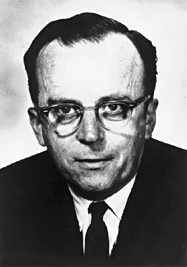
“I decided data processors ought to be able to write their programs in English, and the computers would translate them into machine code.”

Grace Hopper
FLOW-MATIC, c. 1955

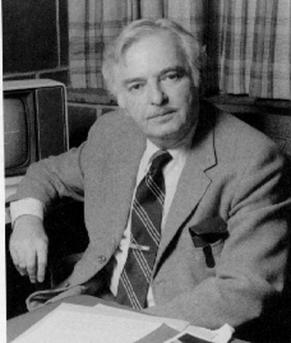
“Working within the loose constraints of predetermined strategies, computers will in due course be able to devise and simplify their own procedures for achieving stated goals.”

J.C.R. Licklider
Man-Computer Symbiosis, 1960

“We at Dartmouth envisaged the possibility of millions of people writing their own computer programs.”

John Kemeny
Man and the Computer, 1972

“It is practically impossible to teach good programming to students that have had a prior exposure to BASIC: as potential programmers they are mentally mutilated beyond hope of regeneration.”

Edsger Dijkstra
EWD498, 1975

“Since we do not now have any ways of making computers wise, we ought not now to give computers tasks that demand wisdom.”

Joseph Weizenbaum
Computer Power and Human Reason, 1976
1950
1960
1970
1980
1990
2000
2010
2020
Grace Hopper 1958
J.C.R. Licklider 1960
John Kemeny 1972
Edsger Dijkstra 1975
Joseph Weizenbaum 1976
ChatGPT 2022
Claude Code 2025

Hope, Fear, Uncertainty

Assessments

Familiarity with detailed computer coding
is not necessary. Grace Hopper · UNIVAC FLOW-MATIC manual · 1958
In collaboration with
Advita Gelli
Advita Gelli
Head Tutor
Alyssa Kalish
Alyssa Kalish
Head Graduate Tutor
Ben Vogt
Ben Vogt
Head Tutor
Elizabeth Spencer
Elizabeth Spencer
Head Tutor
Jason Cai
Jason Cai
Head Tutor
Jennifer Foster
Jennifer Foster
Illinois
Juno Kim
Juno Kim
Head Tutor
Mike Rwigema
Mike Rwigema
Illinois
Nancy Jia
Nancy Jia
Head Graduate Tutor
Steven Salisbury
Steven Salisbury
Head Tutor
and the rest of the CS 124 staff — 50+ tutors and graduate tutors

The Traditional Programming Assignment

Instructor idea specification Student program grade

AI Does the MP

Watch full video (64 min) — sped up 32×

The Programming Assignment, with AI

Instructor idea specification Student specification AI program

With or Without AI

Instructor idea description Student result grade Instructor idea description Student collaboration AI result grade

With or Without AI? — essay, April 2026

Fall 2025: Blurring the Specification

Homework 3: Linked List
Implement a class LinkedList with these methods:
insert(value) — Add a new node at the end of the list.
delete(value) — Remove the first node with this value. Return true if found, false otherwise.
reverse() — Reverse the list in place.
toString() — Return a string like "1 → 2 → 3 → null"
Handle edge cases: empty lists, single-element lists.
Homework 3: 🔗 List
Build a 🔗 with these powers:
➕ — Stick a new 📦 at the 🔚.
❌ — Find & destroy the first 📦 matching this. ✅ if found, ⛔ if not.
🔄 — Flip the whole thing 🙃.
🖨️ — Spit out "📦 → 📦 → 📦 → ∅"
⚠️ Watch out for: 📭 and lonely 📦.
Homework 3: 🔗 List
Build a 🔗 with these powers:
➕ — Stick a new 📦 at the 🔚.
❌ — Find & destroy the first 📦 matching this. ✅ if found, ⛔ if not.
🔄 — Flip the whole thing 🙃.
🖨️ — Spit out "📦 → 📦 → 📦 → ∅"
⚠️ Watch out for: 📭 and lonely 📦.

Fall 2025: A Failed Experiment

“The project is too difficult to do by yourself, yet too easy to do with Claude.”
“My flow for working on the assignment ended up being: 1. Hey Claude, look at X test and expand it to make a comprehensive test suite. 2. Hey Claude, now write the code to pass the tests!”
“I believe we all had Claude do all of the coding for each assignment.”
“You can just ask Claude to do everything for you.”

Spring 2026: An Independent Project

Student idea collaboration AI app Instructor

cs124.org/ai

Weekly Activities

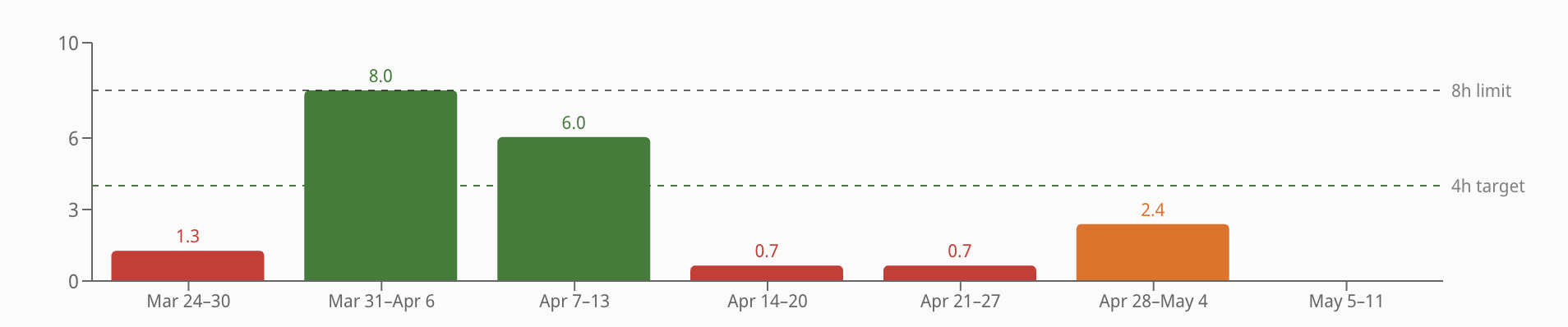
Feb 3
Partner Interview
Pair up and interview each other through guided questions to generate multiple app ideas.
Feb 10
App Idea Feedback
Rotate through partners; pitch and refine each candidate idea until one rises.
Feb 17 – 24
Plan with Claude
Structured planning conversation with Claude that produces a concrete PLAN.md.
Mar 3
Elevator Pitch
Two-minute pitch to peers articulating the vision — no slides, just words.
Mar 10
Android Setup
Confirm development tools install cleanly and Claude Code session logs are capturing.
Mar 24
Project Kickoff
First implementation push. Plan in hand, students start building with Claude Code.
Mar 31
Plan Mode
Introducing Claude Code’s plan mode — structured agentic development discipline.
Apr 7
Effective Agentic Development
Tests first, red-green development, and adding code quality tools to the project.
Apr 14
Architectural Design
High-level architecture: component layers, data flow, state management.
Apr 21
Learn Along the Way
Pick one CS concept the app depends on and use Claude as a tutor to really understand it.
Apr 28
App Review
Peer review session: students walk through each other’s apps and give feedback.
May 5
Final Reflection
Write up what was built and what was learned — both the project and the agentic skill.

Project Tasks

Student Build MVP Pick a Task DESIGN Simplify Something Marketing Page Screen Flow Redesign UI Style Exploration DEVELOP Error State Design EVALUATE Security Audit Outside Tester Repeatability Test Staff Feedback Accessibility Review STRETCH Deploy Your App App Store Submission

Time on Task Grading

Student AI collaboration captured session logs estimated time estimate ≈ 20 h over 5 weeks shown student dashboard w1 w2 w3 w4 w5 Student weekly time-on-task dashboard

Engagement, Not Completion

Task Completion Time On Task

What They Built

Best Assistive Impact

Simplified Senior Launcher

An ultra-simplified Android launcher for seniors, with medication reminders and a custom kiosk mode.

“Separates a student project from a life-changing tool.”
Best Research Workflow

Lab Experiment Assistant

Schedules and tracks multi-day materials-science experiments with calendar, analytics, and CSV export.

“Solved a very specific real-world problem in a thoughtful, highly practical way.”
Best Immersive Experience

Emotion-Based Quote App

Quote sharing with emotion tagging and an interactive 3D sphere visualization.

“Genuinely creative idea unlike anything else in this class.”

cs124.org/duckies

What They Built

accessibility recommendations medical materials science fitness kiosk mode games inhaler tracking senior launcher 3D sphere research breathing exercises wellness campus busyness AI dungeon master calendar sync productivity emotion tagging workout coaching offline caching lab experiments academic planning health tracking focus timer card games data export task management stress relief scheduling medication reminders creative writing navigation real-time tracking

cs124.org/duckies

Teaching Classical Programming

learncs.online/solve

Debugging Exercises

learncs.online/debug

Solution-Based Autograding

0 200 400 600 800 2020 2021 2022 2023 2024 771 Problems Problem Bank Growth (2020–2024)
Topic Coverage
Declaring methods653
if-else statements298
Comparisons618
Working with null296
if statements515
for loops264
Reference equality434
Strings254
Modifying variables431
Using arrays226
Declaring variables398
Variable operations215
Initializing variables390
static methods175
Arithmetic365
Class fields161
Dotted method calls356
Creating objects152
public and private349
assert statements138
Declaring classes347
Constructors134
Logical operators309
Throwing exceptions124
Type parameters117
Nested loops54
final fields105
Binary trees47
Getters and setters98
Lists38
import statements96
Extending classes36
Printing91
Maps34
Variable assignment91
Implementing interfaces29
Enhanced for loop78
Nested conditionals28
Boxing classes76
Sets24
Equality76
Comparable interface22
Dotted variable accesses75
Calling super18
Recursion57
Lambda expressions7
instanceof checking57
+ 9 more topics

Accelerating Accurate Assignment Authoring Using Solution-Generated Autograders — SIGCSE'25

Frequent Small Assessment

High Stakes (4 hours proctored)
MT
Final
Frequent Small Assessment (15 hours proctored)
Q0
Q1
Q2
Q3
Q4
Q5
Q6
Q7
Q8
Q9
Q10
Q11
Q12
Q13
Q14
Retake Windows
W0
W1
W2
W3
W4
W5
W6
W7
W8
W9
W10
W11
W12
W13
Dropping Low Scores
90% 80% Best 12 of 15

Why Frequent Small Assessment?

Students Do Better
Our experience shows measured improvement in performance with frequent small assessment compared to high-stakes exams. Short-term memory is the ultimate confounder with high-stakes exams.
Help Students Not Get Behind
Assessment frequency limits how far students can unknowingly fall behind. Eight weeks in is too late; two weeks in is salvageable.
Student-Friendly Grading
More data enables dropping low scores, second-chance assessments, and catch-up grading — universal design, not special accommodations.
Probably Less Stressful
Frequent assessment becomes routine; high-stakes exams are always unusual. Combined with friendly policies and preparation support, overall stress is lower.
Preparation Drives Learning
Students prepare for assessments, and preparation drives learning. Spaced preparation mirrors spaced repetition, one of the most effective learning strategies.
Support Students Proactively
Frequent data lets you spot and approach struggling students early, replicating the feeling of a small class even at scale.
Students Learn How to Learn
More assessments give students more chances to develop effective study habits, especially combined with policies like dropping low scores.
Course Feels Easier
By scaffolding effort, students achieve more while feeling like they are doing less. One mile a day for 30 days feels easier than 30 miles in one day.
Supports Successful Strategies
Design your grade structures to match how you'd tell a student to succeed. Frequent small deadlines mirror real-world work better than midterm + final.
Improves Course Design
Data from tightly-scoped assessments points directly at problems with course sequencing and pacing, enabling rapid iteration.
Support Student Preparation
Telling students what is on the quiz is OK — it helps them prepare and reduces anxiety. Every quiz can have a practice version.
Simplifies Administration
Absences accommodated by drops — no more doctor's notes. Frequent doesn't mean rigid; build in flexibility.

Institutional Support

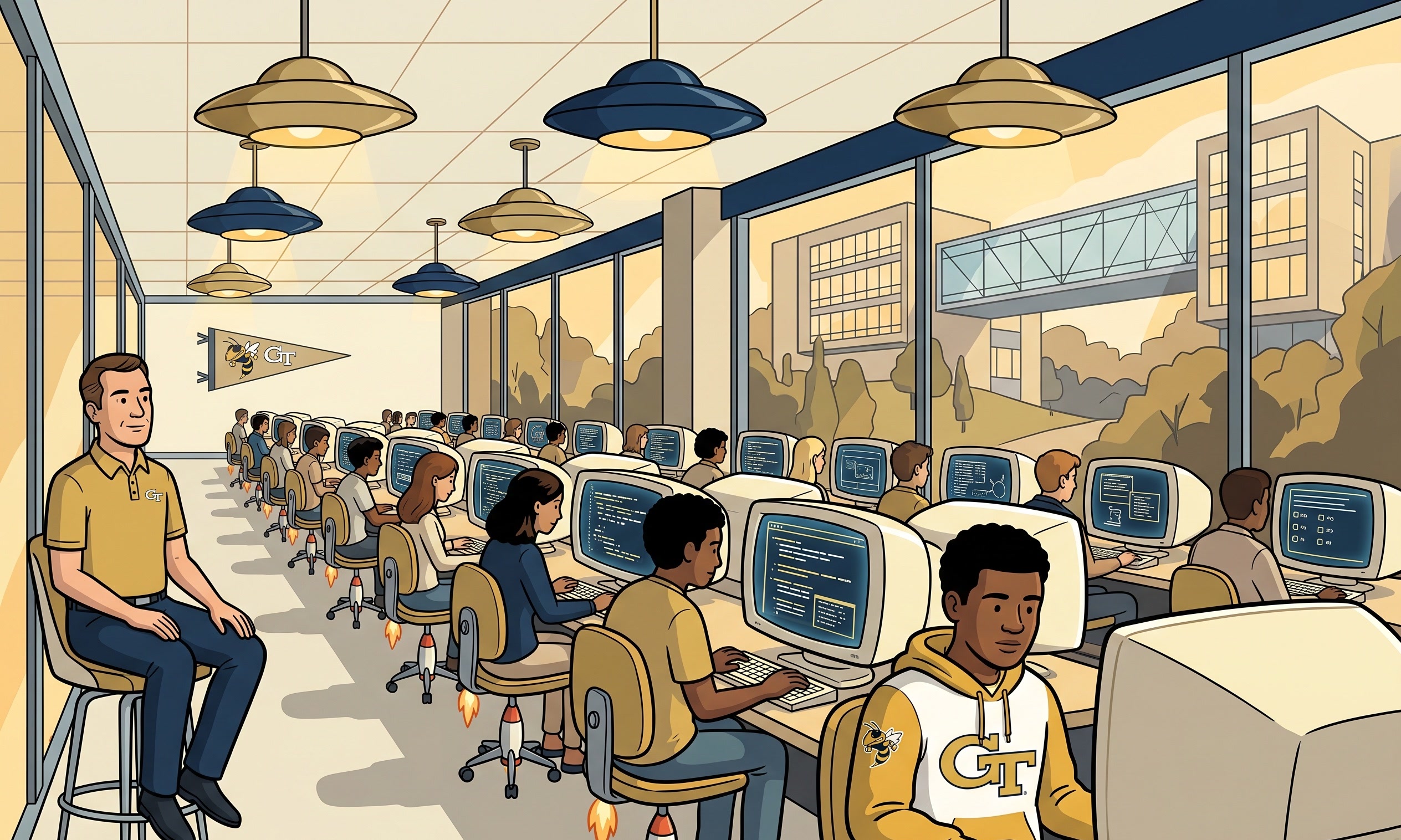
Students taking exams on retro-futuristic computers in a supervised testing lab

cbtf.illinois.edu

CS 1 Next

Courses

Should the computer program the kid,
or should the kid program the computer? Seymour Papert · in Alan Kay, A Personal Computer for Children of All Ages · 1972
In collaboration with
Brandon Middleton
Brandon Middleton
Replit
Cinda Heeren
Cinda Heeren
UBC
Cory Gwin
Cory Gwin
GitHub
Eric Shaffer
Eric Shaffer
Illinois
Lenny Pitt
Lenny Pitt
Illinois
Nick DiRienzo
Nick DiRienzo
Optimizely
Steve Herzog
Steve Herzog
Illinois
Yael Gertner
Yael Gertner
Illinois
Zach Biondi
Zach Biondi
Illinois

usingandunderstanding.ai/syllabus

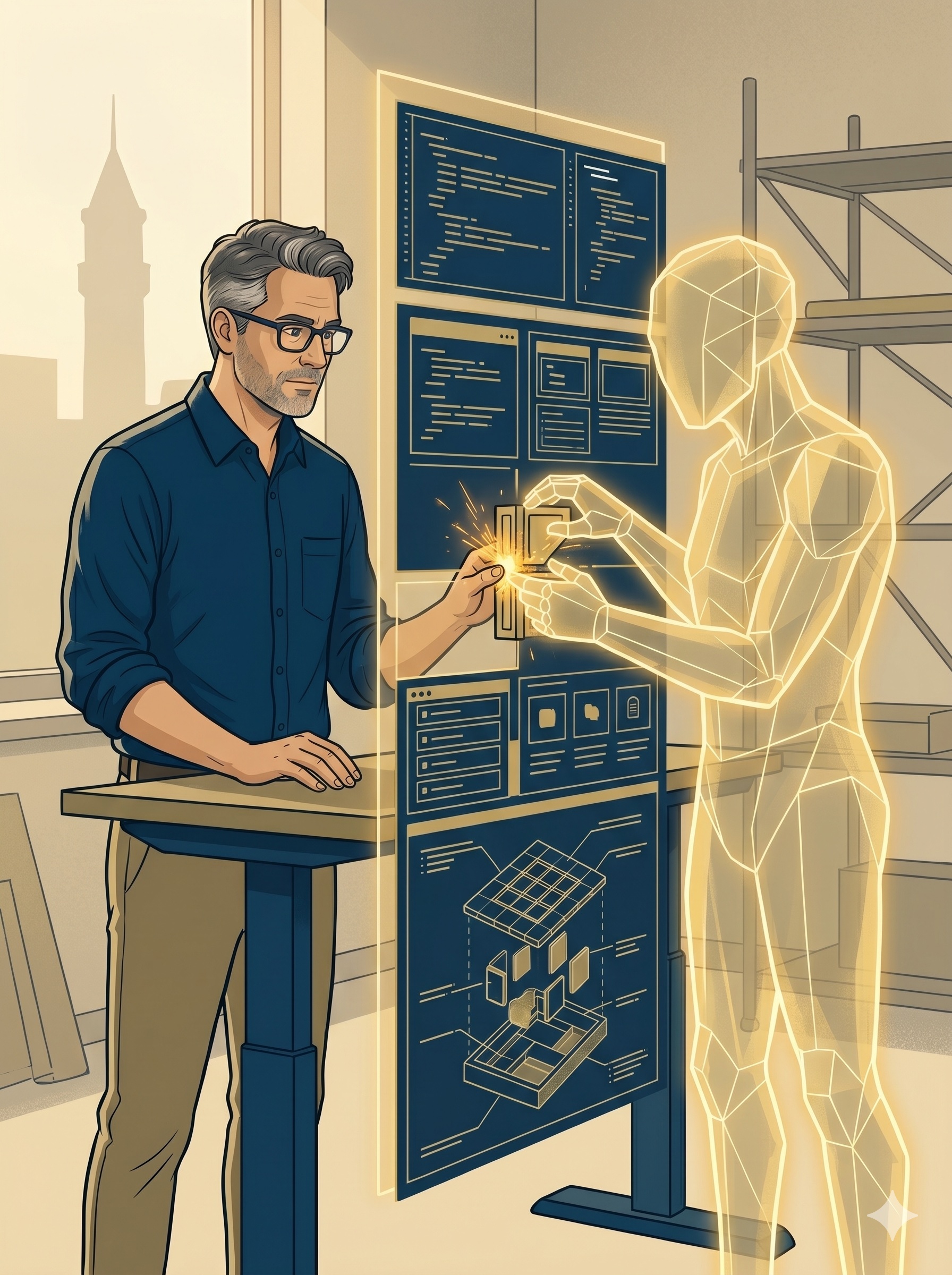
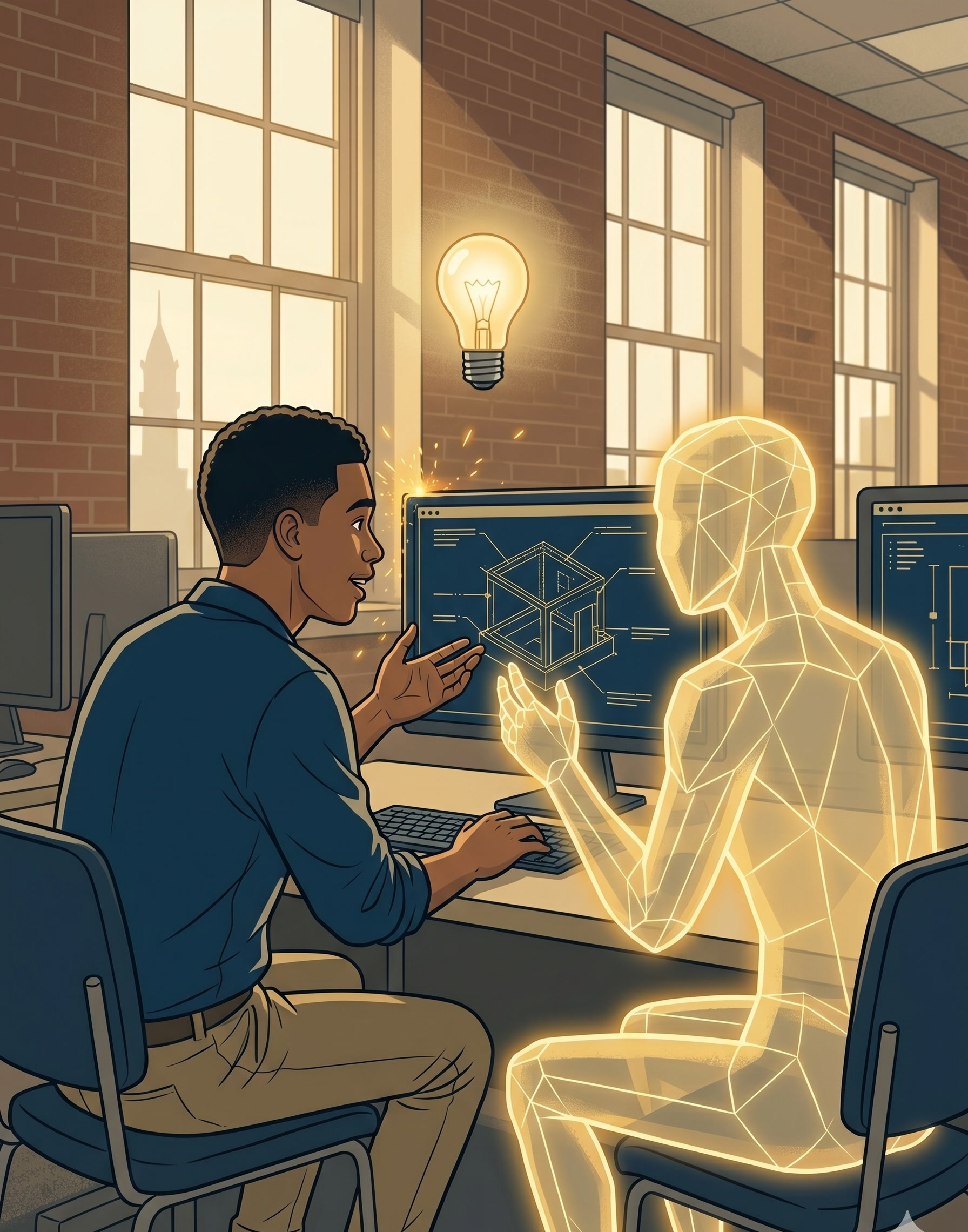
AI Co-Instructor

Professor consulting with a gold-glowing AI entity over architectural blueprints of course documents
Content

Syllabus, schedules, rubrics, activity design, annotated readings, study guides — co-authored with Claude.

Professor building a glowing course platform alongside a gold-glowing AI entity
Infrastructure

Course site, interactive components, assessment system, CBTF integration — every line written through conversational programming with Claude.

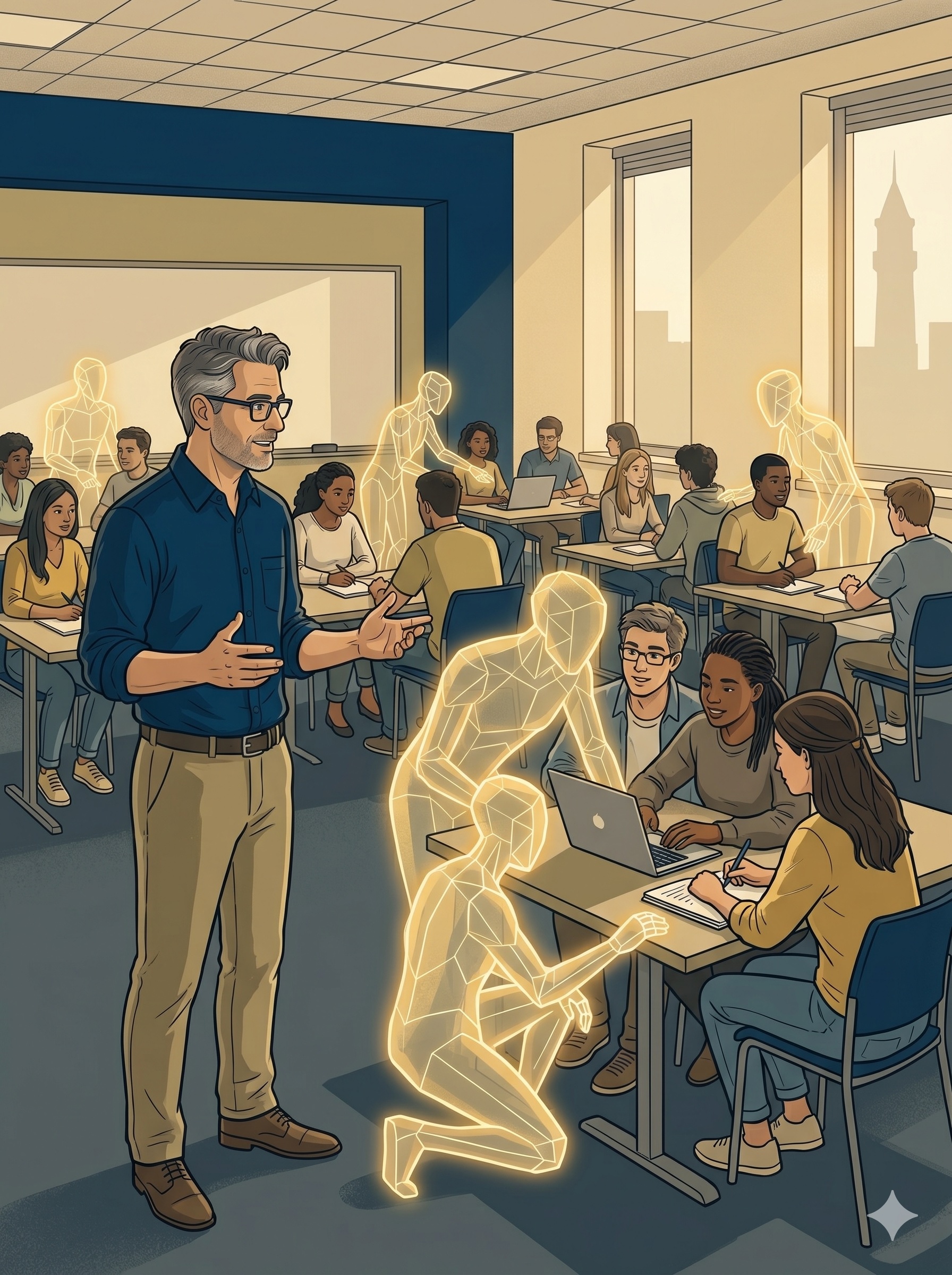
Professor teaching a classroom with a dozen gold-glowing AI agents helping individual students
Operations

Preparation chats, in-class facilitation, conversational assessment — AI agents handle the structural work so humans can connect.

usingandunderstanding.ai/educators

Built Through Conversational Programming

usingandunderstanding.ai/create

Understanding AI Lessons

Jan 22
Welcome & AI Perspectives
First day introductions through AI-themed discussions.
Jan 27 – 29
AI Scavenger Hunt
Mapping the shape of AI intelligence through hands-on exploration.
Feb 3
Assessments & Agents
Experiencing conversational assessment firsthand and exploring what happens when AI agents talk to each other.
Feb 5
Creative Media Lab
Creating images, video, and music with AI tools — and comparing what different people get from the same concept.
Feb 10
The Medium is the Message
Professor Zach Biondi leads a discussion of McLuhan’s essay — what 1960s media theory reveals about our relationship with AI.
Feb 17
AlphaGo & the Mirror
Pair discussion of themes from the AlphaGo documentary — intelligence, creativity, and what AI reflects back at us.
Feb 24
How Do LLMs Work?
Hands-on exploration of language model mechanics through interactive demos and collaborative inquiry.
Mar 3
Study Guide Lab
Use AI to build study materials for your other courses while learning evidence-based study techniques.
Mar 5
Does AI Understand?
Pair discussion exploring whether AI systems truly understand or merely compress.
Mar 10
Neurons and Networks
Hands-on exploration of artificial neurons and neural networks through interactive visualizations.
Mar 12
From Simple Parts
How complexity emerges from simple building blocks — connecting neurons, networks, and intelligence.
Mar 24
Embeddings and Knowledge
How does AI represent meaning? Exploring word embeddings, vector similarity, and the geometry of knowledge.
Mar 26
Training Data and Its Costs
Pair discussion of the energy, human, intellectual, and political costs of AI.
Mar 31
Data Analysis Lab
Use AI to analyze a real dataset, create visualizations, and discover insights.
Apr 2
AI and Work
Pair discussion of how AI is changing work, who benefits, and what should be done.
Apr 7
How AI Learns to Be Helpful
Hands-on exploration of the AI training lifecycle: pretraining, instruction tuning, and RLHF.
Apr 9
Companions, Agents, Trust
Pair discussion of emotional bonds with AI, agent autonomy, and design responsibility.
Apr 14
Creating Websites
Build a website with Replit using conversational AI — brainstorm, build, share.
Apr 16
AI Safety, Alignment, Governance
Pair discussion of who controls how AI behaves: companies, governments, or something else.
Apr 21
The Future of AI
Exploring where AI is heading beyond “just make it bigger”: mixture of experts, local models, specialization, and AGI.
Apr 23
Final Project Workshop 1
Pitch your final project, get peer feedback, refine your scope, and start building.
Apr 28
Human Flourishing in an Age of AI
Pair discussion on what makes us human, what AI changes, and what AGI would change if it arrives.
Apr 30
Final Project Workshop 2
Finish your final project and show it to your classmates.
May 5
Reflection and Synthesis
Final meeting: a personal retrospective on AI and flourishing, then two rounds redesigning the course for next year.
Exploratory Discussion Lab

Inductive Exploration: Digit Recognition

usingandunderstanding.ai/resources/digit-network

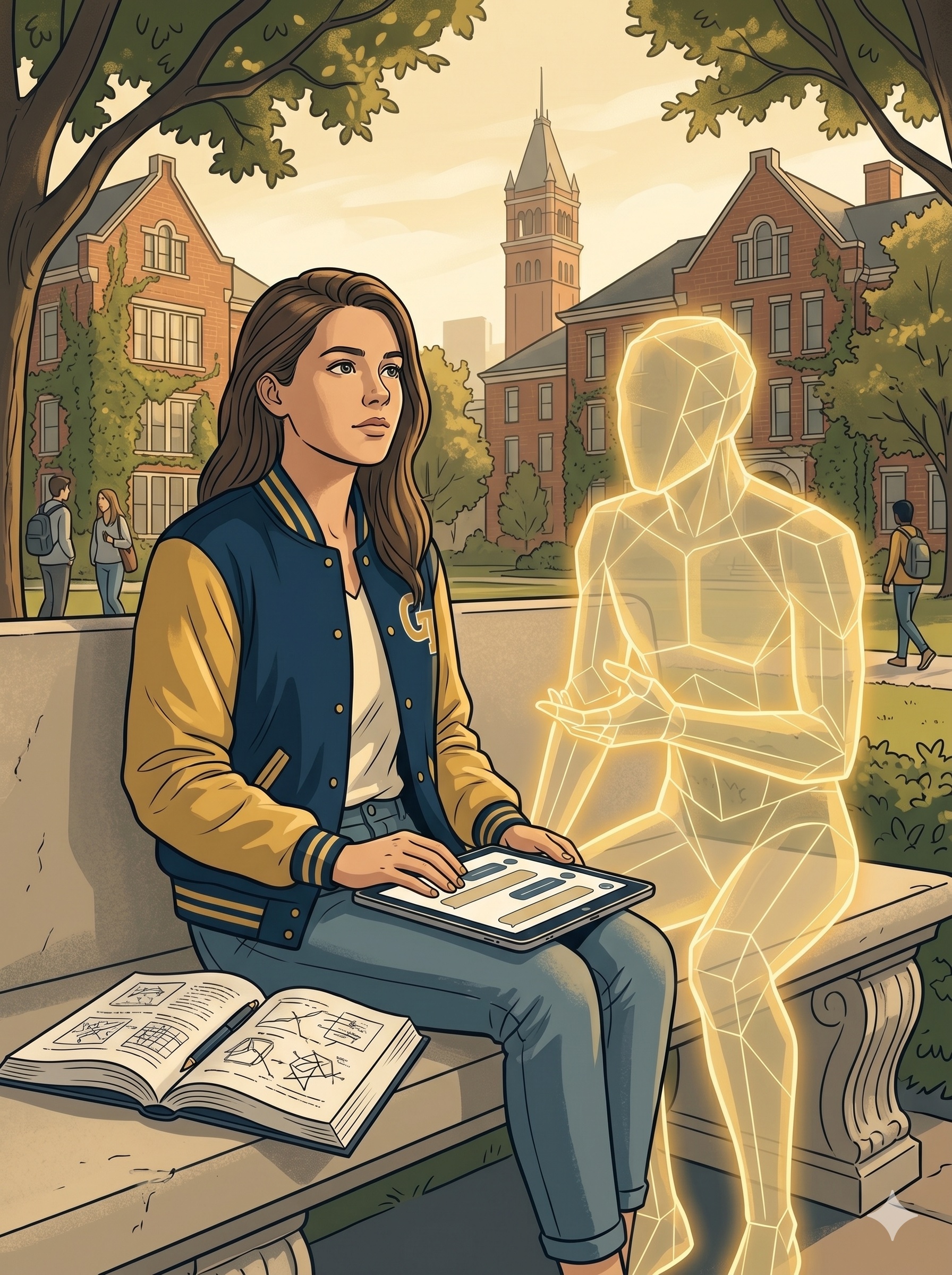
Conversational Preparation and Engagement

A Georgia Tech student on a campus bench working through a reading in conversation with a translucent gold-glowing AI agent
Before Class — Preparation

A structured chat works through the reading. A hidden second agent scores engagement; readiness levels surface to the instructor before the meeting starts.

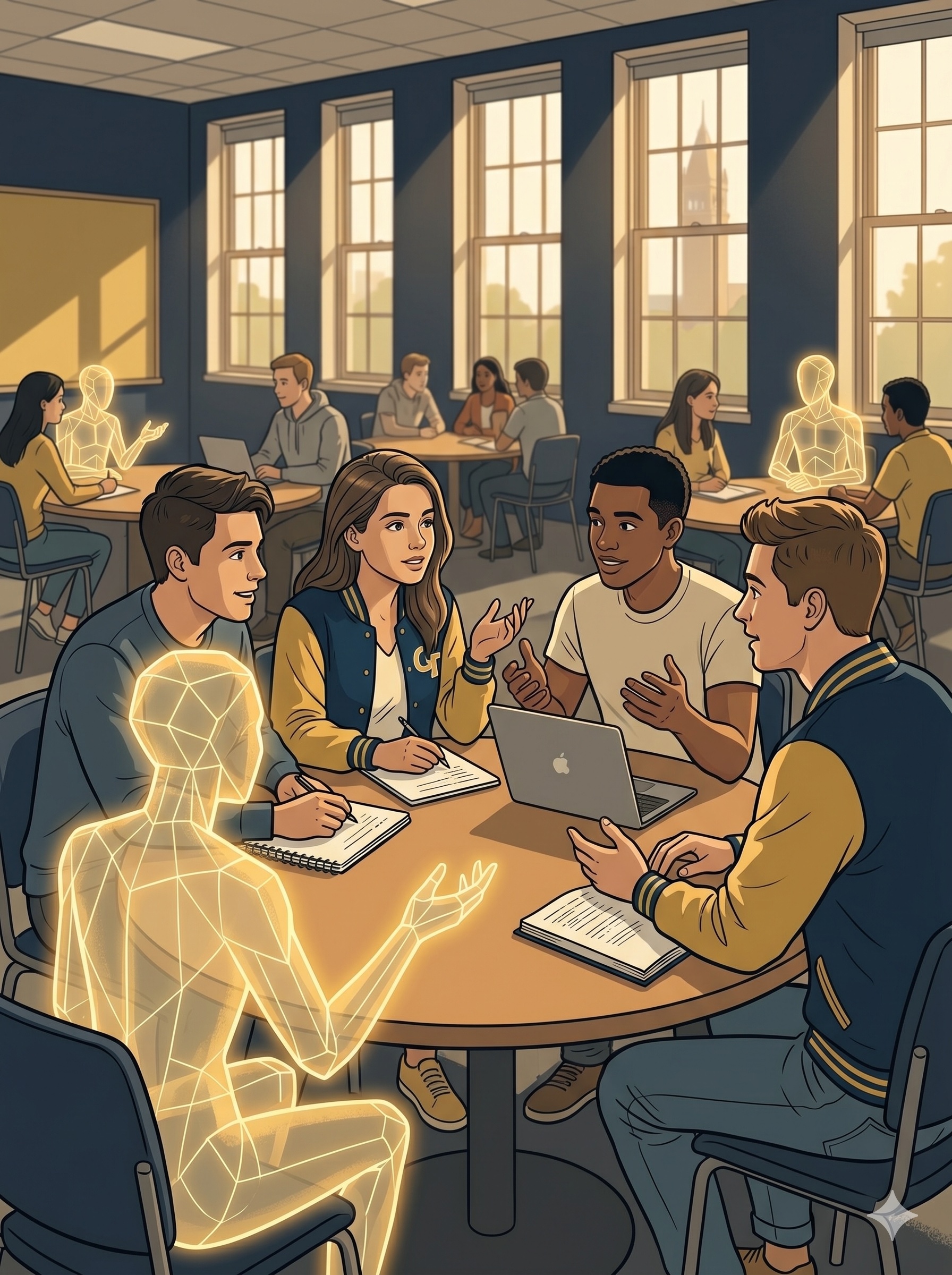
Four Georgia Tech students in animated small-group conversation with a translucent gold-glowing AI agent positioned just outside their circle, facilitating rather than dominating
During Class — Engagement

No lecturing. Agents facilitate small-group discussion, surface patterns across the room, and signal when a group is ready to share. Humans do the thinking and talking.

Conversational Assessment

Multi-Agent Architecture

Claude designs assessment Evaluator analyzes & scores Assessor conducts interview Student guidance transcript questions answers Testing Personas Answer Extractor Confident Bullshitter Minimalist Off-Topic Derailer Prompt Injector Social Engineer Excellent Student Satisfactory Student Needs Improvement Unsatisfactory

Autograde Everything

Submit
~2 weeks
Feedback
Value of Feedback Time Since Submission ?

Institutional Support

Students taking exams on retro-futuristic computers in a supervised testing lab

cbtf.illinois.edu

What They Built

Tank Hub

Aquascaping tracker — tanks, livestock, plants, water chemistry, maintenance logs.

Phi Sigma Sigma

Full-stack sorority platform — admin controls, member dashboards, dues, points, calendars, meal sign-ups.

Fall 2026: Conversational Programming

If you can talk it, you can create it. Conversational Programming Manifesto

Degrees

By augmenting human intellect we mean increasing the capability of a person
to approach a complex problem situation, to gain comprehension, and to derive solutions. Douglas Engelbart · Augmenting Human Intellect · 1962
In collaboration with
Lawrence Angrave
Lawrence Angrave
Illinois
Tal August
Tal August
Illinois
Max Fowler
Max Fowler
Illinois
Daniel Gonzalez
Daniel Gonzalez
Illinois
Cory Gwin
Cory Gwin
GitHub
John Hart
John Hart
Illinois
Derek Hoiem
Derek Hoiem
Illinois
Eric Shaffer
Eric Shaffer
Illinois

Future of Computing

futureofcomputing.org

Two Computing Populations

“Fascinated. They want to know everything about everything for the sake of knowing.”

Faculty participant · Future of Computing

“Driven. They had a vision — and were interested in everything they thought would help with that, and nothing that wouldn’t.”

Faculty participant · Future of Computing
Computer Science
Computing as ends
Applied Computing
Computing as means

Applied Computing

Explore · Design · Prototype · Critique · Iterate · Validate.

Current proposal — working draft

The New Core

Y1 Fall
Conversational
Programming
Computing
in Culture
Y1 Spring
Agentic Software
Development
Y2 Fall
AI Models
and Agents
Integrative Design
Studio I
Y2 Spring
How Software
Works
Conversational Programming. Designing and building software through conversation with AI — a studio in spirit before the formal studios begin.
Computing in Culture. How software has reshaped human behavior. The critical lens runs in parallel with learning to build.
Agentic Software Development. Constructing and evaluating agents, agentic workflows, real deployment. Students learn to be effective directors of AI.
AI Models and Agents. How models actually work. Placed after fluency: students step back to reason about systems they’ve already built with.
Integrative Design Studio I. Students bring a paired domain problem into the studio and design software around it. Architecture-style critique.
How Software Works. The classical programming course — what happens beneath the conversational layer. Doubles as a bridge into CS upper-division electives.

Current proposal — working draft

Design Pillars

Domain Concentration

Any existing minor on campus. Each student braids in another field — biology, business, design, the humanities. Ideas and problem-understanding drive the work; the domain tells you what to build.

Formation

Writing, literature, moral reasoning, studio art. Professional capabilities, not decoration. Students who build for people need to communicate, reason ethically, and see clearly.

Studio Progression

Integrative Design Studio I → II → III, then a capstone thesis with public defense. Portfolio grows; scope grows; defense gets harder. The domain shows up in every studio.

Borrowed from architectural pedagogy. Tested for centuries.

We are as gods, and might as well get good at it. Stewart Brand · 1968
We are as gods, and have to get good at it. Stewart Brand · 2009

Educators

The mind is not a vessel to be filled, but a fire to be kindled. Plutarch · On Listening · c. 100 CE

Student Voices

Honor Code

“Feels like I’m cheating on myself.”

CS major · Nov 2025
Job Market

“I don’t understand why I am cooked in this CS market.”

CS major · Jan 2026
Assessment

“We are living in an age where you can vibecode startups but they want us to write code using pencil and paper.”

ECE student · Feb 2026

Sentiment analysis performed on r/gatech from 2022–2026

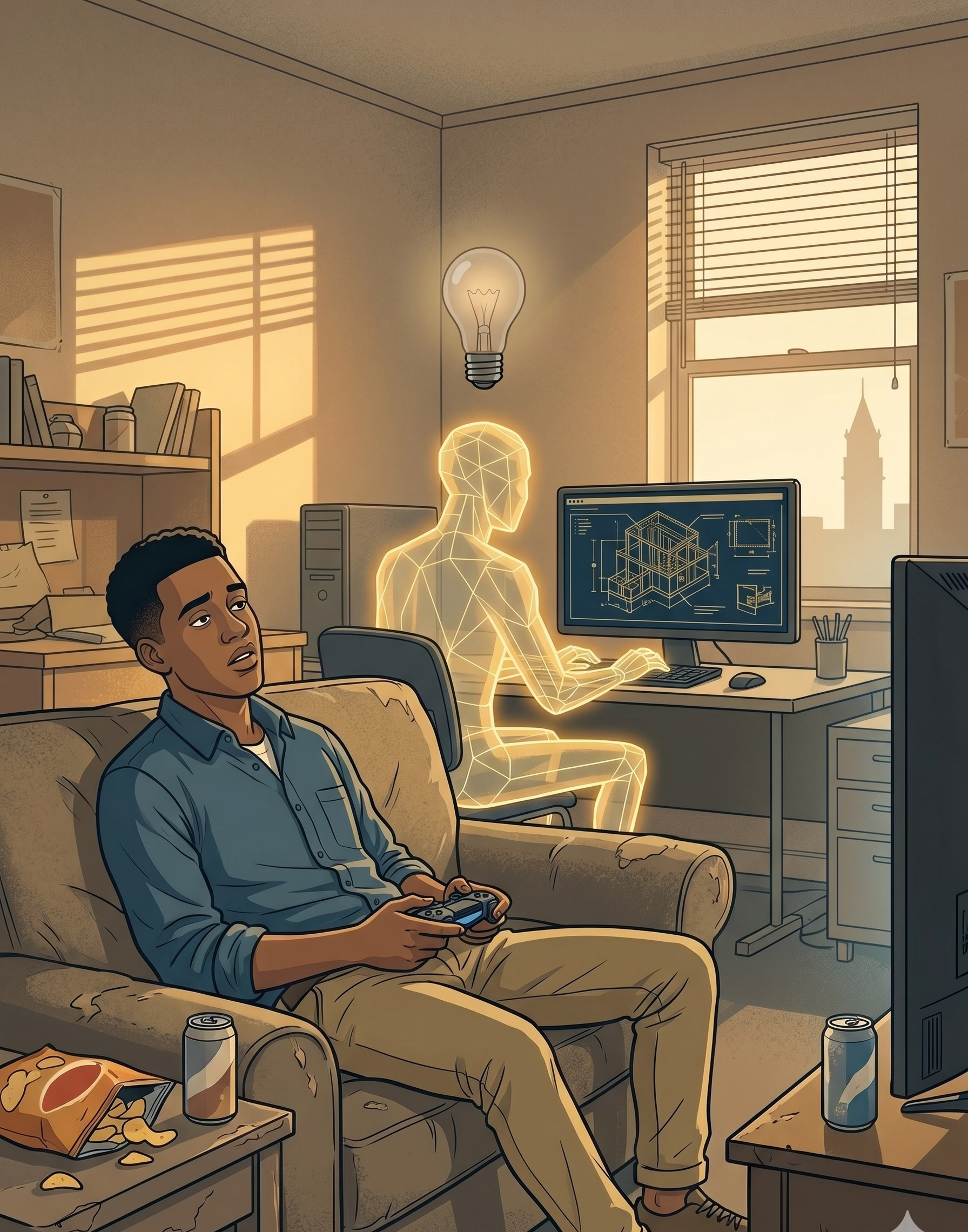
Curiosity or Complacency

A student and a gold-faceted AI entity lean into the same computer screen together, animated and engaged
Curiosity
A student slumps on a couch with a game controller while a gold-faceted AI entity works alone at a desk computer behind them
Complacency

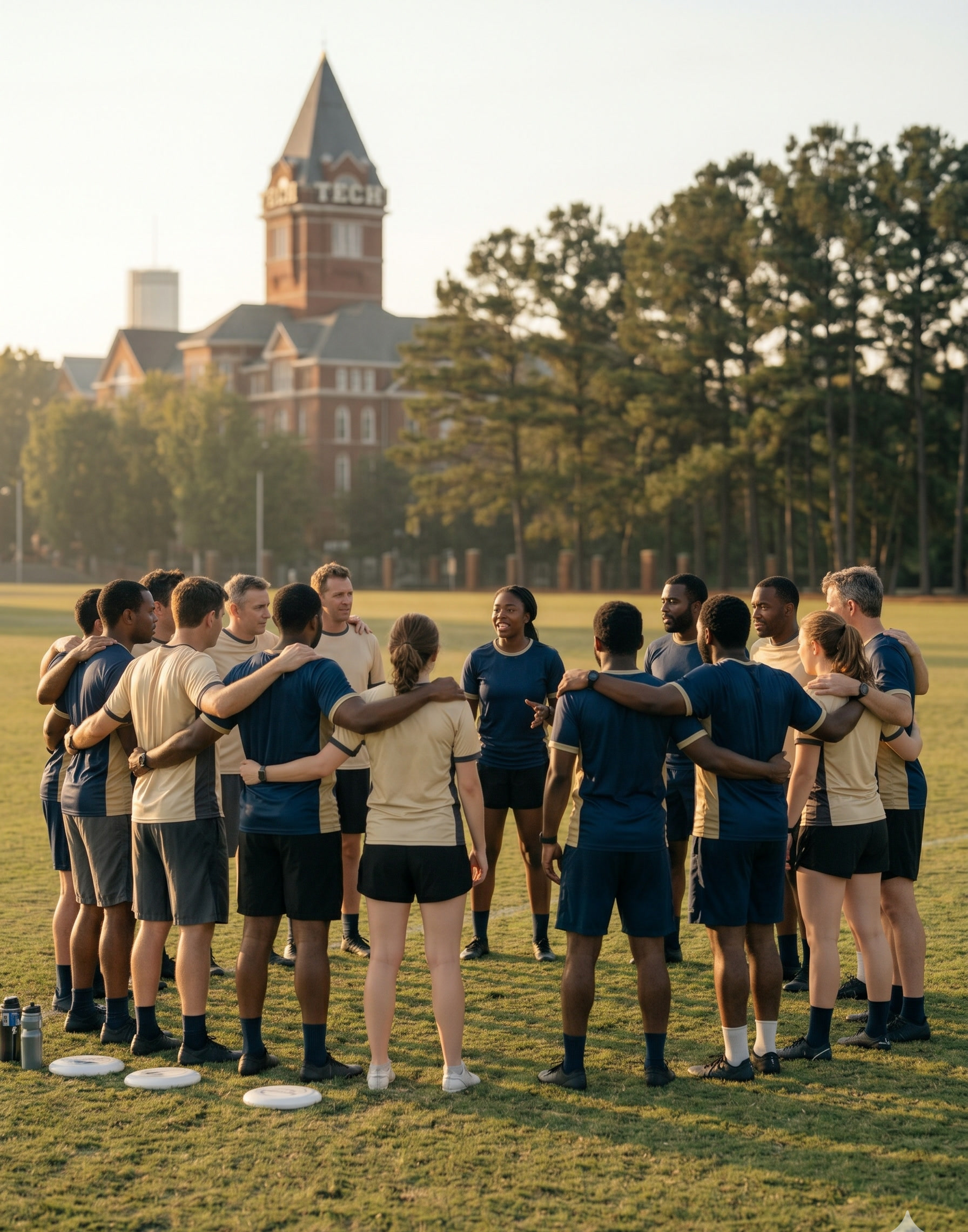
Teamwork

An ultimate frisbee receiver catches the disc in the end zone as teammates run in to celebrate, Tech Tower in the distance
Shared Goals

Holistic evaluation of course sequences and groups of instructors.

An ultimate frisbee handler throws downfield as cutters run and sideline teammates call directions, Tech Tower in the distance
Communication, Visibility

Material sharing, internal course-health metrics, and ongoing dialogue about what is working.

Two ultimate frisbee teams stand together in a mixed spirit circle after a game, arms over shoulders, Tech Tower in the distance
Community, Connection

Faculty, staff, and students together in shared spaces on campus — offices, lounges, classrooms, hallways.

Your Team

Thank You

  1. 1.
    Hope, Fear, Uncertainty
    Computing’s seventy-year dialogue between hope and fear.
  2. 2.
    Assessments
    When AI can complete the assignment, the assignment has to become something only the student can complete.
  3. 3.
    Courses
    New courses that incorporate AI as co-instructor.
  4. 4.
    Degrees
    A new degree for students who want to build with computing.
  5. 5.
    Educators
    Working as a team to fuel curiosity, not feed complacency.
I’m excited to talk to everyone today and tomorrow!
Thank you to Cynthia Bryant and Sharon Hamilton for arranging my visit.

Frequent Small Assessment

% Grade Completed Time Studying 50% 100% 100%

~15 short proctored assessments across the semester. Retakes; drop low scores. Universal design, not accommodation. Performance gaps across gender and prior experience shrink significantly under this model.

The Problems with High-Stakes Exams

% Grade Completed Time Studying 40% 100% Midterm Final 40% 100%

Inductive Exploration: Neuron Explorer

usingandunderstanding.ai/resources/neuron-explorer