GitHub Education Day · October 26, 2026

Computing Education
in Human Language

Conversational programming in the agentic studio classroom
Geoffrey Challen · University of Illinois
geoffreychallen.com/ai
geoffreychallen.com/talks/2026-10-26 · Join

“Anyone … can use this system with little training. Detailed computer coding is no longer necessary.”FLOW-MATIC, Grace Hopper’s team, 1958

Computing

“Anyone … can use this system with little training. Detailed computer coding is no longer necessary.”FLOW-MATIC, Grace Hopper’s team, 1958

Computing

“In a few more years millions of schoolchildren will have … a tutor as well-informed and responsive as Aristotle.”Patrick Suppes, Scientific American, 1966

Educators
the overlapComputing
Educators

Conversational Programming

No prerequisites·No code·Codex on their own laptops·Every request through our proxy
A student and her coding agent at one laptop, a personal website taking shape on the screen
1Your own websitelive by week three
A classmate leans in and points at the screen while a student and his coding agent build what she describes
2Something for a classmatefrom the classmates’ own ideas
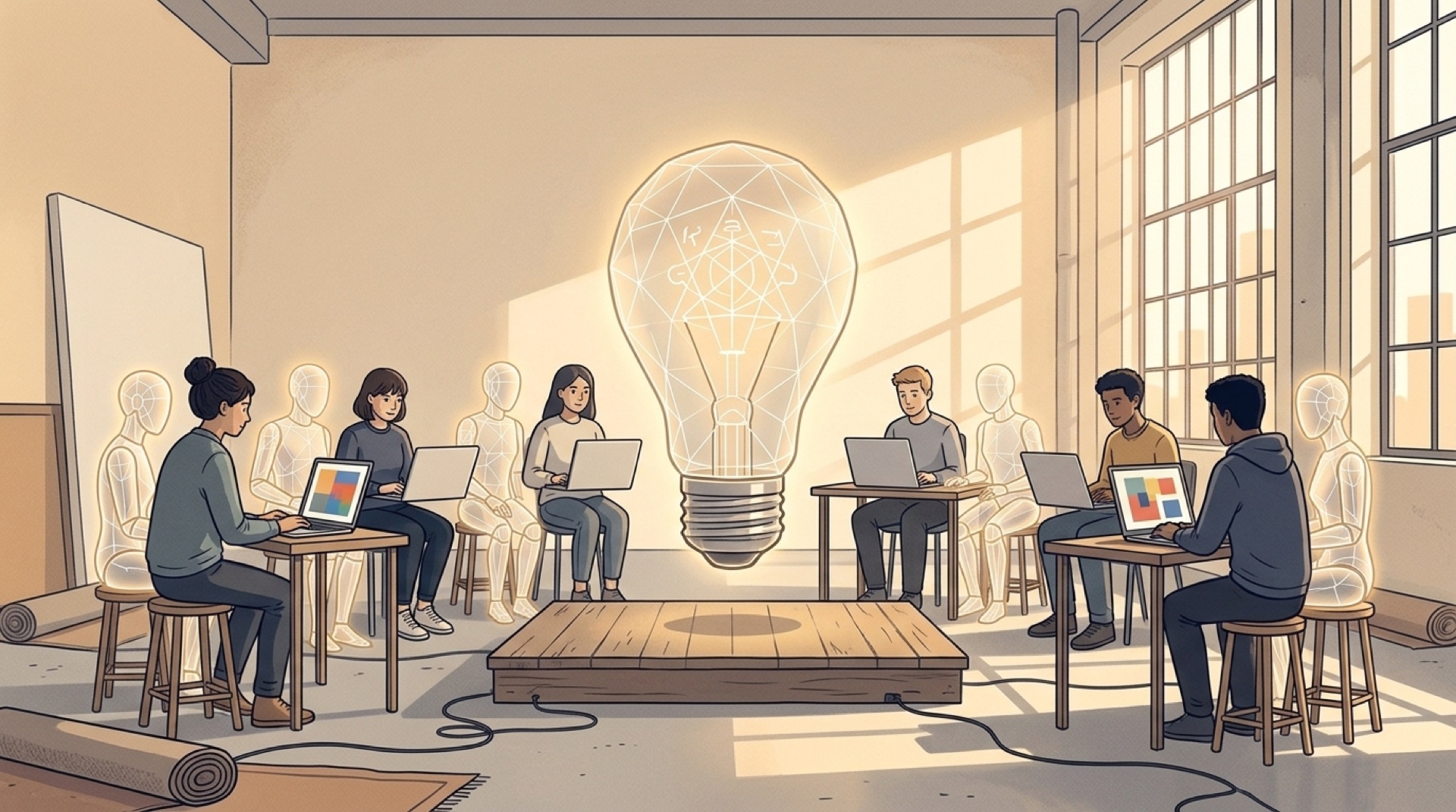
An atelier: a glowing light bulb on the model's platform, students and their agents around it, each sketching it on their own screen
3One idea the whole room choosesprototyped many ways

conversationalprogramming.org

One Semester, Many Iterations

A New Skill

People, weekly · approximate, from public announcements

A Year of My Own Practice

46,800
prompts to a coding agent
1,830 sessions on 369 days
206 projects
busiest day, 790

usingandunderstanding.ai/create

August 30, 2026, 8:16 PM · a working session on the CS 124 transcripts
meThis is also going to influence the design of my new conversationalprogramming.org course and cs124.org’s project, so the stakes here are high. I want to teach students to communicate with you effectively. How do I do that? Any help is greatly appreciated.
the agent
  1. The conversation is set before the first prompt.What matters is whether the student knows what “done” looks like, not how the prompt is phrased.
  2. Tell it what you saw, not what you concluded.“The button does nothing on the second screen” is worth ten of “the click handler is broken.”
  3. Never accept “done” without looking.“That should work now” is sincere and sometimes wrong. Thirty seconds a turn.
  4. Give outcomes and constraints; let it own the steps.Decomposition at the level of instructions is a mistake that looks like diligence.
  5. Correct it. Out loud, early.The agent is deferential by design. Students afraid to disagree get steamrolled by their own politeness.
  6. Ask for explanations before failure, not after.“What would break if I changed X?” is what good users ask.
  7. Keep it oriented.Say what changed since last time. Keep a plan file. Ask for a summary before anything big.
  8. Calibrate the hand-off.Handing over the whole app on day one and never handing over more than one line both lose.
  9. Ask the agent how to work with it.The meta-move expert human teams make and almost nobody makes with an agent.
meI’m kind of embarrassed to say that I’ve never asked you that question. I used you for over a year before we had this conversation.

conversationalprogramming.org/educators

A man in glasses and a flat-brimmed cap walks down a mountain carrying two stone tablets; a giant glowing wireframe figure sits on the summit; students with laptops wait below
  1. Thou shalt say what done looketh like, and not the way thereto.
  2. Thou shalt tell what thine eyes have seen, and not what thou hast concluded.
  3. Thou shalt not accept “done” without looking upon it.
  4. Thou shalt correct it aloud, and early.
  1. Thou shalt ask what would break, before it breaketh.
  2. Thou shalt keep it oriented, and tell it what hath changed.
  3. Thou shalt measure how much thou handest over.
  4. Thou shalt ask it how to work with it.

Never Accept Done Without Looking

Agentic validation · last Friday: how would you know?

261 ideas Nobody should read the code. Agents do the looking.14 students, 32 minutes, no list · most came out of the conversation with their agent · one of the 261 said to read the code

An agent uses it like a person

  • Drives the browser through every screen, first time
  • Rushes through, skipping the instructions
  • On a phone, a slow connection, the keyboard only
  • Opens the live link fresh, in a private window

An agent tries to break it

  • Blank fields, nonsense, double taps
  • Quits halfway and comes back
  • Reloads: is the work still there?
  • Two accounts: can one see the other’s data?
  • Cuts the network: does it pretend it worked?

An agent checks the facts

  • Works one example by hand and compares
  • Checks its facts against the real source
  • Follows every link to where it claims to go
  • Asks the same question twice and compares

Agents check each other

  • A second agent hunts for unsupported claims
  • Tests it writes, and runs after every change
  • Fakes the AI’s replies to test the failure path
  • Watches the logs while someone uses it
  • Saves screenshots as evidence, not a verdict

Different Days, Different Shapes

Fresh EyesSep 9 · critique in pairs, four partners in a row
Round 1↻
Round 2↻
Round 3↻
Round 4↻
Built for UsSep 30 · four rounds by the clock, then the room votes
Round One
Round Two
Round Three
Round Four
Head to Head
How Would You Know?Oct 23 · independent, then the whole room, then independent
Brainstorm
Go Around↻
Build It
Feedback
ReadyOct 21 · pairs try it, build on it, new pairs, again
Get Ready
↻
Build On It
↻
Keep Building
whole roompairsindependentninety minutes across · ↻ repeats until the room moves on

conversationalprogramming.org/activities

Every Class So Far

Sep 4
Pair Prompting
Pairs trade the keyboard in rounds; notes on what they saw; the room compares.
Sep 9
Fresh Eyes
Critique each other’s sites: builder and critic, four partners in a row.
Sep 11
Going Live
Every site online by the end of the hour, then make it yours.
Sep 16 & 18
Show and Tell
Everyone presents; the whole room as one band, two days running.
Sep 25
Ask the Agent, Then Eight Sites
Ask your agent how to work with it; three rounds; then find eight sites worth learning from.
Sep 30
Built for Us, Then Head to Head
Four rounds by the clock writing ideas for each other, then head-to-head votes.
Oct 2
What's Out There
Pick an idea, research it in pairs, then go around the room.
Oct 7
What Done Looks Like
The standings; say what done looks like; partners back it up and weigh it.
Oct 9
What You Want to Happen
Build in pairs, twice, saying what should happen rather than how.
Oct 16
Say What You Saw
Build on your own, try a partner’s, report what you saw, build on it.
Oct 21
Ready
Get ready; partners try it; what they hit; build on it; new partners; try it again.
Oct 23
How Would You Know?
Brainstorm on your own, go around the room, then build it.
Oct 28
Ready to Ship
Get it ready; try it; build on it; try it again; last fixes.
Studio: buildingDesk crit: critique in pairsPin-up: critique by the roomeach card’s bar is the day’s minutes by mode; the edge is its main one

conversationalprogramming.org/activities

What is happening
~/Desktop/the-appa real conversation, October 16, redacted
I fixed the disappearing window … All 362 tests pass. Please … click Start break … tell me what you see.
OK. Now I want to use otherAI's api instead of openai.
Before I switch from OpenAI to OtherAI’s API, what did you see when you opened the app and tried the break?
After I clicked I have resumed, the app window disapeared
I see why it disappeared: “I’ve resumed” currently clears the reminder and closes its window. I’ll change that flow so you can see what happened.
›
via conversationalprogramming  ·  Esc to interrupt

What It Costs

$713for 19 students’ coding agents, September 1 to today · 36,033 requests · estimated at list prices
$37.54 a studentabout two months of one $20 AI subscription, and no student holds an account: the course holds the key
  • $0.35 for the watcher that rated 2,947 turns
  • The university pays through its central AI service; students pay nothing
  • A daily cap bounds the tail: past $15 a day a student gets a cheaper model, and no student has cost more than about $16.50 in a day

Spend by week: the climb is students building, on the strongest model

$11Aug 31 $17Sep 7 $15Sep 14 $28Sep 21 $62Sep 28 $82Oct 5 $253Oct 12 $244Oct 19

October’s rate is about $13 a student a week. Hosting runs on infrastructure we already had, with no separate bill. Source: the course’s proxy records, aggregates only.

CS 124 · today’s lesson

Say what, not how

Your agent knows how. It does not know what you want to happen. This lesson runs inside your own project, with your own conversations.

Paste this into your agent:Walk me through today’s CS 124 lesson on saying what, not how, using my own project and my own prompts.
Walk me through today’s lesson using my own project and my own prompts.
Here is a prompt of yours that said what you wanted:
“Let people mark a task done and see what’s left for the week.”
And here is one that told me how instead:
“Add a boolean column, loop over the rows, and filter where it’s false.”
Let’s rewrite the second one together.
→

cs124.org/educators

You Can See Everything

One afternoon, October 21. Every student is a line; every request their agent made, every word they typed, as the proxy recorded it.
a request, brighter for morea message they typed (159)the TA stepped in (13)— partners
A student sits calmly with the top of her head opened like a lid of light; a stream of small glowing marks pours out, arcs across the table and flows into the hands of the glowing wireframe figure typing at the laptop
Claude Code: how is it going? Claude reads the ideas board and the room, then proposes when to call the stage
Claude Code: is a student here, what have they been doing, page them to come talk to me
Claude Code: next section, restart the music, extend the build to the end of class

Educators Building

go.illinois.edu/aistudio-dashboard

Educators Building

educatorswhobuild.org

Educators Building

conversationalprogramming.org/educators

“Tech without the tech companies.” Danny Hillis, The Atlantic, May 2026
A few built the technology everyone lived with.
Now everyone can build for a few,
or for themselves.
I look forward to meeting you all in this future.
GitHub Education Day · October 26, 2026

Questions?

Geoffrey Challen · University of Illinois
geoffreychallen.com/ai
geoffreychallen.com/talks/2026-10-26